Compete, Don’t Retreat
A Smarter U.S. Response to China’s Automotive Revolution

Overview
The primary U.S. response to China’s first-mover advantages in emerging auto technologies has been protection. A smarter strategy would seek to compete by supporting producers and collaborating with allies, while managing security risks.
 David M. HartCFR ExpertSenior Fellow for Climate and Energy
Executive Summary
The global auto industry has entered a period of profound change. A rapidly increasing share of cars is powered by electricity and connected to the internet, and their ability to operate autonomously is improving rapidly as well. A full transition to these new technologies could yield social and economic benefits for the United States and significantly reduce global greenhouse gas (GHG) emissions as well.
But right now, China is leading the way. Given fulsome support for autonomous, connected, and electric (ACE) vehicles from government at all levels, Chinese consumers have adopted them at higher rates than have consumers in any other market. Chinese auto producers’ low cost and high quality have sent exports soaring.
China’s first-mover advantages pose substantial economic and national security risks to the United States. U.S. auto manufacturers support millions of jobs, nearly $150 billion in exports, and over $1 trillion in total output. The software used by ACE vehicles and the data they generate could be used to attack individual vehicles or disrupt transportation systems.
The primary U.S. response to those risks has been to isolate the American market from Chinese vehicles through tariffs and regulation. Kept in place indefinitely, those measures will lead to the United States’ divergence from international markets, forgoing the benefits of the transition for U.S. consumers and producers.
A smarter strategy would seek to compete, not retreat. The U.S. goal should be to manage, rather than resist, the shift, echoing the nation’s response to the rise of Japanese exports decades ago. Its key elements would include providing conditional financial support to help domestic producers reposition themselves, collaborating with allied nations pursuing aligned strategies, and ensuring competitive discipline by carefully regulating imports and inward investment. In parallel, national security risks would be addressed through data localization and supply-chain diversification.
Introduction
Automobile production is the world’s largest manufacturing industry and plays a major role in global trade and investment. Until the 2020s, China was on its periphery, even though the Chinese domestic market surpassed the U.S. market in 2009 to become the world’s largest. International firms serving China’s domestic customers channeled its influence on the auto industry’s global dynamics. That is no longer the case. China has joined the world’s auto export powers and has begun disrupt the incumbents.
China’s ascent rests on far-sighted investments in emerging technologies. Unable to crack the hundred-year-old code of building internationally competitive internal combustion engine (ICE) vehicles, Chinese auto manufacturers, with support and encouragement from government at multiple levels, developed and learned to efficiently produce electricity-powered, internet-connected vehicles that can increasingly operate autonomously—often referred to as autonomous, connected, and electric vehicles, or ACE vehicles. The rapidly improving performance, novel features, and societal benefits of ACE vehicles caused global ICE vehicle sales to peak in 2018 and drop by about one-quarter since.1
Although China has shifted the most from ICE to ACE among the major global auto markets, many others are moving in that direction as well. The market share of electric vehicles (EVs) in Europe, including in France and Germany, has surpassed 25 percent. China’s head start at home has helped its exports make inroads in Europe, and they are growing rapidly elsewhere.2
That great global game, however, is far from over. The pace of change, whether ICE vehicles retain a significant market share in the long run, and the game’s ultimate winners and losers will be decided largely by the actions of governments of other auto-exporting nations. The auto industry is simply too important for those nations to let the market and the Chinese government determine the outcome.
That is certainly true of the United States. U.S. auto manufacturers support millions of jobs, nearly $150 billion in exports, and over $1 trillion in total output.3 The United States birthed Tesla, the world’s first significant auto manufacturer to produce only ACE vehicles. But American consumers are adopting ACE vehicles more slowly than their counterparts abroad, while federal policy focuses largely on keeping Chinese imports out.
U.S. auto manufacturers support millions of jobs, nearly $150 billion in exports, and over $1 trillion in total output.
The U.S. government should not stand by passively as the game plays out in the rest of the world, leaving the American market as a protected island where ICE vehicles rule the road.4 It needs a strategy to shape the global rise of ACE vehicles, while advancing U.S. national interests and domestic producers.
The Biden administration implemented elements of such a strategy, but it did not work effectively with U.S. allies or provide a pathway for domestic ACE producers to compete globally. The second Trump administration has rejected the goal of shaping the global market and discarded most of the prior administration’s policy tools. That purely protectionist approach is likely to realize many of the risks and costs of the global shift from ICE to ACE while sacrificing many of the benefits.
A smarter strategy would make full use of the breathing space afforded by the Biden and Trump administrations’ tariffs but not maintain them in perpetuity. It would provide conditional financial support to help domestic producers reposition themselves to compete globally, collaborate with allied nations pursuing aligned strategies, and ensure competitive discipline by carefully regulating imports and inward investment. In parallel, the federal government should address national security risks by requiring data localization and pursuing supply-chain diversification. In short, the United States should seek to compete, not retreat.
The respite tariffs provide will not last indefinitely. Repositioning will take a few years, but the longer the United States waits to act, the further behind its producers will fall. At some point, the gap could become too large to overcome, leaving American drivers and the U.S. auto industry stranded.
National Interests and Managed Trade in the Auto Industry
National interests and auto production have long been entwined. International trade and investment have been significant factors in the industry’s development, but governments concerned about risks to their domestic economies and national security have regularly sought to manage them.
The United States dominated the industry’s early decades. In 1928, 72 percent of global auto exports were American, and U.S. auto production was twenty times larger than its nearest competitor. General Motors and Ford expanded abroad after World War I, accelerating the development of the industry in Germany, Great Britain, and other major markets.5 The Great Depression constricted that incipient globalization, and World War II froze it. That global conflict demonstrated the military importance of vehicle production. Assembly lines converted from cars to tanks, which were deployed in a war of maneuver from the blitzkrieg to the fall of Berlin.
At the war’s end, the United States sought to build an open international economy, hoping to avoid the kinds of crises that had marred the interwar period. The new order’s architects envisioned trade and investment binding past enemies together. Yet, they were also sensitive to the risks of excessive dependence and nationalistic backlash. The economic weight and cultural significance of auto production placed it at the center of that discussion. Postwar economic policymakers managed the tension carefully. They prioritized the health of domestic auto producers over international trade, and foreign direct investment over imports. Trade operated on the margins.6
That new regime restricted U.S. exports to Europe in the war’s immediate aftermath so that the continent’s producers had a chance to recover. Once the recovery had taken root, however, the tables were turned as European exports to the United States grew. Although the United States remained attentive to the interests of its “big three” automakers, the country came to accept an auto trade deficit as the price of maintaining its security alliances.7
U.S. auto trade and investment policy went through a major adjustment in the 1970s and 1980s. Japanese auto exports to the United States grew explosively, propelled by government policy, corporate strategy, and the Arab oil embargo, which heightened the appeal of small, fuel-efficient, Japanese-made cars to Americans. Newly elected President Ronald Reagan’s free trade principles notwithstanding, the United States and Japan negotiated voluntary export restraints in 1981, inducing foreign direct investment (FDI) into the United States from firms such as Toyota and Honda while restoring profitability to domestic producers. South Korean and European firms followed the FDI strategy in the following decades, building U.S. factories in part to manage trade tensions.8
Meanwhile, eschewing the interdependence advocated by its superpower rival, the Soviet Union built its own auto industry and helped establish production among its allies, including China. Soviet-style cars were lower quality, however, so when China rejoined the world economy after the Cultural Revolution, it jettisoned its partner. Bringing domestic auto production up to global standards was a core objective of Beijing’s long-term plan under Chinese leader Deng Xiaoping and his successors. Multinational automakers were invited to invest in China, but only if they created joint ventures with domestic manufacturers. The strategy aimed to give Chinese consumers better cars while transferring production expertise to the Chinese partners.9
The strategy achieved limited success as the Chinese auto market grew into the world’s largest during the twenty-first century’s first decade. The joint ventures required by Beijing sold many cars, but non-Chinese partners dominated them. The quest to indigenize expertise, much less follow China’s East Asian neighbors into auto exports, failed. Chinese producers, particularly legacy producers rooted in the Soviet era, tended to passively receive technology and marketing know-how, rather than actively absorbing the capabilities of their foreign partners.10
In 2010, the central government changed its strategy. Rather than compete head-to-head in existing auto technologies, China would seek a first-mover advantage in electric vehicles. In addition to breaking the nation’s dependence on foreign carmakers, the strategy sought to alleviate air pollution that blanketed Chinese cities and reduce petroleum imports. The strategy supported producers and consumers, used direct and indirect subsidies as well as regulation, encouraged new entrants and competition among lower levels of government, and built out the supporting supply chains and charging infrastructure.11
Beijing stuck to that new strategy through a long fallow period, and its faith is now paying off handsomely. The paradigm shift unlocked the creativity of independent domestic manufacturers, who have added autonomous and connected features to electrification as they seek to differentiate their products. (The government’s 2018 decision to allow Tesla to set up in China without a domestic partner further fueled that outburst.) Domestic ACE vehicle sales exploded, gaining a majority of the market by 2024. China’s auto trade balance turned positive in 2021, and it became the world’s largest exporter of autos of all types only two years later. (In addition to its emerging ACE vehicle industry, China’s ICE vehicle exports to Russia grew dramatically as the two countries drew closer after Russia’s invasion of Ukraine.)12
China’s successful pursuit of its national interest through this strategy is forcing the United States and allied ICE-vehicle-producing nations to rework the global auto trade and investment regime once again. The domestic auto industry is simply too big and important for those nations to lose. Their economic health depends on it, and it plays a continuing role from a security perspective as well. The incumbents, led by the United States, should seek to secure the benefits and reduce the costs of the ICE-to-ACE transition, while managing the risks to their national interests from their geopolitical rival.
ICE to ACE: Benefits, Risks, and Costs From a U.S. Policy Perspective
The internal combustion engine was a technological breakthrough at the turn of the twentieth century. It promised massive power for vehicles in a small package, besting early batteries (as well as horses) by a wide margin. Decades of refinement delivered on the promise.13 The benefits of ICE technologies are considerable. Buyers can select from diverse combinations of features, from high-powered muscle cars to highly efficient motorcycles, acquiring personal transportation that meets their needs (and perhaps fulfills their desires) for a smaller fraction of their incomes than their animal-riding forebears. Yet, the social costs of that convenience are also considerable.
Local air quality is one of those costs. ICE vehicles emit particulate matter as well as gases that become smog. Emissions-control technology, such as catalytic converters, can reduce that damage significantly. Those controls have not been adopted worldwide, however, nor are they completely effective. Cities such as New Delhi suffer from some of the worst air pollution in human history thanks in part to ICE vehicles.14
ICE vehicles also emit carbon dioxide, driving global climate change. Road transportation accounts for about 10 to 12 percent of global greenhouse gas emissions.15 ACE vehicle adoption will not necessarily eliminate those emissions. If the electricity that charges ACE vehicles comes from very dirty sources, such as coal-fired power stations, their emissions could exceed those of comparable ICE vehicles. Such situations are already rare, however, and they are becoming rarer as electricity sector emissions decline. The ICE-to-ACE transition is therefore a pillar of decarbonization strategies worldwide.16
In addition to those environmental risks, ICE vehicles pose economic and security threats. The growth of domestic petroleum production in the United States in recent decades has lessened but not eliminated those threats. Petroleum prices are volatile, and their ups and downs can have macroeconomic effects, contributing to recessions and inflation. Petroleum resources are concentrated geographically, which adds to price volatility and creates supply vulnerability. The security posture of the United States continues to focus on reducing the risks to international trade in petroleum.17
Electricity could be easier to secure than petroleum, but electrifying road transportation has costs and risks as well. Grids need to be expanded and upgraded to serve that important new end use. The more society depends on the grid, the greater the premium placed on its reliability, which adds to its cost. The public vehicle charging infrastructure needs to also meet the high standard for access set by the incumbent petroleum infrastructure. On the other hand, electric vehicles could offer the benefit of serving as grid-stabilizing resources, if their batteries can be tapped for that purpose.18
The benefits, risks, and costs for consumers of the shift from ICE to ACE vary widely. Electric vehicles cost more to buy in most markets. They generally cost less to operate, because they need less maintenance and because electricity is generally cheaper than fuel. On the other hand, short driving range and slow recharging detract from their appeal. Those attributes are changing rapidly as battery and grid technology improves, and the consumer calculus could follow. Range is growing, recharge times are shrinking, and the first cost gap is narrowing worldwide. Indeed, in China, electric vehicles are now cheaper than ICE vehicles.19
Autonomy and connectedness bring additional advantages, drawbacks, and pitfalls. Those capabilities do not require electrification, and their incorporation into ICE vehicles muddies the comparison with ACE vehicles. But their synergy with electrification appears to be substantial. Autonomous and connected systems require significant amounts of electrical energy, which large batteries used for propulsion could supply more easily. Electrification also makes possible a “clean sheet” approach to vehicle design, unconstrained by the need to place the engine under the hood with the battery nearby, that has accelerated the integration of autonomous and connected systems into ACE vehicles. It is not an accident that Tesla, founded by a tech entrepreneur, pioneered the car-as-computer vision. The Chinese auto industry, infused with entrants from the tech sector, has made the “software-defined vehicle” into a standard.20
A major potential benefit of autonomous and connected vehicles is improved traffic safety. Although crashes caused by inattentive drivers who overrate current self-driving features have grabbed headlines, that aspect of ACE vehicle adoption should save many lives. Distracted driving is a major cause of traffic accidents. Smart vehicles and infrastructure systems, which communicate with one another and share information about potential risks, can help drivers anticipate and react more effectively to dangerous situations than they could on their own. The automation company Waymo reports an 85 percent reduction in serious crashes per mile traveled for their vehicles relative to the U.S. average.21
A major potential benefit of autonomous and connected vehicles is improved traffic safety.
Autonomous and connected vehicles could also improve ground transportation efficiency and equity. Congestion could ease as vehicles coordinate to better use available road capacity. Passengers with disabilities could be liberated from dependence on licensed drivers. As with safety benefits, the degree to which adopting ACE vehicles achieves efficiency and equity benefits will depend on how well autonomous and connected technologies are designed and implemented. In a worst-case scenario, roads could become more crowded and harder to use.22
The implementation of autonomy and connectedness depends on vehicle makers as well as their users. If Chinese firms are the makers, additional risks arise. Autonomous and connected vehicles generate massive amounts of data about the vehicles themselves, the people inside them, and their surroundings. Close ties between Chinese manufacturers and the Chinese security apparatus could enable that data to be used for nefarious purposes. In 2023, the UK Prime Minister Rishi Sunak’s official car was reportedly monitored using a tracking device imported from China and embedded in the vehicle.23
The risk that transportation services could be disrupted at the behest of the Chinese government, using back doors or other weaknesses built into software, also worries Western security analysts. ACE vehicle software presents “an expansive attack surface.”24 Attackers could take over an ACE vehicle’s steering or braking function, harming targeted passengers. They could go after many vehicles at once or the systems that connect them, snarling a city or region in traffic.
China’s dominance over ACE supply chains heightens the security risks of adopting Chinese-made vehicles on a large scale. Chinese entities control much of global manufacturing capacity, not only for ACE vehicles themselves but also for batteries, battery components, sensors, and other inputs. In some cases, such as battery anodes, the Chinese share exceeds 90 percent. China’s commanding position could give it leverage over its international rivals, a proposition recently tested by export restrictions imposed on graphite, rare-earth elements, and other ACE vehicle inputs.25
Slowing or halting the adoption of ACE vehicles would not necessarily alleviate those security risks, however, because a range of defense and other civilian industries draw on the same supply chains. Fighter jets, submarines, and missiles, for example, use large quantities of rare-earth elements. Drones, seen by some security experts as the core technology of twenty-first-century warfare, need batteries and electric motors. Without an ACE industry to provide large-scale demand, defense technologies such as those could become more expensive and less capable relative to Chinese versions.26
Finally, the economic risks to incumbent ICE vehicle producers would be profound if ACE vehicles diffuse quickly worldwide and China sustains its first-mover advantages. Auto production is the world’s largest manufacturing industry. In the United States, it supports nearly 775,000 direct jobs and well over 3 million indirect jobs. Nearly half of those are in five Midwestern states, with another third in the South. Exports exceed $143 billion, and the industry’s total economic impact is more than $1.2 trillion (nearly 5 percent of gross domestic product). Auto production looms even larger in other nations, notably Germany, Japan, and South Korea.27
Exports exceed $143 billion, and the industry’s total economic impact is more than $1.2 trillion (nearly 5 percent of gross domestic product).
Chinese ACE vehicles are already making significant headway in nations that have little auto production capacity and have historically imported cars from the incumbent producers. In Brazil and Thailand, for instance, large emerging markets where the ICE-to-ACE transition is accelerating, China’s BYD is far and away the top EV brand, displacing firms such as Toyota, Volkswagen, and Stellantis. Along with economic value, any soft power that American and allied auto brands create for their home nations in these third-country markets is at risk.28
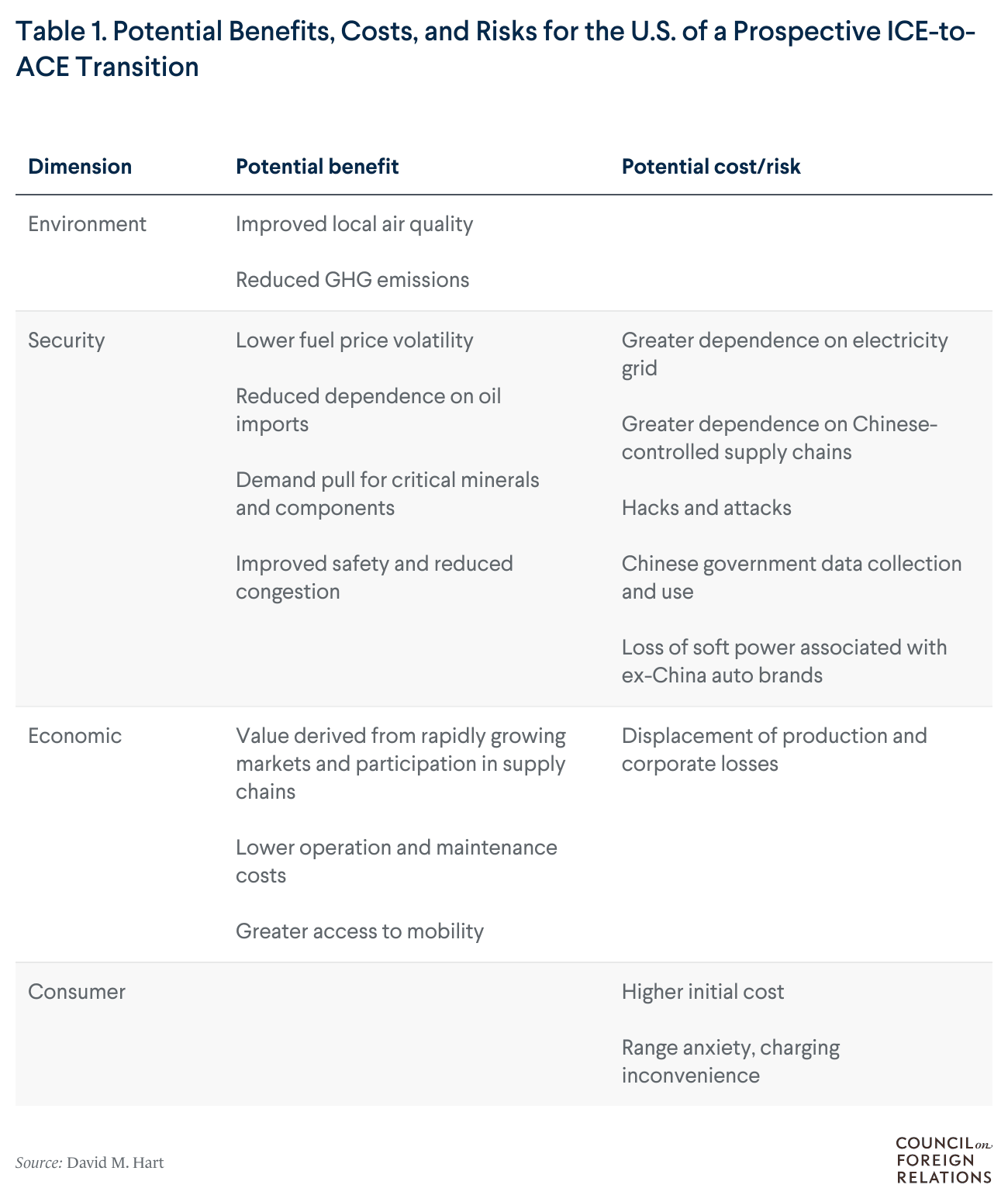
The potential benefits, costs, and risks of a prospective ICE-to-ACE transition from a U.S. policy perspective are summarized in table 1.
State of Play: The Global Auto Industry Today
The environmental, security, economic, and consumer implications for the United States of the shift from ICE to ACE are not fixed. Countries and companies are jostling for position, reshaping those variables. Technological innovation is rapid and difficult to forecast. Any policy prescription needs account for that dynamic situation, while acknowledging that China and its domestic producers have substantial momentum and growing advantages.
China did not invent the core technologies used in ACE vehicles or put them into initial practice. The lithium-ion battery was invented by researchers in the United States, Japan, and the United Kingdom. Sony, a Japanese conglomerate, brought it to scale to power personal electronics. General Motors, headquartered in Detroit, developed OnStar, the earliest dominant platform for connected vehicles in the early 2000s, offering emergency service, directions, and concierge services. It later added telephony and internet service and licensed the system to competitors such as Toyota and Honda. U.S.-based Tesla put the ACE package together, releasing a series of pathbreaking models in the 2010s.29
China has largely supplanted those pioneers over the past fifteen years. The central government initially designated “new energy vehicles” as a strategic industry in 2010. It adopted more aggressive targets in the 2015 Made in China 2025 plan and established a comprehensive set of policies to pursue them: protecting the domestic market, investing in technology and supply chains, driving up demand, and building out an extensive charging infrastructure. Researchers at the Center for Strategic and International Studies (CSIS) estimate conservatively that Chinese government support for the industry totaled over $230 billion between 2009 and 2023.30
The result is a dynamic and growing market. More than half of new auto sales in China are now ACE vehicles. Although Tesla’s Model Y (made in Shanghai) is among the best-selling models, BYD, Wuling, GAC, and other Chinese brands dominate the market. According to Reuters, annual sales of the top five foreign auto brands declined by three million units in the past five years, while their Chinese counterparts rose by almost five million. General Motors dropped from the top tier to sixteenth in sales, losing money on every transaction. Government policy could still play a role in consumer choice, but CSIS’s Scott Kennedy observes that “China’s leading automakers have made enormous strides and can’t be pegged as copycats or be relegated to the lower end of the market.” The window-sticker cost gap between ICE and ACE vehicles has closed or even reversed in China.31
More than half of new auto sales in China are now ACE vehicles.
Chinese innovations span the entire industry. Chinese firms drove a fundamental transition in battery chemistry, making lithium-iron-phosphate (LFP) a new standard. Even Tesla, which made its reputation with other chemistries, has adopted LFP for some of its cars. Battery makers BYD and Contemporary Amperex Technology Co., Limited (CATL) have both announced systems that would enable ACE vehicles to charge as rapidly as ICE vehicles refuel. Supply-chain integration has allowed Chinese producers to drive down input costs, while automation and other process improvements have brought down assembly costs. Chinese ACE vehicles incorporate advanced digital features, not only to assist and amuse occupants but also to operate and integrate subsystems, such as motors and brakes. They also update those features more frequently than non-Chinese competitors.32
Chinese producers’ combination of low cost and high quality is helping them make major strides outside their home market. The total global market for battery electric vehicles (BEVs) has grown by about 50 percent per year for the past five years. While sales in the United States and Europe slowed last year, they accelerated in emerging African, Asian, and Latin American markets. In Brazil, for instance, BEV sales more than tripled, largely due to imports from China. In Turkey, they went up by 50 percent, following a tenfold jump the year before.33
In all, China exported well over one million electric vehicles in 2024, an estimated 40 percent of global EV exports. Interestingly, export growth slowed from 2023. Indeed, some analysts question whether exports could already have peaked (although growth accelerated again in the first half of 2025). One key factor is foreign direct investment by Chinese carmakers, which receiving-country governments induce through mandates, tariffs, and incentives. BYD and Great Wall Motors, for instance, announced that they will commence production in Brazil by 2026. BYD is also opening a plant in Turkey, among other destinations.34
That pattern recalls the early phases of past adjustments in the global auto trade and investment regime; developments in the European Union also followed it. The EU was both a major exporter and a major importer of electric vehicles in 2024. Although non-Chinese brands composed a majority of imports to Europe that year, Chinese brands gained market share. More important, Chinese companies such as BYD and CATL have begun to establish production within Europe. In October 2024, responding to the import surge, the EU imposed tariffs of up to 35 percent, which could accelerate FDI flows. Proceeds of CATL’s May 2025 initial public offering, for instance, will support battery factory construction in Hungary.35
Federal policy has prevented the United States from going down that road, blocking imports from China as well as Chinese FDI. Tax incentives for EV purchases under the 2022 Inflation Reduction Act excluded from eligibility vehicles made in China or with Chinese batteries or components. That disincentive was strengthened further by 100 percent tariffs imposed by the Biden administration in 2024. Conflict over Ford’s plan to use licensed CATL technology in its EV batteries manifested broader hostility to Chinese FDI: Virginia Governor Glenn Youngkin rejected siting a battery plant that would have employed about 2,500 workers in his state over the issue. Republican legislators from Michigan, which landed the plant, have attacked it as well. The United States has also pressured Mexico to keep out Chinese FDI, although imports there are growing rapidly.36
Japan and South Korea, too, receive virtually no EV imports from China. Although those countries do not impose tariffs and are nominally open to FDI, formidable nontariff barriers discourage auto imports and FDI generally.37
Analysts Gregor Sebastian and Endeavor Tian of the Rhodium Group envision an emerging regime in which Japan, South Korea, and North America exclude both Chinese imports and FDI; Brazil, Thailand, the EU, and a few other emerging markets receive FDI but few Chinese imports; and the remaining markets, which lack domestic production, such as Australia and the United Kingdom, remain open to Chinese imports.38
Compete, Don’t Retreat: A Smarter U.S. Response
That vision—in which the United States cedes the future of the global auto industry to China—should not be acceptable to U.S. policymakers. It would result in economic and environmental costs and isolate American producers and consumers from the cutting edge of auto innovation. Although the immediate risks to U.S. national security could be reduced, China’s geopolitical influence would grow.
The United States needs a strategy that leads to a different outcome. It should compete, not retreat, seeking to benefit from the emergence of the new paradigm by fostering internationally competitive domestic and allied ACE producers, while simultaneously managing the national security risks of ACE vehicles. Tariffs are a temporary precondition for such a strategy, but the prospect of lifting them, along with potential inflows of Chinese FDI, will be an essential driver of the strategy.
The Biden administration’s auto industry policy combined tariffs with several other elements: federal investments in battery supply chains and electric vehicle assembly plants, consumer tax incentives and public procurement to support purchases from domestic producers, and environmental regulations that would have driven down ICE sales. The Biden administration also imposed restrictions on connected vehicles that excluded Chinese software and hardware from vehicles sold in or imported to the United States.39
That strategy had much to recommend it. It sought to accelerate the adoption of ACE vehicles while strengthening domestic production for them. But it did not create a sustainable framework for international trade and investment. It failed to account for the interests and potential contributions of U.S. allies. It did not create pathways for domestic producers to reach competitiveness abroad, whether by competing with, learning from, or outflanking Chinese market leaders.40
The Trump administration expresses hostility to what it characterizes as former President Joe Biden’s “EV mandate” and (with congressional support) is rolling back as much of the previous administration’s auto policy as it can, except tariffs and regulations on connected vehicles. It is eliminating federal supply- and demand-side support for electric vehicles and relaxing environmental regulations. Those measures will blunt the adoption of the vehicles by American consumers and deter investment in production. A study by Resources for the Future estimates that 800,000 fewer EVs and 1.7 million more ICE vehicles will be sold in the United States in 2030 than would have had the Biden policy stayed in place.41
President Donald Trump further disrupted international trade and investment by imposing a global 25 percent tariff on all autos and auto parts in early 2025, including those from Canada and Mexico that do not comply with the free trade agreement among those two countries and the United States. Subsequent bilateral agreements cut the rate for Japan, South Korea, and the European Union, among others, in exchange for general promises of increased purchases of U.S. goods and investment in the United States. Tariffs on inputs such as steel, as well as the uncertainty of future policy, further complicate domestic production decision-making.42
The Trump strategy could preserve domestic ICE production, particularly if the North American free trade zone and auto supply chains can be maintained. It will be especially helpful for sales of large, inefficient ICE vehicles, which Americans purchase in greater numbers than their counterparts elsewhere. It will do little to shift the current trajectory toward Chinese dominance of ACE production in the rest of the world. Cui Dongshu, secretary-general of the China Passenger Car Association, told the Wall Street Journal that U.S. policy “should give China greater room to develop in overseas markets” by offering “intelligent EV models against the obsolete technology of internal-combustion-engine vehicles.”43
Tariffs are a necessary part of any U.S. response to China’s growing capabilities. Chinese ACE manufacturers have a structural advantage over domestic producers, due to their experience, supply chain, innovation, and domestic market—all of which, in turn, owe much to state support. Chinese policy drives overcapacity, allows unprofitable firms to survive, and compels companies to focus on exports. Even with moderate tariffs in place, Chinese ACE vehicles could well be competitive in some vehicle categories.44
But tariffs alone will not turn the tide. If they are to effectively compete with subsidized Chinese competitors that have gained significant first-mover advantages, U.S. ACE producers and suppliers will need substantial and sustained financial assistance from the government, including support for exports and outbound foreign direct investment. Such investment should be conditioned on their pursuit of ambitious strategies to compete at home and abroad.45 The Department of Energy’s Loans Programs Office and the U.S. International Development Finance Corporation have the authority to provide such support, but they would need funding and White House backing, perhaps spearheaded by an “auto czar” (as the lead auto policy staffer after the 2007–08 financial crisis was labeled).46
Some domestic manufacturers (including foreign-headquartered firms and the big-three automakers) recognize the risks Chinese competition poses. Ford CEO Jim Farley has been particularly outspoken, calling in August 2025 for a “radical approach,” notably focusing on software and integration as well as hardware. U.S. firms have been whipsawed by policy instability, however, and their confidence could take some time to secure.47
A U.S. strategy to reposition its auto industry would be more effective if pursued collaboratively with Japan, South Korea, and the European Union. Those U.S. allies have a shared interest in fending off a common threat from China. Volkswagen, Renault, Toyota, and Hyundai are among the firms most exposed to Chinese competition in developing-country markets. Aligning trade and public investment policy in what Council on Foreign Relations President Michael Froman calls a “coalition of the ambitious” would create economies of scale and accelerate innovation.48
The United States and its allies should also pursue joint interests in supply-chain diversification. Breaking China’s chokehold on access to key raw and refined materials will require coordination, patience, and substantial capital. Efforts to “invent around” areas of Chinese dominance by substituting new materials and technological approaches, such as advanced battery chemistries and magnet components, are a natural complement to diversification of existing supply chains.49
One of the most challenging policy questions facing federal policy-makers is whether to allow Chinese market leaders to invest directly in the United States and under what conditions. Factories run by firms such as BYD and CATL could provide market discipline for domestic competitors and accelerate learning, echoing the past impact of Japanese, South Korean, and European producers in North America. Such investment should be acceptable as long as the price of market entry includes technology transfer and high-quality workforce training. (The Chinese government, for its part, has expressed concern about losing control of key automotive technologies.) Europe has moved further down that path than the United States, and some coordination on inward FDI will be necessary to align trade policy.50
Whether Chinese ACE vehicles are imported or built in the United States, U.S. leaders should continue to insist that allies work together to regulate software to protect national security. David Gantz of the University of Arizona suggests “paralleling Chinese restrictions on Teslas sold in China.” In that approach, data collected from vehicles made by Chinese and other foreign producers would be stored and accessed locally. U.S. and allied authorities would test the software installed in those vehicles rigorously, or else produce it locally or procure it from secure allied sources. European Union automotive cybersecurity regulations, which require that automakers certify that their vehicles protect against known vulnerabilities, could provide a starting point for multilateral negotiations that would ease the U.S. ban without compromising its goals.51
Conclusion
Like Japan decades earlier, China has disrupted established patterns of international auto trade and investment. As in the past, the United States has responded reflexively, in this case isolating its domestic market from Chinese imports. Meanwhile, changes are accelerating in the rest of the world. Tariffs have bought the United States time, but the clock is ticking. If the nation waits too long to respond more fully and constructively, North America, or perhaps just the United States, could become an isolated island of ICE vehicles in a Chinese-controlled world.
A purely protectionist strategy would avoid important economic and national security risks. Domestic production would continue, as would the adoption of ACE technology, albeit more slowly than in alternative scenarios. Vehicle data and services would be no more exposed to misuse or attack than they are today.
U.S. drivers and the transportation system as a whole, however, would miss out on important benefits as domestic auto innovations fail to keep pace with the global industry. U.S. producers would become increasingly uncompetitive in international markets. Domestic greenhouse gas emissions reductions would stagnate, while the United States would be excluded from global trade in the most important clean technology sector.52
The federal government, led by the president, should not merely protect this vital industry but set it up for global success. It should use all the available tools—investment, regulation, diplomacy, and more—to make the most of the opportunity that tariffs are creating. If the policy is effective, a visitor arriving from abroad a decade from now will find that their rental car provides state-of-the-art mobility, rather than feeling like a nostalgia trip.
Acknowledgments
An earlier version of this paper was presented at the 2025 Industry Studies Conference. In addition to participants in that conference, I thank Jeff Gerlach and Ron Minsk, Sue Helper, JP Helveston, Lindsay Iversen, Ilaria Mazzocco, Milo McBride, Jonas Nahm, Beia Spiller, and John Zysman for helpful comments.
About the Author
David M. Hart is a senior fellow for climate and energy at the Council on Foreign Relations. His research focuses on policies that will accelerate clean energy and climate-tech innovation and diffusion worldwide. Also a fellow of the American Association for the Advancement of Science, he is a professor emeritus and a former senior associate dean at George Mason University’s Schar School of Policy and Government. Hart has served as assistant director for innovation policy at the White House Office of Science and Technology Policy, director of the Information Technology and Innovation Foundation’s Center for Clean Energy Innovation, and assistant and associate professor at Harvard Kennedy School. His recent work for CFR’s Climate Realism Initiative includes the “Global Energy Innovation Index” (November 2025). He also coauthored “Re-Energizing America” (Clean Tomorrow, 2025), a sequel to “Energizing America” (Columbia University Center for Global Energy Policy, 2020). Hart’s books include Unlocking Energy Innovation, The Emergence of Entrepreneurship Policy, and Forged Consensus: Science, Technology, and Economic Policy in the U.S., 1929-1953. He holds a PhD in political science from the Massachusetts Institute of Technology (MIT).
 Report
 Report
 Report
 Report
 Report
 Report