China in the Indo-Pacific: November 2025
In November, China coupled sustained maritime pressure in contested waters with expanded defense, economic, and technological engagement across the Indo-Pacific, advancing its regional influence despite ongoing geopolitical frictions.
By experts and staff
- Published
By
- Saee Parulekar
Continued Tensions in the South China Sea
On November 1, China’s Southern Theater Command reported that it had monitored a joint Philippine patrol in disputed waters, framing the operation as destabilizing to regional peace and security. Manila proceeded with its own activities later in the month. On November 18, Philippine forces transported fuel, food, and personnel to their outpost at Second Thomas Shoal despite the presence of China Coast Guard vessels that reportedly jammed communications during the resupply mission. Philippine defense officials also reported an increased presence of Chinese maritime militia vessels operating near Thitu Island (Pag-asa) later in the month. Those developments came as the Philippines sought an additional five TC-90 aircraft from Japan amid intensified Chinese pressure in the region.
The November 5 commissioning of Fujian (Type 003), China’s new eighty-thousand-ton carrier capable of accommodating fifty to sixty aircraft, also raises concern about a potential shift in the balance of power in the Indo-Pacific region. Analysts say that Beijing will use the carrier, accompanied by up to ten warships, to intimidate rivals in the South China Sea.
At the same time, external actors stepped up their responses to China’s maritime posture. During meetings with Association of Southeast Asian Nations (ASEAN) defense ministers in Kuala Lumpur, Malaysia, in early November, U.S. Defense Secretary Pete Hegseth criticized what he described as China’s increasingly “destabilizing actions” in the South China Sea and proposed expanded shared maritime domain awareness initiatives to help Southeast Asian states respond collectively to perceived threats to territorial sovereignty.
The next day, Canada and the Philippines signed a defense cooperation agreement to expand joint military exercises and strengthen deterrence capabilities. Meanwhile, China continued to assert its territorial claims through military activity, conducting joint patrols with coast guard units near Scarborough Shoal on November 29 to safeguard what it described as its sovereignty and maritime rights.
The operational friction coincided with renewed diplomatic engagement between Washington and Beijing. Beginning on November 22, U.S. and Chinese military delegations convened in Hawaii under the Military Maritime Consultative Agreement Framework to discuss risks associated with air and maritime encounters in the region; Chinese officials used the talks to reiterate objections to U.S. naval transits through the South China Sea.
Rising Tensions Between Japan and China
Relations between China and Japan deteriorated sharply in November following remarks by Japanese Prime Minister Takaichi Sanae on November 7 that a Chinese naval blockade of Taiwan could trigger a military response from Japan. China condemned her comments as an interference in its internal affairs and demanded that Takaichi retract her statement, warning that Japan would face a “crushing military defeat” if it intervened militarily in a Taiwan contingency. Chinese authorities further cautioned their citizens against visiting Japan, and three Chinese airlines announced that tickets to Japan would be refunded in full.
Maritime tensions escalated further as a formation of China Coast Guard vessels passed through the waters of the Japan-administered Senkaku Islands, as China stated the ships were conducting a “rights enforcement patrol.” Meanwhile, on November 17, Kanai Maasaki, director-general of the Japanese foreign ministry’s Asian and Oceanian Affairs Bureau, arrived in Beijing to urge Chinese officials to avoid further damaging bilateral relations amid the growing diplomatic dispute.
On November 18, Japan issued a warning to its citizens living in China to increase personal safety precautions and avoid large crowds amid escalating tensions. The next day, China announced it would ban all imports of Japanese seafood. China’s UN ambassador, Fu Cong, protested in a letter to UN Secretary-General António Guterres, alleging that the Japanese prime minister violated both diplomatic norms and international law in her initial statement. Fu stated that if Japan were to attempt an armed intervention, China would exercise its right to self-defense under the UN charter and international law.
Russia and China Deepen Military and Financial Support for Myanmar’s Junta
On November 12, Myanmar’s military government announced it had commissioned three Russian Mi-38T helicopters and two Chinese Y-8 transport aircraft into its air force. The aircraft, unveiled in the capital city of Naypyidaw, are expected to improve the military’s ability to deploy troops into mountainous conflict zones amid the ongoing civil war.
China’s support extended beyond military hardware. On November 19, Myanmar authorities announced expanded crackdowns on online scam compounds near the Thai border, detaining hundreds of foreigners in operations that a military spokesman attributed to cooperation with China.
In the Washington Post, analysts Dan Swift and Sean Turnell suggested that China is assisting Myanmar’s central bank in developing a digital payments system modeled on the digital yuan; the proposed “digital kyat” would rely on infrastructure from Huawei and the Industrial and Commercial Bank of China, and could route transactions through China’s Cross-Border Interbank Payment System rather than the U.S.-monitored SWIFT network, potentially reducing the effectiveness of U.S. sanctions.
A separate Washington Post report found that manufacturers in China are shipping meth precursor materials to China-backed warlords in Myanmar. The shipments have contributed to a surging drug crisis across Southeast Asia, caused in part by Chinese authorities’ failure to coordinate with neighbors to prevent cross-border drug flows.
Uneven Reengagement Between China and India
Military and territorial tensions persist between the two countries. On November 13, India’s air force chief conducted the inaugural landing of a military transport aircraft at a newly operational air base capable of supporting fighter jet operations near the Line of Actual Control (LAC), expanding India’s logistical reach in contested border areas. A Washington Post report noted that although both sides have pledged to maintain peace along the LAC, critics within India’s political and military establishment argue that new buffer zones have disproportionately restricted Indian patrol access in previously monitored areas, potentially allowing Chinese forces to consolidate more advantageous positions along the contested frontier.
Separately, a November 18 report by the bipartisan U.S.-China Economic and Security Review Commission revealed that China ran a disinformation campaign to hurt the sale of the French Rafale fighter jet; the commission published that report after India used the planes to counter Chinese weapons deployed by Pakistan.
India lodged a formal protest over the reported detention of an Indian passport holder at Shanghai Pudong Airport on November 21, after Chinese authorities allegedly questioned the validity of documents issued to individuals born in Arunachal Pradesh, a territory China continues to claim as South Tibet. India’s foreign ministry described the incident as “arbitrary,” reiterating that Arunachal Pradesh is an integral part of India, while Chinese officials maintained that border authorities acted in accordance with domestic regulations.
At the same time, recent bilateral agreements have restored people-to-people ties. On November 17, Air India announced plans to resume direct New Delhi-Shanghai flights beginning in February 2026, nearly six years after services were suspended in 2020 amid pandemic-related disruptions and deteriorating relations.
Beyond the bilateral relationship, both countries pledged humanitarian assistance to Taliban-ruled Afghanistan following a deadly earthquake near Mazar-i-Sharif on November 4. Harsh Pant, however—the head of foreign policy studies at the Observer Research Foundation think tank in New Delhi— observed that the parallel aid reflected ongoing competition to expand diplomatic and reconstruction engagement in Afghanistan amid reduced Western presence, rather than coordinated relief activity.
Continued Competition Over Bhutan
Indian Prime Minister Narendra Modi visited Bhutan, where he issued a $455 million line of credit and launched a hydroelectric power project. The expansion of energy ties reflects India’s efforts to draw the country closer while China competes in its engagements.
Bangladesh Continues China Pivot
A Bangladesh Air Force insider, speaking anonymously, confirmed that Bangladesh is planning to procure China’s J-10 multi-role fighter aircraft. China will reportedly not only supply the aircraft but also train Bangladesh Air Force personnel on the platform.
China Deepens Ties With Thailand, Vietnam
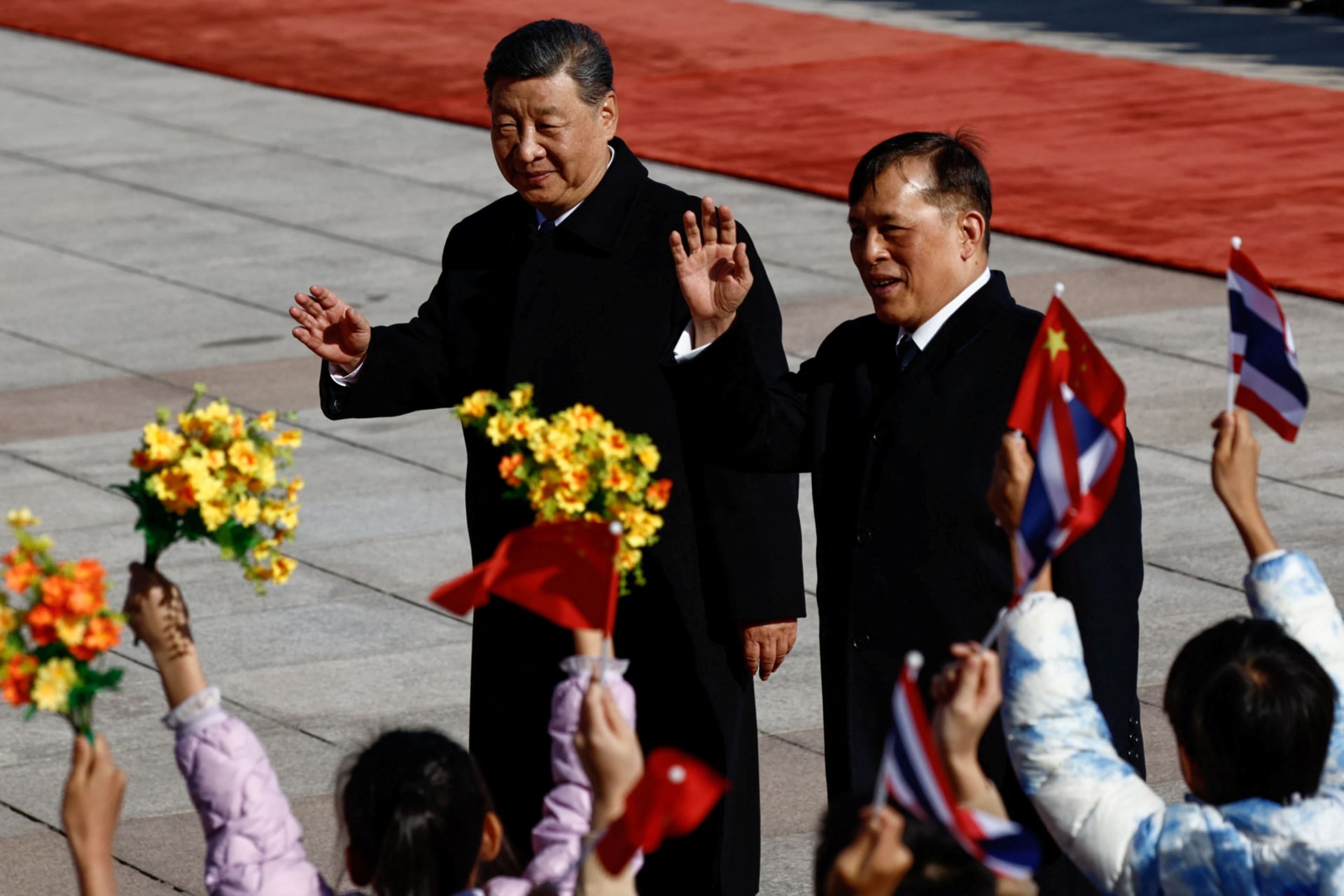
During the first official visit official visit to China by a reigning Thai monarch, Chinese President Xi Jinping and Thai King Maha Vajiralongkorn pledged to expand cooperation across various economic and technological sectors. Chinese officials signaled interest in increasing agricultural imports from Thailand while advancing joint initiatives in railway infrastructure development, aerospace technology, and artificial intelligence (AI). Thai leadership likewise emphasized the importance of strengthening bilateral exchanges.
China and Vietnam strengthened military relations on November 19 when naval fleets from both nations conducted a joint patrol in the Beibu Gulf to improve combined capabilities and practical cooperation in the region. Technological ties between the two nations were strengthened on November 28, when Chinese telecommunications firms Huawei and ZTE secured contracts to supply fifth-generation (5G) cell network equipment to Vietnamese state-owned operators. Vietnam has historically limited the use of Chinese technology in critical telecommunications systems due to security concerns, but recent procurement data indicates that Chinese firms have begun winning smaller tenders for network components such as antennae and radio access equipment.
China-South Korea Cooperation
During Xi’s first visit to South Korea in over a decade, South Korean President Lee Jae Myung sought China’s support resuming dialogue with North Korea, citing recent exchanges between China and North Korea as a potential opening for renewed talks. Xi signaled China’s willingness to expand cooperation with South Korea and jointly address regional security challenges, while emphasizing the importance China places on maintaining stable relations with South Korea.
The two nations also signed a bilateral currency swap, among other economic cooperation agreements. The won-yuan swap entails a maximum of ₩70 trillion for ¥400 billion for five years between the People’s Bank of China and the Bank of Korea.
China Expands ASEAN Tech and Trade Integration
On November 13, Malaysia announced plans to enter a joint electronic data exchange arrangement with China for certificates of origin under the ASEAN-China Free Trade Area and Regional Comprehensive Economic Partnership, with implementation expected in January 2026. The initiative will streamline customs procedures, improve tariff enforcement, and enable secure information sharing between the trade authorities of both countries.
Later in the month, China and ASEAN states launched the Collaboration Innovation Demonstration Base for Emerging Industries at the ASEAN-China GBA Cooperation Forum, with planned sites in Guangzhou and Shenzhen, China, as well as in Malaysia and Singapore. Over twenty cooperation agreements were signed at the forum across sectors, including distributed solar energy, AI healthcare, and biotechnology.
China Raises Concerns Over Malaysia, Cambodia Trade Deals
China expressed “grave concerns” about a recently signed trade agreement between the United States and Malaysia, warning that its provisions could undermine regional trade cooperation and harm Chinese economic interests. China’s response followed a meeting between Chinese and Malaysian commerce officials during which Malaysia reportedly offered reassurances regarding its continued commitment to bilateral economic cooperation with China. China delivered a similar message to Cambodia regarding its October 2025 trade deal with the United States.
Chinese-Funded Jakarta-Bandung Rail Project Faces Financial Strain
Indonesia’s Chinese-built Jakarta-Bandung high-speed rail line continued to face mounting financial pressures, with state railway officials warning lawmakers that the project could require a government bailout amid growing debt obligations. Low passenger demand further raised concerns about the project’s long-term commercial viability. Indonesia’s anticorruption commission opened an investigation into cost overruns, while government officials have reportedly begun discussions with Chinese lenders on extended repayment terms or converting dollar-denominated loans into yuan.