China’s New Ethnic Unity Law: From Autonomy to Assimilation
A sweeping new national law signals Beijing’s decisive turn away from ethnic autonomy and toward enforced assimilation.
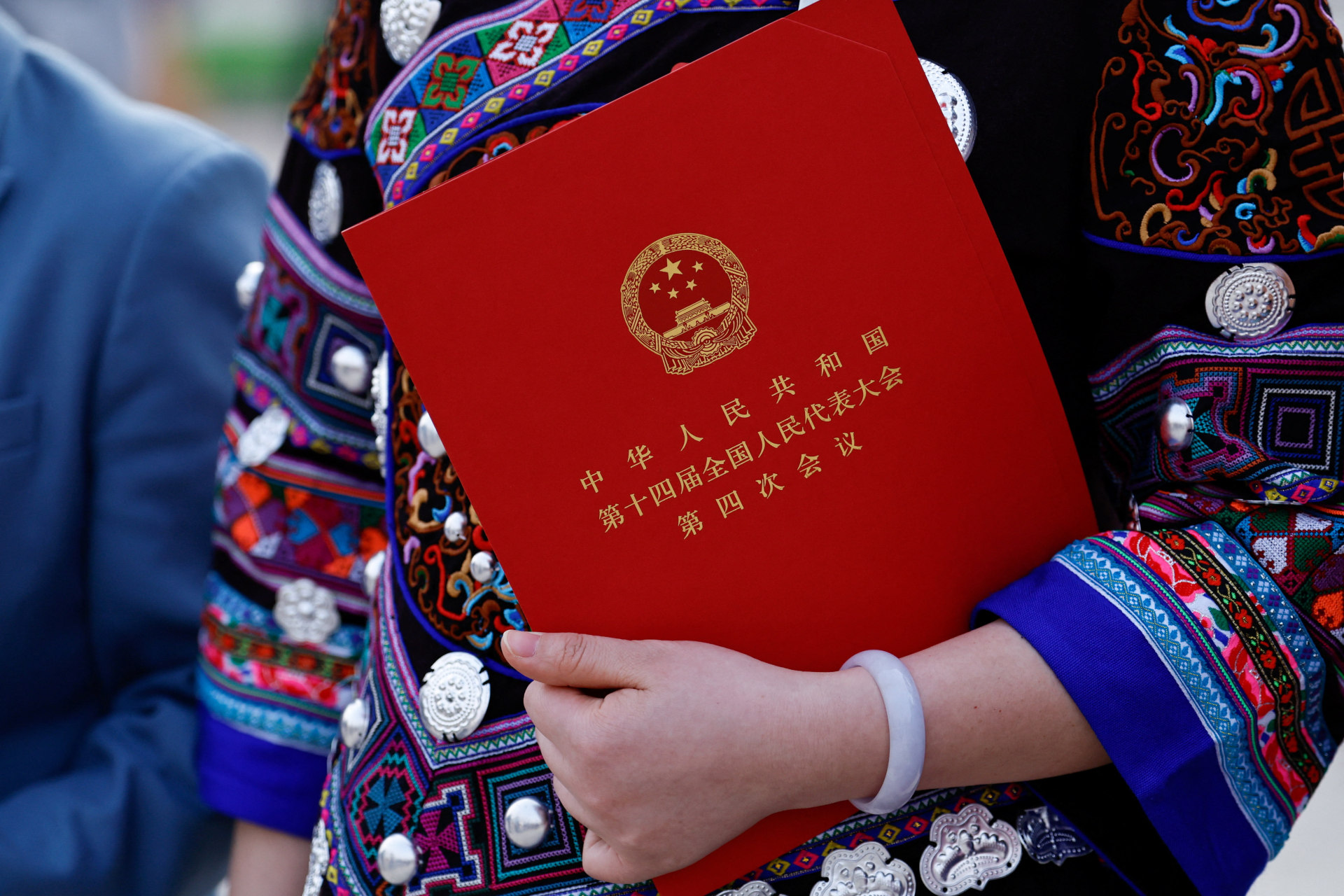

On March 12, China’s legislature adopted the Law on Promoting Ethnic Unity and Progress (Chinese; English translation), a sweeping new statute that codifies Beijing’s approach toward China’s 56 officially recognized ethnic groups. Substantively, the law enshrines a decades-long shift towards aggressive assimilationist policies. Structurally, it reflects a deepening merger of Party ideology and state law that is becoming increasingly prevalent under Xi Jinping.
This new law is the culmination of a policy trajectory that has been building for over a decade, dating back to the 2014 Central Ethnic Work Conference. Under Xi, Beijing is steering away from the post-1949 legal framework of nominal ethnic autonomy (albeit under tight Party control) imported from the Soviet Union. In its place, officials have steadily been pivoting towards what scholars have termed “second-generation ethnic policies”—an aggressive assimilationist approach that emphasizes a common Chinese national identity over accommodation of ethnic differences. Provincial and municipal authorities across China have enacted a wave of local “ethnic unity and progress” regulations in recent years, such as those in Xinjiang (2015) or Inner Mongolia (2021). The new national legislation elevates this approach to the level of a national statute governing all of China.
The new law’s core concept is captured in the term zhulao (铸牢) – to “forge” or “cast” metal – and its instruction that “forging the communal consciousness of the Chinese nation” is core to the Party’s ethnic policies. As James Leibold has pointed out, this phrasing reflects a hardening of Beijing’s political line under Xi Jinping – explicitly written into the Party’s Charter at the 19th Party Congress in 2017 – aimed at “melting” subnational and ethnic identities into a shared collective one.
This is a sharp departure from the framework of the 1984 Regional Ethnic Autonomy Law, which explicitly provided for education in minority languages and warned against majoritarian (i.e., Han) chauvinism in an effort to reset ethnic relations in the wake of the Cultural Revolution. In contrast, the new 2026 law has no such warning, mandates pre-school education in Mandarin, directs government authorities and private firms to “give prominence” to the display of Chinese characters over minority languages in public settings, and instructs them to promote the “forging of national identity” as a component of all official work on families and family education.
Naturally, Beijing’s assimilationist pivot risks worsening ethnic tensions in China. Efforts to roll out similar policies in Inner Mongolia back in 2020 (including ramping up Chinese-medium instruction in elementary schools) generated widespread citizen protests and boycotts, followed by a purge of ethnic Mongolian Party and government officials viewed as insufficiently committed to Beijing’s new line.
Apart from its substance, the new ethnic unity law is also notable for its structure. As the legal scholar Changhao Wei has observed, two features of the text are highly unusual. It opens with a narrative preamble—a device used in only three other PRC statutes in over four decades. And core chapters are organized around political slogans directly lifted from Xi Jinping’s ethnic work doctrine, rather than the functional legal categories that are standard in Chinese legislation.
This parallels a broader trend: the steady blurring of the boundary between Party regulations and state law. As political scientist Holly Snape has documented, Beijing is steadily constructing a comprehensive network of Party regulations that increasingly reaches beyond the Party itself to regulate state and society. On the one hand, this process has involved the importation of quasi-legal mechanisms within the Party’s own regulatory system, such as the introduction of filing and review mechanisms to verify whether regulations issued by lower-level Party organs are compliant with Xi’s personal political doctrine. But on the other, it is leading Party ideological practices to steadily “seep into state law.” And the newly issued ethnic unity law is a clear example of that latter trend, with the top leader’s specific ideological formulations being used as the statute’s organizing skeleton. Taken together, both the substance and structure of the new ethnic unity law point in the same direction. China’s reform-era legal institutions and practices – the framework of nominal ethnic autonomy, and the conventions that maintained some degree of separation between Party and state – are steadily eroding as the country moves yet deeper into the counter-reform era.