Direct Israel-Lebanon Talks
By experts and staff
- Published
- CFR Editors
Welcome to the Daily News Brief, CFR’s flagship morning newsletter summarizing the top global news and analysis of the day.
Subscribe to the Daily News Brief to receive it every weekday morning
Top of the Agenda
Israel and Lebanon held their first direct civilian talks in decades yesterday as part of a U.S.-backed effort to iron out tensions threatening their year-old ceasefire. A spokesperson for Israeli Prime Minister Benjamin Netanyahu called the talks near the countries’ border an “initial attempt to establish a basis for a relationship and economic cooperation,” while Lebanese Prime Minister Nawaf Salam was more cautious, telling reporters that Lebanon was “far” from diplomatic normalization with Israel but that the talks were aimed at “defusing tension.” He added that Lebanon is open to having French and U.S. troops on the ground as part of efforts to verify Hezbollah’s disarmament.
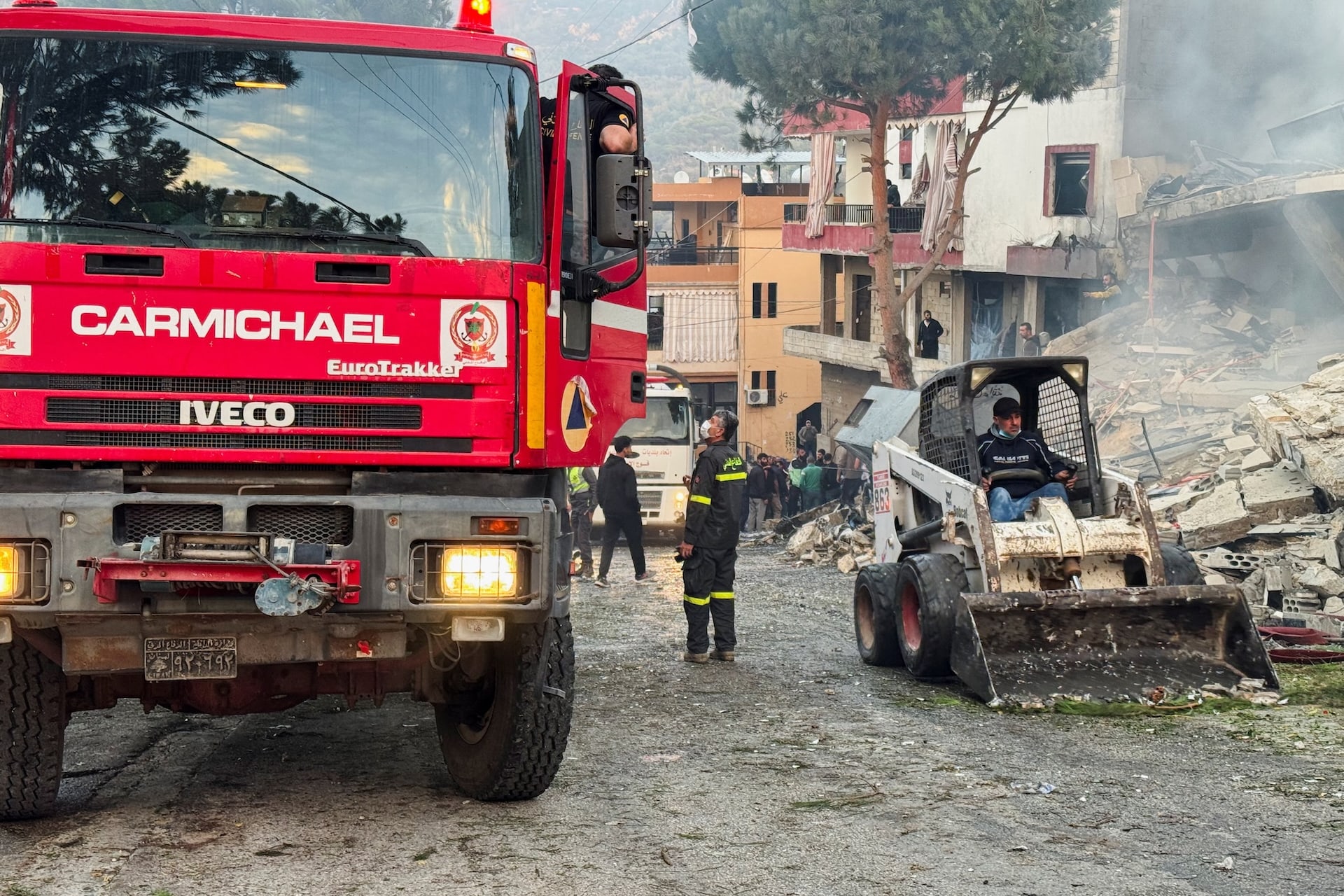
The context. While the ceasefire requires the disarmament of Hezbollah and Israel’s withdrawal from parts of southern Lebanon, a lack of progress on both fronts has raised fears in Lebanon about a return to full-blown fighting between the countries. Citing Hezbollah’s alleged attempts to rebuild its forces, Israel stepped up its strikes in Lebanon in recent weeks, including a bombing in Beirut that killed a senior Hezbollah official late last month. Hezbollah did not immediately comment on yesterday’s talks, but has previously resisted disarmament unless Israel ends its attacks and withdraws from the south.
What comes next. A delegation from the UN Security Council is visiting Lebanon this week to discuss the ceasefire, which is overseen in cooperation with a UN peacekeeping mission in Lebanon. While Israel and Lebanon have officially been at war since 1948, the Trump administration has urged them to improve relations. The U.S. Embassy in Lebanon said yesterday’s meeting was a step toward “lasting” civilian dialogue—rather than just military contacts—between the countries.
“How can an organization based on ‘resistance’—whose very flag declares it to be ‘The Party of God’ and ‘The Islamic Resistance in Lebanon’ with an assault rifle thrust into the air—disarm? It is asking Hezbollah not to be Hezbollah. That is a worthy goal, but is it something that can be accomplished—especially by the end of the year, as the Trump administration is demanding?” —CFR expert Steven A. Cook, Foreign Policy
Across the Globe
Report on Signal chat. Defense Secretary Pete Hegseth violated department policy and risked endangering troops by sending plans to bomb the Houthis via Signal in March, according to multiple media outlets describing a new report from the Pentagon’s inspector-general. It reportedly does not discuss whether those details were classified at the time, but notes Hegseth’s authority to declassify information. Ahead of the report’s release later today, a Pentagon spokesperson called it a “total exoneration” of Hegseth because “no classified information was shared.”
Poland’s G20 invite. The United States is uninviting South Africa from next year’s G20 summit in Miami and inviting Poland in its place, U.S. Secretary of State Marco Rubio wrote in a statement yesterday. Amid chilled relations between the United States and South Africa under Trump, Washington did not participate when South Africa hosted this year’s summit.
EU options on Russian assets. European Union (EU) leadership yesterday proposed two options for funding a large-scale loan to Ukraine after Belgium voiced concerns over using frozen assets that it holds. One proposes using as much as $245 billion in Belgian and other European-held frozen Russian assets to back a loan to Kyiv, while the other would use funds drawn directly from the EU budget. The options are expected to be discussed further at a December 18-19 meeting.
Macron in China. France and China will work together to allow more Chinese direct investment in Europe, while China voiced openness to reducing trade barriers for French products, French President Emmanuel Macron said during a visit to Beijing. Macron also urged Chinese President Xi Jinping to support efforts for peace in Ukraine, though Xi only briefly mentioned the issue in his public statements. China’s foreign minister also called for France’s backing in its current dispute with Japan on Taiwan policy, which the presidents did not address in public remarks.
Increased H-1B vetting. The Trump administration will intensify vetting of applicants for H-1B skilled worker visas by reviewing their social media accounts, Reuters reported. Consular officers will assess whether the applicants worked in areas such as misinformation and content moderation. Applicants who participated in “censorship” will be deemed ineligible for the visa, a State Department cable reportedly said.
Black Sea attacks. Turkey’s foreign minister condemned what he said were attacks on ships in Turkey’s exclusive economic zone in the Black Sea, saying they proved the Russia-Ukraine war is expanding. Ukraine has acknowledged attacking some Russia-linked oil ships in the Black Sea, where the cost of shipping insurance has risen.
Talks with Maduro. Brazilian billionaire Joesley Batista flew to Caracas last week to try to persuade Venezuelan President Nicolás Maduro to step down, Bloomberg reported. The Trump administration was reportedly aware of Batista’s actions, though the Batista family holding company said he was not acting as a representative of any government. Batista personally mediated bilateral tensions between Trump and the Brazilian government earlier this year.
Rising toll of floods. More than 1,500 people have reportedly been killed in recent flooding across South and Southeast Asia, with authorities saying 836 people died in Indonesia, 481 in Sri Lanka, 185 in Thailand, and at least three in Malaysia. In many of the flood-affected areas, it has taken rescuers days to reach rural villages and assess the damage.