Netanyahu to Discuss Gaza and Iran During Washington Visit
By experts and staff
- Published
Welcome to the Daily News Brief, CFR’s flagship morning newsletter summarizing the top global news and analysis of the day.
Top of the Agenda
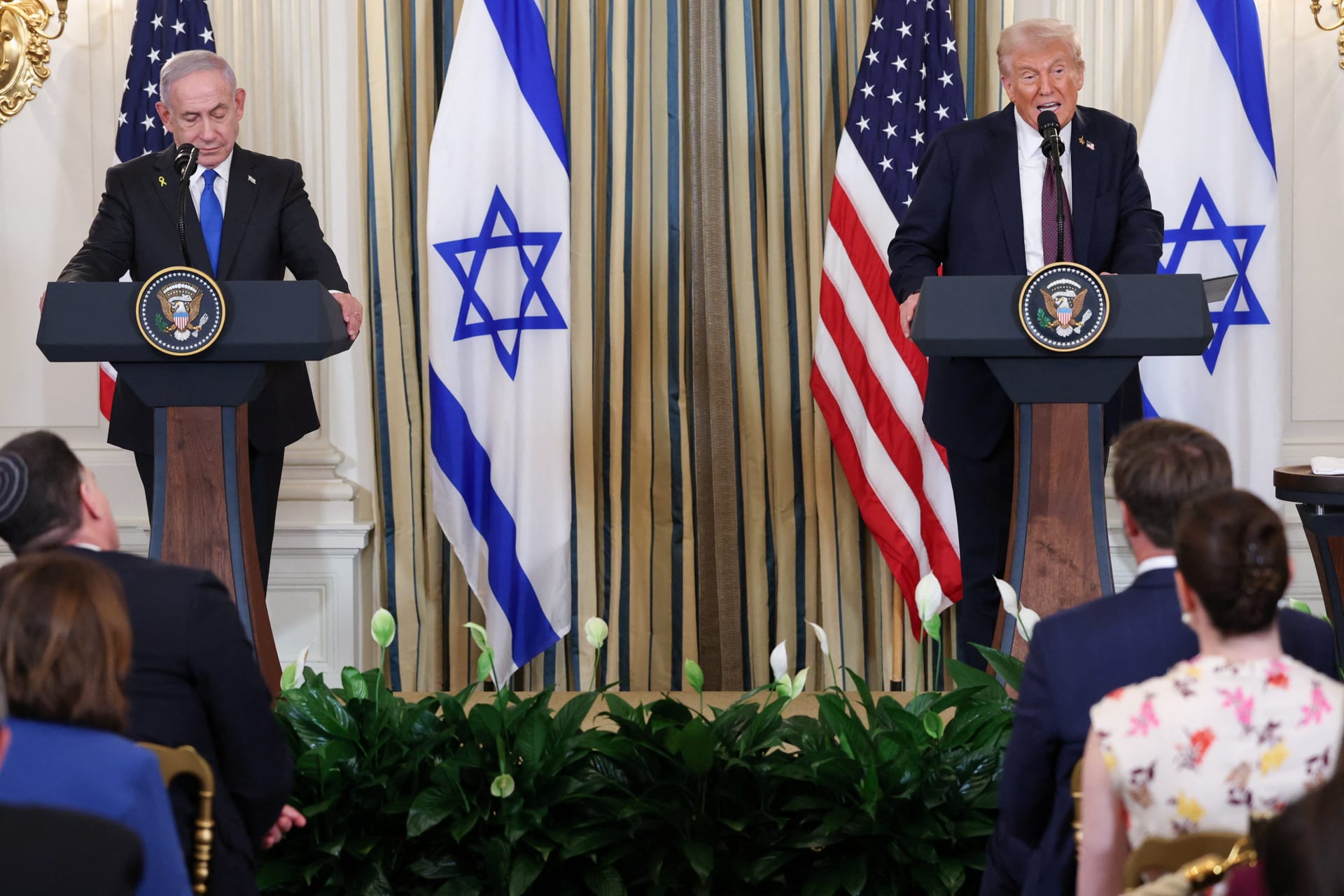
U.S. President Donald Trump and Netanyahu are set to discuss their approaches toward Iran and Gaza during a White House meeting today. Washington’s consideration of military action or a nuclear deal with Tehran prompted Netanyahu to move up his visit, which was initially slated for later this month. He has taken at least six trips to the United States since Trump returned to office last year.
Where U.S.-Iran talks stand. The United States and Iran held indirect nuclear talks in Oman last Friday that both sides described as positive but inconclusive. The United States warned U.S.-flagged commercial ships Monday to stay “as far as possible” from Iran’s territorial waters, and Trump yesterday said he was considering sending a second U.S. aircraft carrier strike group to the Middle East if talks do not progress.
Iran has tried to limit talks with the United States to the subject of its nuclear program, while the United States has also sought agreements covering ballistic missiles and Iran’s support for regional proxy groups. Netanyahu likewise favors a broader deal. Before departing yesterday, he told reporters his “first and foremost” goal was to press for a deal that covered more than just Iran’s nuclear program.
Where plans for Gaza stand. Trump’s Gaza Board of Peace, which includes some two dozen countries, is expected to meet next week in Washington. The U.S. draft plan demands Hamas surrender all weapons capable of striking Israel as part of the second phase of Trump’s Gaza peace plan, but at least initially allows the group to keep some small arms, the New York Times reported yesterday. Spokespeople for Netanyahu and Hamas did not immediately comment. A senior Hamas official on Sunday rejected any surrendering weapons, though Israel insists demilitarizing Gaza is a non-negotiable step for the peace process.
“The Israeli government is concerned that continued diplomatic engagement between Iran and the United States could result in U.S. concessions, such as permitting some degree of domestic enrichment in Iran, coupled with sanctions relief.”
—CFR expert Ray Takeyh
Across the Globe
U.S.-Azerbaijan partnership. The two countries signed a strategic partnership agreement yesterday during U.S. Vice President JD Vance’s visit to Baku. Azerbaijani President Ilham Aliyev said the pact would increase cooperation on defense sales and artificial intelligence (AI), while Vance said the United States would send Azerbaijan ships for maritime protection. The leaders also discussed Trump’s proposed infrastructure project in the region.
GOP defections on tariffs. Three Republicans in the House of Representatives yesterday joined Democrats to defeat a resolution that would have blocked congressional challenges to Trump’s tariff policies. The measure opens the door to a vote against Trump’s Canadian tariffs that Democrats have been considering.
Plan for U.S. troops in Nigeria. The United States is sending two hundred troops to Nigeria to help train local forces to combat Islamist extremists, a spokesperson for U.S. Africa Command told the Wall Street Journal yesterday. They will be stationed around the country but won’t directly participate in combat or operations, a Nigerian military spokesperson said. The deployment follows a U.S. warship’s December strikes on camps that Washington said belong to the self-declared Islamic State.
Reported RSF training camp. Ethiopia is hosting a training camp for Rapid Support Forces (RSF) paramilitary fighters involved in Sudan’s civil war, Reuters reported citing satellite data and unnamed sources. Eight sources, including a senior Ethiopian official, claimed the United Arab Emirates (UAE) had provided financial and logistical support for the camp. The UAE foreign ministry said it was not “in any way” involved in Sudan’s hostilities and Reuters did not independently verify the claim about Emirati backing. Ethiopia’s government, Sudan’s military, and the RSF did not comment.
School shooting in Canada. A rare mass shooting in Canada left at least nine people dead and another twenty-five injured, officials said. Seven people were killed at a secondary school in the Canadian Rockies town of Tumbler Ridge, while two others were found dead at a house that authorities believe was connected to the shooting. Police said a suspect also appeared to have died from a self-inflicted injury. In light of the shooting, Prime Minister Mark Carney suspended upcoming travel plans to Halifax, Canada and to Munich, Germany for the Munich Security Conference.
U.S. deportation case. A federal judge blocked further deportation proceedings against Tufts graduate student Rümeysa Öztürk and ruled that the government lacked sufficient grounds to remove her, Öztürk’s lawyers said in a court filing Monday. The Department of Homeland Security detained and attempted to remove Öztürk from the country last year, with the administration later saying in a memo that its main justification for doing so was a pro-Palestinian op-ed she had written for a student newspaper. The Trump administration could appeal the ruling, though a State Department official said the administration would comply with laws and court orders.
Latin American AI model. Chile’s government announced the launch of an open-source AI language model that has been trained on private databases from the region, including libraries and historical documents. Organizations from eight countries teamed up to create the model, which is meant to correct for inaccuracies about Latin America that occur on models trained in English.
What’s Next
- Today, Sweden and Finland hold a high-level security dialogue in Espoo, Finland.
- Tomorrow, Israeli Prime Minister Benjamin Netanyahu visits Washington, DC.
- Tomorrow, Barbados holds parliamentary elections.
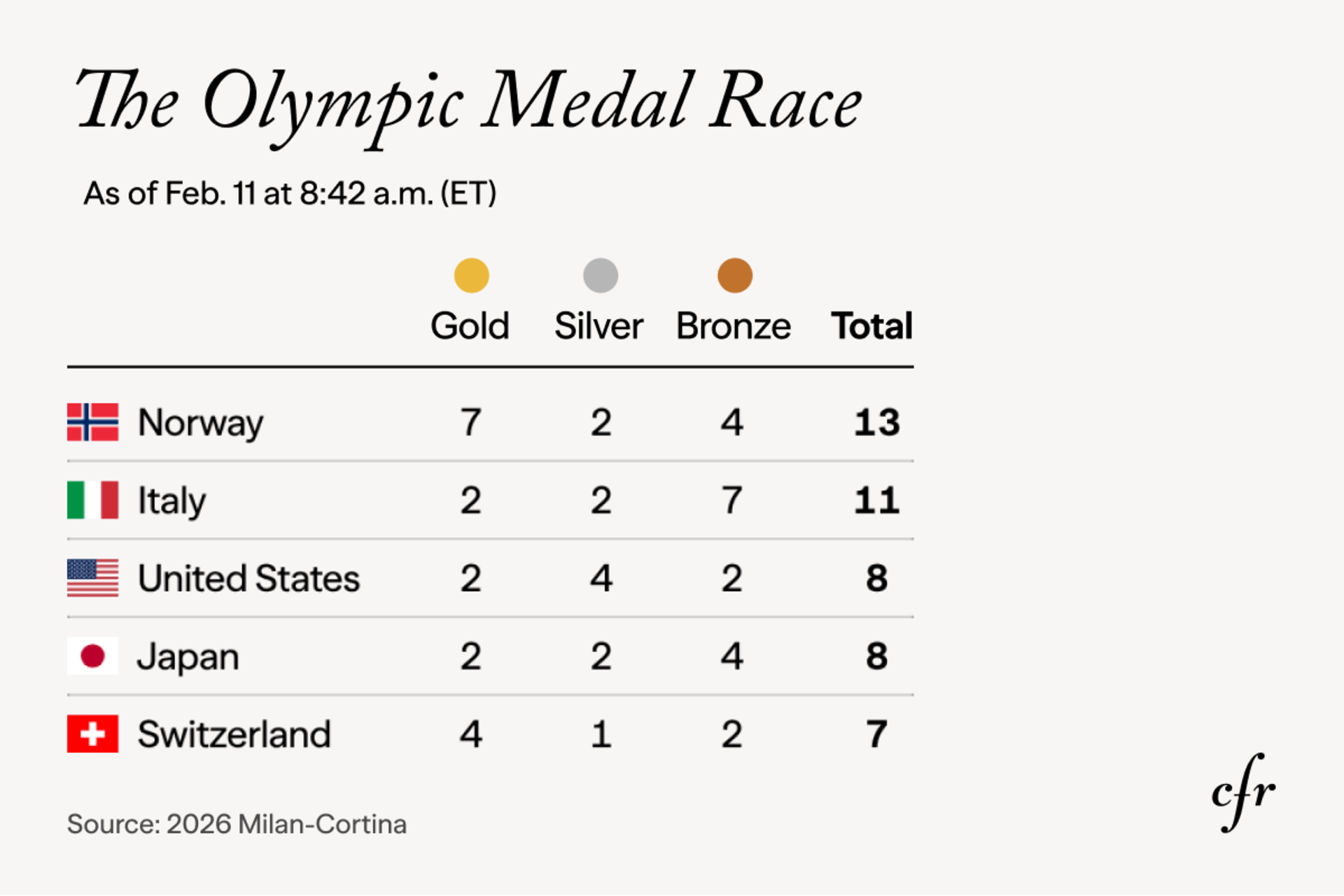
What You Missed: 2026 Milan-Cortina Olympics
A heated rivalry. The United States and Canada played each other in the women’s group phase of hockey yesterday. The United States prevailed in what could be the first of multiple face-offs throughout the Olympics. With Canada’s captain Marie-Philip Poulin out with an injury, Team USA delivered a 5-0 shutout. Check out U.S. forward Hannah Bilka’s two goals here. The two countries’ simmering political tensions have added an extra dimension: Carney invoked a hockey defense tactic—“elbows up”—in speeches responding to U.S. economic pressure, while Trump also mentioned the sport tangentially in posts about tensions with Canada.
The politics of apparel. The International Olympic Committee (IOC) banned Ukrainian skeleton racer Vladyslav Heraskevych from wearing a helmet with images of countrymen killed in the war with Russia as part of the Games’ prohibition on political speech and symbols. Heraskevych has risked disqualification by continuing to wear it anyway, saying he believed it did not break any rules. Other athletes have run up against the same prohibition this year: the IOC ruled that an image of a historic revolutionary leader on the Haitian team’s jackets was too political, prompting the team to paint over it. Their jackets now feature a riderless horse.
AI enters the soundtrack. Czechia’s brother-and-sister ice dancing team Kateřina Mrázková and Daniel Mrázek sparked pushback on Monday for skating to a song created with help of AI. Multiple other skaters at this Olympics have faced uncertainty over their music choices due to copyright issues, with one skater reworking their routine at the last minute. A music-licensing expert told The Athletic that AI-generated music—which can recreate existing melodies—is not immune to copyright law.