Israel’s Plan to Relocate Gazans
By experts and staff
- Published
- CFR Editors
Welcome to the Daily News Brief, CFR’s flagship morning newsletter summarizing the top global news and analysis of the day.
Subscribe to the Daily News Brief to receive it every weekday morning.
Top of the Agenda
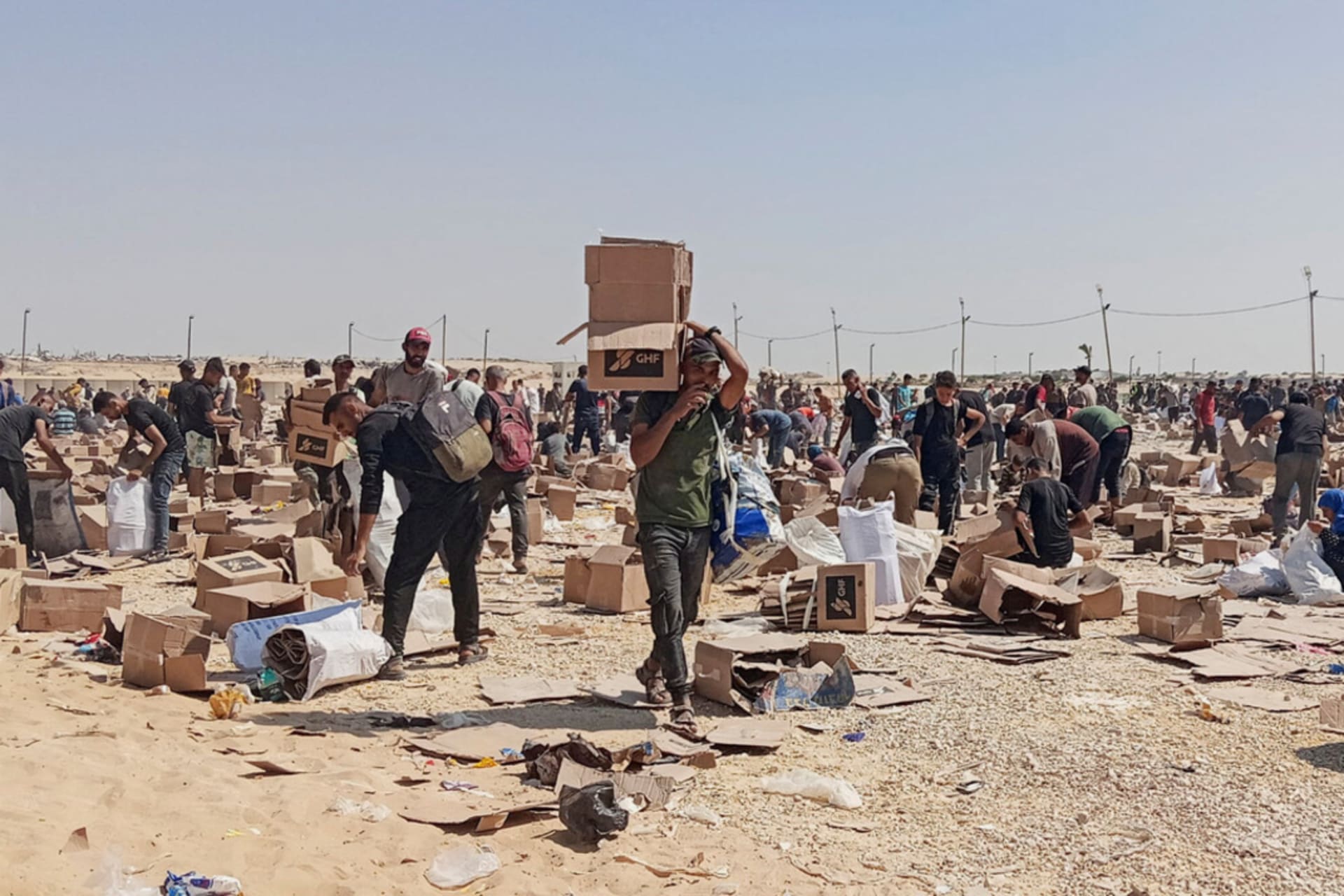
Israel’s defense minister, Israel Katz, said he had instructed the military to relocate all Palestinians in the Gaza Strip into a “humanitarian” zone in Rafah. The plan was disclosed in a closed meeting with military media in Israel on Monday, and later widely reported.
The details. Katz said the move would initially affect hundreds of thousands of Gaza residents and eventually the territory’s entire population of around 2 million.
- The plan’s first stage would relocate some 600,000 Palestinians from an existing coastal so-called humanitarian zone to Rafah, a southern city near Gaza’s border with Egypt that has been ravaged by Israel’s war.
- Israel’s military could start construction on the zone during a potential sixty-day ceasefire being discussed this week in Qatar, Katz said.
- Palestinians entering the zone would undergo a screening to separate civilians from Hamas, Israeli officials said.
- Katz reportedly said that people would not be allowed to leave the zone afterward. In a media briefing, he made reference to an “emigration plan, which will happen,” according to Haaretz. A separate official later told the outlet that Israel does not plan to facilitate emigration and no other country had agreed to take Gazans.
The reactions.
- Legal experts critical of the plan condemned it as a violation of international law, with one Israeli human rights lawyer calling it “an operational plan for a crime against humanity.” Human rights groups expressed concern that it could set the stage for a mass removal of Palestinians from Gaza.
- A spokesperson for the United Nations agency in Gaza said there was “nothing humanitarian or humane” about “seeking to confine” Gaza’s population.
- Israel claims the plan aims to weaken Hamas’s leadership.
- U.S. President Donald Trump and Israeli Prime Minister Benjamin Netanyahu continued to support what they characterized as a voluntary relocation of Gazans to other countries during a meeting in Washington on Monday.
“If the Trump administration truly wanted to end the Gaza war, it could simply declare that Netanyahu’s strategy of ‘negotiating under fire’—that is, starving and bombing the population of Gaza—has failed.”
—The International Crisis Group’s Max Rodenbeck in Foreign Affairs
Across the Globe
Continued tariff talk. At a cabinet meeting yesterday, Trump announced an intent to impose a 50 percent tariff on copper, which U.S. Commerce Secretary Howard Lutnick said could come by “end of July—maybe August 1.” Trump also described a potential 200 percent tax on pharmaceuticals and repeated a threat to hit BRICS member countries with an additional 10 percent levy. He later said in a social media post that he would make seven new tariff announcements today.
Heavy Russian air strikes. The country launched a record 700-plus drones and 13 missiles onto Ukraine overnight, the Ukrainian air force said. The attack was most severe in the northwestern city of Lutsk, though ten other regions were also hit. It comes after Trump said Tuesday that the United States would renew weapons shipments to Ukraine, and that he was considering additional sanctions to pressure Russian President Vladimir Putin.
Warrants for top Taliban leaders. The International Criminal Court (ICC) on Tuesday issued warrants for the arrest of the Taliban’s supreme leader and the chief justice of Afghanistan’s Supreme Court. They are charged with persecuting women, girls, and people who do not conform to the Taliban’s hardline gender policy since taking power in the country in 2021. A spokesperson for the Taliban rejected the ICC’s authority in a statement.
France-UK state visit. During the UK’s first state visit from a European Union head of state since Brexit, French President Emmanuel Macron has emphasized strong partnership and said France and the UK should “save Europe” from threats to democracy and order. In a speech to Parliament yesterday, Macron pledged to address illegal migration with “firmness”; he is due to meet with UK Prime Minister Keir Starmer today to discuss that issue along with defense and investment.
Rubio’s Asia trip. U.S. Secretary of State Marco Rubio’s highly anticipated first trip to the region in his role was cut short, according to reports from Japanese and South Korean media. Rubio skipped planned stops in Tokyo and Seoul this week on his way to a regional summit in Malaysia, where he is today. The State Department did not specify why Rubio’s schedule had changed. Rubio attended Nentanyahu and Trump’s meeting in Washington on Monday, the same day Trump announced 25 percent tariffs on Japan and South Korea.
New malaria drug approval. Medical officials in Switzerland have approved a malaria drug treatment for newborns and babies less than eleven pounds for the first time. It was developed in collaboration between a Swiss nonprofit and a pharmaceutical company. Experts say it could fill a treatment gap for the mosquito-borne illness, which remains a major threat worldwide. Malaria caused more than half a million deaths in 2023, according to the World Health Organization.
SCOTUS on federal layoffs. The Supreme Court yesterday lifted a block from a lower court on the Trump administration’s efforts to dramatically restructure federal agencies including the State, Treasury, and Housing and Urban Development departments. It clears the way for the administration to move forward with reduction-in-force plans that could affect tens of thousands of federal workers. The challenge will continue through lower courts, but yesterday’s ruling allows the administration to proceed in the meantime.
Leaked call of former Bangladesh PM. The BBC reports that an audio recording of a telephone call between officials and Sheikh Hasina, Bangladesh’s ex-prime minister, appears to reveal that she authorized the use of lethal weapons against student-led demonstrations last year. The United Nations has estimated that up to 1,400 people died in the clashes. Hasina is currently in India, where she fled last August.
What’s Next
- Today, ASEAN foreign ministers will meet with Rubio in Malaysia.
- Today, Pope Leo pauses his vacation to deliver a special mass to call for action on climate change.
- Today, Italy’s Prime Minister Giorgia Meloni will host the first half of a two-day Ukraine reconstruction conference.
- Today, Mexican drug lord El Chapo’s son is expected to plead guilty to drug trafficking in U.S. court.