How Spain’s Migration Surge Tested EU Border Policy
An unprecedented surge of migrants into Spanish territory in North Africa marked the first test of the European Union’s new migration pact and has reignited the bloc’s debate over immigration.
By experts and staff
- Published
- Roxy EkbergDigital Editorial Intern
Tens of thousands of migrants crossed from Morocco into Ceuta, an autonomous Spanish territory in North Africa, between July 30 and 31. The unexpected crisis overwhelmed local authorities and infrastructure, marking a first test of the European Union’s (EU) new Pact on Migration and Asylum. The scale and speed of the crossing exposed a real flash point in Europe’s migration system, but how fast authorities regained control has become its own point of contention—over whether the EU system is failing or working as designed.
The surge drew criticism from Washington and European capitals. The U.S. State Department claimed that the Spanish government had led efforts “to enable and facilitate mass illegal migration into Europe.” Denmark and Italy led a similar critique at the EU level, sending a letter—co-signed by twenty-two member states—that called for coordinated EU border measures and accused Spain of enacting policies that were a “pull factor” for undocumented migrants. Far-right parties across Europe have seized on the crisis to attack Spain and Europe’s migration policy.
Charles A. Kupchan, an expert on European affairs at CFR, explained that the surge came as a shock because migration to the EU is generally “more of a trickle than a deluge” in terms of the number of arrivals. “This rush, this mass of humanity, all coming in the span of forty-eight hours is quite unusual, and it’s because of the size, scope, and speed that it caused such a stir,” he said.
While most migrants have since returned to Morocco, the incident has renewed the debate over European border and migration policy—long a thorny political issue.
What happened in Ceuta?
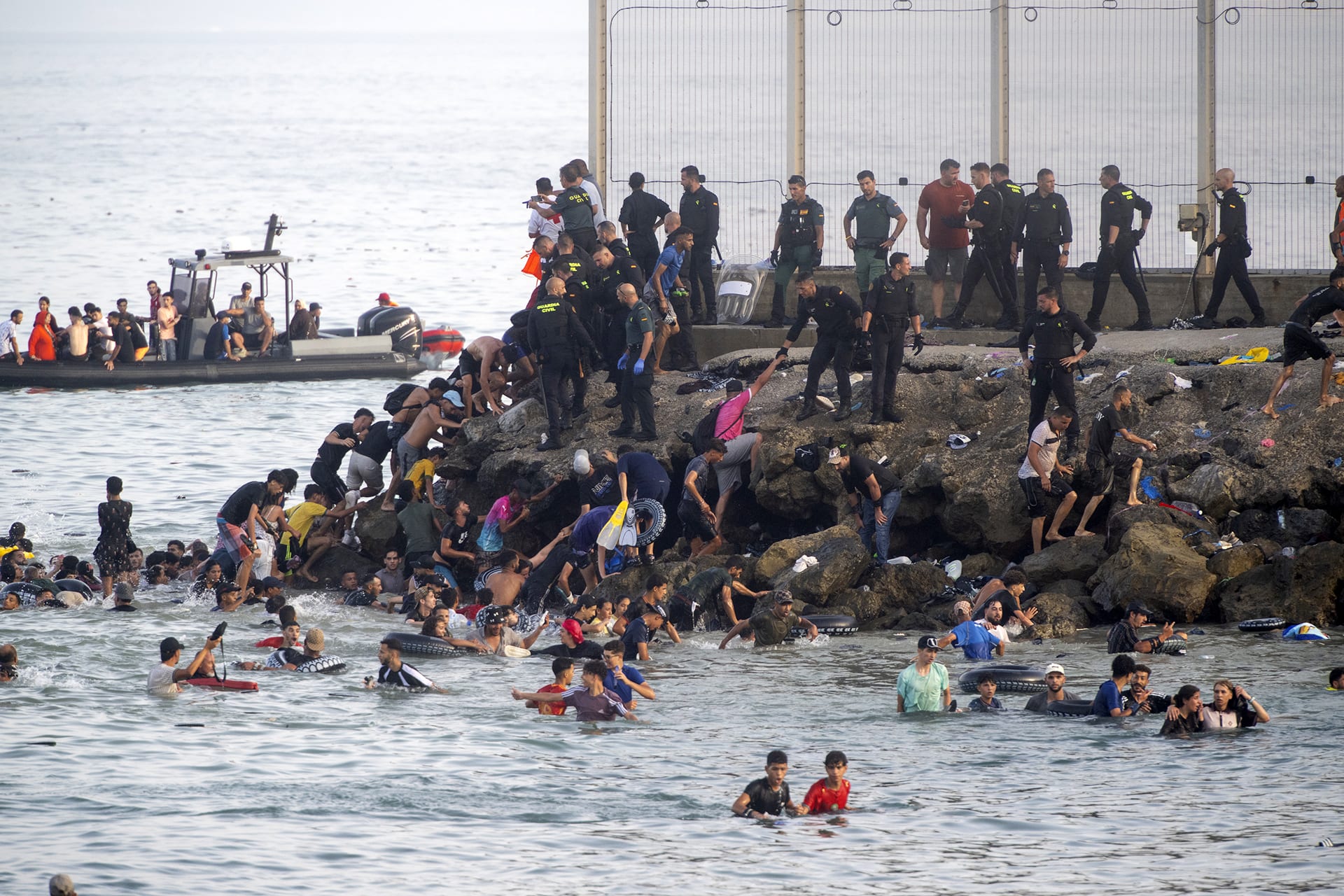
Approximately seventy-two thousand migrants crossed into Ceuta from Moroccan territory in just a few days, according to Spain’s interior minister. (Some reports put this figure at between fifty and sixty thousand.) Most migrants reached Ceuta by sea, either by swimming or using makeshift flotation devices. More than eighty people died on both sides of the border, with many drowning or getting killed in stampedes.
Ceuta, which has a population of just eighty-four thousand, has long been a migration flash point. It is one of only two autonomous Spanish cities—the other being Melilla—located on the northern coast of Africa. Experts say that while both cities have seen migration waves before, the sheer size of this latest incident is unprecedented. The most recent surge occurred in 2021, when roughly twelve thousand people crossed into Ceuta over the span of two days.
What caused this surge of migration?
Experts say there was no single cause behind the border surge, but some point to the effect of a recent ruling by Spain’s Supreme Court that migrants who arrive in Ceuta and Melilla by sea cannot be summarily returned through the expedited “hot returns” process. Instead, authorities must place these migrants into Spain’s regular deportation proceedings, which provide greater due process protections.
CFR migration expert Rita Fernández said that misinformation about the situation spread rapidly online, prompting tens of thousands to make the journey. Many believed a rumor that those who reached either city would not be deported. “While Spanish authorities have also claimed that larger trafficking networks were involved, migrants on the ground told reporters that information on social media, not smugglers, mainly drove their decision to cross,” she said. Fernández added that this type of misinformation fallout has unfolded before in the Western Hemisphere, where social media has similarly become a forum where false or misleading information about changing policies or migration routes can spread.
Critics have also placed blame on Spain’s progressive migration policies under Prime Minister Pedro Sánchez. In April 2026, his administration launched a regularization program, allowing undocumented migrants living in the country to apply for an initial one-year residency and work permit. More than one million people applied before the application window closed at the end of June.
While most EU member states are cracking down on immigration, “the Spanish case is a bit of an exception, both in terms of who’s coming in as well as the more liberal policies that Sánchez has implemented,” Kupchan said.
Leaders of governments with stricter migration policies have criticized Sánchez. Denmark and Italy, for example, accused Spain of not being able to secure the EU’s only border with Africa.
How has Spain responded?
Spain deployed armed forces and police to Ceuta, where migrants were met with water cannons and tear gas and escorted back across the border. Ceuta’s leader declared that the exclave was experiencing a humanitarian and security emergency. The city’s official migrant reception center, already overcrowded before the surge, continued to operate above maximum limits.
Sánchez traveled to Ceuta on July 31. Speaking to reporters, he called the migrant surge “a violation of Spain’s territorial sovereignty” and defended his administration’s migration policy, asserting that migrant smugglers’ misinterpretation of the Supreme Court’s ruling was the trigger.
Shortly after the influx ended, Spain installed a five-hundred-meter-long floating sea barrier off the coast of Ceuta to deter similar crossings.
Roughly 1,100 unaccompanied minors who came to Ceuta before and during the latest wave are still in the city, according to the local government. The Spanish government approved $29 million for Ceuta to support the minors, many of whom had to find shelter in warehouses or sleep on the streets due to overwhelmed reception centers.
What are the broader implications for Europe’s migration policy?
Experts say the situation in Ceuta was the first real test of the EU’s new Pact on Migration and Asylum, which is intended to move the bloc toward a more coordinated system for managing migration. That some member states opted to impose unilateral Schengen suspensions rather than rely on the pact’s new mechanisms is “a sign that more time may be needed to build trust in the new system,” Fernández said.
In recent years, irregular migration has become a third rail of European politics, said CFR’s Kupchan, bolstered by sudden, massive surges that have reignited debate over the issue. A day after the migrant flood into Ceuta, twenty-two of the EU’s twenty-seven member states issued a joint letter calling for an “immediate and coordinated European response.”
Several countries have also taken action of their own. Italy suspended its Schengen open-border policy with Spain on July 31, reinforcing air and sea border patrols, while France announced a five-fold increase in the number of police stationed at its border with Spain. Portugal also declared more controls at its southern land and maritime borders.
Blocwide, the EU held an emergency meeting on August 4 to address the surge. During the videoconference, ministers discussed making improvements to shared situational awareness, suggesting the development of early warning systems and social media monitoring, according to a press release from the Council of the European Union.
After the meeting, EU migration chief Magnus Brunner said member countries stand in solidarity with Spain and condemned attempts to use the debate of illegal migration to divide the bloc. “Europe has not had this much control over illegal migration in a decade, but of course the events from Ceuta show that dramatic images beat actually the best statistics,” Brunner said. Frontex, the EU’s border agency, reported irregular border crossings into the EU were down by 40 percent in the first five months of 2026 compared to the same period in 2025.
Kupchan said the situation in Ceuta represents a temporary breach, and that Spain’s rapid response—including the quick removal of migrants—signifies the system is working, not failing. “Are there holes that need to be plugged? Yes. Does Europe probably need more effective border control systems? Yes,” he said. “But broadly speaking, this was a temporary breach in controlled migration, not an event that would suggest the system is in crisis.”
This work represents the views solely of the author(s). The Council on Foreign Relations is an independent, nonpartisan membership organization, think tank, and publisher, and takes no institutional positions on matters of policy.