India’s Cockroach Party Protests Have a Powerful Precedent—and It Isn’t the Arab Spring
Global media have likened India’s Cockroach Janta Party movement to the Arab Spring and to the uprisings that toppled governments in Nepal, Bangladesh and Sri Lanka. A more instructive comparison is India’s own protest wave of the mid-1970s—and the political reckoning it produced for former Prime Minister Indira Gandhi.
By experts and staff
- Published
 Sadanand DhumeCFR ExpertSenior Fellow for India, Pakistan, and South Asia
Sadanand Dhume is the author of the forthcoming book Tinderbox: The Unpredictable Rise and Uncertain Future of Modern India. He also writes the biweekly East Is East column for the Wall Street Journal focused on South Asia and the Indian diaspora.
“Everything in the country is rotten. The system of education is outdated. The students don’t see a ray of hope. The people are being crushed under the weight of high prices. There is corruption and bribery everywhere. Unemployment goes on rising.”
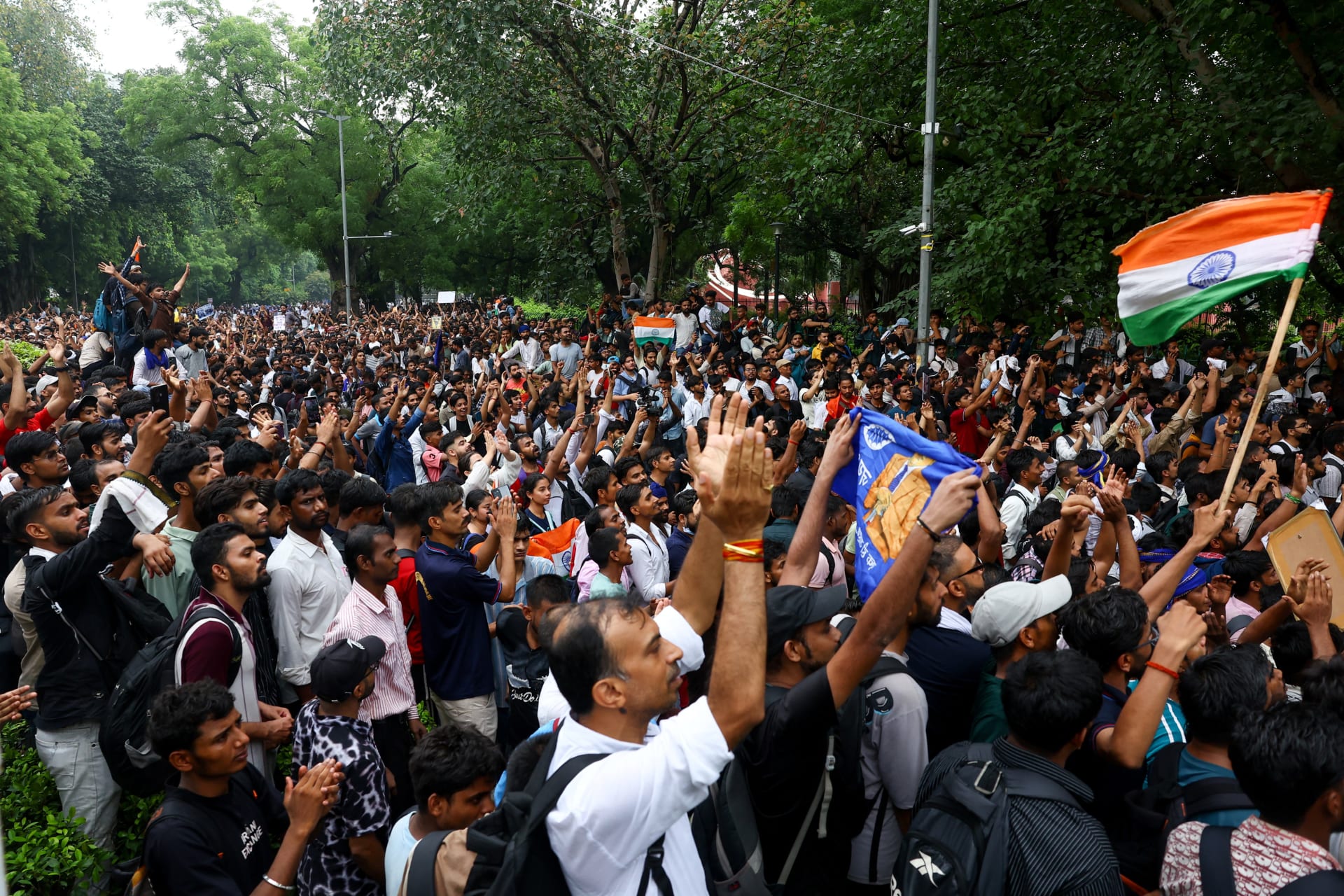
Anyone who has followed India’s recent Gen-Z protests, led by the memorably named Cockroach Janta Party (CJP), might assume that these words were spoken last week at a demonstration in Delhi. But they are, in fact, fifty years old. You would have to go back to a 1975 New York Times story about Jayaprakash Narayan, an opposition leader who led a mass movement against Prime Minister Indira Gandhi, to find them.
In recent weeks, the global media has produced a deluge of stories likening the protests in India to the 2011 Arab Spring or to more recent protests in South Asia that brought down governments in Nepal, Bangladesh and Sri Lanka. These comparisons are vastly overblown. If you want to understand India’s cockroach movement, the best comparison isn’t with Bangladesh or Egypt, but with India’s own past.
Narayan was quoted while speaking outside the western city of Poona (now Pune) at a time of mounting disaffection with Gandhi’s rule. In 1974, students upset with joblessness, corruption, and rising prices spearheaded mass protests that led to scores of people losing their lives in police shootings. The septuagenarian Narayan, a former Marxist and disciple of Mohandas “Mahatma” Gandhi (1869–1948), emerged from retirement to lead the youthful protest movement. (Mahatma Gandhi and Indira Gandhi were not related.)
The Cockroach Janta Party gets its name from a throwaway remark in May by India’s chief justice, who likened a section of the country’s unemployed youth to “cockroaches.” In response, Abhijeet Dipke, a thirty-year-old with a master’s degree in public relations, who was living in Boston at the time, called on X for “all cockroaches” to “come together.” He soon formed the CJP, a pointed contrast with the ruling Bharatiya Janata Party (BJP). Within weeks the CJP’s following on Instagram dwarfed the BJP’s. In June, Dipke returned to India to lead the protest movement he had birthed on social media.
[Video: https://vimeo.com/1214399360?share=copy&fl=sv&fe=ci]
The CJP has tapped into a deep vein of discontent among India’s youth. About 30 percent of India’s 1.5 billion people are between fifteen and twenty-nine. And concerns about jobs loom large among the young. A recent study by economists at Azim Premji University found that a staggering 40 percent of Indian graduates under the age of twenty-five are unemployed. Many of their families have taken on debt to pay for their children’s education. Artificial intelligence threatens India’s large information technology sector, which has ceased to be a reliable fount of middle-class jobs.
A broken examination system has compounded these anxieties. In May, the government voided a national medical examination taken by more than two million aspiring doctors after evidence emerged that the questions had leaked in advance. This was the second time in three years that the national medical examination, known as NEET, had been compromised. A 2024 investigation by the Indian Express counted forty-one major exam leaks spanning fifteen states over the previous five years. With the stakes for students so high, criminal cartels, some of them linked to India’s massive test prep industry, have turned procuring and selling test papers into a business.
In June, the CJP began protesting at Jantar Mantar, an eighteenth-century observatory in Delhi long used by protestors. (It was also one of the sites of India’s 2011 anti-corruption demonstrations.) The protestors received a boost at the end of June when Sonam Wangchuk, a well-known environmental and educational activist, joined them in solidarity. On June 28, Wangchuk began a hunger strike to demand the resignation of former Education Minister Dharmendra Pradhan, the primary focus of student ire. As the fifty-nine-year-old activist’s health declined, the government appeared to panic. On July 18, police forcibly moved Wangchuk to a government hospital.
Two days later, thousands of protestors attempted to walk to Parliament House. They were thwarted by police and paramilitaries armed with batons, tear gas, and pellet guns. According to the police, clashes injured at least sixty protestors and more than one hundred police. The CJP estimates the injury count among protestors as closer to one hundred and fifty. Videos of police brutality quickly flooded social media, forcing the prime minister to record a late-night Instagram video three days later to defuse the situation. On July 25, Pradhan, the education minister, stepped down.
The parallels with India in the mid-1970s are striking. Then, too, corruption and unemployment dominated the concerns of India’s youth. Then, too, India was led by a long-serving prime minister who had vanquished intra-party rivals and diminished opposition parties. Then, too, critics accused the prime minister of cultivating a cult of personality, eroding democratic institutions, and bringing the media to heel. Then, too, ruling party supporters tended to spot foreign plots under every bed. The external environment also shared similarities. The 1973 OPEC oil shock hurt India’s energy import dependent economy much like the war in Iran is doing now.
India’s protest movement of 1974–1975 eventually led to Indira Gandhi suspending democracy and declaring an “Emergency” in June 1975. When she called for elections twenty-one months later, voters booted her out of office, a turning point in Indian political history. Indian Prime Minister Narendra Modi, whose home state of Gujarat was the birthplace of the 1974 protests, and who cut his own political teeth as a Hindu nationalist activist opposed to Gandhi’s Emergency, is deeply aware of this precedent.
But rather than examine India’s own history, much of the global media has reached for parallels with the 2011 Arab Spring and more recent government ousters in South Asia when framing the CJP protests for an international audience. The Arab Spring protests famously toppled governments in Egypt, Libya, and Tunisia. In 2022, in the midst of an economic crisis, rampaging mobs ousted Prime Minister Mahinda Rajapaksa and his brother President Gotabaya Rajapaksa from office. In 2024, student protestors drove long-serving Bangladesh Prime Minister Sheikh Hasina into exile in India. A year later, Gen-Z protestors in Nepal upset about nepotism, corruption, and a crackdown on social media apps, set fire to the country’s parliament and Supreme Court buildings, and forced the government to resign.
Could this happen in India? Some of the ingredients may be the same—economic anxieties, concerns about corruption, and burgeoning inequality—but it would be a mistake to compare India with much smaller countries, most of which (apart from Sri Lanka) have far less experience with democracy than India. The Indian government retains a firm grip on the bureaucracy, police, and paramilitaries. Unlike many of its peers in developing countries, the Indian army has never meddled in politics. The sheer size of the country makes it impossible to paralyze simply by flooding the national capital. Like the United States, and unlike Bangladesh, Egypt, Libya, Nepal, Sri Lanka, and Tunisia, political, financial, and technological power in India are not concentrated in a single city.
But while Modi is unlikely to face the fate of Egypt’s ousted former President Hosni Mubarak or Bangladesh’s Sheikh Hasina, this does not mean smooth sailing ahead. Indira Gandhi also looked unassailable, right up until the moment Indians got to vote again. It would be woefully premature to predict a similar turn of events today—sometimes history neither repeats itself nor rhymes. But if the past is prologue, then Modi should brace for stormy days ahead.
This work represents the views solely of the author(s). The Council on Foreign Relations is an independent, nonpartisan membership organization, think tank, and publisher, and takes no institutional positions on matters of policy.