Ten Anniversaries to Note in 2026
As 2025 comes to a close, here are ten notable historical anniversaries to mark in 2026.
By experts and staff
- Published
 James M. LindsayCFR ExpertMary and David Boies Distinguished Senior Fellow in U.S. Foreign Policy
Anniversaries mark the passage of time, recall our triumphs, and honor our losses. Two thousand twenty-five witnessed many significant anniversaries, including the two-hundred-and-fiftieth anniversary of the battles of Lexington and Concord, the seventy-fifth anniversary of the start of the Korean War, and the fiftieth anniversary of the fall of Saigon. Two thousand twenty-six will see its share of milestone anniversaries as well. Here are ten of note.
Centennial of the Launch of the First Liquid Rocket, March 16, 1926. The dawn of the space age can be dated to experiments a century ago on a farm in central Massachusetts, when Robert Goddard launched the first liquid-propelled rocket. Goddard had a sickly childhood; he frequently missed school, though he became a voracious reader. He started high school when he was nineteen, but he excelled in class and went on to earn his bachelor’s, master’s, and doctoral degrees in physics. He did foundational work on gyroscopes and became intrigued with the idea of space flight. His research was derailed for a time while he battled and eventually overcame tuberculosis. In 1914, he recorded his first patents on aspects of rocket technology. He worked over the next decade, often alone though with the support of the Smithsonian Institution, to perfect the components needed to launch a rocket. His efforts gained increasing public attention, with critics calling him “moon man” and deriding the fantastical idea of space travel. On March 16, 1926, he tested a ten-foot-high rocket on a snow-covered field. The flight lasted 2.5 seconds, reached an altitude of 41 feet, and crashed in a cabbage patch nearly two hundred feet from the launch point. That meager result established the engineering principles that underpinned the German, Soviet, and U.S. rocket programs, becoming the basis for the V-2 missile, the Redstone and Atlas rockets, and ultimately the Saturn V rocket that sent the Apollo astronauts to the Moon.
Five Hundredth Anniversary of the Founding of the Mughal Empire, April 21, 1526. Great empires change the course of history. The Mughal Empire is a case in point. The empire’s origins lie more than a thousand miles to the northwest in modern-day Uzbekistan with the birth of Zahīr ud-Dīn Muhammad, better known to history as Babur. A descendant of Genghis Khan through his mother and Timur (Tamerlane) through his father, he lost control of his ancestral lands as a young man. With the help of the Safavid (Persian) emperor, he rebounded from his defeat by conquering Kabul, in modern-day Afghanistan, in 1504. Rebuffed in his efforts to retake his homeland, he turned his sights southward on India. Aided by the Ottoman emperor as well as his Safavid counterpart, Babur’s army defeated the forces of the Sultan of Delhi at the First Battle of Panipat in April 1526. Babur’s control over India was cemented the following year when his forces defeated the Kingdom of Mewar at the Battle of Khanwa. Babur’s successors extended his empire across most of the Indian subcontinent, reshaping its governance, economy, and culture by blending Central Asian, Persian, and Indian traditions. The empire’s legacy can be seen in its architectural masterpieces, which include the Taj Mahal, Agra Fort, and Red Fort. The Mughal Empire began to decline in the mid-eighteenth century as the result of weak leadership, internal conflict, corruption, and foreign intervention. The British deposed the last Mughal emperor in 1857 and formally dissolved the empire the next year.
Four Hundredth Anniversary of the Dutch Purchase of Manhattan, May 1626. Origin stories often invent or distort facts. American schoolchildren were long taught that Peter Minuit purchased Manhattan from the indigenous Lenape people on behalf of the Dutch West India Company for goods worth 60 Dutch guilders or $24. Many of the particulars of that transaction, including the precise day it occurred and any deed that was signed, have been lost to history. The Dutch West India Company’s motives were clear: It wanted to control the island to protect its lucrative fur trading routes up the Hudson River and to create a commercial center for its North American operations. The intent of the Native Americans who agreed to the deal is far harder to establish. They did not share the European concept of land purchases and ownership; they may have viewed the transaction as simply giving the Dutch the right to access the island. An additional complication is that Minuit likely negotiated with members of the Carnarsee tribe who lived primarily in what is now Brooklyn but hunted in Manhattan. The primary inhabitants of Manhattan at the time were members of the Wappinger tribe, from whose language the name “Manhattan” is derived. Indeed, the Dutch West India Company later worked out a deal with the Wappingers, leading to talk that they had bought Manhattan twice. Whatever the true story of Minuit’s deal, New York City is a far different place than it was four centuries ago.
Tenth Anniversary of the Brexit Vote, June 23, 2016. Be careful what you wish for, you may get it. The United Kingdom joined the European Community, now the European Union, in January 1973. Two years later, Britons voted by a two-to-one margin in a non-binding referendum to endorse membership. Despite the vote, membership in the EU never sat well with many Britons, who recoiled at linking their fate to decisions made on the continent. “Euroskeptic” politicians and pundits made their careers by complaining that EU membership was holding Britian back, even though economic integration with Europe benefited the UK economically. Looking to defang the anti-EU wing of his Conservative Party and anticipating a repeat of the 1975 vote, British Prime Minister David Cameron called for a national referendum on British membership. Cameron looked to be making a savvy let; most polls showed Britons favoring the “Remain” option over the “Leave” option. But when the ballots were counted after the polls closed on June 23, 2016, voters had opted for Leave by a margin of 52 to 48. Cameron immediately announced that he would resign as prime minister. Although the referendum was non-binding, Cameron’s successor, Theresa May, negotiated Britian’s withdrawal from the EU, which took place on January 31, 2020. A recent analysis concluded that Brexit has shaved 6 to 8 percent off Britian’s GDP. Polls show that a majority of Britons now see leaving the EU as a mistake. Despite the change in public opinion, none of Britain’s major political parties is looking to revisit the decision.
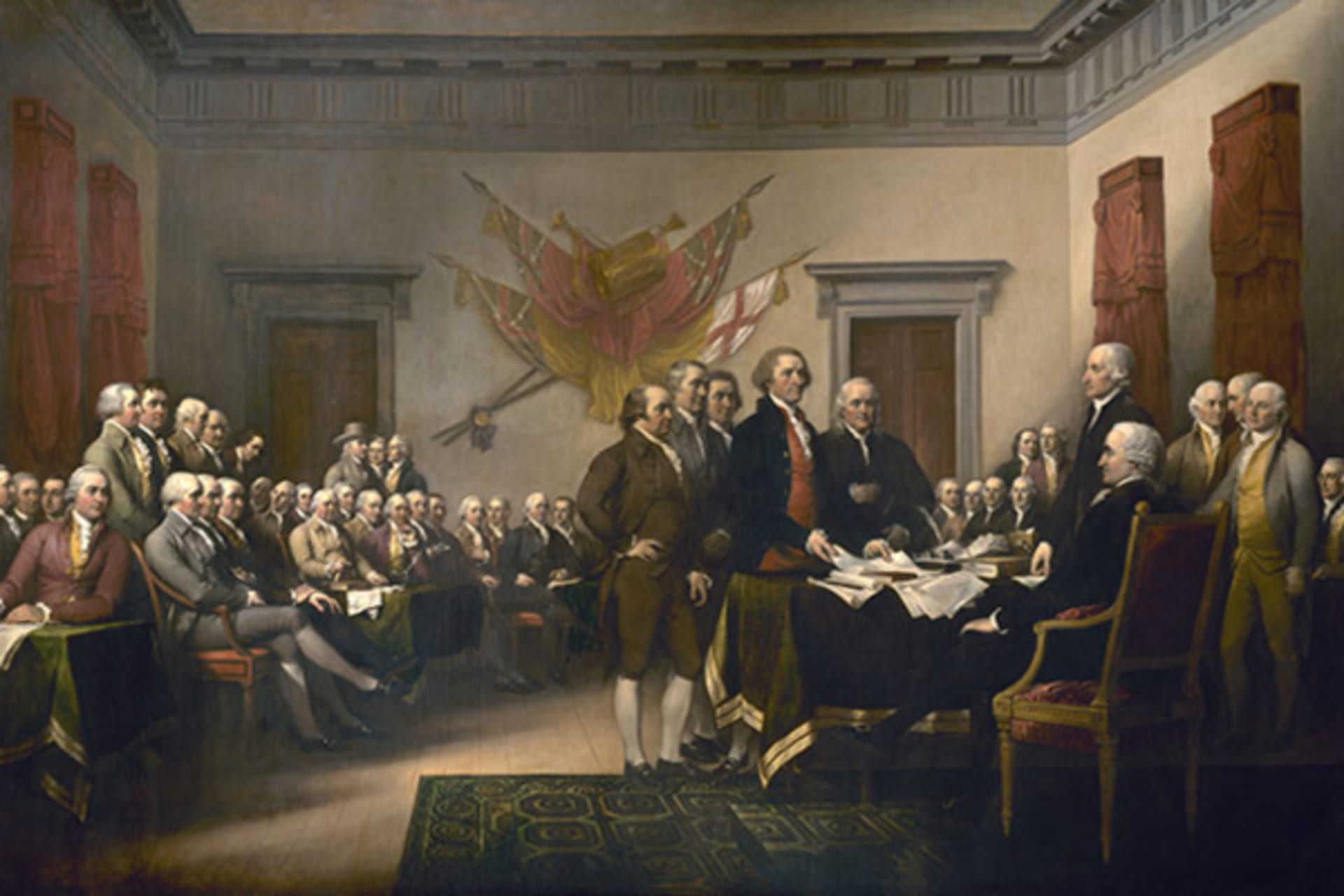
The Two-Hundred-and-Fiftieth Anniversary of the Signing of the Declaration of Independence, July 4, 1776. “We hold these truths to be self-evident, that all men are created equal, that they are endowed by their Creator with certain unalienable Rights, that among these are Life, Liberty, and the pursuit of Happiness.” The opening sentence of the Declaration of Independence may be the most consequential words ever written. But the declaration drafted by Thomas Jefferson and edited by a committee that included John Adams and Benjamin Franklin responded to immediate, practical concerns. Simmering tensions between Great Britain and the thirteen colonies had exploded into open warfare a year earlier with the battles at Lexington and Concord. In choosing to break with Britain, the second Continental Congress hoped to legitimize its decision with American colonists and lay the groundwork to gain support from foreign powers like France. To that end, the declaration listed more than two dozen “injuries and usurpations” that the “King of Great Britain” had inflicted on his subjects. Few Americans today can name any of those specific injuries. What has been handed down across the generations has instead been the belief in the declaration’s opening words. As has often been noted, Jefferson and his fellow signatories did not always live by the principle they proclaimed. But as Martin Luther King Jr. put it two centuries later, the Declaration of Independence is a “promissory note” to future generations of Americans. It is a note that has yet to be fully redeemed.
Seventy-fifth Anniversary of the Treaty of San Francisco, September 8, 1951. Bitter enemies can become good friends. After the United States defeated Japan in World War II, the U.S. military occupied the island nation with the goal of building new democratic institutions while ensuring that Japan stood as a bulwark against communist expansion. Six years passed, however, before the United States turned to negotiating a formal end to the war. Washington consciously declined to pursue a punitive peace deal and instead focused on creating a bilateral security arrangement that tied Japan to the United States and kept it distant from the newly established People’s Republic of China. To reassure U.S. allies in the Pacific, Washington negotiated additional security arrangements with Austria, New Zealand, and the Philippines. Once those agreements were set, the United States convened a peace conference in San Francisco, even as the Korean War raged on the other side of the Pacific. Fifty-two countries attended; China and Korea were noticeably absent because of disagreements over who should represent them. The Soviet Union, joined by Czechoslovakia and Poland, voted against the treaty, arguing among other things that it did nothing to prevent the return of Japanese militarism. Forty-seven other countries voted with the United States in favor of the Treaty of San Francisco, thereby restoring full sovereignty to Japan. In conjunction with signing the peace treaty, Japan and the United States signed a bilateral security treaty. The Soviet Union did not formally end its state of war with Japan until 1956. Japan today is one of the United States’ largest trading partners and most important allies.
Fiftieth Anniversary of Mao Zedong’s Death, September 9, 1976. Mao Zedong was one of the most consequential figures of the twentieth century. Born to a peasant father who became a successful grain dealer, Mao rebelled against farm life as a teenager and left to pursue his education. When the Xinhai Revolution began in October 1911, he joined the revolutionary army. After the Chinese Republic was established in 1912, Mao worked various jobs and continued his studies. He eventually became a librarian’s assistant at Peking University, where he discovered the writings of Karl Marx and Vladimir Lenin. In July 1921, Mao became a founding member of the Chinese Communist Party (CCP). For the next several years, he and the CCP collaborated with the Nationalist Party in campaigns against regional warlords that they both saw as preventing national reunification. That alliance collapsed in 1927 when the new Nationalist leader, Chiang Kai-shek, turned on the communists and forced them to flee to avoid annihilation. Mao’s leadership of the 1934–35 Long March elevated him to the top of the CCP. His strategy of peasant mobilization and ideological discipline enabled the communists to survive the Imperial Japanese invasion of China in 1937 and then drive Chiang and the Nationalists from power in 1949. Once in power, Mao moved to centralize political authority, restructure the economy, and remake society. However, the Great Leap Forward launched in 1958 and the Cultural Revolution begun in 1966 were catastrophic for China. Mao’s death touched off political turmoil in the upper ranks of the CCP, and his eventual successor, Deng Xiaoping, whom Mao previously purged, took the country in a decidedly different direction.
The Twenty-fifth Anniversary of the September 11 Terrorist Attacks, September 11, 2001. Beautiful days can produce horrific events. It was a postcard perfect late summer morning when Al Qaeda terrorists flew hijacked planes into the north and south towers of the World Trade Center in New York City and into the Pentagon outside of Washington, DC. A fourth plane, United Flight 93, crashed into a field in central Pennsylvania after passengers tried to wrest control from the hijackers. Nearly three thousand people died in the attacks, making September 11 one of the deadliest days in U.S. history. A week later, Congress passed the 2001 Authorization to Use Military Force, which authorized the president to “use all necessary and appropriate force against those nations, organizations, or persons he determines planned, authorized, committed, or aided the terrorist attacks that occurred on September 11, 2001, or harbored such organizations or persons.” When the Taliban government in Afghanistan refused to turn over Osama bin Laden and other Al Qaeda leaders, the United States launched Operation Enduring Freedom. The invasion drove the Taliban from power, but a decade passed before Navy Seals killed bin Laden in his hideout in Abbottabad, Pakistan. The legacy of the U.S. response to the September 11 attacks remains extensive and complex. The Department of Homeland Security was created, intelligence authorities were expanded with the Patriot Act, and new rules established to track and disrupt terrorist financing. But many Americans soured on the occupation of Afghanistan and the use of “enhanced interrogation techniques” against suspect terrorists.
Twenty-fifth Anniversary of the Start of the War in Afghanistan, October 7, 2001. Winning the war does not always mean winning the peace. Afghanistan had not figured in U.S. military thinking before the September 11, 2001, terrorist attacks. When President George W. Bush decided to oust the Taliban for refusing to hand over Osama bin Laden, his advisers scrambled to develop a war plan. They agreed to start by inserting CIA paramilitary teams with deep ties to Afghan opposition groups into the country along with Special Operations Forces to call in air strikes on Taliban targets. On October 7, U.S. and British forces entered Afghanistan to, as Bush put it, “disrupt the use of Afghanistan as a terrorist base of operations, and to attack the military capability of the Taliban regime.” Initial progress was slow. But the tide turned in early November, and on December 7, the Taliban fled their stronghold in Kandahar. Although bin Laden and many other senior Al Qaeda leaders escaped, the U.S. victory was impressive in military terms; just eleven U.S. soldiers died in the fight to oust the Taliban. But the occupation of Afghanistan proved a different story. More than 2,400 U.S. troops, hundreds of allied soldiers, and an untold number of Afghans died in what come to be called America’s longest war. Despite spending billions on aid, the United States was unable to bring peace or stability to Afghanistan. The last U.S. troops left Kabul in August 2021 as the Taliban seized the capital.
The One-Hundred-and-Fiftieth Anniversary of the Hayes-Tilden Election, December 6, 1876. Disputed elections and unsavory political compromises are not a twenty-first century invention. The 1876 presidential race offers a vivid example. The election pitted Rutherford B. Hayes, the Republican governor of Ohio, against Samuel J. Tilden, the Democratic governor of New York. Tilden took the popular vote by three percentage points, the first Democratic popular vote victory in two decades. But presidential elections are decided in the Electoral College. Things there were in turmoil. Tilden had 184 electoral votes, one shy of what he needed for victory. But four states with twenty total electoral votes—Florida, Louisiana, Oregon, and South Carolina—sent conflicting slates of electors to Congress, one for Hayes and one for Tilden. Deadlocked on how to allocate the disputed votes, Congress created a fifteen-member commission composed of senators, representatives, and Supreme Court justices to decide the issue. The commission, which tilted 8-7 Republican after an independent Supreme Court justice refused to serve, voted along party lines to award the votes to Hayes. Democrats, who believed that Tilden had won the three former Confederate states, initially rejected the commission’s decision but ultimately relented. It has long been alleged, though no definitive evidence exists, that they did so in exchange for a Republican pledge to withdraw federal troops from the South, thereby ending Reconstruction. Whether Republicans cut a deal or simply lacked the ability or will to enforce civil rights in the South, white Southerners reasserted political control during Hayes’s presidency, rolled back political rights for African Americans, and ushered in the Jim Crow era.
On the lighter side. January 28 marks twenty-five years since the Baltimore Ravens won their first Super Bowl title, defeating the New York Giants 34-7. February 8 marks fifty years since the premiere of Taxi Driver starring Robert De Niro as a disturbed New York City cabbie. March 9 is the semi-quincentennial anniversary of the publication of The Wealth of Nations by Adam Smith, one of the most influential books ever written on economics. April 1 marks the fiftieth anniversary of the founding the Apple Computer Company by Steve Jobs, Steve Wozniak, and Ronald Wayne. May 1 marks the centennial of Hall of Fame pitcher Satchel Paige’s professional baseball debut with the Chattanooga White Sox of the Negro Southern League. June 9 marks the sesquicentennial anniversary of the publication of Mark Twain’s classic The Adventures of Tom Sawyer, the often-overshadowed prequel to The Adventures of Huckleberry Finn. July 26 marks the seventy-fifth anniversary of the premiere of Walt Disney’s animated film Alice in Wonderland, which was initially considered a commercial failure. August 5 is the tenth anniversary of the opening of the Olympic Games in Rio De Janeiro, in which gymnast Simone Biles and swimmer Michael Phelps made history. September 18 is the seventy-fifth anniversary of the premiere of A Streetcar Named Desire, starring Vivien Leigh and Marlon Brando in the film adaptation of Tennessee Williams’ classic play. October 14 is the centennial of the publication of A.A. Milne’s Winnie-the-Pooh. November 2 marks the tenth anniversary of the Chicago Cubs’ victory over the Cleveland Indians in the World Series, ending the North Siders’ 108-year championship drought. December 3 is the centennial of Agatha Christie’s mysterious disappearance from her home in Sunningdale, England, which triggered international speculation about where she went and why.
Oscar Berry and Sofia Park Jadotte assisted in the preparation of this post.
Other posts in this series: