Midterm Elections Are Eight Months Away
U.S. foreign policy is unlikely to change significantly even if divided government returns to Washington next January.
By experts and staff
- Published
 James M. LindsayCFR ExpertMary and David Boies Distinguished Senior Fellow in U.S. Foreign Policy
The conventional wisdom has divided government returning to Washington next January. Democrats are a favorite to retake the House in November. They may even have put the Senate in play. While it is common to mock conventional wisdom, it is also often right. So, it is worth asking, how much would the return of divided government change U.S. foreign policy?
The short answer is, probably far less than many think. Before I explain that answer, a bit of history would be helpful. Some midterms have mattered, and mattered a lot, for foreign policy. Some have not.
The 1918 Midterms and the League of Nations
On October 24, 1918, with World War I ending and peace negotiations looming, President Woodrow Wilson told Americans that if you
want me to continue to be your unembarrassed spokesman in affairs at home and abroad, I earnestly beg that you will express yourself unmistakably to that effect by returning a Democratic majority to both the Senate and the House of Representatives.
Wilson’s partisan pitch to voters during wartime had precedent. Twenty years earlier, President William McKinley had called on voters to elect a Republican Congress as his administration negotiated the peace treaty to end the Spanish-American War.
Things did not go as Wilson hoped. When all the ballots were counted on November 5, 1918, Americans had delivered him a stinging defeat. Republicans gained twenty-five seats in the House and six seats in the Senate. That transferred control of the House and Senate from the Democrats to the Republicans. (McKinley’s appeal fared somewhat better. Republicans held onto control of Congress despite losing thirty-seven House seats.)
The results of the 1918 midterms likely doomed Wilson’s effort to persuade the Senate to embrace U.S. membership in the League of Nations. When the new Senate convened in March 1919, the majority leader was Republican Senator Henry Cabot Lodge of Massachusetts. Lodge and Wilson detested each other. (Lodge once said of Wilson: “I never expected to hate anyone in politics with the hatred I feel toward Wilson.”) The Massachusetts senator made himself chair of the Senate Foreign Relations Committee and stacked it with so-called “Irreconcilable Republicans” who loathed the League of Nations. For months they attacked it as a “treacherous and treasonous scheme.” When the resolution for ratification for the Treaty of Versailles came to a vote that November, it failed to achieve even majority support. U.S. membership in the League of Nations was dead.
The 2006 Midterms and the Iraq War
The 2006 midterms provide a contrary example of the impact of midterm elections. Those elections went well for Democrats. Campaigning on public unhappiness over the U.S. occupation of Iraq, they picked up six Senate seats and thirty-one House seats. That gave them control of both Houses of Congress.
Three days after the polls closed, President George W. Bush announced Dick Rumsfeld’s resignation as secretary of defense. However, the departure of one of the Iraq War’s chief architects did not mean that Bush intended to wind down the U.S. troop presence in Iraq. To the contrary, in January 2007, just after the new Congress was sworn into office, he ordered 20,000 more U.S. troops sent to Iraq as part of what became known as “the surge.”
The House responded to the surge in mid-February by passing a non binding resolution expressing its disapproval. A Republican filibuster stymied Senate consideration of the resolution, thereby killing it. Two months later, Congress passed a supplemental appropriations act that would have forced a U.S. drawdown in Iraq. Bush vetoed the bill, which Congress failed to override. Bush’s surge went ahead as planned.
A Lesson About Leverage
The policy consequences of the 1918 and 2006 midterm elections illustrate one of the fundamental lessons of executive-legislative battles over U.S. foreign policy: the institution that has the upper hand is whose consent is needed. Congress is at its strongest when, as in 1919, the president needed legislative—in this case, Senate—action. Then, the president bears the burden of building a winning coalition. Conversely, presidents enjoy the advantage when they can act and dare Congress to stop them. Then, as was the case in 2007, members of Congress bear the burden of navigating all the veto points that make it difficult to pass legislation.
If divided government does return to Washington next January, President Donald Trump’s situation will be more like the one that Bush faced than the one that Wilson did. As Operation Epic Fury and the Liberation Day tariffs show, Trump interprets his presidential authorities—both constitutional and statutory—broadly. November’s midterms are not likely to make him suddenly timid. Even if Congress passes legislation seeking to rein him in, he can expect Republican lawmakers to sustain his veto. And because Trump has offered little in the way of domestic legislation that he hopes to enact, congressional Democrats will have few presidential priorities they can hold hostage to extract concessions on foreign policy.
Politics and Policy
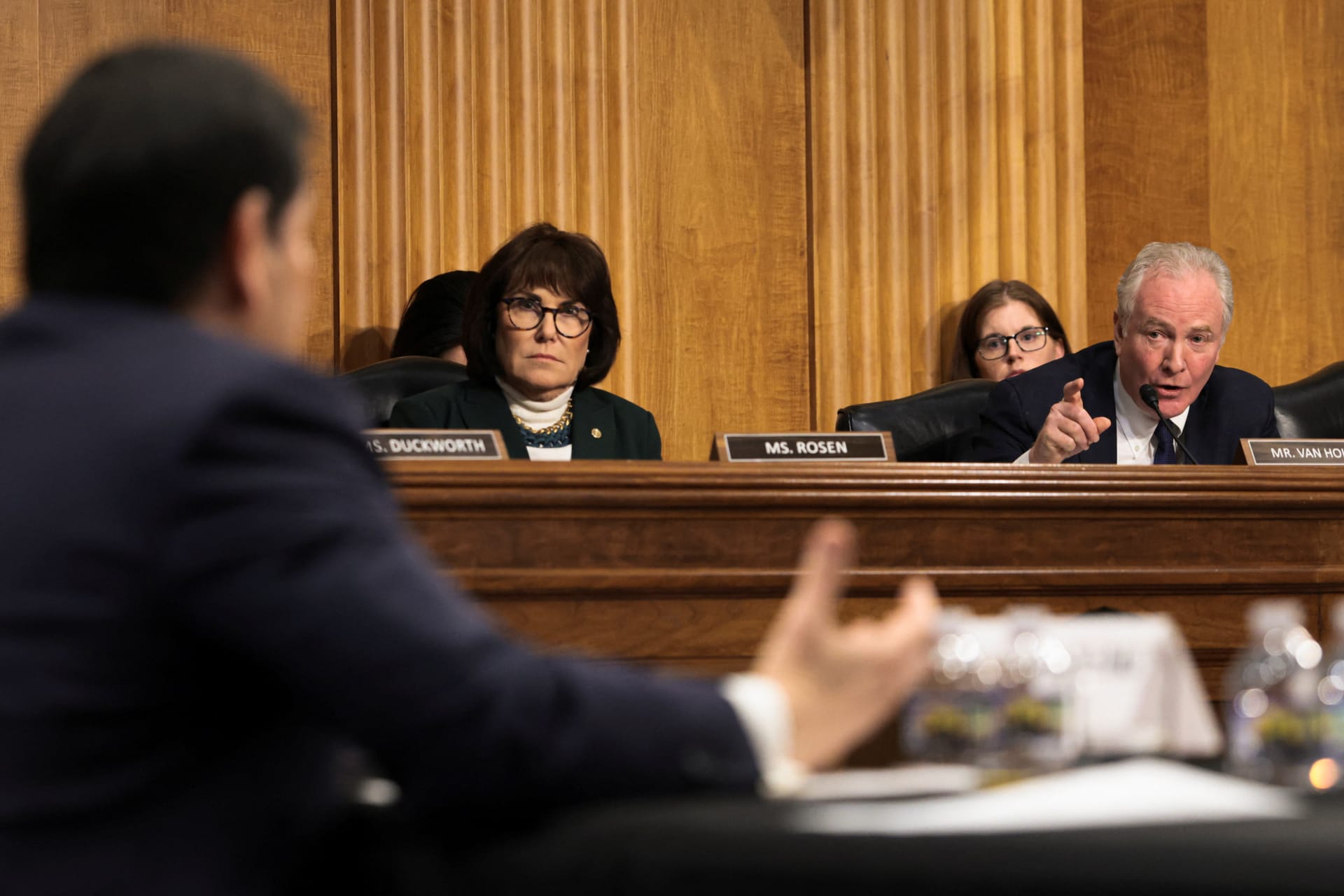
While Democrats will not be able to seize the reins in foreign policy after the midterms, they will be able to raise the political costs that Trump will face with his policy choices. Control of either chamber of Congress brings with it the power to decide which bills come to the floor for a vote, what topics become the subject of hearings, what investigations to start, and who receives subpoenas. Democrats will assuredly use those powers to put Trump on the defensive, much like a baseball pitcher might use a pitch high and inside to gain an advantage over a batter.
How much such tactics move the policy debate depends on how much they move public opinion. That could be a lot, or it could be a little. It may be that, in our highly polarized time, hearings and investigations will generate outrage but do little to shift public opinion.
And much like how a brushback pitch unnerves some hitters and not others, presidents vary in how much political pain they are willing to risk. Some respond to disappointing midterms by tacking back toward the political center, as Bill Clinton did with his policy of triangulation after the 1994 midterms. Others, like George W. Bush in 2007, double down on their core priorities.
Having built his presidency on attacking Democrats and tending to his MAGA base, Trump seems more likely to follow Bush’s lead. That said, Trump’s abrupt shift during his first term from maximum pressure on North Korea to leader-to-leader diplomacy shows that he is also capable of breathtaking pivots on policy. But whether he toes the line or seeks an accommodation with Democrats, a return to divided government will inject an additional element of choppiness into an already turbulent U.S. foreign policy.
Numbers to Note
As of this week, fifty-two House members have announced that they are either retiring or running for other offices in November. That ties 2018 for the most recent high in departures. Thirty-one House Republicans are leaving voluntarily, compared with twenty-one Democrats. As a general rule, open seats are easier for the party out of power to win.
Nine incumbent senators have decided not to run for reelection. Five are Republicans; four are Democrats.
The generic congressional ballot has Democrats with a 5.4-point lead over Republicans. That is essentially unchanged since last month.
Trump remains upside down in his overall approval rating, with polls showing on average 55 percent disapproving and 42 approving. The polls released since the United States launched air strikes on Iran last Saturday do not show any significant movement in Trump’s approval ratings in either direction. So neither he nor Republicans are so far benefitting from a ‘rally-round-the-flag effect.
Republicans look to be winning the fundraising wars so far. Trump’s super PAC, MAGA Inc., started 2026 with $304 million in the bank, and the Republican National Committee entered the year with $95 million on hand, compared to the Democratic National Committee’s $14 million. The Democratic National Committee also carries $17 million in debt.
News of Note
The Brennan Center discussed how the SAVE Act, which the House passed last month, would disenfranchise millions of voters from both political parties as well as independents.
The New York Times’s Shane Goldmacher profiled five Democrats seeking to win support in deeply red House districts. In a tried-and-true tactic, they are playing up their deep roots in their districts and making a virtue out of having little formal political experience.
The Atlantic’s Mark Leibovich traveled the country to see what steps Democrats are taking to win back political power in Washington. What he found helps explain why Democrats have a brand problem.
The New York Times’s Shawn McCreesh, Alexandra Berzon, and Nick Corasaniti report on how Trump has put a 2020 election denier in charge of U.S. election security.
Oscar Berry assisted in the preparation of this article.
Other posts in this monthly series:
Colophon
Research and Assistance
Oscar Berry