Trump Pledges Security for Ukraine
By experts and staff
- Published
- CFR Editors
Welcome to the Daily News Brief, CFR’s flagship morning newsletter summarizing the top global news and analysis of the day.
Subscribe to the Daily News Brief to receive it every weekday morning.
Top of the Agenda
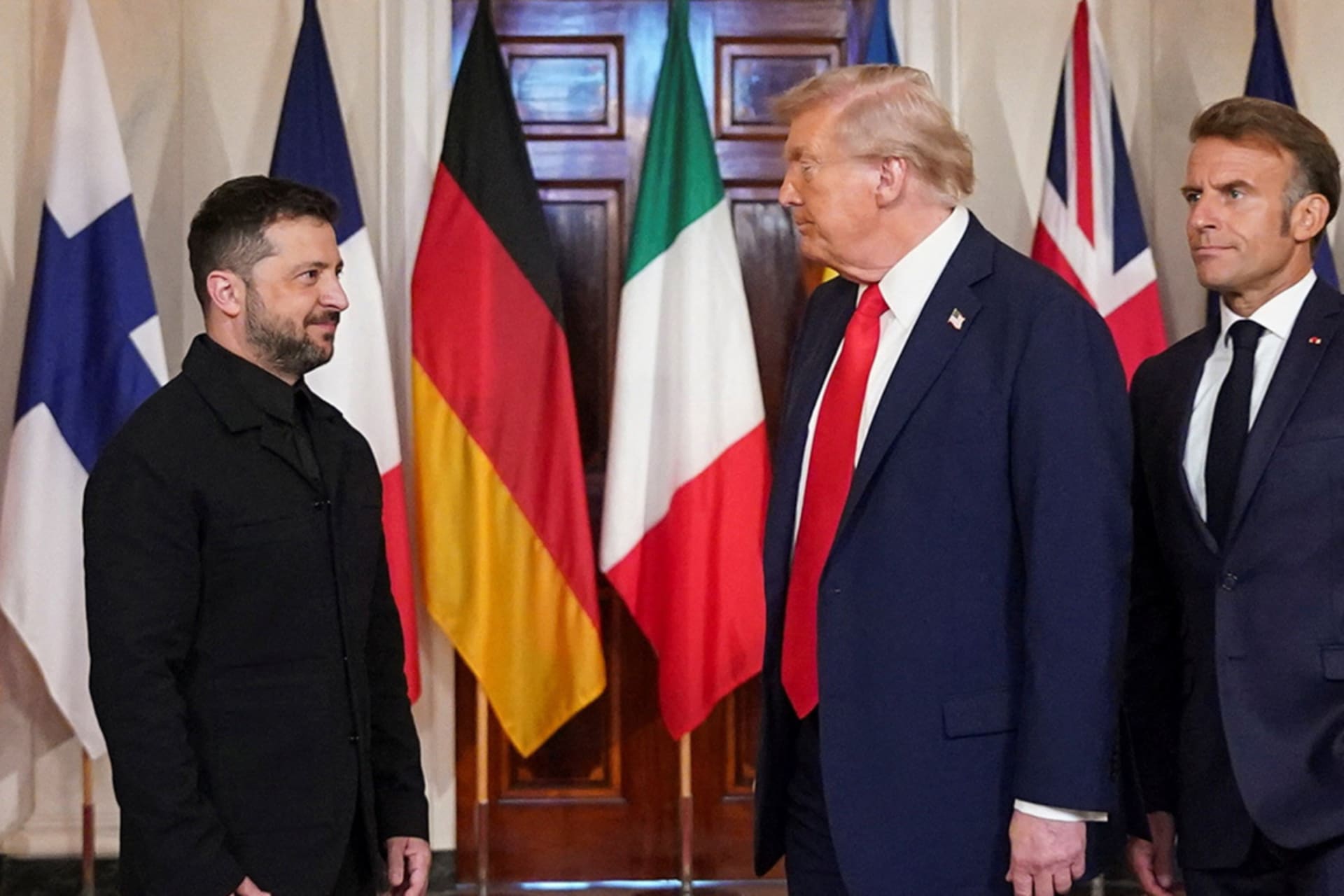
U.S. President Donald Trump pledged yesterday that Washington would play a role in assuring Ukraine’s security following a peace settlement. Ukrainian President Volodymyr Zelenskyy called the unusual meeting—in which heads of several European countries, NATO, and the European Union (EU) flew to visit the White House at the last minute—a “big step forward.” Leaders said they would work out details of security guarantees for Ukraine in the coming days.
The latest.
- Washington will provide “coordination” for security guarantees given directly by European countries, Trump wrote on social media after the meeting.
- Zelenskyy said he presented a proposal for Ukraine to buy about $90 billion in U.S. weapons and for the United States to buy Ukrainian drones.
- Trump also paused talks to call Russian President Vladimir Putin yesterday to push for a meeting between Putin and Zelenskyy. After that call, a Kremlin aide said that Moscow and Washington would increase the seniority of negotiators appointed for peace talks.
- European leaders pushed back on Putin’s ambitions of controlling Ukraine’s Donbas region at the meeting. Publicly, Zelenskyy said that any decisions over territory would need to be made directly between him and Putin.
The context.
- While the meeting did not immediately produce a timeline for the next stage of peace talks, Trump and Zelenskyy both reported a far more positive dialogue than during a bilateral Oval Office talk that broke down in February. Zelenskyy said it was Ukraine’s “best meeting with President Trump.”
- Major questions still hang over the nature of Western security guarantees for Ukraine. Russia’s foreign ministry issued a statement yesterday reiterating its opposition to NATO boots on the ground in Ukraine.
- Meanwhile, Russian attacks across Ukraine killed fourteen people in the hours after Zelenskyy arrived in Washington, underscoring Russia’s capacity to harm Ukraine as long as there is no ceasefire in place.
“The Ukraine-Russia conflict and the back-and-forth between the United States and Europe on this is not dissimilar from how the U.S.-EU trade relations have gone. There are always high expectations, and then the Europeans’ expectations are dashed by the Americans… Then when they meet again, having avoided the worst outcomes, they come to some sort of agreement. It’s better than they feared, but it’s always worse than the status quo. But as the saying goes, the Europeans live to fight another day.”
—CFR expert Matthias Matthijs
Across the Globe
Hamas approves truce. Hamas accepted a plan for a ceasefire presented by Arab mediators, senior official Basem Naim said yesterday. While he did not give further details, an unnamed Egyptian official told the Associated Press that the proposal is similar to a previous one accepted by Israel and stipulates the negotiation of a lasting ceasefire. Egypt and Qatar sent the proposal to Israel, a senior Egyptian official said.
Wildfires in Spain. Fires have burned a record 1,344 square miles of the country this year, the EU’s Earth observation program said yesterday. The bloc’s firefighting force has already been mobilized more than sixteen times this year, more than in the entirety of 2024. Spanish Prime Minister Pedro Sánchez called the fires “accelerating effects of the climate emergency.” Europe is the fastest-warming continent in the world.
Germany’s tariff demand. The United States must follow through on a previously agreed pledge to lower tariffs on Europe-made cars before it can formalize a preliminary trade deal with the EU, a German government spokesperson said yesterday. Late last month, Washington and Brussels announced a framework for a trade agreement that would have the bloc direct hundreds of billions of dollars worth of investment into the United States.
Crypto for Thailand tourists. Thailand will test a program in which tourists can exchange digital assets for the local currency, the baht. The pilot is due to begin in the fourth quarter of this year. Bangkok is trying to stimulate the tourism sector; the country has seen a slump in Chinese tourists in particular after the January kidnapping of a Chinese actor near the Thailand-Myanmar border.
Pyongyang’s nuclear pledge. North Korean leader Kim Jong Un said the country should move forward with the “rapid expansion of nuclearization” and condemned annual joint U.S.-South Korea military drills that are currently taking place. South Korea’s new leader has pledged to improve ties with its northern neighbor but said it still aims for denuclearization of the Korean Peninsula, which Kim rejects.
U.S.-Taiwan security ties. Taiwan’s foreign ministry said today that the island’s security must be a result of “its own efforts.” The statement came after Trump said that Chinese President Xi Jinping told him China would not invade Taiwan during Trump’s term. Taipei closely monitors the interactions between Beijing and Washington, a foreign ministry spokesperson said.
Japan eyes export support. The Japanese government plans next year to introduce multi-year subsidies for companies investing in semiconductors, rare earths, and shipbuilding across Southeast Asia and other emerging markets, Nikkei reported. Doing so would require altering a domestic economic security law. The government is studying using the state-funded Japan Bank for International Cooperation to incentivize some of the investments.
DRC-rebel talks. The Democratic Republic of Congo (DRC) and M23 rebels missed a deadline yesterday to reach a peace deal, which they committed to doing around a month ago. Qatar is mediating the negotiations. On Sunday, M23 called for a prisoner release before the next round of talks.