U.S. Officials Questioned on Signal Chat and Other Headlines of the Day
By experts and staff
- Published
- CFR Editors
Welcome to the Daily News Brief, CFR’s flagship morning newsletter summarizing the top global news and analysis of the day.
Subscribe to the Daily News Brief to receive it every weekday morning.
Top of the Agenda
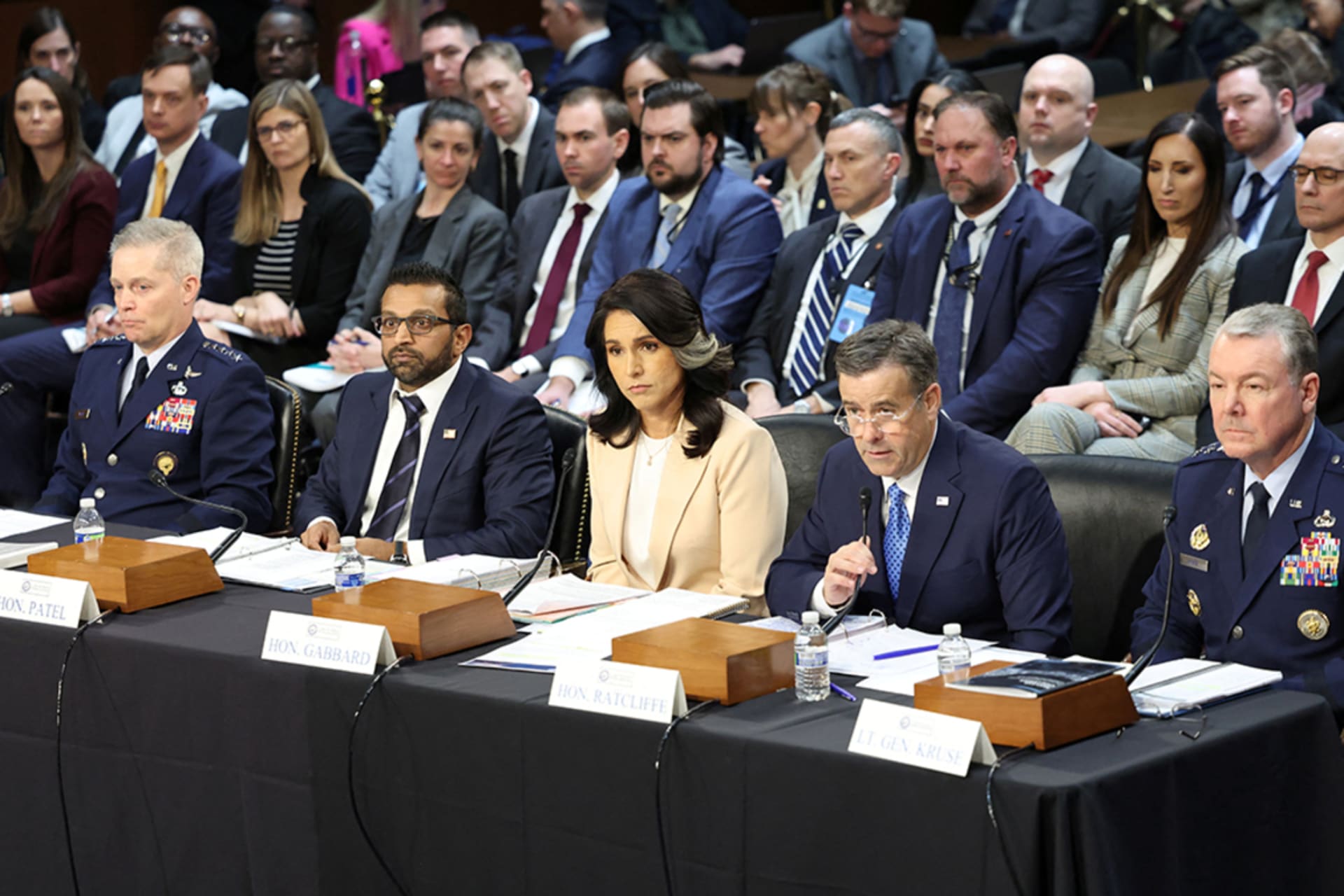
Top U.S. intelligence officials denied wrongdoing as lawmakers questioned them yesterday about their use of the commercial chat app Signal to discuss plans to bomb Yemen. Military planning is typically conveyed through special government channels; the unusual situation reportedly came to light because National Security Advisor Michael Waltz added The Atlantic’s editor-in-chief to the chat group, according to the magazine.
The hearing. Yesterday’s previously scheduled Senate hearing was due to focus on the release of a new global threat assessment by the intelligence community. The witnesses included Director of National Intelligence Tulsi Gabbard and CIA Director John Ratcliffe, who were part of the Signal group.
- Gabbard and Ratcliffe disputed the Atlantic’s reporting that information on weapons packages, targets, or the timing of strikes were discussed in the group; Gabbard later said there was discussion “around targets in general,” and Ratcliffe agreed. Another Atlantic article published today listed detailed strike information shared in the chat. The White House press secretary said that “there was no classified information transmitted” but the administration objects to the information’s release as it was “sensitive.”
- Both Gabbard and Ratcliffe denied sharing classified information. Regarding planning information shared by Defense Secretary Pete Hegseth, Ratcliffe saidthat Hegseth has the authority to determine whether military information is considered classified or not.
- Senator Mark Warner (D-VA) contested that the information was unclassified, saying the incident showed “sloppy, careless, incompetent behavior.”
- Senator Michael Bennet (D-CO) pointed out that chat member Steve Witkoff, Trump’s special envoy to the Middle East, was in Russia during the time of the exchange. Warner flagged known incidents of China and Russia trying to hack Signal.
- Some Republicans, such as Chair of the Senate Armed Services Committee Roger Wicker, separately said they would seek to learn more about the incident.
The political fallout. As some Democrats called for Waltz and Hegseth to resign, U.S. President Donald Trump downplayed the incident yesterday, saying Waltz had “learned a lesson.” Trump repeated the assertion that no classified information was shared in the group. In a separate interview with Fox News yesterday, Waltz said he took “full responsibility” for the journalist being added to the chat.
Meanwhile, European officials lamented comments attributed to U.S. Vice President JD Vance and Hegseth in the chat that characterized Europe as overly dependent on the United States.
- A former United Kingdom (UK) defense secretary posted on social media that “some in D.C. need reminding” that when combating Yemen’s Houthi rebels, “the UK led from the front” and authorized numerous strikes.
- European Parliament member Nathalie Loiseau questioned Washington’s ability to keep information confidential, posting that there’s “no point in spying anymore.”
- Many European officials declined to speak on the record about the comments, but reportedly said they confirmed a new distance in the transatlantic relationship.
“The transatlantic alliance has weathered many crises over the past eighty years, some of which seemed existential at the time. But the one now roiling the alliance feels different and much more treacherous. Unlike previous episodes of transatlantic discord, which mostly revolved around how the alliance should respond to an external threat of one kind or another, the challenge today comes from within. European leaders are asking themselves whether the United States—the alliance’s founder and steadfast champion for eight decades—is still committed to the security of Europe and the West more generally.”
—CFR expert Paul B. Stares and the Brookings Institution’s Michael E. O’Hanlon, Foreign Affairs
Across the Globe
China threat assessment. The U.S. intelligence community’s annual assessmentreleased yesterday ranked China as the top military and cyber threat to the United States. It said that Beijing likely aims to displace Washington as the world’s top artificial intelligence power by 2030. CIA Director John Ratcliffe told yesterday’s Senate hearing that Beijing had only taken “intermittent” efforts to stem the flow of fentanyl precursor chemicals bound for the United States; the report elevated fentanyl and transnational drug gangs as a top concern. A Chinese Embassy spokesperson said China aims for “peace, stability, and progress.” Separately, Washington yesterday added more than fifty entities from China and Hong Kong to a technology blacklist, citing efforts to block Beijing from developing supercomputing and quantum computing abilities for military use.
Black Sea truce in the making. Russia and Ukraine agreed “to ensure safe navigation, eliminate the use of force, and prevent the use of commercial vessels for military purposes in the Black Sea,” the White House said yesterday. It did not specify when the truce would begin. Kyiv said it would comply immediately, while Moscow said it would only do so after Washington lifted sanctions on certain Russian banks as well as some export restrictions. Separately, Ukrainian President Volodymyr Zelenskyy said yesterday that Washington had proposed a “comprehensive” new version of a critical minerals deal to Kyiv.
Strike in Sudan’s Darfur. The Sudanese army carried out an air strike in the Darfur region that killed at least fifty-four people, monitoring groups said. Images from the strike’s aftermath showed destruction of a town market. The army denied targeting civilians. The country’s civil war is approaching two years and has displaced nearly thirteen million people.
Bird flu in Bangladesh. The country reported its first outbreak of highly pathogenic avian flu on a farm since 2018, the World Organization for Animal Health said. The flu has spread in different parts of the world over the past few years, including the United States. In Bangladesh, nearly two thousand birds were killed and more than two thousand were culled in an effort to stop the spread of the disease.
U.S. stance on Syria sanctions. The United States gave Syria’s transitional government a list of conditions to fulfill in order for sanctions to be partially removed, six unnamed sources familiar with the matter told Reuters. The conditions include the destruction of any chemical weapons, cooperation on counterterrorism, and a pledge that foreign fighters will not have senior government roles, multiple sources said. Syria’s government did not comment, and a State Department spokesperson said the agency does not “discuss our private diplomatic conversations publicly.”
Canada-India dialogue. The countries are engaged in talks to restore envoys after tit-for-tat expulsions last year, unnamed sources told Bloomberg and the Hindustan Times. The current chill in ties began when then Canadian Prime Minister Justin Trudeau accused Indian officials of involvement in the killing of a Sikh Canadian activist in British Columbia. India’s government denied any involvement. U.S. protectionism has reportedly led the two countries to consider reconciling, though some bilateral frictions remain. Yesterday, the Globe and Mail reported that Indian agents meddled to support Pierre Poilievre’s successful 2022 campaign for Conservative Party leader. Poilievre yesterday said he won the contest fairly, while India’s foreign ministry did not immediately comment.
Thai PM survives confidence vote. In yesterday’s vote, 319 of 488 lawmakers present backed Prime Minister Paetongtarn Shinawatra after opposition lawmakers accused her of being unqualified and being improperly influenced by her father, a former prime minister. Paetongtarn took office around seven months ago as part of a deal to block the progressive Move Forward party from the government.
Nigeria’s real estate financing plan. The government plans to create a $654 million fund to provide mortgages and boost the civil construction sector, Finance Minister Wale Edun said. Most home purchases in Nigeria are currently done in cash, and mortgages account for less than 1 percent of economic output. A World Bank loan, as well as credit from private banks, will help the fund provide “single-digit and low double-digit mortgages to Nigerians,” Edun said.