A Conversation With Jennifer Klein: The History of Gender Policy at the White House and Where We Go From Here?
A former White House gender policy official reflects on the Biden administration’s legacy and recent shifts under the Trump administration.
By experts and staff
- Published
 Catherine PowellAdjunct Senior Fellow for Women and Foreign Policy
As the country hurtles headlong into the midterm elections, women continue to be a key voting bloc—as skippers and flippers—given ongoing concerns regarding affordability, health care (including women’s health), and the costly Iran war siphoning away resources from daily kitchen table concerns. At the same time, gender inequality affects men and boys—both indirectly (as sons, husbands, and partners of women) and directly, given the rigidity of gender stereotypes. For example, Black men are often stereotyped as criminals, not only because of their Blackness, but because of their maleness.
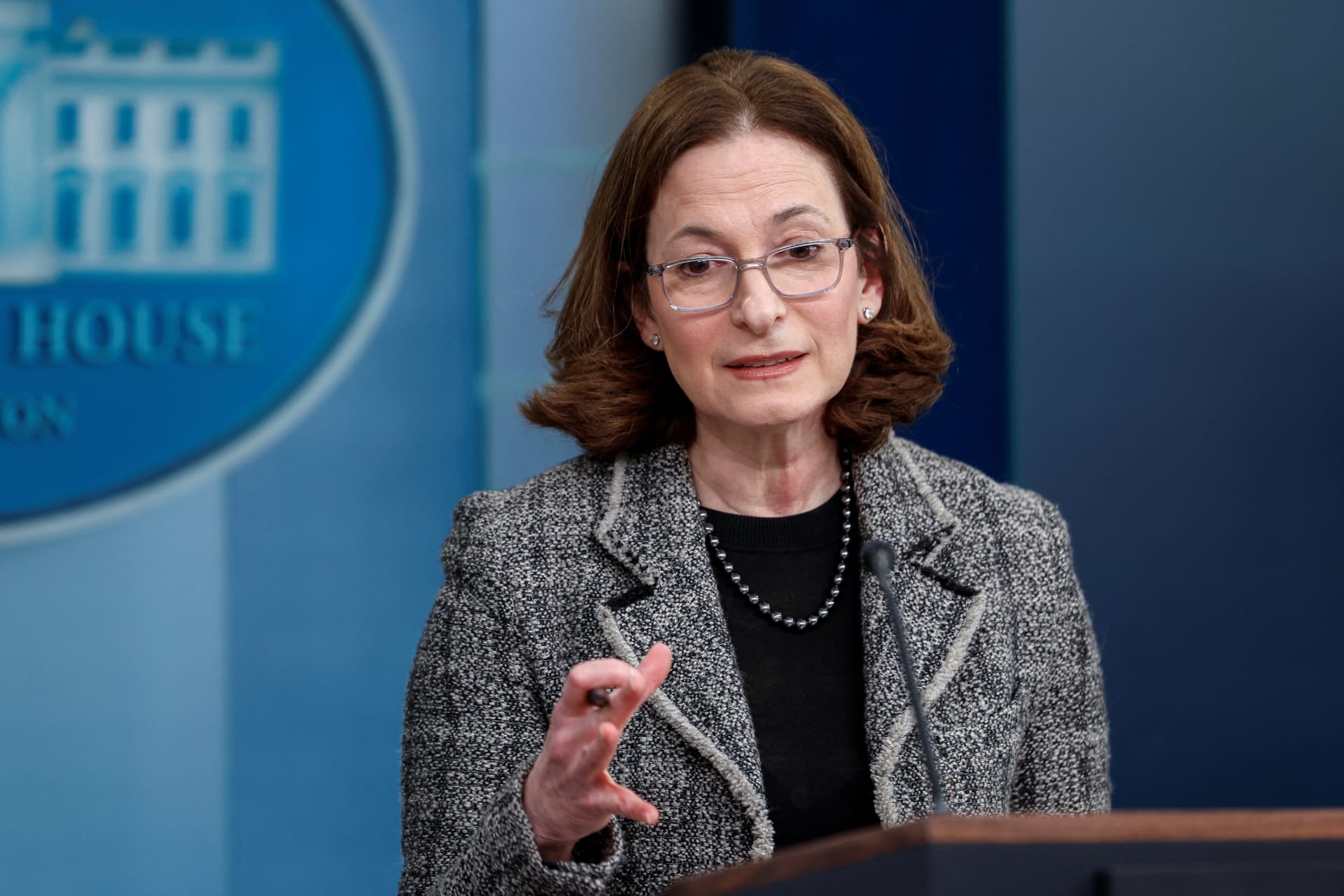
As a CFR adjunct fellow, I hosted Jennifer Klein, assistant to the president and director of the White House Gender Policy Council (GPC) during the four years of the Biden administration, about the history of gender policy at the White House and the shifts in gender policy since the Obama administration. Having been a GPC senior advisor during part of 2024, I had the good fortune of working for Klein and the incredible GPC White House team. A Columbia Law graduate, Klein is the Ann F. Kaplan Professor of Professional Practice at Columbia University’s School of International and Public Affairs, and she directs the Ann F. Kaplan Women’s Initiative in Columbia’s Institute of Global Politics.
The GPC was preceded by the Obama administration’s White House Council on Women and Girls—the first White House office created with a broad mandate to advise the president on gender equality—created by executive order in March 2009. Led by Valerie Jarrett and her deputy, Tina Tchen (whom I hosted, separately, at CFR), this Obama-era council worked to ensure that the needs of women and girls were considered by each agency in the process of drafting policy, creating programs, or supporting legislation. It was one of the first instances of recognizing the goal of gender equality in the government, but it faced limitations due to its limited purview and staffing. Although the council was engaged in some aspects of policy work, it largely focused on engagement, as it was housed under the Office of Public Engagement. Although the council consisted exclusively of high-ranking government officials—with Jarrett and Tchen at the helm—it retained no full-time staff, except for an executive director.
The Obama-era council was abolished in June 2017 after President Donald Trump took office for his first term. Most work relating to gender fell to his daughter and senior advisor, Ivanka Trump, who helped launch the Women Entrepreneurs Finance Initiative with the World Bank in July 2017 and later the Women’s Global Development and Prosperity Initiative in February 2019.
The creation of the GPC under President Joe Biden marked a new shift in federal gender policy. Unlike the Obama-era White House Council on Women and Girls, the GPC was on par with other full-fledged policy councils, such as the National Economic Council, National Security Council (NSC), or Domestic Policy Council (DPC). It also had dedicated staff, a budget, and a full-time director, and it was a freestanding office, unlike the Obama-era council. Further, the GPC focused on gender policy—a broader framing—not just women and girls as was the case under the Obama-era council (though under Biden, the DPC had the lead on LGBTQ+ matters). As with the Obama-era council, the GPC centered intersectional layers of inequality, including the ways gender inequality intersects with race, economic precarity, disability, age, among other forms of marginalization.
The GPC was somewhat unique among policy councils in that it focused on both foreign and domestic policy, while the NSC and DPC were, respectively, primarily foreign- and domestic-policy facing. For its part, the GPC’s transnational reach recognized that a variety of gender inequality matters span borders, such as trafficking, gender-based asylum, and the challenges facing Indigenous women (whose concerns the GPC addressed through a Trilateral Working Group on Violence Against Indigenous Women and Girls—with Canada and Mexico—an innovation that another former CFR fellow, Caroline Bettinger-López, helped pioneer).
The GPC was first cochaired by Klein and former Ambassador Julissa Reynoso (coincidentally, another Columbia Law graduate and former student of mine from my days directing Columbia’s Human Rights Institute and Clinic). The GPC’s policy priorities ranged from reproductive health and rights to the care economy to preventing and responding to gender-based violence in the United States and abroad. Upon their appointment, the GPC’s first task was issuing the first-ever National Strategy on Gender Equity and Equality, laying out underlying principles. With a team of fifteen staff, the GPC worked across policy councils to implement a comprehensive and ambitious plan for gender equity, key accomplishments of which are summarized in the GPC’s last fact sheet.
Under the second Trump administration, the country is experiencing a return to retrenchment. Klein remarked how the Trump administration’s regression on federal policies and programs critical to women’s rights and gender equality, both for domestic and foreign policy, is politicizing a previously bipartisan commitment. This contradicts what both Democratic and Republican administrations, including the first Trump administration, have done.
Klein notes a few ways this is taking place. First is the weaponization of diversity, equity, and inclusion (DEI)—as well as the initiatives, offices, and employees working on these issues—without precisely defining what DEI, as an umbrella term, means. In fact, as I have written elsewhere, programs that open up opportunities for women and other historically disadvantaged groups have strengthened peace and security as well as economic growth. As Klein remarks, “it’s not a surprise that when half the population gets left behind, we all suffer.”
Second, the reorganization of the State Department—including the elimination of the Office of Global Women’s Issues and the defunding of the U.S. Agency for International Development (USAID)—has devastated gender equity efforts abroad. USAID previously helped to provide $2.6 billion in federal aid to advance gender equality around the world, including programs to lift women out of poverty, advance prosperity, reduce gender-based violence, provide education and critical health services, promote democracy, and defend human rights. The funding freeze has halted lifesaving maternal health programs in Ghana, Syria, and sub-Saharan Africa; jeopardized programs to support girls’ secondary schooling and online education for Afghan women and girls; and weakened efforts to combat global child marriage and human trafficking. This is existential, as these cuts have threatened the viability of women’s organizations aiding women, despite their role in protecting peace, security, and economic prosperity in many corners of the world—stability which has paved the way for U.S. national security and economic interests. Lastly, these policies are weakening U.S. credibility and influence as rising powers such as China expand their presence and are happy to fill the gap.
These trends don’t mean there isn’t hope. Klein pointed toward promising policy changes and priorities under the second Trump administration that point in a positive direction for gender policy. For example, the passage of the Take It Down Act—signed into law in 2025 by President Trump—criminalizes the publication of nonconsensual intimate imagery and requires social media websites to remove content within forty-eight hours of notice from a victim. President Trump also signed an executive order to expand access to in vitro fertilization (IVF), though there have been limited legislative efforts to fund that directive to meaningfully expand access. Lastly, the administration’s focus on families offers promising potential for policies such as baby bonuses or savings accounts for children; though its limited focus on specific families is likely designed to exclude certain families.
The Trump administration’s retrenchment is part of a global backlash on gender and attacks on democracy. Argentina, Poland, and Turkey have all experienced steps back on gender equity, ranging from restrictions on reproductive freedom to a reduced commitment to ending gender-based and domestic violence. These challenges parallel harmful backsliding in the United States as well, which is why Klein has decided to return to Columbia. There, she is connecting with scholars across disciplines including economics, psychology, and data science to, in her words, “address social norms in service of better policies and outcomes.”
This blog post was coauthored by Catherine Powell, an outgoing adjunct senior fellow at the Council on Foreign Relations (in the Women and Foreign Policy program and the Digital and Cyberspace Policy program), as she returns to being a full-time professor at Fordham Law School, following a sabbatical as a Crane Fellow at Princeton University’s Program in Law and Public Policy, and Ranen Miao is enrolled as a joint degree student in Harvard Law School’s juris doctor program and Princeton University’s School of Public and International Affairs master of public affairs program.
This work represents the views solely of the author(s). The Council on Foreign Relations is an independent, nonpartisan membership organization, think tank, and publisher, and takes no institutional positions on matters of policy.
Colophon
Additional Credits
Ranen Miao, Juris Doctor and Master of Public Affairs candidate, Harvard Law School and Princeton University’s School of Public and International Affairs