Beyond Taiwan, a ‘Decent Peace’ at the Trump-Xi Summit
CFR President Michael Froman analyzes the form and substance of this week’s highly anticipated meeting between U.S. President Donald Trump and Chinese President Xi Jinping.
U.S. President Donald Trump and Chinese President Xi Jinping just wrapped up their long-awaited summit. Expectations were low—and met. We are, officially, “not fighting,” which is better than the alternative, but the form and substance of the meeting merit a close read.
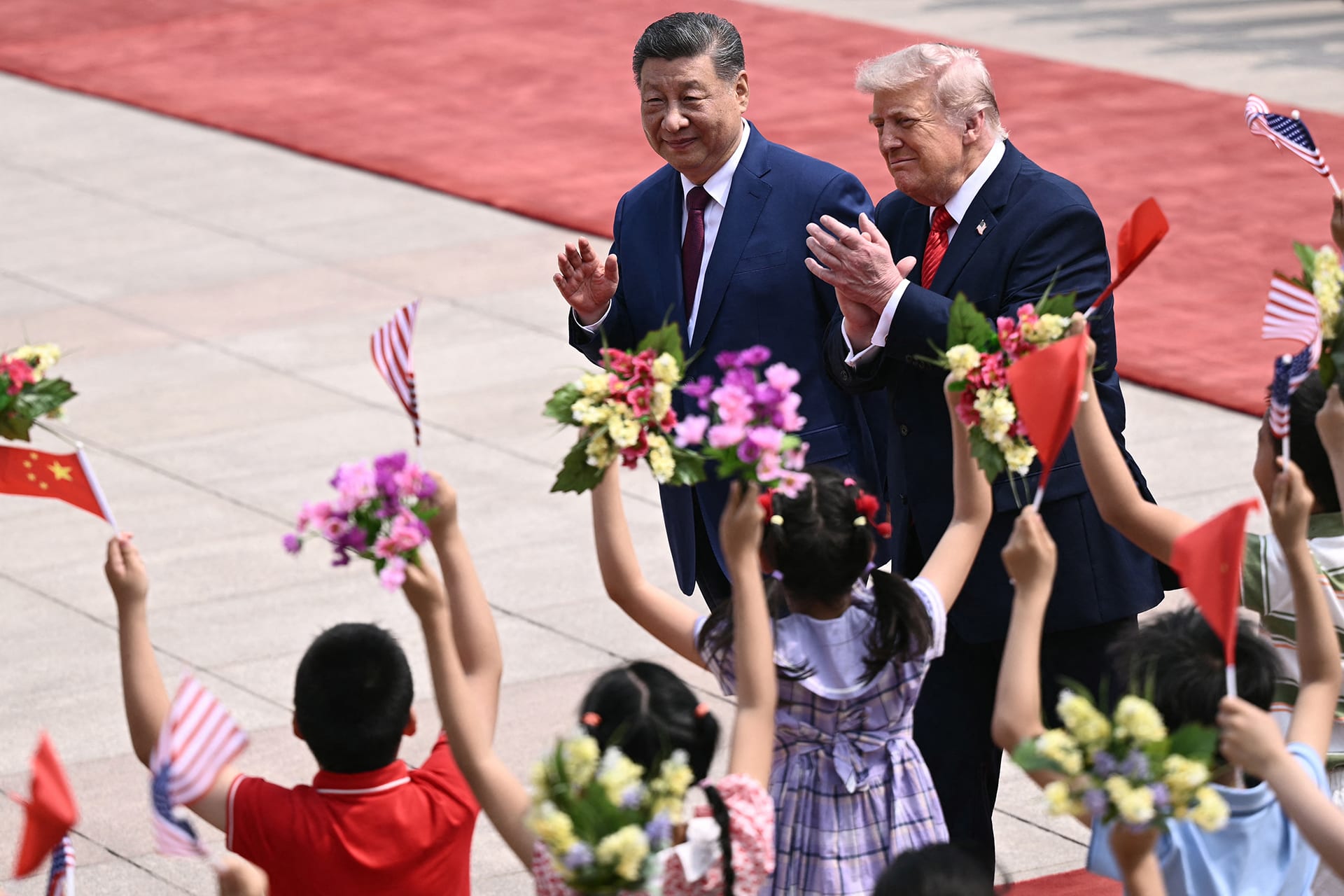
If the summit was short on major concrete deliverables—at least as far as we know at this point—it was long on protocol, pomp, and circumstance. From the reviewing of the troops to the throngs of screaming children to the People’s Liberation Army band playing Trump’s beloved “YMCA,” in what was surely the first rendition of the Village People’s hit single by uniformed Chinese military personnel, the choreography was meant to impress, if not flatter, the U.S. president.
Not to be outdone, Trump noted that the number of Chinese restaurants “outnumber the five largest fast-food chains in the United States, all combined.” He observed that the “Chinese now love basketball and blue jeans.” Meanwhile, Elon Musk’s six-year-old son, known as Lil X, was spotted scurrying about the Great Hall of the People in an embroidered Tang Dynasty-style vest, clutching a small “tiger head” bag. Within hours, Chinese netizens were scrambling to buy copies of his outfit on e-commerce site Taobao.
Both leaders left able to claim a measure of victory, having locked in what amounts to a delicate détente. For Trump, that meant a fresh round of commercial deliverables—China’s commitment to purchase more planes, agriculture, and energy products. For Xi, it was an opportunity to lay down a marker on Taiwan and to offer up a new framework for the bilateral relationship.
As Xi announced at the Great Hall, “I have agreed with President Trump on a new vision of building a constructive China-U.S. relationship of strategic stability. This will provide strategic guidance for China-U.S. relations over the next three years and beyond.”
The Chinese excel at producing word salad formulations for the U.S.-China relationship which I imagine are designed to send a meaningful signal through their system in Mandarin but lose something in translation. I, for one, won’t miss the motto that has defined the relationship for the last several years: mutual respect, peaceful coexistence, and win-win cooperation (which has been derided as meaning China wins twice).
Xi asked: “Can China and the United States overcome the ‘Thucydides Trap’ and establish a new paradigm for relations between great powers?” Implicit in Xi’s invocation of Graham Allison’s frame is the premise that China’s rise is unstoppable, and that the United States must accommodate it, lest the two stumble into a Peloponnesian War with nuclear characteristics.
Taiwan was clearly top of mind for Xi. Before Xi had even finished his remarks, the Xinhua state news agency reported that Xi warned that “The Taiwan question is the most important issue in China-U.S. relations. If it is handled properly, the bilateral relationship will enjoy overall stability. Otherwise, the two countries will have clashes and even conflicts, putting the entire relationship in great jeopardy.”
Xi went so far as to propose that the “great rejuvenation of the Chinese nation” and “Make America Great Again” could “go hand in hand.” Given that so-called reunification with Taiwan sits at the heart of Xi’s notion of national rejuvenation, Xi must be rooting for the rise of the more isolationist, restrainer wing of the MAGA movement which might be less likely to come to the aid of Taiwan in the event of conflict with China. On his way back to the United States, Trump told reporters that he and Xi “talked a lot about Taiwan” and discussed “in great detail” the pending $14 billion weapons sale to Taiwan. He added, “I think the last thing we need right now is a war that’s 9,500 miles away.” Trump’s handling of the arms package will be the first real test of those limits. Speaking to reporters aboard Air Force One on his return from Beijing, Trump said that “on Taiwan [Xi] feels very strongly, I made no commitment either way.” Whether Trump ultimately approves the package, slow-walks it, or uses it as a bargaining chip in broader negotiations will be one of the summit’s most consequential outcomes.
As Rush Doshi, the Council’s resident Pekingologist, observed in his readout of the readouts, Xi “appears to wish to lock in a ‘truce’ favorable to them, and they want to do so beyond Trump, with this post-trade war détente setting the baseline. Presumably, any U.S. actions to reckon with excess capacity or deter conflict could be framed by Beijing as a violation of this new frame. Beijing acknowledges the relationship as competitive—as they did with us in 2023—but talks about keeping it within acceptable limits.”
Beyond Taiwan, both leaders appeared content to forge a decent peace in other areas, including the Middle East. Per the White House readout, the two leaders reached a mutual understanding that “Iran can never have a nuclear weapon” and that the Strait of Hormuz “must remain open,” with Xi voicing opposition to the militarization of the strait and to any effort to “charge a toll for its use.” No country has a greater interest in seeing oil flow freely through the strait than China, which is the primary buyer of oil transiting the strait. Trump reported that Xi promised to be helpful with Iran and suggested he might lift sanctions on Chinese companies buying Iranian oil. We haven’t seen any movement by China to deploy its navy to support the United States in restoring freedom of navigation, but perhaps they can at least stop providing satellite targeting assistance to the Iranians.
To mark the détente, a number of commercial deals were cinched at the summit. Trump announced that Chinese firms had agreed to purchase two hundred Boeing aircraft—the manufacturer’s first major state-linked order from China since 2017. American farmers may finally be able to exhale, given Xi’s commitment to honor the 25-million-metric-ton soybean pledge made at Busan last October, with additional purchases of U.S. oil, liquefied natural gas, and other energy and agricultural products to come.
Semiconductor exports and cooperation on artificial intelligence (AI) safety may follow suit. Shortly after the bilateral, Reuters reported that Washington had cleared sales of Nvidia’s H200 AI chips to roughly ten major Chinese technology firms—Alibaba, Tencent, ByteDance, and JD.com among them. There is an ongoing debate inside and out of the U.S. government about whether we should be selling advanced chips to China, and there is debate within China about whether Chinese firms should be allowed to buy them or be required to purchase Huawei’s instead.
The two sides also appeared to open a new track on AI safety, framed as a protocol to ensure that “nonstate actors don’t get a hold of these models.” This is no doubt a worthy effort, but it does not seem to include a conversation about China’s potential use of AI, including in the military or cyber domain, which continues to be of great concern.
On the trade front, the two sides are discussing a Board of Investment and a Board of Trade, paired institutions intended to fast-track Chinese investment into “non-strategic, non-sensitive areas” of the U.S. economy, alongside reciprocal tariff reductions on non-critical goods. Tariffs are easier to put on than to take off but reducing tariffs on non-sensitive goods certainly makes sense given concerns about affordability at home. Will the administration permit Chinese electric vehicle companies to invest in the United States, and if so, will they be required to transfer their technology to U.S. counterparts?
Summits are great moments for personal diplomacy. Having been present at Sunnylands and several other U.S.-China summits, I firmly believe there is no more valuable asset than a leader’s time and engagement. Upon their first meeting before the towering colonnade of the Great Hall of the People, Trump and Xi looked right at home with each other, shaking hands and, for a minute, chatting away. I figure one of three things must be true: Xi speaks better English than he lets on, President Trump has a knack for Mandarin, or both leaders were speaking to each other with little idea what the other was saying. This being the most important bilateral relationship in the world, let’s hope we’re not talking past each other.
Let me know what you think about the outcomes of the Trump-Xi summit and what this column should cover next by replying to [email protected].