China and Climate: China Suspends Oil Exports Amid Iran War
March’s edition of China and Climate tracks China’s response to the Iran war, as well as its updated five-year plan and new environment and ecology code, and unpacks China’s crude-oil stockpiling.
By experts and staff
- Updated
- Research Associate, Climate and Energy
- Research Associate, Climate Change Policy
The China and Climate primer series tracks and breaks down China’s engagement with energy and climate issues around the world.
Chinese response to Iran war, suspending oil exports, and promoting domestic energy security
Following the outbreak of the Iran war, China has taken several steps to prioritize its domestic oil needs. Although China has taken action to reduce its reliance on oil from the Gulf, it continues to receive close to half of its supply from the region; around one-third of its oil and one-quarter of its gas passes through the Strait of Hormuz.
Days after the Iran war began, China instructed its leading oil refiners to stop diesel and gasoline exports and told exporters to renegotiate cancellation of new contracts and further delay the release of all oil products that had not gone through customs. That tactic is not new for China; following Russia’s invasion of Ukraine, Chinese government officials have taken to lowering export quotas, aiming to potentially promote the country’s energy security and stability. As Asia’s third-largest fuel exporter, China joins several regional countries that have restricted exports in response to tightening global supply.
China also decreased the preestablished set increase in fuel prices, hoping to diminish harm to consumers. Even so, that price hike on fuels was the fifth and largest rise of the year for China, boosting domestic oil prices by close to 20 percent.
U.S. President Donald Trump delayed his visit to China to continue his involvement with Iran, postponing his trip to Beijing until mid-May. Trump also called on China to help police the Strait of Hormuz.
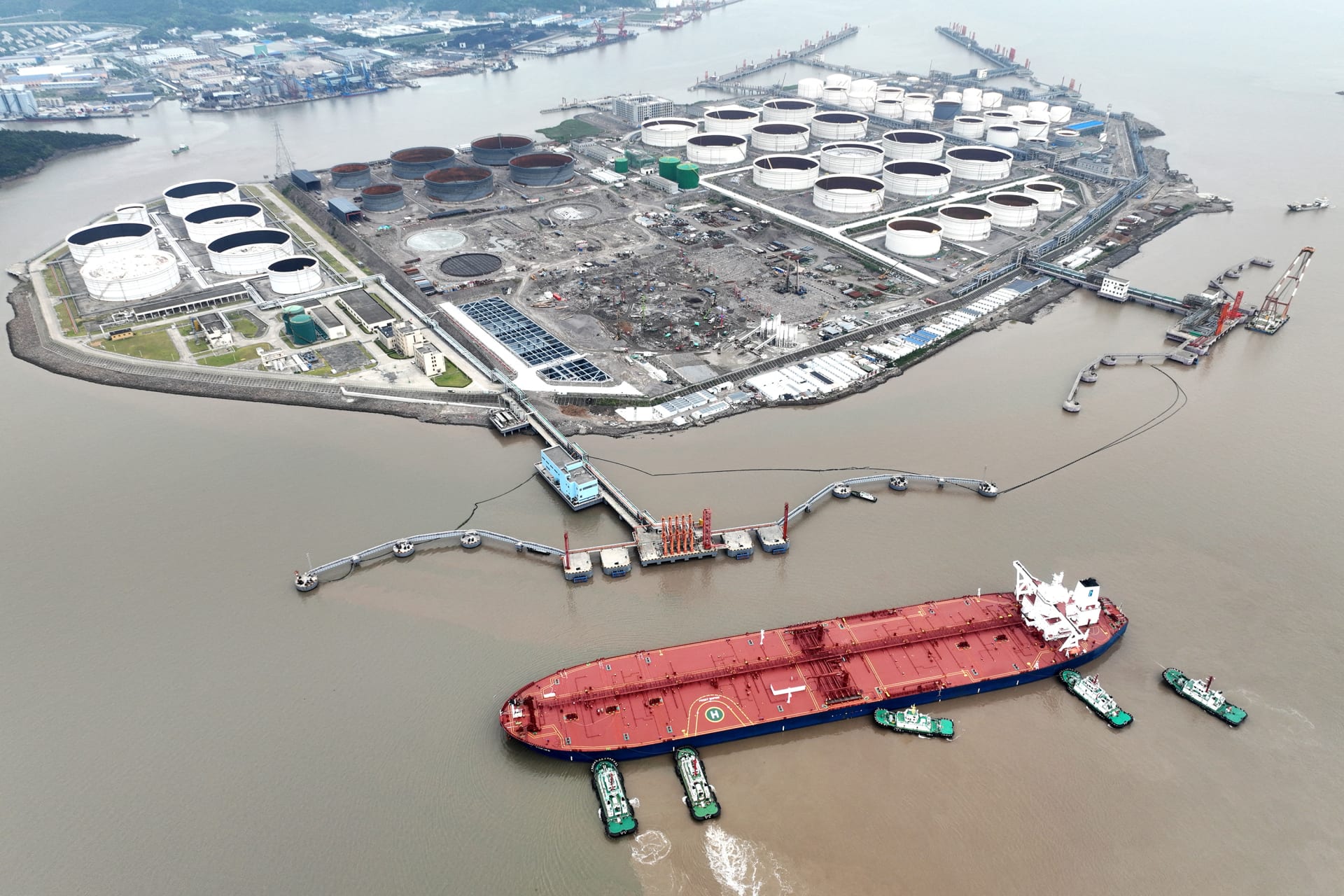
A Closer Look Into China’s Crude-Oil Stockpiling
In 2025, China took advantage of lower global oil prices to stockpile crude oil, helping to stabilize prices and buffer against supply disruptions. Chinese President Xi Jinping made building reserves a national security priority.
China does not report its stockpile size, so analysts rely on trade, budget, and satellite data to identify trends in China’s crude-oil imports; consequently, estimates can vary. The Center on Global Energy Policy estimates, however, that China has a net stockpile of 104 days’ worth of crude oil. The Energy Information Agency also estimated that, between January and August of 2025, China increased its crude-oil reserves by around nine hundred thousand barrels per day.
That identified trend continued into the first few months of 2026, when China continued to augment its crude-oil stockpiles. In the first two months of the year, customs data revealed that China’s imports increased by 16 percent with no correlated rise in domestic consumption.
What China’s Fifteenth Five-Year Plan Means for Climate
Those hoping China’s fifteenth Five-Year Plan would deliver ambitious emissions cuts will be disappointed. The plan sets no emissions cap and targets only a 17 percent reduction in carbon intensity (CO2 emissions per unit of GDP), which likely falls short of its commitment under the Paris Agreement. It also retreats on stronger language on reducing coal consumption. Taken together, these targets, or lack thereof, reflect a continuation of modest reductions in the pace of China’s emissions growth. Yet, analysts have previously pointed out China’s capacity to over-deliver on climate goals.
However, the plan is certainly not wholly disappointing. It continues the country’s significant investment in clean energy, calling for a “clean, low-carbon, safe and efficient” energy system. China reports that it installed around 430 gigawatts (GW) of new solar and wind power in 2025, bringing total renewable energy capacity to 1,800GW, according to the National Energy Administration. But the country will need to double its total renewable energy capacity to meet its international climate goals.
China’s dominance of clean energy market and its framing of that role as providing “global public goods” lies at the heart of international climate engagement. And the plan signals China’s willingness to be an active participant in global climate negotiations. But Chinese leadership at those negotiations has been uneven. Whether it will make good on that willingness to lead remains to be seen.
The plan does not just concern mitigation; in fact, it elevated climate adaptation to the same level of importance. In doing so, the plan pledges to strengthen the climate adaptation framework, with particular emphasis on extreme weather and developing a “national water network,” as well as early-warning systems and infrastructure investments.
Sorting through the signals in a Five-Year Plan offers, at best, a high-level sense of China’s development trajectory. But the plan does include strong signals that clean energy investments and gradual emissions reductions are likely to continue. The same cannot be said for the country’s geopolitical rival, the United States, where the Trump administration has moved away from climate action and clean energy.
China’s New Ecological and Environmental Code
In mid-March, China’s National People’s Congress adopted the Ecological and Environmental Code. Primarily, the code unifies existing but disparate pieces of environmental legislation into one law—with the objective of bridging regulatory gaps. Although analysts are still parsing through the lengthy code, early assessments highlight several notable developments.
First, the code introduces a chapter on climate change that covers both adaptation and mitigation and, according to Feng Ge, a visiting scholar at the U.S.-Asia Law Institute, “commits China to active participation in global climate governance.” The chapter establishes a system to cap total carbon emissions and integrate climate targets more deeply into national planning, while requiring authorities at all levels to develop adaptation plans.
Second, the code weakens environmental public interest litigation in China by limiting the types of lawsuits that nongovernmental organizations can bring and instituting legal hurdles. Feng argues that enforcement of the code requires broad participation, including from organizations bringing litigation, and curtailing their ability to do so could limit its effectiveness.