China in Latin America: March 2026
In March, tensions between China and Panama continued to grow as Beijing ratcheted up retaliatory pressure over the annulment of two Chinese port concessions. U.S. President Donald Trump convened twelve Caribbean and Latin American leaders at the Shield of the Americas summit, where he declared U.S. opposition to hostile foreign influence in the Western Hemisphere, prompting backlash from Beijing. Chile’s presidential transition faced unprecedented disruptions over a proposed Chinese fiber-optic cable.
By experts and staff
- Published
- Jonas Wright-Lee
Security and Sovereignty
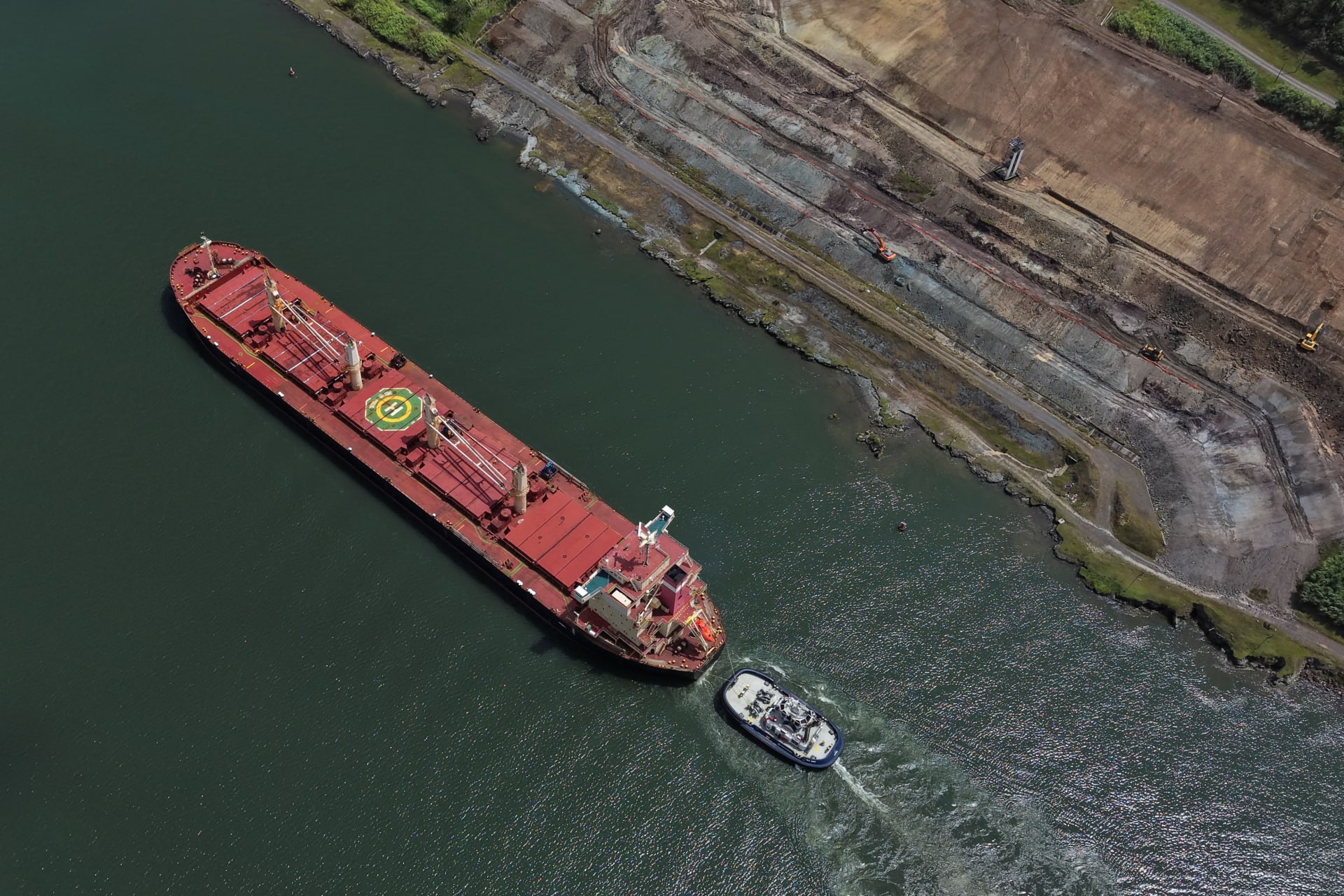
After warning that Panamawould pay a heavy price, China has ramped up retaliatory pressure following a January 30 ruling by Panama’s Supreme Court annulling the concessions for two ports held by the subsidiary of Hong Kong’s CK Hutchison, Panama Ports Company (PPC).
Earlier in March, the Chinese Ministry of Transport summoned Maersk and Mediterranean Shipping Company, the two firms whose subsidiaries received temporary contracts to replace PPC at the Panama Canal ports, for “high-level discussions.”
China has dramaticallyincreased inspections of Panama-flagged vessels entering its ports, prompting the U.S. Federal Maritime Commission to state that it is closely monitoring China’s retaliation.
On March 10, the Chinese state-owned shipping giant China Cosco Shipping Corp. abruptly suspended its services at Panama’s Balboa port, one of the two ports at the center of the legal dispute. Since then, Panama’s government hasasked the company to reconsider its suspension of operations, with Panamanian Minister for Canal Affairs José Ramón Icaza expressing hope they would return.
On March 13, PPC alleged that Panama missed a deadline to respond in its international arbitration case, which it filed in February seeking $2 billion in damages, because it lacked proper legal representation. Panamanian President José Raúl Mulino responded to the accusations, declaring them “outrageous” and “a lie.”
On March 24, a unit of CK Hutchisonwidened its claims, stating that damages now exceeded $2 billion.
On March 7, U.S. President Donald Trump convened twelve Caribbean and Latin American leaders for the Shield of the Americas summit in Florida to form a coalition combating narco-trafficking and organized crime. During his address, Trump declared that the United States wouldnot allow hostile foreign influence to gain a foothold in the Western Hemisphere, including the Panama Canal.
In response to the summit, Chinese Foreign Minister Wang Yi called for “third parties” not tointerfere in China’s relations with Latin America, asserting that Latin American countries need to choose their own path.
Chile’s outgoing president, Gabriel Boric, and its incoming president, José Antonio Kast,clashed over the Chile-China Express project, a proposed Chinese submarine fiber-optic cable that would connect the two countries. The conflict led to an unexpected breakdown in the power transfer process in early March, with Borictelling reporters that the president-elect cut short a face-to-face meeting and canceled a subsequent gathering with cabinet members over disagreements concerning the project. Kast stated that he advised Boric not to make any major decisions before the transition.
After leaving office on March 11, Boric said the United Statesmade explicit threats against Chile over the proposed fiber-optic cable project.
At a press conference, U.S. Ambassador to Chile Brandon Juddsuggested the Chile-China Express project would not go ahead, stating that, although the government still needs review the permits, he believed it was already doomed to fail.
Amid the controversy over the proposed underwater cable between China and Chile,a recent Google report revealed that the cyber espionage group UNC2814, linked to the Chinese government, is reportedly operating in the country.
The Costa Rican Institute of Electricity, a state-owned company that controls the vast majority of the country’s energy and telecommunications,denounced a cyber-espionage incident by the Chinese-linked group UNC2814. China’s ambassador to Costa Rica, Wang Xiaoyao, requested that the Costa Rican government submit evidence for verification of the claim.
The U.S. company Launch on Demand plans to begin construction in late 2026 on a$600 million spaceport facility in the Dominican Republic. According to its chief executive, Burton Catledge, the rocket launch center is an attempt to counter China’s dominance in the space race in Latin America.
Diplomacy
Three years after breaking off relations with Taiwan and establishing diplomatic ties with China in hopes of economic gain, Honduran shrimp farmers are pushing back against the decision as China has failed to offset the drop in sales from Taiwan, resulting in the closure of at least ninety-five shrimp farms and one processing plant and the loss of more than twenty-five thousand jobs.
The National Congress of Hondurasapproved a motion requiring the Ministry of Foreign Affairs to report on the results of diplomatic relations with the People’s Republic of China. The initiative was introduced by Representative Mario Segura, vice president of the National Congress, who questioned the lack of economic progress after three years of ties with China.
For the inauguration of Chile’s president-elect, José Antonio Kast, China sent its minister of housing and urban rural development, Ni Hong, as Chinese President Xi Jinping’s special envoy. The appointment was seen in Chile as an intentional step down, as China sent higher-ranking officials, including Vice President Wang Qishan, for other recent Latin American inaugurations.
In a congratulatory message to the tenth Community of Latin American and Caribbean States Summit, inaugurated in March, Xi stated that China will always be a good friend and partner to the countries of the Caribbean and Latin America.
Ecuadorian President Daniel Noboa stated that he is aligned with the Trump administration on combating crime in his country, but ruled out distancing himself from China because he cannot pick a fight with his second-largest trading partner. He claimed that while China invested in Ecuador, the United States, under previous administrations, did not, ignoring significant prior U.S. investment, including a $150 million loan from the Biden administration to support women-owned businesses.
On March 24, according to the weekly newspaper Búsqueda, citing several attendees, Uruguay’s Economy Minister Gabriel Oddone told business leaders at a private meeting that the United States has been exerting “unimaginable” and “unsustainable” pressure on the country to “break” its trade relationship with China.
On March 5, Chinese and Chilean scientists completed what they calledthe most ambitious deep-sea expedition ever conducted in the Eastern Pacific, reaching the bottom of the Atacama Trench. The team conducted the mission aboard the Chinese state-owned research vessel Tan Suo Yi Hao.
Trade
In March, the United States and Mexico launched their review of their trade agreement with Canada, the United States-Mexico-Canada Agreement, with a focus on curbing imports from Asia and other regions, tightening product-qualifying rules, and improving supply chain security. The United States seeks to limit Chinese investment in Mexico while accusing the country of serving as a “backdoor” for Chinese products to enter at a lower tariff rate.
In light of the review,Mexican authorities cracked down on companies suspected of using Mexico to circumvent U.S. tariffs, including investigating hundreds of firms that imported Asian steel through programs such as the Manufacturing Industry, Maquila, and Export Services, which allows businesses to import certain components duty-free. Officials have also pressured state governments to stall Chinese automakers’ direct manufacturing investments in the country.
Colombia imposed a 35 percent levy, the maximum allowed under the World Trade Organization, onimports of steel and metalworking products from countries with which it does not have a trade agreement—including China, which is the largest source.
Investment and Infrastructure
In Brazil, Chinese automaker GAC announced a $1.3 billion investment plan through 2030, including the launch of a factory set to open in 2027. The plant is expected to have an annual production capacity of fifty thousand vehicles and will be developed in partnership with the Brazilian company HPE Automotores.
Kevin Murakami, the U.S. consul general in São Paulo, Brazil,told Brazilian port industry executives that the United States does not want the concession for a major container terminal in Santos, Brazil—the largest port in Latin America—to fall into the hands of a Chinese company.
China’s Huawei agreed to sell batteries to the British firm Aggreko for arenewable energy project in Brazil’s Amazon region, as part of what is expected to become the country’s largest-ever energy storage system.
In Argentina, Economy Minister Luis Caputo announced that work on the Jorge Cepernic hydroelectric dam in Santa Cruz Province is set to resume after receiving a $136 million loan from China to complete the project.
The Chinese retail chain Miniso announced its arrival in Argentina, with a $50 million investment plan, and intends to open one hundred stores over the next five years. According to a company statement, the project will create between eight hundred and one thousand direct jobs.
Minerals and Natural Resources
In March, the Nicaraguan government stripped U.S.-owned BHMB Mining Nicaragua S.A. of a 2,500-hectare (nearly 6,200-acre) concession and transferred it to the Chinese-linked firm Palacagüina Mining. The Nicaraguan government has granted mining concessions to sixteen Chinese companies between 2021 and 2026, totaling over 1 million hectares (nearly 2.5 million acres), or 8.5 percent of Nicaraguan territory.
The Nicaraguan regime alsogranted a new open-pit mining license in the Southern Caribbean Coast Autonomous Region, awarding over 157 hectares (nearly 388 acres) to the Chinese company Tutuwaka Mining Company S.A.
China’s state-owned Jiangxi Copper completed the acquisition of SolGold for approximately $1.2 billion, securing control of the Cascabel copper-gold porphyry project and the company’s exploration portfolio in Ecuador.