China Is Planning Decades Ahead on Clean Energy. The U.S. Has Other Priorities.
China’s national legislature has approved a blueprint for building on its commanding lead in the carbon-free energy sources that are increasingly vital worldwide as the climate warms. It sharply contrasts with the Trump administration’s short-sighted approach that relies on fossil fuels.
By experts and staff
- Published
 David M. HartCFR ExpertSenior Fellow for Climate and Energy
 Alice C. HillCFR ExpertDavid M. Rubenstein Senior Fellow for Energy and the Environment
- Deputy Director of the Climate Realism Initiative
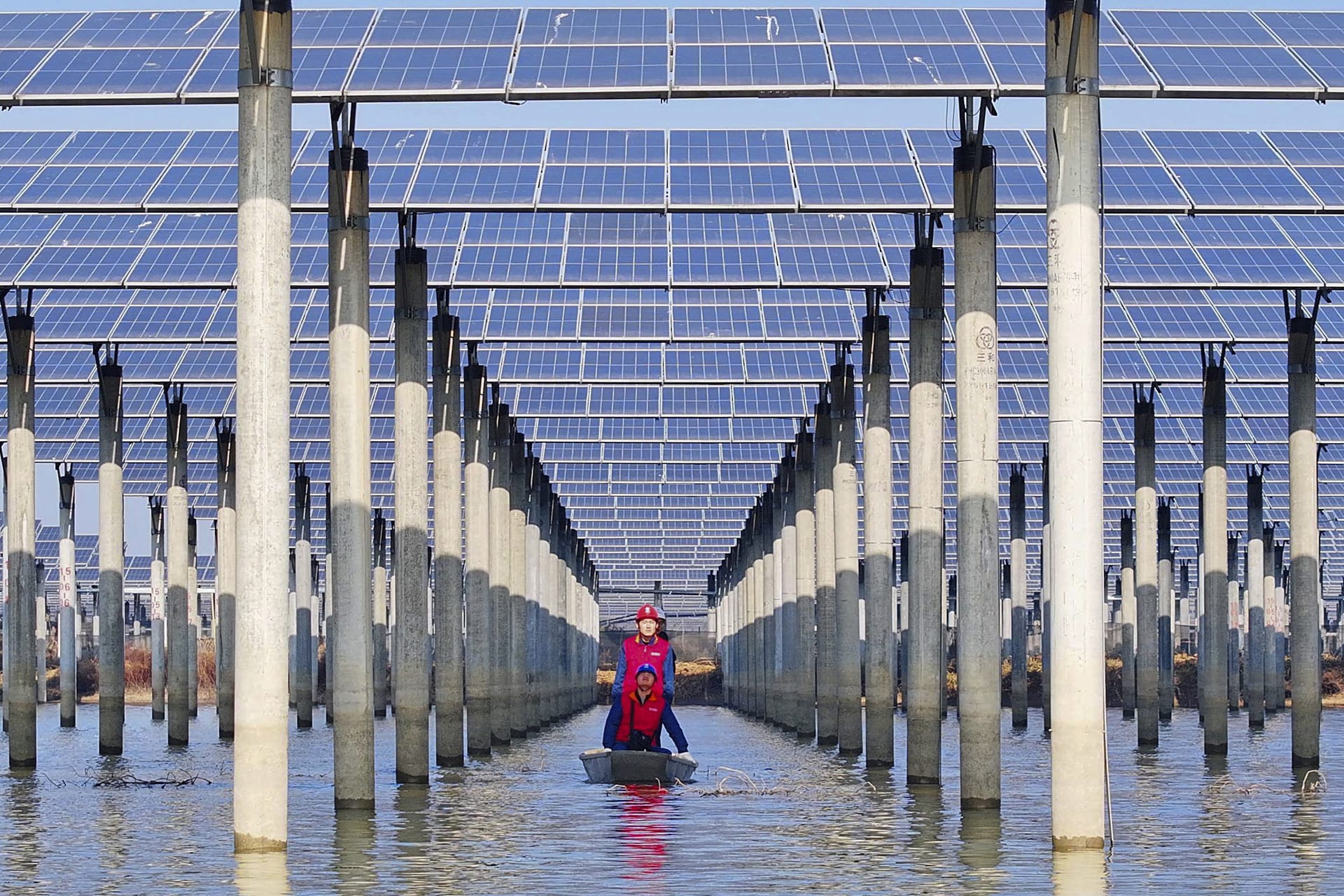
China’s leaders have worked intently over the past twenty years to dominate clean energy technologies, building commanding leads in solar panels, electric vehicles (EVs), wind turbines, and other critical industries. In the new Five-Year Plan, approved in early March at the annual National People’s Congress, policymakers signaled their intent to double down on their successes and establish a lead in frontier technologies like hydrogen and fusion power.
Beijing’s focus on these industries recognizes both climatic and industry trends. According to the most recent consensus report [PDF] from the Intergovernmental Panel on Climate Change, the world is on pace to warm by nearly 3°C by the end of this century—a level of warming that could imperil food production, worsen public health, and threaten infrastructure resilience in large parts of the world. Clean energy technologies not only help mitigate these and other climate-related risks, but also improve countries’ resilience to price shocks in traditional fuels like oil and gas stemming from external crises like the ongoing conflict in Iran. That is why the International Energy Agency projects that renewable energy installations will double over the next five years, and Chinese companies are now in a prime position to capitalize on that opportunity.
The contrast with the United States could hardly be more stark. The Donald Trump administration has withdrawn from major international climate commitments and uprooted its domestic investments in clean energy development to focus on fossil fuel exploration and production. The United States is now paying companies not to build renewable energy projects—an extraordinary turnaround from previous administrations, and a clear contrast to China’s approach.
Climate Realism Initiative experts Alice C. Hill, David M. Hart, and Lindsay Iversen unpack the most important climate and energy messages from China’s fifteenth five-year plan and explore what they might mean for the United States and the world.
Long-Term Plans, Short-Term Thinking
David M. Hart is a senior fellow for climate and energy at the Council on Foreign Relations (CFR).
The Five-Year Plan sets out China’s ambitions for defense, energy, and industrial technology, among other things. Although those ambitions will not all be realized, the plan serves as a powerful tool to focus the entire country, both private and public sector, on medium- and long-term priorities. As with climate adaptation, the contrast with China’s geopolitical rival in “hard tech” is striking. The United States government struggles to think long term, much less plan long term, a potentially fatal flaw in the U.S.-China rivalry.
The results of China’s hybrid system are uneven but frequently spectacular. Clean energy manufacturing and deployment, for instance, far exceeded the goals of the previous Five-Year Plan, which ran from 2021 to 2025. China’s domestic solar power-generating capacity quadrupled in this span, roughly equaling the entire generating capacity of the United States by the end of 2025, while Chinese solar manufacturers exported about that much capacity to the rest of the world as well. The electric vehicle (EV) industry, similarly, soared from 6 percent of cars sold in China in 2020 to more than 50 percent in 2025. China became the world’s largest auto exporter (electric and conventional combined) in that same period.
Chinese President Xi Jinping’s China harnesses the power of competition in ways that Soviet planners never imagined. When the central government designates an industry as a strategic priority, provinces and municipalities vie for Beijing’s support, while the entrepreneurs and firms within each region seek their support. The ferocious competition that follows is not efficient—firms in these industries frequently lose money but stay alive thanks to their political relationships—but it is effective, as these statistics reveal.
The plan for the next five years will seek to deepen China’s strengths and build new ones. Aluminum, used widely in defense, energy, and industrial goods, falls in the first category. China is already the dominant global producer, using a massive amount of coal-fired electricity. The plan will sustain the shift toward lower-carbon sources, targeting 70 percent of electricity used in primary aluminum production, up from about 25 percent today. Green hydrogen is among the emerging industries that the plan aims to commercialize and scale. The effort will include both electrolyzers, which produce the hydrogen with low-carbon power, and end-uses, which may span the power, industrial, and transport sectors.
The United States has pursued many of the same sectors as China, but with far less patience. Solar power was invented and initially commercialized in the United States, but inconsistent government support meant it reached large-scale production elsewhere. The American start-up company Tesla pioneered the mass-market EV, but timid infrastructure investments and limited consumer incentives have collapsed domestic EV production.
To make matters worse, the U.S. federal government in the past year has begun defunding and dismantling scientific infrastructure built over many decades. The Department of Energy, for instance, canceled far more projects than it supported in 2025. President Trump raised tariffs by an order of magnitude and changes them unpredictably, undermining industrial planning.
Short-term thinking isn’t always a vice. Flexibility enables adaptation when circumstances change, as they often do. Long-term plans can be a straitjacket. But the contest between the United States and China for global leadership in this century will ultimately turn on complex, extremely expensive technological systems that take decades to mature—what some analysts call the “electro-tech industrial stack.” If the United States doesn’t take a few pages from China’s planning book and learn to think further ahead, it may well lose.
China Charts a Leadership Course in Adaptation
Alice C. Hill is the David M. Rubenstein senior fellow for energy and the environment at CFR.
When it comes to climate change, China and the United States capture a lot of attention given their status as the world’s first and second largest emitters of heat-trapping gases. Neither country has sufficiently aggressive plans to curb emissions to meet the stretch goal of the Paris Agreement of containing heating to 1.5 degrees Celsius above pre-industrial levels. With regard to preparing for the impacts of climate change, however, the two nations diverge sharply.
The United States and China are both vulnerable to climate-worsened extreme weather. For the three decades between 1993 and 2022, China ranked second among all nations for economic and human impacts from the increased frequency and intensity of weather extremes, according to an analysis by Germanwatch, a German climate action non-governmental organization. That analysis also found that the United States was the seventh most vulnerable country in 2022. China’s Ministry of Emergency Management estimated that in 2025 alone China’s direct losses from natural hazards reached over $30 billion, with flooding causing the greatest harm. That same year, the United States suffered $115 billion in direct damages, much of it stemming from the Los Angeles wildfires, according to Climate Central, a nonprofit news organization.
To reduce growing losses, China has embraced climate adaptation. In its National Climate Adaptation Strategy 2035, issued in 2022, China called for the creation of a “climate-adaptive society.” Drawing on that aspiration, China’s fifteenth Five-Year Plan aims to sharpen the country’s adaptation framework with greater emphasis on extreme weather events. In a recent draft Report on the Work of the Government [PDF], China pledged to accelerate efforts to strengthen “weak links in flood prevention, drainage, and disaster response” in northern China. It also signaled support for catastrophe insurance and improved early warning systems—critical components for responding to climate-worsened disasters.
China’s focus on risk reduction makes economic sense. Cost-benefit analyses for investments in risk reduction and preparedness, estimate that $1 invested in disaster response and recovery can save $4 or more. The U.S. Chamber of Commerce estimates that in the United States pre-disaster preparedness could yield a $1 to $13 ratio.
Despite the economic case for adaptation, the United States has abandoned efforts to develop a national adaptation strategy. President Trump has spent his second term dismissing climate change as a “hoax” and a “scam.” His administration has scrubbed federal websites addressing climate risks and sought to end grant programs that funded adaptation efforts nationally. The Trump administration’s 2025 U.S. National Security Strategy went further still, explicitly rejecting climate change as a concern and branding it a “disastrous” ideology. Although some states have adopted their own climate adaptation plans, huge swaths of the country, including hard hit areas like Mississippi, South Carolina, Tennessee, and Texas, have no such plans in place.
The divergent policies of the two superpowers are unmistakable. China is taking seriously the dangers posed by climate change. Meanwhile, the U.S. federal government has chosen to ignore the climate harm barreling towards it.
Climate Leadership with Chinese Characteristics
Lindsay Iversen is the deputy director of the Climate Realism Initiative at CFR.
For climate advocates hungry for good news, China’s new Five-Year Plan offers a healthy buffet. The plan calls for expanding China’s already world-leading “new energy system,” including new additions of solar, wind, hydroelectric, and nuclear power generation, and a hugely expanded electrical grid to balance supply and demand at a national scale. It also signals that frontier energy technologies will remain a strategic priority, highlighting nuclear fusion and hydrogen as “key domains that will lead future development” alongside familiar top-tier priorities like quantum computing and the biosciences.
The news is not, to be sure, uniformly good. The plan dilutes China’s accounting method for its emissions pledge, making it easier to hit, and walks back previous leadership statements about reducing its consumption of coal, a highly polluting fossil fuel that still accounts for more than 60 percent of its energy supply. Still, China’s undeniable successes in energy innovation have led many climate observers to celebrate it as the rising global leader in climate policymaking, especially as the United States is curtailing its own commitments. Speaking to The Guardian ahead of the 2025 UN climate summit, for example, Li Shuo, director of the China Climate Hub at the Asia Society, said, “There is only one player. The U.S. is not even in the room.”
Some caution, however, is warranted.
Afterall, there is no guarantee that China will lead international climate governance toward an ambitious, coordinated global agreement. At last year’s UN climate summit in Belém, Brazil, for example, China resisted pressure to pledge deeper emissions cuts and successfully opposed efforts to include a clear commitment to phasing out fossil fuel use in the summit’s final communique. It also worked to ensure that a tacit criticism of the European Union’s carbon border adjustment tax was included in that text—the first time that trade issues had been included in this way, and a move that was better-aligned with protecting its own high-carbon heavy industries than furthering trade in low-carbon goods.
Despite Beijing’s dominance of clean energy technologies, in short, it used its weight in international climate negotiations to preserve its economic freedom of movement—not to encourage accelerated global emissions reductions. This stance is consistent with China’s overarching foreign policy framework, which strongly resists any external influence over its domestic policy sphere, so it should not be a surprise. But it does suggest that those hoping that China will pick up the mantle of leadership in collective climate action may well be disappointed.
This work represents the views and opinions solely of the authors. The Council on Foreign Relations is an independent, nonpartisan membership organization, think tank, and publisher, and takes no institutional positions on matters of policy.