China’s platform economy is an AI deployment engine. The U.S. is still looking for its own.
OpenClaw deployment brought China’s advantages into focus: fiercely competitive platforms, a coordinated regulatory apparatus, and a tech-literate, engaged public. Washington can still close the deployment gap if it builds public trust in AI and reasserts itself in setting global standards.
By experts and staff
- Published
- Research Associate, Digital and Cyberspace Policy
- Research Associate, Digital and Cyberspace Policy
On May 20, Alibaba released MuleRun, an “always-on AI workforce” that taps AI agents (mules) to safely run code and automate tasks. MuleRun is Alibaba’s polished response to the agentic AI craze triggered in March by OpenClaw, an open-source agent harness that allows users to easily build personal AI assistants that run commands on their behalf. OpenClaw’s adoption catalyzed the newest wave in AI, driving competition between U.S. and Chinese tech companies to deploy and scale agentic consumer and enterprise applications much more capable than chatbots.
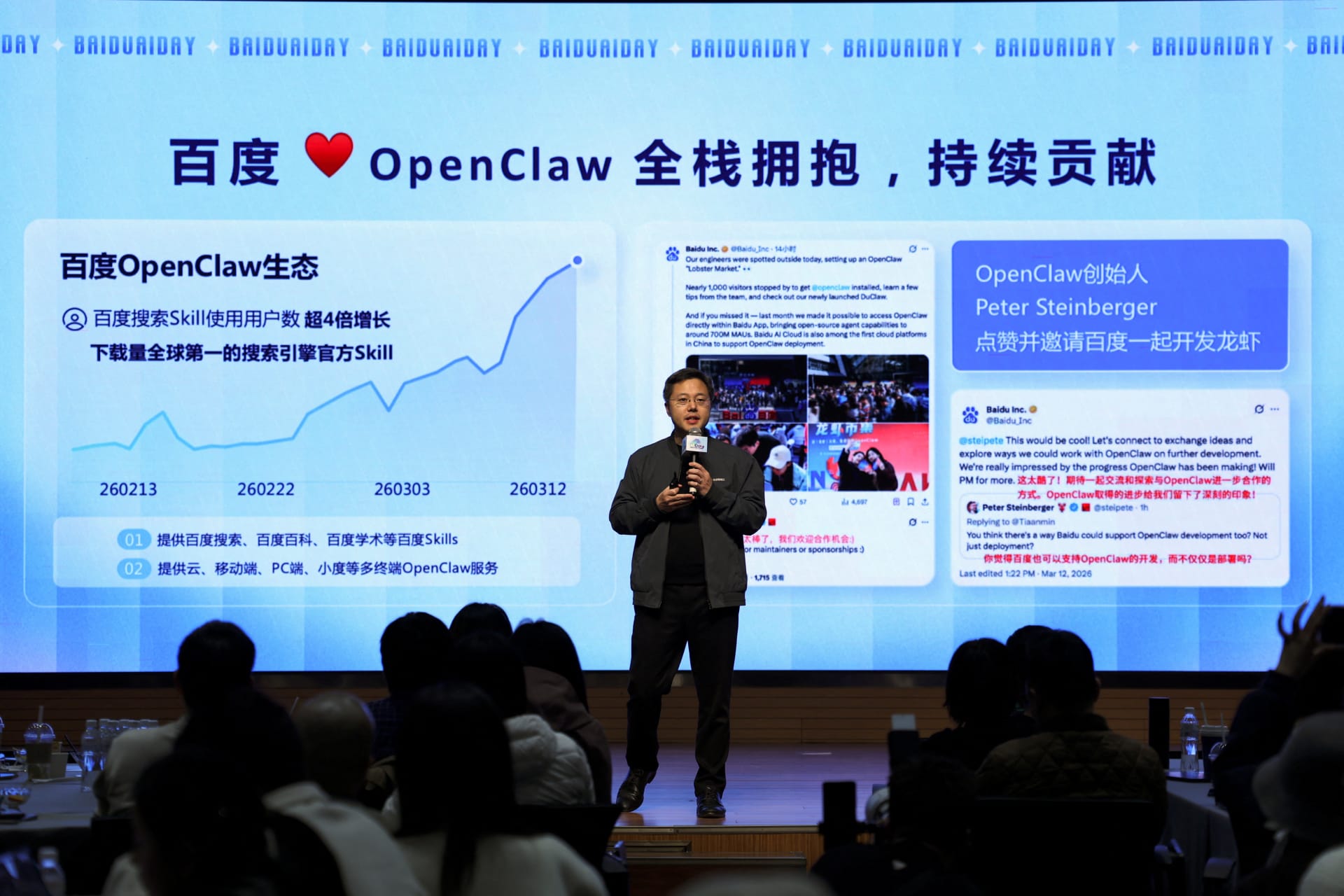
OpenClaw was open sourced as Clawd in November 2025, and adoption skyrocketed in March. Usage in China nearly doubled that in the United States in mid-March, with 85,000 active instances in China and 48,900 in the United States according to SecurityScorecard. At the height of the craze, hundreds of people lined up outside of Tencent headquarters in Shenzhen for engineers to install OpenClaw for them. Some early adopters even quit their full-time jobs to install OpenClaw freelance: one Beijing-based programmer’s side gig grew to over 100 employees and 7,000 orders within weeks.
However you define and score the “AI race” between the United States and China, analysts broadly agree that if there will be a “winner,” it’ll be whoever can adopt the latest AI at scale. In China, cutthroat platform competition, a regulatory imperative to adopt AI, and a growing technologically savvy user base drive deployment at a scale and speed without parallel in the United States.
China’s OpenClaw wave
In China, the OpenClaw boom has become the latest arena for companies to compete in building domestic distribution channels, with some touting “one-click installation” for the technical agent. Users refer to training agents as “raising lobsters,” referring to OpenClaw’s logo.
Tencent was one of the first companies to roll out a full suite of “lobster special forces,” making it easy for users to control personal QClaw agents or WorkBuddy workplace agents through its social media super app WeChat. AI agents rely on access to payment, messaging, social media, and e-commerce apps, which Tencent and Alibaba can offer all in-house. Chinese regulators have compelled interoperability between rival companies’ products before, whether for social media or between smart home devices. By comparison, iMessage, Instagram, and WhatsApp users face friction: power users can configure OpenClaw access, but no “one-click” integrations are on offer.
The OpenClaw hype quicky led to a cottage economy of sorts in China, with installation services, “one person companies” employing only OpenClaw agents and Tmall reporting a 40 percent increase in computer sales in March as people bought dedicated machines to run agents. Claws were “raised” for everything from product management to automating takeout responses to translating livestreams.
Writing a diffusion manual
China’s OpenClaw craze comes as industry implements the “AI+” initiative, an outgrowth of the Internet+ policy that urges all sectors to adopt AI. Much of the drive came at the local level as city governments supported OpenClaw ventures with policies including free computing credits and cash rewards. As local governments competed to show how they were supporting priority technology sectors, entrepreneurs benefited from metrics that reward practical applications and government support.
OpenClaw’s risks also tested how nimbly Chinese institutions would respond to AI safety concerns. “Lobster victims” reported incidents including agents deleting documents or disobeying orders. China’s cyber emergency response team, CNCERT, released a usage guide for ordinary users, cloud service providers, developers, and companies, and the Ministry of Industry and Information Technology (MIIT) and others issued security advisories.
Industry groups followed suit with specialized safety guidance on cybersecurity risks in the financial sector and manufacturing. OpenClaw was banned in several schools and for state-owned enterprises, and the China Academy of Information and Communications Technology launched a standards initiative.
In early May, the Cyberspace Administration of China, National Development and Reform Commission, and MIIT released “implementation opinions on the standardized application and innovative deployment of intelligent agents,” building on the “AI+” program and elevating agentic AI governance to the national level. The measures encourage safe deployment, describing nineteen scenarios for applications across sectors.
The adoption gap
China’s super apps provide its companies a structural edge, and a 2021 MIIT campaign targeting Tencent and Alibaba’s “walled gardens” suggests regulators could eventually mandate greater interoperability to enable agentic AI diffusion. In contrast, the U.S. ecosystem is fragmented, causing friction demonstrated by OpenAI’s underwhelming ChatGPT agent launch last year.
American AI companies continue beta testing agentic AI. Sam Altman announced OpenAI is building an OpenClaw replacement trained on Codex, after using OpenClaw to triage his morning email rush gave him one of his biggest “this is magic AGI moments.”
Altman and his peers have been slow to share that magic with American consumers. As usage soared, Anthropic announced Claude Code subscribers would be charged extra to integrate with OpenClaw. The company cited engineering constraints, but in effect, added friction for users of the open-source tool while upgrading their proprietary agentic interface. American tools that encourage safe adoption, like open-source software company Red Hat’s TankOS, require technical expertise to use.
The asymmetry in attitudes toward OpenClaw has not gone unnoticed. Peter Steinberger, who developed the original Clawd and now works at OpenAI, told Bloomberg: “In the U.S., I feel that in some companies, if you use OpenClaw, you might get fired. In China, however, it’s the exact opposite in many companies–you might get fired if you don’t use OpenClaw.”
It’s not only in the race to deploy agentic AI systems domestically that China is ahead. Chinese AI companies stand to gain global market share. Running agents is expensive; users run up expensive “token” bills as companies charge for every call to their application programming interface (API). Agentic systems can require five to thirty times more tokens per task than a chat conversation, with token usage in the hundreds of thousands to millions per task compared with thousands. Many users are opting for Chinese models, which can cost one-fifth to one-twentieth the price of American models according to OpenRouter estimates. Smooth plugins also allow developers to cross previous barriers from Chinese AI such as Mandarin-language documentation. In early April, the top six models by global token usage were all Chinese.
OpenClaw’s lessons for U.S. policymakers
U.S. officials have called for industry to ensure American AI primacy globally, while failing to address the public’s concerns about AI. Polling overwhelmingly shows the American public report levels of distrust towards AI well above global averages and widespread anxieties around job loss. Even as Americans increasingly use AI tools, trust levels have not increased, and Americans particularly distrust agentic AI, with 68 percent saying they distrust AI acting on their behalf in one YouGov poll. Legislators must fill the gap in regulation, tackling issues including education, labor rights, and ethical concerns.
The tech industry must join the U.S. government in addressing the public trust deficit towards AI head-on, by building security-first products. So far, companies have responded defensively, developing tools with controlled permissions, changing terms of service, and increasing prices for OpenClaw users.
China’s diffusion advantage doesn’t automatically translate to global standard-setting power: the United States has an opportunity and the capacity to lead in trusted frameworks even as China’s set to dominate price-sensitive markets. The U.S. government should incentivize companies to adopt permissive licensing practices and release open-source models with independent assurance measures like National Institute of Standards and Technology (NIST)-led evaluation standards. It should support sandboxing to encourage experimentation in safety, and reassert influence in technical standard-setting, including at the International Telecommunication Union (ITU).
Though U.S. companies maintain the frontier edge, Chinese models out-compete on price and availability. OpenClaw adoption is a warning for U.S. companies and policymakers of the challenges the United States faces in AI diffusion, and a reminder that industry norms are starting to flow the other direction across the Pacific.
Colophon
Expert Reviewers
 Adam SegalCFR ExpertIra A. Lipman Chair in Emerging Technologies and National Security and Director of the Digital and Cyberspace Policy Program