How the Coup Turned Myanmar Into Asia’s Deadliest Conflict—and Why the World Is Looking Away
Five years after its generals seized power, Myanmar has collapsed into Asia’s deadliest war and a nearly unequalled humanitarian catastrophe. And yet, the rest of the world has decided to ignore the conflict amid other major geopolitical developments.
By experts and staff
- Published
 Joshua KurlantzickCFR ExpertSenior Fellow for Southeast Asia and South Asia
Joshua Kurlantzick focuses on the growing global ties among illiberal states and their impacts on the world. He also examines the militarization of politics, China’s relations with Southeast Asia and other developing regions, China’s influence and information efforts, U.S.-China relations, and Southeast Asian politics and economics.
The war in Myanmar, driven by a 2021 coup, is now Asia’s deadliest conflict. ACLED, a conflict-monitoring group, counts more than 100,000 people killed since the military overthrew the democratically elected government in February 2021. The group calls it the most fragmented conflict anywhere—with over 1,200 armed factions—and considers Myanmar one of the most war-torn countries on earth.
It was not always this way. While Myanmar often seemed to be in a time warp through decades of autocratic military rule, it began to change. In the decade since the country began opening up its political system in 2011, the economy grew by an average of about 6 percent a year, and poverty fell steeply—from 48.2 percent in 2005 to 24.8 percent by 2017, according to the World Bank. Hunger was in retreat too; by most measures the share of people facing serious food shortages had been declining for two decades. None of this made Myanmar rich. But a country that had spent half a century as one of Asia’s poorest was visibly getting better—and, however imperfectly, becoming a democracy. Aung San Suu Kyi’s National League for Democracy won a free election in 2015 and another, in a landslide, in 2020.
Investors took note. Foreign direct investment, which had run at just $1.4 billion in 2012 and peaked near $9.5 billion in 2015, stood at about $4.9 billion in the 2019–2020 fiscal year—the last full year before the military coup. Telecoms and banks and hip new restaurants poured in. Then, on February 1, 2021, the generals arrested the civilian leadership, a multi-front civil war broke out, and the country became essentially a failed state, and (along with Gaza) the most dangerous place on earth.
The reversal has been staggering. GDP shrank by nearly 18 percent in 2021 and has barely recovered since. By 2023 the poverty rate had roughly doubled, to 49.7 percent, erasing more than a decade of gains, and that rate likely remains around the same today. Meanwhile, the UNDP found that the middle class has been cut in half and that three in four people are living at or near subsistence. Inflation topped 30 percent by last year, and the price of a basic food basket has nearly tripled.
Skilled workers have fled by the hundreds of thousands, and foreign investment has collapsed by nearly three-quarters since before the coup. Hunger, once receding, has exploded: the United Nations now counts 15.2 million people—nearly a third of the population—facing acute food insecurity, with Rakhine State in western Myanmar on the edge of famine. Some 3.5 million people have been driven from their homes. The health system, meanwhile, has all but collapsed, with medical facilities damaged more than 330 times since the coup.
Lawlessness abounds in conflict, and it has bred a criminal economy of extraordinary scale in Myanmar. In 2023, the country overtook Afghanistan as the world’s largest producer of opium—an estimated 1,080 metric tons, worth up to $2.4 billion. The country has also become the planet’s methamphetamine engine, with Thailand alone seizing a record one billion meth tablets in 2024 that nearly all came from Myanmar. Cyber scam compounds inside Myanmar, often staffed by trafficked workers held in conditions close to slavery, generate billions of dollars a year; one global index now ranks Myanmar the most crime-ridden country on earth.
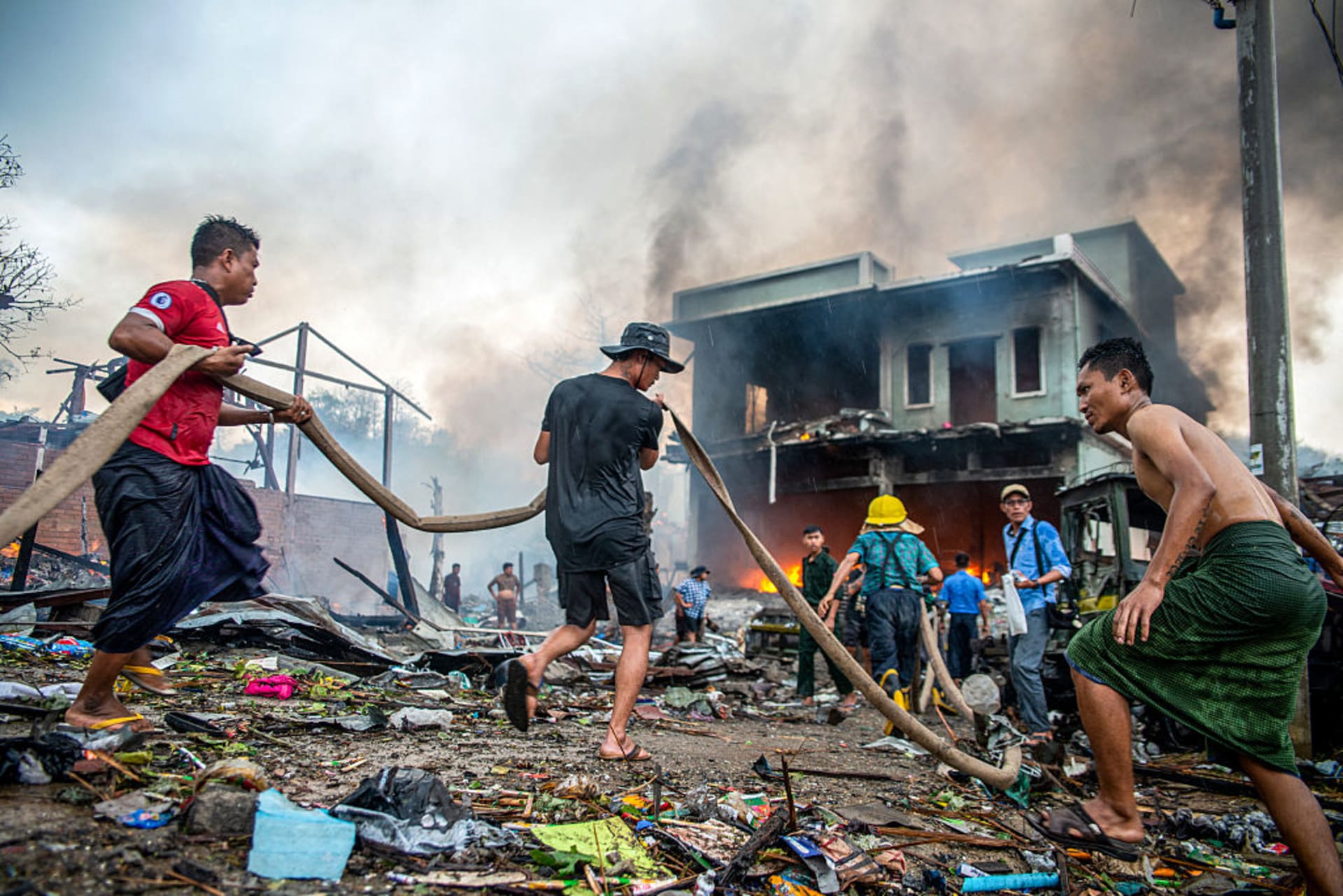
And then there is the killing. The ACLED data attributes roughly 71 percent of civilian fatalities to the junta. The military’s signature weapon is the airstrike against civilians. Military jets and drones have hit markets, monasteries, displacement camps, hospitals, and schools. In May 2025, a strike on a school in Sagaing’s Depayin Township killed twenty-two children and two teachers. In December 2025, an airstrike on a hospital in Mrauk-U killed at least thirty-three patients, caregivers, and staff. The opposition’s shadow government estimates junta airstrikes nearly doubled in a single year, from 2,471 in 2024 to 4,881 in 2025.
Behind the numbers are scenes that human rights investigators say amount to crimes against humanity. The International Criminal Court’s prosecutor has gone so far as to seek an arrest warrant for junta leader Min Aung Hlaing. Survivors have described not only indiscriminate airstrikes but also soldiers torching villages, executing detainees, and leaving bodies in the fields; the military has burned more than 116,000 homes since seizing power.
Despite the viciousness of the military junta’s campaign, there was a point in the conflict when it looked as though the generals could lose the civil war. In 2023 and 2024, an alliance of ethnic armies and volunteer militias drove the military out of much of the country, seized the northern city of Lashio, and by late 2024 controlled roughly half of Myanmar, pushing to within fourteen miles of Mandalay, the second-largest city.
What turned the tide was not the generals’ skill but their autocratic friends, part of a growing network of authoritarian collaboration in which dictatorial regimes help each other. Belarus has provided Myanmar with advanced military systems, including V3D radar technology, and ground-based missile systems. In 2025, Myanmar became the first country to buy Russia’s sophisticated new assault transport helicopters, which the junta is using to expand its dominance of the skies. Iran has secretly supplied the Myanmar regime with critical jet fuel—keeping planes in the air that the junta then uses to bomb civilians. Beijing has separately dangled some $3 billion in assistance. Rearmed and resupplied, the military in 2025 and 2026 went back on the offensive, retook the critical town of Lashio and the highway to China, and staged managed elections that installed coup leader Min Aung Hlaing as president.
And still the world looks away. The region’s own bloc, the Association of Southeast Asian Nations (ASEAN), agreed to a Five-Point Consensus days after the coup—an end to violence, dialogue among the parties, humanitarian access—and the junta repudiated it within two days and has flouted it ever since.
Aid for the country is dwindling too. The United Nations’ 2025 humanitarian plan for Myanmar—$1.14 billion to reach nearly 20 million people—was only 12 percent funded by midyear, and got nowhere near full funding by year’s end. A heavy blow came from Washington, historically a strong supporter of Myanmar’s pro-democracy forces and aid programs there. The Trump administration’s dismantling of USAID axed an estimated $259 million in aid to Myanmar in 2025 alone and cut aid going forward.
Washington has also abandoned immigrants from Myanmar who had already fled their country’s implosion. In November 2025, the Department of Homeland Security terminated Temporary Protected Status for roughly four thousand Myanmar nationals in the United States, declaring the country safe. Almost no one who studies Myanmar agrees. The State Department’s reporting found that the human rights situation had deteriorated. To send people back is to send them into a warzone.
And the United States is hardly alone in sending Myanmar citizens back to the conflict in their country:
- Five EU states—Germany, Austria, Denmark, the Netherlands, and Greece—are exploring offshore “return hubs” for rejected asylum seekers.
- Thailand hosts by far the largest Myanmar population outside the country—over four million people, roughly half of them undocumented. Thai authorities conduct regular immigration raids and mass deportations, detaining and returning more than 144,000 Myanmar citizens in a single three-month sweep in 2024.
- India has been aggressively deporting Myanmar refugees too, especially those who cross into the strife-torn Indian northeast.
- Malaysia has repeatedly deported Myanmar asylum seekers despite urgent UNHCR appeals to stop.
- Bangladesh has allowed refugees to cross the border, but it has pinned them all in camps around the area of Cox’s Bazar, including the world’s largest, and probably worst refugee shelter—Kutupalong Camp. There, refugees live in flimsy shelters vulnerable to the monsoon, feces runs in rivers through the camp, children do not get enough to eat, and young men with nothing to do are known to take the potent and illegal stimulant yaba all day long.
More telling still is the United States’ quiet drift toward the regime. In July 2025, the Treasury Department lifted sanctions on several companies and individuals linked to the Myanmar military—including men accused of brokering the junta’s weapons. The junta, sensing an opening, has spent lavishly to court Washington. It has hired the Trump-connected firm DCI Group on a $3 million contract, with the president’s longtime confidant Roger Stone drawing $50,000 a month to “rebuild” relations between the two countries.
A regime that bombs schools and starves its own citizens is now purchasing respectability by the month—paying with the blood of its people. As the body count rises, the question now is whether anyone with the power to help still cares to look—or whether looking away is its own kind of answer.
This work represents the views and opinions solely of the author. The Council on Foreign Relations is an independent, nonpartisan membership organization, think tank, and publisher, and takes no institutional positions on matters of policy.