How Ukraine’s Drone Innovation Reversed Russia’s Momentum
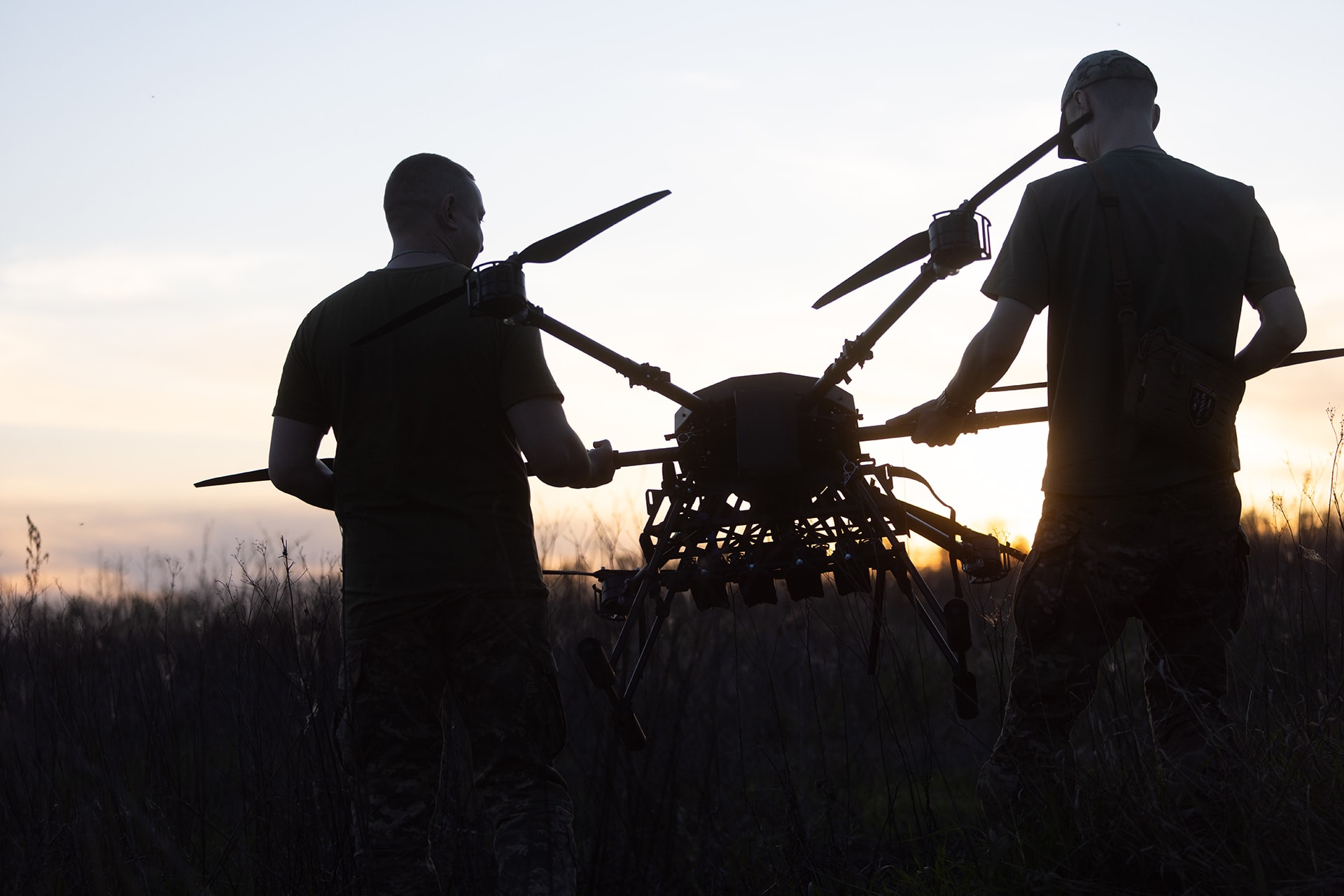
Ukraine’s continuing innovation in emerging capabilities—such as longer-range systems operating deeper into Russian territory, greater autonomy to avoid Russian jamming, and success in the Black Sea—have reversed recent Russian gains and presented new avenues for its success.
By experts and staff
- Published
 Michael C. HorowitzCFR ExpertSenior Fellow for Technology and Innovation
 Erin D. DumbacherCFR ExpertStanton Nuclear Security Senior Fellow
- Lauren KahnSenior Research Analyst
Michael C. Horowitz previously served as deputy assistant secretary of defense for Force Development and Emerging Capabilities and director of the Emerging Capabilities Policy Office. He is the director of Perry World House and Richard Perry professor at the University of Pennsylvania. Erin Dumbacher most recently served in the Department of Defense in the Office of the Under Secretary for Policy’s force development and emerging capabilities office. Lauren Kahn previously served as an advisor for Force Development and Emerging Capabilities in the Office of the Under Secretary of Defense for Policy.
Ukrainian innovation has led to territorial gains on the battlefield. In large part due to the scaling up of drone operations, Ukraine was able to retake seventy-eight square miles over five days in February 2026 and has continued making gains throughout its fifth spring offensive. Now, compared to the start of the war, Ukrainian drones are able to strike at longer ranges, including thirty to one hundred kilometers behind the front lines, expanding the kill zone and forcing Russia to divert resources to protect its supply lines and infrastructure. This reverses a trend of Russian gains throughout 2025 that had many analysts worried about Ukraine’s capacity to continue fighting. Russia continues offensive pressure in the east and Zaporizhzhia region, but the front remains fluid.
Precise mass systems at scale, both in the air and at sea, have been a key driver of recent headway. Even with its society on a wartime footing, Ukraine cannot match Russia’s conventional arms or manpower. Defense innovation remains essential to Ukraine’s asymmetric strategy and operational successes.
What’s new about Ukraine’s drone operations?
Drones have dominated the frontline kill zone for years now, generating 75–85 percent of its casualties. The difference this spring was the extent to which Ukraine perfected its ability to strike with precision en masse to augment its combat forces. Operationally, Ukraine is having greater success disrupting Russian command and control and logistics, reducing Russia’s battlefield connectivity, and forcing it to disperse forces. For example, by striking electronic warfare and radar sites, Ukraine is increasing the fog of war for Russian forces—denying them access to information and the capacity to stop attacks. Ukrainian drone strikes have targeted Novorossiysk and other rear-area logistics nodes, compounding pressure on Russian supply lines. Some Russian roads that had been passable since the first offensive in 2022 are now unusable. Medium-range drones diminish Russian capacity on the battlefield when concentrated against high-consequence infrastructure or transit targets that will take Russia time and resources to rebuild.
The calculations of commanders have shifted as drone costs diminish due to advances in technologies like additive manufacturing and artificial intelligence (AI), and weapons become more attritable. The U.S.-supplied Hornet, for example, costs under $10,000 to produce and complements drones produced domestically in Ukraine. Ukraine has also adapted how it defends against Russian drones and electronic warfare, mixing high-tech and low-tech measures to blunt the impact of Russian capabilities. For instance, in addition to traditional air defenses, Ukraine’s forces use fiber-optic cables to guide one-way attack systems to protect against jamming, and deploy nets to ensnare drones approaching key Ukrainian supply roads. Ukraine’s combat operations advance and resupply increasingly happen at night, in poor weather, or under tree cover when Russian drones are least likely to be able to parse the shadows.
If Russian radar or electronic warfare systems are neutralized, Ukrainian drones can progress deeper into Russian territory. When Ukrainian forces must contend with signal jamming that degrades or destroys communications links between operators and systems, alternative methods of guiding a drone to its target—such as increasing reliance on AI or autonomy—become vital. AI and autonomy allow drones to continue operating when GPS signals are unavailable or the communications link with an operator is severed. A case in point, after a human chooses the target, Ukraine’s TFL-1 can operate autonomously if the data link is disrupted and it survives even amid Russian electronic warfare.
Drone production machine
Since the start of the war, Ukraine has quickly recognized the need to scale defense production. It has steadily increased output to the point where it now arguably has the most robust and innovative defense industrial base in Europe. Ukraine’s existential war allowed for quick conversion to wartime manufacturing. Yet factories, energy infrastructure, and transportation networks remain targets for Russian strikes, while Western military aid still arrives in uneven tranches and is subject to political winds. Technology and critical parts providers, from Starlink to China’s manufacturing giants, are also mercurial, their friendliness toward Russia raising real questions about supply chain reliability. These factors led Ukraine to prioritize building up its domestic capacity.
Ukraine’s production has recently included a partially successful shift away from Chinese parts. Whereas in the first year of the war nearly all of Ukraine’s drones relied on Chinese components, by 2025 that share had fallen to around 38 percent, with domestic manufacturers filling the gap. What Ukraine has managed to construct at home in less than five years is a remarkably resilient and robust defense technology ecosystem that is constantly iterating. Ukraine’s defense industrial base as Elina Ribakova and Lucas Risinger wrote in Foreign Affairs, features “soldiers, startups, volunteers, and government agencies fused into a single ecosystem in which a product could move from prototype to frontline deployment within weeks.”
Despite sustained Russian strikes against Ukrainian drone production and logistics facilities, Russia has been unable to meaningfully degrade Ukraine’s drone production or launch capacity throughout the war. Ukraine has no equivalent to, say, an advanced U.S. defense industry facility or specialized shipyard. The types of systems being produced and the workshop nature of Ukraine’s domestic industrial base disperses the risk.
On June 4, Ukrainian Deputy Defense Minister Mstislav Banik said the country’s defense industry could produce as many as 20 million military drones per year if allies commit sufficient funding to Ukrainian manufacturing. Ukraine may get the capital. The European Union (EU) is currently finalizing a two-year €90 billion loan to Ukraine, with €6 billion earmarked for drones that could be disbursed as early as late June. In her State of the EU address last September, European Commission President Ursula von der Leyen said, “Ukraine has the ingenuity. What it needs now is scale.” With asymmetric tactics and scale combined, Ukraine may be able to pierce Russian defenses in the war.
How much capital will be enough? Relative to other states, Ukraine is already producing and operating drones at a scale like no other: Ukraine was able to produce an estimated four million robotic and autonomous systems in 2025, and is, by all counts, on track to produce between five million to six million in 2026. The United States has capital but is only now ramping up lower-cost production capacity; the Pentagon’s new drone dominance effort, which its test directors describe as a “challenge industry to deliver drones at scale for America,” is just getting started. Out of the 22,320 systems the Pentagon has ordered through the drone dominance initiative, less than 3,000 have been shipped as of writing. Ukraine holds between $25 billion and $40 billion in defense production capacity that sits underused due to lack of capital investment.
Don’t sleep on the sea
The growing pressure Ukraine is placing on Russia is not simply a function of production, aerial concepts of operation, or increasing autonomy in operation. Ukraine has also built effective innovation using uncrewed surface vessels (USV) in the Black Sea. Ever since sinking Russia’s Moskva with a USV in the early days of the war, Ukraine has become a global pioneer at USV operations. Ukraine became the first military to launch a surface-to-air missile from a USV in combat, shooting down a Russian helicopter in 2025, and Ukraine’s Magura V7—an advanced, multi-role USV that debuted in spring 2025—used AIM-9X Sidewinder missiles to shoot down Russian SU-30 fighter aircraft the same year. Ukraine’s Lilia—another multi-role USV that entered the fray this spring—and its USVs have deployed aerial drones that can drop bombs and launch attacks in GPS-denied environments, placing Russian radar installations ashore at risk. These systems are not perfect, of course; a recent explosion in a Romanian port occurred when electronic warfare caused one of Ukraine’s USVs to veer off course. But the rate at which Ukraine is able to introduce and then effectively wield its new and improved USVs is thus far unparalleled.
The pressure that Ukraine and its USVs have put on Russia in the Black Sea have shifted dynamics in the naval war. The growing range of Ukraine’s USVs, and the ability to launch drones and missiles from them, enabled strikes on Russian ships at Novorossiysk, hundreds of nautical miles from Ukraine. The Russian fleet had already moved from Sevastopol to reduce its vulnerability to USVs, but could not get out of range and did not anticipate the distance from which Ukraine was able to strike. Ukraine’s ability to consistently strike from so far away could further impede Russia’s Black Sea fleet, narrowing the scope of its possible impact on the war, including by limiting Russia’s options for launching cruise missile strikes on Ukraine. Driving Russian forces into port also facilitates Ukraine’s grain exports, which are critical to Ukraine’s economy and its ability to continue fighting the war.
Sustainable defense
Ukraine’s continued operational innovation, increasing use of autonomy, and capacity to scale production of many different kinds of drone capabilities have opened a narrow but real window of opportunity. By fielding precise mass systems faster than Russia can develop effective countermeasures, Ukrainian forces are once again making small territorial gains in spite of Russia’s vast arsenal.
Still, Ukraine’s improving capabilities may not change the probability of a settlement. As long as Russian President Vladimir Putin refuses to negotiate, settling for nothing less than the end of an independent Ukraine, the war will go on. But these advances are making it easier for Ukraine to sustainably defend itself, and could eventually place greater pressure on Russia to innovate or negotiate.
This work represents the views and opinions solely of the authors. The Council on Foreign Relations is an independent, nonpartisan membership organization, think tank, and publisher, and takes no institutional positions on matters of policy.