India’s Struggle for (Cleaner) Power
India is in the middle of a revolutionary energy transition, attempting to pull off what other countries such as the United States have done over decades in a very short time frame.

This memo is a part of CFR Expert Manjari Chatterjee Miller’s project on India and the liberal international order published by CFR’s China Strategy Initiative through its China 360° program.
Introduction
India’s efforts to shift to a cleaner power generation mix are breaking with historical patterns of sustainable development. That is, the country is already ahead of the curve in decoupling power demand and carbon emissions growth relative to where the United States and even China were at during similar developmental stages.1 Further, India has achieved this distinction while carrying out one of the most aggressive and successful campaigns to reduce energy poverty—that is, expanding access to electricity—in history.2 In sum, India offers a powerful rebuttal to the argument that a rapid pivot to new tools, supply chains, and incentive schemes is inherently at odds with an orderly energy transition that delivers a more sustainable, affordable, and prosperous future.
India’s rise poses a challenge for articulating best practices in the global energy transition, however, as those best practices are different than in other domains, such as global trade. That is, many outside India worry that the country’s current approach is not disruptive enough. To avoid the worst-case scenarios associated with climate change, the energy transition roadmaps of the International Energy Agency (IEA), Asian Development Bank (ADB), and multiple others all suggest that it essential to achieve a zero-carbon power mix globally as soon as possible.3 India is now the world’s third-largest electricity market and, by some estimates, its consumption of electricity is on track to more than triple between now and mid-century.4 Thus, the country’s ambitions for—or resistance to—deep decarbonization matter greatly.
Despite its progress in decoupling power demand and emissions growth, India has yet to unlock the absolute sectoral emissions declines that the United States and others have already achieved (see figure one). Consequentially, there is a substantial risk that India will remain on a trajectory where its sectoral emissions not only continue to rise—but rise on a scale that could effectively negate the progress in other economies.
India’s greatest obstacle for escaping this trajectory is its ongoing, heavy reliance on coal. Coal is the largest source of India’s power generation (see figure 2) and also the source of over 97 percent of the sector’s carbon emissions (see figure 3). Indian policymakers have generally not disputed the merits of shifting to a cleaner energy mix. They have sought international guidance and support for how to best do this, emerging as active and enthusiastic participants in relevant working groups convened under the auspices of the IEA, ADB, Group of 20 (G20), and numerous other multilateral forums. But they have also stressed that any aggressive transition should be highly pragmatic, removing barriers to shifting away from coal before committing to the fuel’s phase out.
To ensure that India meets its rapidly growing electricity needs while further accelerating its energy transition, Indian policymakers need to take several steps: First, the country should redouble its ongoing efforts at containing energy demand growth, particularly by addressing inefficiencies in its electricity transmission and distribution infrastructure. Second, that infrastructure should be further improved to help translate India’s growing renewables capacity into fully realized electricity generation. This will require targeted technical and operational improvements. Finally, and most ambitiously, Indian policymakers should prepare for a world in which their country consumes coal in a radically different way.
This will be an uphill battle; international support for India’s energy transition is increasingly in doubt. India’s approach is grounded in climate realism norms—that is, India has to continually find opportunities to move aggressively on climate action while being cognizant of both its economic and geopolitical interests and structural constraints. To achieve its goals India will, thus, be required to reach consensus on the contours of a more ambitious yet still viable energy transition.
India’s Objections to Phasing Out Coal
To date, the most ambitious global vision for curtailing coal remains the one championed by the United Kingdom at the 2021 UN Climate Change Conference (COP26): committing to a date to phase out coal-fired power. Yet the final commitments at the end of the conference omitted such strong language, largely due to India’s prominent and vocal pushback.5
Part of this pushback owes to the role that coal (as an industry) has played in India’s rise, with domestic production supporting economic growth and substantial employment. But it was also a highly pragmatic assessment about the fundamental economics of a phase out in India. India’s coal plants are still relatively young—on average, less than fifteen years old—meaning that their natural retirement age is still decades away.6 Early closures would require addressing challenging questions about hard costs and economic losses: primarily, who will absorb them.
India has also pushed back against previous U.S.-backed proposals for resolving such concerns, declining to participate in novel arrangements such as the Just Energy Transition Partnerships (JETPs) that were finalized with Indonesia and other emerging economies. Under a JETP, India would in theory be eligible to receive financial support in exchange for undertaking specific commitments to early coal-plant closures. Yet Indian policymakers have expressed concerns that those arrangements do not change the underlying costs of phasing out coal—in part because JETPs with other emerging economies have relied heavily on loans, implying that the money would ultimately need to be paid back.7
Instead of committing to a phase out, India—alongside others such as China and Japan—has advocated that a more sustainable approach to decoupling power sector and emissions growth requires a phase down of coal. Under the right conditions, both visions may articulate similar outcomes and timelines. Yet that alignment hinges on a phase down with explicit metrics for evaluating success—in turn, requiring a clear vision for energy-sector breakthroughs.
Curbing Energy Demand Growth
A first principle of any energy transition is to prioritize taming demand growth to minimize the scale of the challenge ahead. Yet India’s per capita electricity consumption is already well-below the global average, as well that of its G20 peers (see figure 4). That virtually guarantees that as the country’s population and economy grow, so too will its electricity consumption. India’s ongoing boom in electricity consumption is also not merely a byproduct of the country’s economic rise. The country’s outsized exposure to the negative impacts of climate change also adds to its projected energy demand growth: domestic demand for air conditioning is surging, driven in part by more frequent and intense heat waves across the country.8
There are, thus, notable caveats on what successful demand management might look like for India relative to undertakings in the United States; Japan; or even China, which enjoys a relatively more temperate climate. Even so, India has staked a claim to being a global energy transition leader in its focus on energy efficiency. Central to this is the country’s National Mission to Enhance Energy Efficiency, which has served as an organizing framework for multiple initiatives that have been ambitious in both scope and scale. The Unnat Jyoti by Affordable LEDs for All, for example, has distributed millions of light bulbs to residential consumers in India to support switching from less efficient bulbs and thereby lower household electricity demand. India also has robust legal and regulatory foundations that underpin its efficiency campaigns, with the World Bank recognizing the country’s regulatory frameworks for encouraging electricity end-users to step up their energy-efficiency efforts.9
To be clear, India has not diverged from the United States and other G20 members in objectives or even views of best practices for promoting energy efficiency; several of the country’s strategic initiatives have benefited from close coordination with the U.S. Department of Energy, the U.S. Agency for International Development, and other U.S. government agencies in planning, implementing, and refining policy approaches. That said, India appears to be diverging from other economies in how aggressively it is continuing to prioritize new gains. Although consensus statements of the G20 and other groups have seen members pledge to double the pace of their energy efficiency improvements this decade, India is one of only a handful of economies that appears on track to actually do so.10
Looking ahead, the ADB estimates that India still has incredible untapped potential for energy savings, equivalent to almost one-fifth of the country’s 2019 power generation needs.11 Several opportunities for savings relate to the country’s power grid. Electricity transmission and distribution losses are quite high and, in relative terms, well-above the levels of losses seen in the United States (see figure 5). Addressing this will require a combination of both technical and process improvements—as well as substantial upfront and long-term investment. No small task, but essential for creating the conditions in which market forces can meaningfully crowd out higher-emitting energy sources.
Deploying Renewable Energy Technologies at Scale
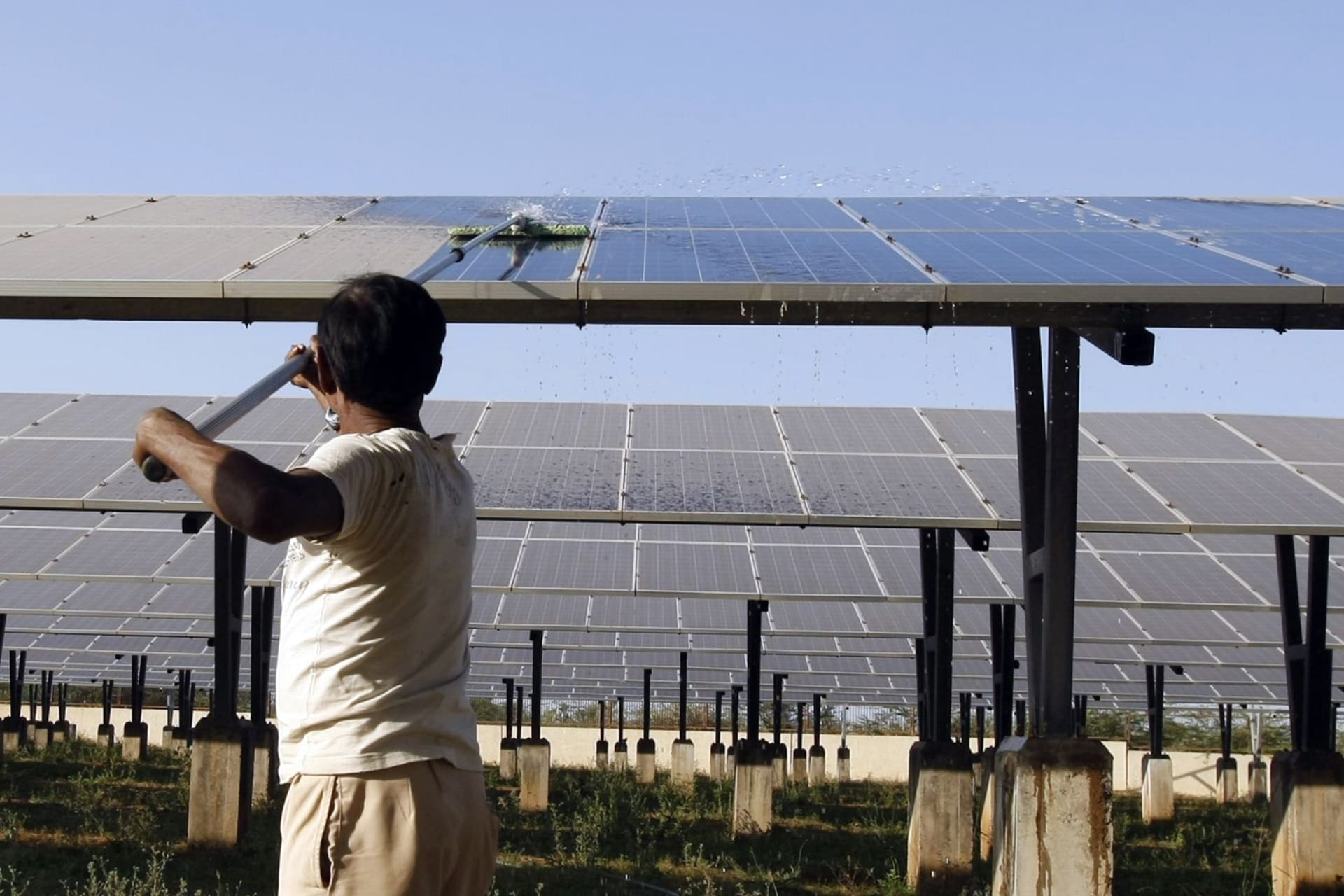
Energy efficiency can support emissions avoidance, but actually shifting to a cleaner energy mix requires deploying lower- and zero-carbon energy sources at scale. Encouragingly, another area where India has shown signs of outperforming its peers is in building out its capacity for renewable energy sources. The country has continued to set—and exceed—aggressive targets for deploying solar technologies in particular: India added as much solar capacity in 2022 alone as the United Kingdom’s entire solar fleet.12 India is now the world’s third-largest solar energy market and one of only ten economies on track to triple renewable energy capacity from 2022 levels by 2030.13
In addition to bringing new capacity online, there is more work that India could (and must) do to maximize its renewable energy sources. To stay on solar energy, India faces challenges in translating that capacity into actual generation, including technical factors—such as insufficient transmission availability—and operational ones—such as ongoing errors and gaps in demand forecasting data.14 As detailed in a study by energy think tank Ember, this curtailment is both sizeable and ongoing: around 4GW of India’s solar capacity faced complete curtailment on some days in December 2025.
Much like energy efficiency, India’s strategy for harnessing its renewable energy potential has involved working with other economies. This includes the United States, which through multiple Republican and Democratic administrations, has been an important partner to India in those efforts, including through the provision of substantial financing and technical support via initiatives dating back for decades.
Ultimately, India’s progress in renewable energy consumption and energy efficiency put it ahead of the curve on two vital benchmarks for decarbonization. The country has not shied away from ambitious endeavors, and in those spaces where it has sought leadership, there is relatively straightforward work it could prioritize to accelerate a phase down from coal. All of this speaks to India’s potential for even greater positive disruption.
The Way Ahead: Charting a New Course for Global Energy Security
India is undertaking an energy transition that is, in many ways, unprecedented. It is attempting to pull off what other economies have sequenced over decades on a much shorter timeline. To an extent, that is necessary. It also makes articulating best practices all that more complex.
There are signs that India’s approach may be bearing fruit. As of February 2026, early indicators suggest that India’s power sector emissions may have declined in 2025, breaking with the overriding trend of the past two decades.15 Yet few, if any, authorities believe the country has already seen peak emissions; 2025 also saw new coal-fired capacity come online and record domestic coal production.
An energy-transition strategy grounded in climate realism will thus require India to advance additional breakthroughs on at least three fronts. The first is in bolstering the overall flexibility of its power grid—both from a technical and an operational standpoint—to better utilize the significant new renewable generation capacity that India has already stood up.16 The second is deploying additional alternatives to coal. To that end, India has recently passed legislation to open its nuclear sector to foreign investment, in hopes to spur further zero-carbon power generation, and expressed ambitions for greater consumption of natural gas. Both opportunities have merit and mirror the tools that the United States and others have deployed in their own energy transition strategies. Yet it remains to be seen how quickly those and other efforts can close the gap or act as partial alternatives to existing decarbonization efforts.
Lastly, and most soberingly, India needs additional breakthroughs to address a likely rebound in coal-linked emissions. If there are hard limitations on how aggressively India can shift from coal to alternatives, there are still other avenues it could pursue to more radically reduce its emissions. One of those is Carbon Capture, Utilization, and Storage (CCUS). In December 2025, India announced a roadmap for how it could deploy CCUS at scale, and in January 2026, released a new Union Budget injecting roughly Rs 500 crore (roughly $55 million USD) into those efforts for the 2026–27 fiscal year.17 But, at least in the near-term, the most likely scenario is still a rise in emissions with consequences that will need to be addressed via future adaptation efforts.
A fractured international climate-action landscape further complicates how India might approach and resource a response to those concerns, particularly the reelection of U.S. President Donald Trump. During the first Trump administration, the animating logic of U.S. -India energy cooperation was energy security, not climate action, yet in practice cooperation regularly focused on how to support clean energy deployment. But after reelection in 2024, the Trump administration has not expressed any interest in clean energy nor in retaining the previous frameworks that it built. Among Trump’s many day-one actions was an order to rescind the U.S. International Climate Finance Plan, placing future U.S. financing for novel initiatives in doubt.18 The administration has also subsequently withdrawn from multiple international forums and dialogues with special relevance to the energy transition. This includes the International Solar Alliance, a platform where participants can both share best practices and pursue joint projects. The road ahead is less clear than it has been. But its urgency—and opportunities—persists.
Clara Gillispie is the Senior Fellow for Climate and Energy at the Council on Foreign Relations.