Iran, the Global Economy, and the Case Against Complacency
The Iran war dominated discussions at the International Monetary Fund and the World Bank Spring Meetings this week in Washington, DC. CFR President Mike Froman analyzes the conversations.
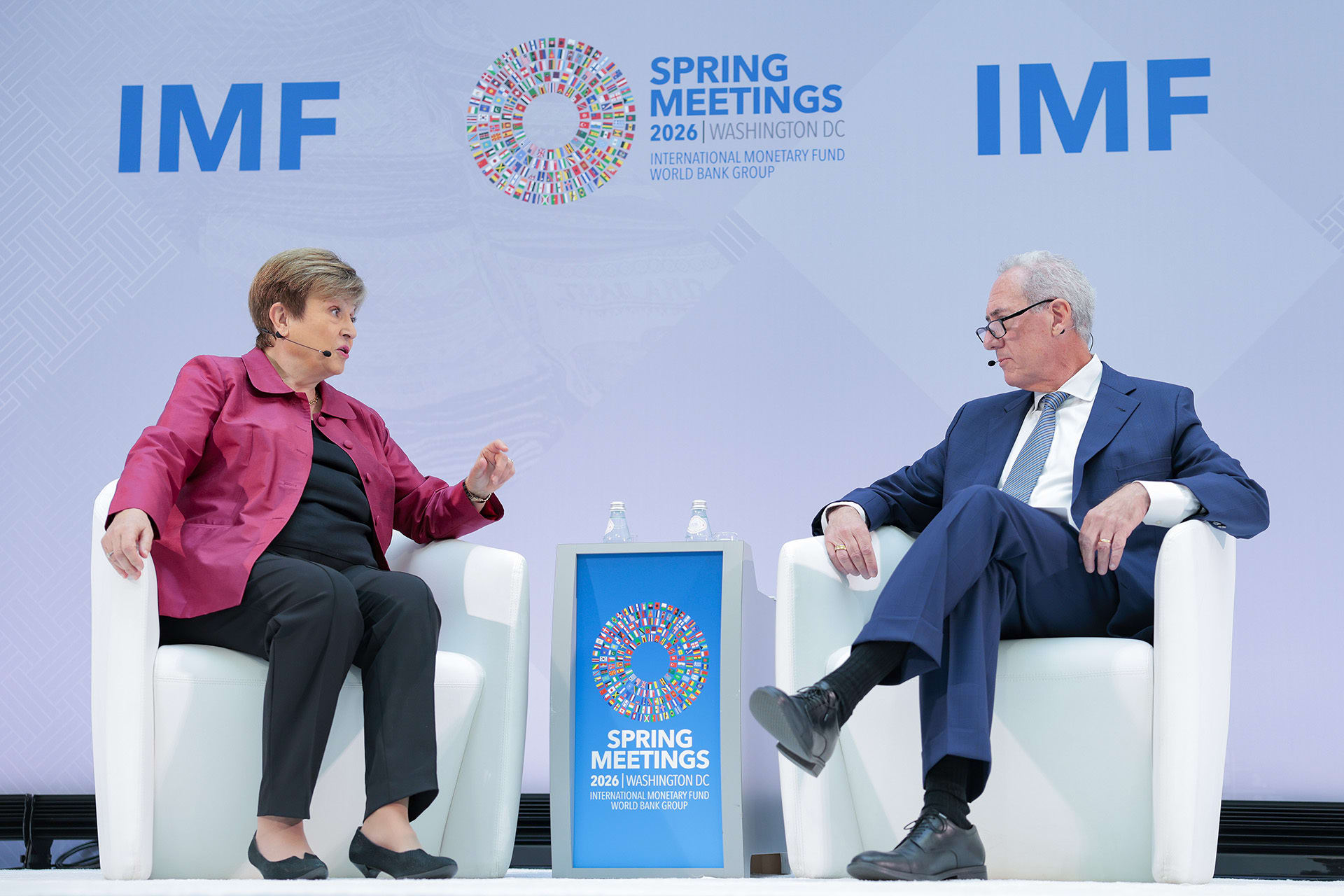

Every spring, central bank governors and finance ministers from around the world gather in Washington for the Spring Meetings of the International Monetary Fund (IMF) and the World Bank to discuss the state of the global economy, macroeconomic coordination, and financial sector management. The topic dominating discussions this year is the war in Iran—and the ensuing economic fallout.
I sat down with IMF Managing Director Kristalina Georgieva last week for a curtain raiser conversation ahead of the Spring Meetings. We discussed the Fund’s macroeconomic outlook, including its latest analysis on how the war is affecting global growth, inflation, and economic stability. I left with a number of takeaways.
The first is that while combat operations have largely ceased, uncertainty still reigns. The true economic impact of this war will not be determined by the damage caused so far, but rather how long the ceasefire lasts, the degree to which traffic in the Strait of Hormuz returns to pre-war levels, and the prospects for a durable peace in the region. The first round of direct peace talks last weekend failed to produce a deal. Earlier today, the United States and Iran announced the strait is open for commercial ships, though President Donald Trump posted on Truth Social that the United States will continue to prevent ships from sailing to or from Iranian ports from the Arabian Sea and the Gulf of Oman until a peace agreement is final.
Whether the war ends in a negotiated settlement or in a frozen stand-off, it’s possible that transit in the Strait of Hormuz does not return to pre-war levels. As Georgieva stated so clearly last week, “Even in a best case, there will be no neat and clean return to the status quo ante.” Global shippers and mariners have long memories. Current transit volume in the Bab el-Mandeb Strait is still only half of what it was before the Houthis’ attack on commercial shipping after the events of October 7, 2023.
A range of potential disruptions to the global economy are detailed in the IMF’s latest world economic outlook report, which sets out three scenarios: the reference forecast scenario, the adverse scenario, and the severe scenario. Considered to be the baseline and most likely scenario, the reference forecast sees global growth falling to 3.1 percent this year, revised down from 3.3 percent in January, and headline inflation rising to 4.4 percent. The adverse scenario—which assumes continued supply chain disruption and higher energy prices—sees growth fall to 2.5 percent and inflation rises to 5.4 percent. The least likely but most severe scenario—which assumes supply disruptions continue through next year—sees global growth tumble to 2 percent and inflation surge above 6 percent.
I’ve written previously about the asymmetric nature of this war on the battlefield, including Iran’s ability to wreak havoc on the global economy with relatively few missiles and drones. It’s also true that the war’s economic consequences are asymmetrically distributed, with Gulf states and low-income energy importers as far away as the South Pacific among the hardest hit. The potential impact on vulnerable countries will be even worse than the IMF’s global figures. In other words, the most significant adverse consequences will fall upon countries least able to absorb them. Sub-Saharan African and small island developing economies make up an overwhelming majority of the non-investment grade net importers from the region.
Rich countries, though, are hardly immune. Since the eve of hostilities, market-implied policy rates have shifted upward across the European Union, Japan, the United States, and the United Kingdom. Markets now expect central banks to hold rates higher for longer than previously anticipated. Benchmark yield curves tell a similar story. Across all four major economies, the entire curve has steepened since February 28, with long-end yields rising most sharply, reflecting both inflation fears and elevated risk premia. All this comes against a troubling fiscal backdrop. Over the past two decades, public debt as a share of GDP has risen across nearly every Group of Twenty economy, with Canada, France, Italy, and the United States all crossing or approaching the 100 percent threshold—leaving policymakers with less fiscal room to absorb future shocks than they had going into prior crises. As Georgieva noted, there is no substitute for good policy, and many countries have missed an opportunity to get their fiscal houses in order while the global economic outlook was relatively benign.
Nonetheless, there are still some bases for optimism. A year ago, few economists, policymakers, and capital allocators would have entertained the scenario now unfolding. On one hand, we have witnessed a quintupling of U.S. tariffs, a prolonged and at times acute drop in U.S.-China trade, and a region-wide shooting war with Iran which resulted in the Strait of Hormuz closing for more than one month. On the other hand, global growth has held up reasonably well. Equity markets have touched new highs, but there is a long history of markets over-rotating on good news and undervaluing bad news—up until the point they don’t.
At a moment of cascading geopolitical crises, the IMF finds itself not in panic mode but focused on what Georgieva might call “cushioning the Middle East war shock” mode. Part of the explanation lies in an unexpected buffer: the artificial intelligence investment boom, which accounted for as much as 40 percent of U.S. GDP growth over the past year. Yet that tailwind has not blown equally across the globe. The countries bearing the greatest costs of the current shocks are largely not the ones reaping its rewards. And there is no guarantee it will continue.
The global economy has hardly enjoyed a smooth ride in the post-Liberation Day era. Yet it has proven remarkably resilient. Still, with so many sources of potential conflict and economic disruption, this is hardly the time to be complacent.
Let me know what you think about the global economic outlook and what this column should cover next by replying to [email protected].