Taking Stock of the War in Iran
CFR President Michael Froman analyzes U.S. objectives and next steps as the Iran war enters its second month.
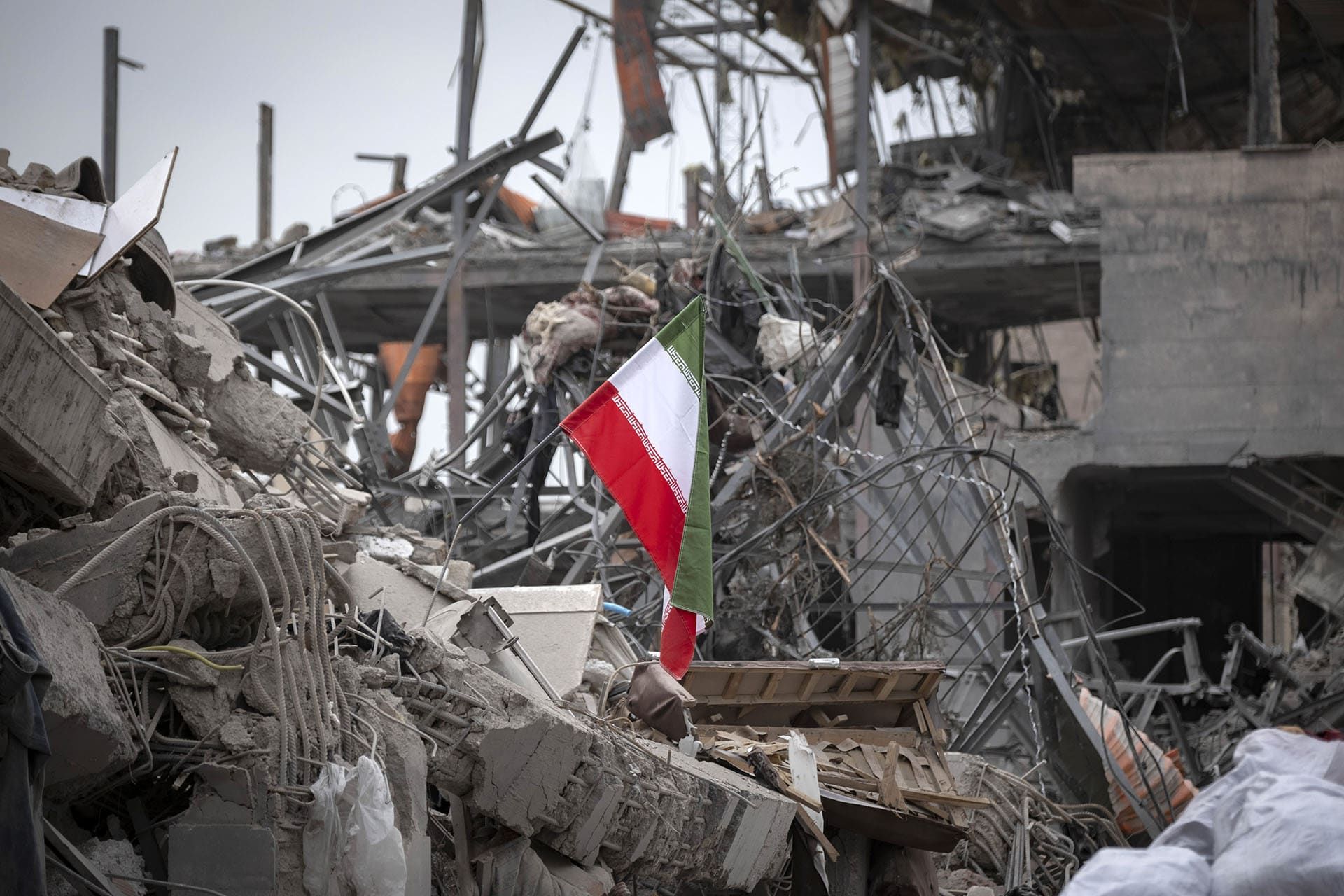

President Donald Trump delivered an important address to the nation this week about the status of the war with Iran. Now, a month into this phase of the conflict, I thought it would be useful to take stock of the United States’ progress toward achieving its initial military objectives, the state of diplomatic relations between the two countries, and the potential economic consequences, particularly as it relates to the Strait of Hormuz.
The damage to Iran’s military capabilities is unquestionable. When I sat down with senior Pentagon official Elbridge Colby at CFR last month, he told me that the president directed the U.S. military to “conduct a military campaign with a focus on degrading and destroying the Islamic Republic of Iran’s ability to project military power in the region, and potentially beyond.” That translated into targeting its navy, its missile and drone capabilities (including both its existing arsenal and its ability to produce these weapons), and its capacity to protect its nuclear program.
In that regard, the president could largely declare “mission accomplished.” But just like former President George W. Bush’s unfortunate use of that phrase, that would not tell the whole story. Since the start of the war, the United States has hit more than eleven thousand targets. Iran’s navy has been largely sunk, but its fleet of small speedboats and dhows that can wreak havoc at the Strait of Hormuz are still largely operational. Similarly, while there is no doubt that Iran’s missile and drone capability has been substantially degraded, Iran has demonstrated that, with just a handful of projectiles, it can effectively close the strait by creating a chilling effect on shippers and insurers. This is to say nothing of the thirteen U.S. service members killed by Iranian strikes since the start of the war, an American airman currently missing in action after an F-15E was shot down over southwestern Iran, and casualties sustained throughout the Gulf as a result of Iranian missile and drone attacks. To paraphrase Henry Kissinger from an article in Foreign Affairs in 1969 about another asymmetric conflict: Iran wins if it does not lose; the United States loses if it does not win.
Much of the regime’s political and military leadership are dead, but what we have seen is leadership change, not regime change. There is also the issue of the 970 pounds of near-weapons-grade enriched uranium still in the country, perhaps buried under the rubble of Natanz or in Isfahan. For now, Trump says that the United States would monitor the sites where the uranium is located and has suggested that those in power in Iran are more reasonable than their predecessors.
So where do we go from here? Diplomatically, the Venn diagram between the United States’ fifteen-point proposal and Iran’s five-point response has scant overlap. The United States’ core demands remain the same: an end to Iran’s nuclear program, missile program, and proxy support, while Iran seeks sanctions relief, international guarantees against future U.S. and Israeli military strikes, and assurances with regard to its sovereignty and rights in the Strait of Hormuz.
Trump may decide to declare victory and exit stage left even in the absence of a negotiated agreement to end the current hostilities. Indeed, this appears to be Trump’s current inclination as he repeated earlier this week that opening the Strait of Hormuz was the problem of other countries, not the United States. The Europeans might complain that this isn’t their war, but Trump’s position is that this isn’t our oil:
All of those countries that can’t get jet fuel because of the Strait of Hormuz, like the United Kingdom, which refused to get involved in the decapitation of Iran, I have a suggestion for you: Number 1, buy from the U.S., we have plenty, and Number 2, build up some delayed courage, go to the Strait, and just TAKE IT. You’ll have to start learning how to fight for yourself, the U.S.A. won’t be there to help you anymore, just like you weren’t there for us. Iran has been, essentially, decimated. The hard part is done. Go get your own oil!
As is so often the case, there are important nuggets of truth in the president’s statement. Only 2 percent of the crude oil and petroleum condensates that flow through the Strait of Hormuz go to the United States. Comparatively, some 80–85 percent go to Asia, with China, India, Japan, and South Korea alone accounting for around 70–75 percent of total Hormuz crude exports. Europe receives only a low single‑digit share of this crude—on the order of about 3–5 percent. The picture for liquefied natural gas (LNG) is quite similar. The United States does not rely on the Persian Gulf for LNG, whereas around 80–85 percent of LNG volumes transiting the strait go to Asian buyers, and roughly 10–15 percent are imported by Europe.
But relative energy independence is a far cry from strategic insulation. Goldman Sachs estimates that the Iran‑war oil and gas shock will knock roughly 0.4 percent off global real GDP growth in its baseline scenario, with a hit to U.S. GDP growth of about 0.4 percent versus only 0.2 percent for China. Asian economies excluding China could face hits as large as 0.7 percent. As higher energy and input prices sap growth in Asia and Europe—the United States’ main export markets—we could eventually feel the effects through weaker external demand, softer earnings, and slower trade. The U.S. labor market and investment environment will likewise be affected, with Goldman predicting that the oil shock alone will slow U.S. payroll growth by about ten thousand jobs per month and push the unemployment rate up by roughly 0.1 percent.
The president is right that the United States is not as dependent on oil being exported through the strait, but as $4 per gallon at the pump demonstrates, American petroleum products remain tethered to global energy markets and will continue to trade in line with international benchmarks. We might not see shortages in domestic supply, but we will certainly see the price effects of a continued market disruption.
The strait is important for reasons that go beyond oil and gas exports. Much has been made of the food and fertilizer exports than transit the strait, but it might be useful to focus on something even more closely tied to U.S. national security: helium. Helium is a critical input to semiconductor manufacturing. It is used as an ultra‑inert cooling and purge gas, which, among its many applications, is used by chip manufacturers to keep wafers cool and free of contamination while tiny circuits are etched into them. There are no ready substitutes for helium in these manufacturing processes. Qatar produces some 30 percent of global helium, and due to the conflict, its main production facility is shut down and its inventories are stuck in coastal storage sites. This disruption is already impacting semiconductor and other technology supply chains in Asia, which have an outsize dependence on Qatari helium—raising input costs in an industry where the United States is heavily import‑dependent. Should the strait remain closed, it will likely slow chip manufacturing and contribute to a rise in chip prices, which could imperil the U.S. data‑center buildout, the artificial intelligence (AI) boom, and the U.S. competition with China over AI.
Other countries are responding: China, India, Malaysia, and Pakistan are cutting their own opaque deals with Iran to get their oil through the strait safely. Oman has begun talking about a regional framework for restoring some semblance of normalcy to the strait, and the United Kingdom has also pulled together a group of forty countries, including Canada, France, and Germany to work towards reopening the strait and preventing Iran from holding “the global economy hostage.” This will be an important test of Canadian Prime Minister Mark Carney’s call for middle powers to step up and demonstrate leadership as the United States retreats. That said, as much as Trump—like so many of his predecessors—would like to pivot away from the region, the United States cannot simply wash its hands of the Iran operation and emerge unscathed if the Strait of Hormuz remains closed.
Before Bush ordered the United States to invade Iraq in 2003, then-Secretary of State Colin Powell, paraphrasing the columnist Tom Friedman, shared with the president the Pottery Barn rule: “You break it, you own it!” Prior to the attacks on Iran that began on February 28, the Strait of Hormuz was open. Now it’s broken.
Let me know what you think about the war in Iran and what this column should cover next by replying to [email protected].