Modern Life, Modern Ills: The NCD Summit
By experts and staff
- Published
- Stewart M. PatrickJames H. Binger Senior Fellow in Global Governance and Director of the International Institutions and Global Governance Program

Beneath the UNGA din about Palestine last week, the United Nations also held its second-ever high level meeting on a health issue: noncommunicable diseases (NCDs). Once considered to primarily plague developed countries, lifestyle illnesses like lung cancer, heart disease, and obesity now place a massive burden on poor and rich nations alike. Beyond the very poorest countries, NCDs now surpass infectious disease in contributing to morbidity and mortality. According to a new report by the World Health Organization and the World Economic Forum, NCDs cost the African continent nearly $500 billion dollars a year—more than ten times the value of aid received from international donors.
Last week, IIGG updated the multimedia package, Global Governance Monitor: Public Health, to reflect the growing effort by international organizations and UN member states to cooperate in reducing the economic and societal burden of NCDs. An interactive map tracks hotspots of health concerns, with tobacco and obesity earning attention alongside H1N1 and smallpox:
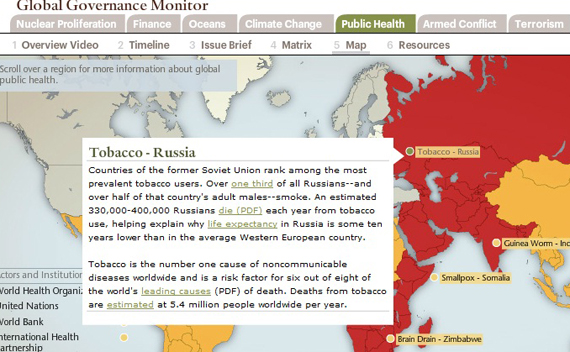
The monitor also highlights recent smoking bans in enclosed indoor spaces enacted by developing countries like China, India and Venezuela, which demonstrate the new visibility of these issues (though my experience traveling to India and China inspires some doubt about enforcement happening soon).
The outcome of the UN NCD summit disappointed many public health experts, who were looking for dramatic action. But in a recent expert brief, my colleague Tom Bollyky, CFR Senior Fellow for Global Health, Economics and Development, argues that the event actually made important strides—particularly in building momentum for addressing the spread of NCDs and establishing a framework for NGOs and private enterprises to cooperate with national governments and international institutions:
The high-level meeting had other benefits as well, increasing media attention on NCDs and improving cooperation among international NGOs and advocacy groups. There also was modest progress at the national level with Hungary and South Africa announcing new regulations on trans-fat and dietary salt and Australia committing $25 million in aid to help Pacific island countries tackle non-communicable diseases. Numerous corporations likewise announced voluntary initiatives to improve the health of their foods and new NCD philanthropic initiatives in low- and middle-income countries.
The G77 nations and NCD Alliance had hoped for firm, time-bound targets for reducing the prevalence of NCDs—with most of the funding, coming as usual, from wealthy states in the international donor community. But considering the economic battles raging in the home courts of the United States, Europe and Japan, as well as their own healthcare burdens, these goals were probably unrealistic from the start.