The Iran War Turned Asia’s Fragile Energy Dependence Into an Emergency
Asia got a glimpse of its energy future during the Iran war. What governments do next will determine whether the crisis becomes a turning point or a missed opportunity.
By experts and staff
- Published
 Joshua KurlantzickCFR ExpertSenior Fellow for Southeast Asia and South Asia
When mediators announced a memorandum of understanding on June 14 intended to bring the Iran war to a formal close within sixty days, Asian capitals breathed something close to relief. The Strait of Hormuz, which had been largely shut to shipping since late February, seems to be slowly reopening, and oil prices have retreated from their crisis peaks. But relief is not the same as recovery, and the damage the conflict has inflicted on Asian economies—on growth, household budgets, and government finances—is neither minor nor quickly reversible.
The numbers are stark. The Asian Development Bank forecasts a drop in GDP growth of 0.7 percentage points in 2026 and inflation rising to 5.2 percent if oil prices hover around $96 per barrel for the year. The World Bank also has downgraded projections for Southeast Asia’s growth in 2026. For countries like the Philippines, which declared a national energy emergency in March after local diesel and petrol prices more than doubled, or Bangladesh, which has purchased liquefied natural gas (LNG) spot cargo at nearly three times normal benchmark prices, the pain has been acute and unevenly distributed. The poorest households—those most dependent on liquefied petroleum gas for cooking and kerosene for light—have been hit hardest.
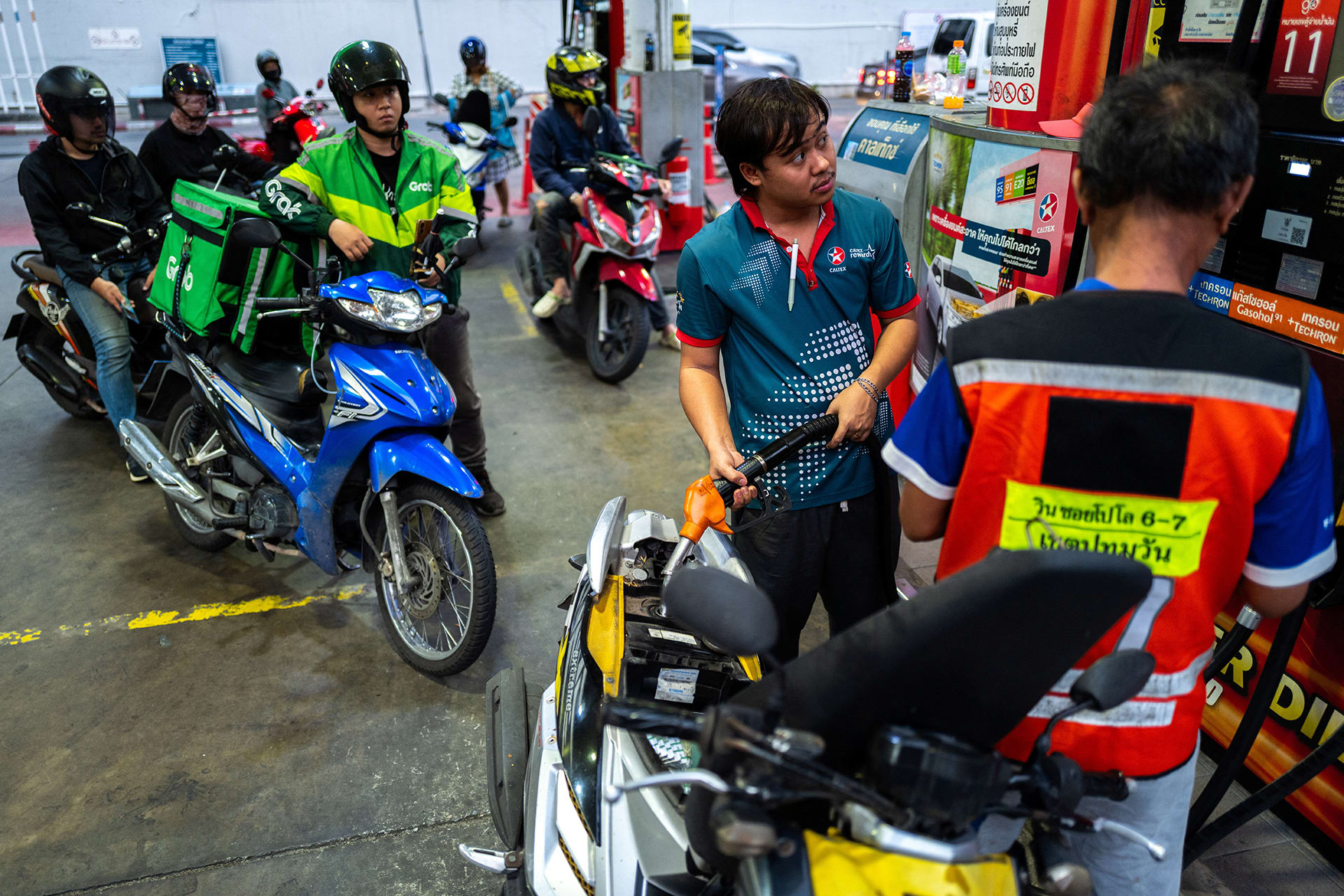
The emergency measures governments rolled out in March and April were, in some ways, a measure of how badly exposed these countries were. Bangladesh, South Korea, Thailand, and Vietnam imposed energy rationing. Indonesia, Malaysia, and others ordered work-from-home requirements. Pakistan and the Philippines shifted to four-day work weeks.
Although the ceasefire remains perilous, those emergency measures are slowly being wound back. Vietnam is lifting its work-from-home directives. Thailand is easing its fuel rationing. Some pent-up economic activity across the region will be released. Whether that translates into a genuine recovery will depend on factors that the ceasefire alone—which is still far from a permanent peace deal, given both sides’ distrust of each other—does not resolve, including infrastructure damage in the Gulf and Iran’s signaled intention to impose tolls on ships using the strait regardless of any final peace deal. Energy analysts warn that a full normalization of Middle Eastern energy exports is unlikely before mid-to-late 2027 at best.
The more consequential story, though, is what the Iran war has done to Asia’s long-held assumptions about energy security—and what those shattered assumptions are going to mean going forward.
Before February 2026, Asian policymakers had understood in theory that their dependence on Persian Gulf energy was a vulnerability. The crisis transformed that abstract vulnerability into an emergency that has forced a complete regional rethink about energy security. Before the war, the Middle East supplied roughly 60 percent of Southeast Asia’s crude oil imports and about a third of its gas. Japan was even more exposed, with 95 percent of its oil arriving through the same routes.
The regional response has materialized quickly—faster than one might have expected from governments that had, for years, moved at an unhurried pace on the energy transition. The Philippines offers a striking illustration: Chinese solar exports to the country roughly tripled in the first quarter of 2026 compared to a year earlier, making it one of the fastest-growing solar markets in the region. Rooftop solar installations have surged as households sought cheaper, self-sufficient alternatives to soaring utility bills. Indonesia—a country not generally known for policy agility—has moved to accelerate a 100-gigawatt solar target and speed up geothermal power projects. Vietnam has expanded electric vehicle (EV) incentives and accelerated charging infrastructure in direct response to the fuel price shock.
Nuclear power is getting a serious second look across the region. Five members of the Association of Southeast Asian Nations (ASEAN)—Indonesia, Malaysia, the Philippines, Thailand, and Vietnam—are now actively pursuing atomic energy. Malaysia has set a 2031 target for its first reactor. Vietnam advanced a nuclear cooperation deal with Russia this week, and Bangladesh is racing to bring its Russia-backed plant online. If current plans hold, nearly half the region could have nuclear capacity by the 2030s.
The search for alternative oil suppliers has also intensified. Several Southeast Asian governments, including Indonesia, the Philippines, and Vietnam, moved quickly to secure Russian crude as Gulf supplies dried up. Countries have also looked more seriously at non-Gulf LNG suppliers such as the United States and Australia as lasting alternatives to Persian Gulf dependence.
Regional leaders are also taking renewables seriously now. A new report by the International Energy Agency (IEA), the Southeast Asia Energy Outlook 2026, projects that renewable capacity—at 120 gigawatts in 2024—could nearly triple by 2035 under current policies or grow fivefold if newly announced targets are met.
The stakes for rapid and sustained energy diversification—focusing on renewables, nuclear energy, new sources of oil and LNG, a drawdown of coal use, and other measures—are high. The IEA’s warning is blunt: if Southeast Asia fails to diversify quickly enough, its energy import bill could rise to $245 billion by 2035, tripling from $80 billion in 2024. That would represent an enormous and recurring drag on economies that had been projected to be among the biggest drivers of global growth.
Whether Asian governments will deliver on these ambitions is an open question. The history of energy transition in Asia, especially in Southeast Asia, is littered with ambitious targets that collided with cheap fossil fuels, entrenched utilities, and the difficult politics of shutting some industries and making major bureaucratic changes. The Iran war has created a rare political window: a genuine crisis that could help overcome inertia. But windows close.
Indeed, many obstacles stand in the way of South and Southeast Asia ensuring greater energy security and durable growth. Conservation efforts remain underdeveloped. Most Asian governments have treated demand management as an emergency lever—something to pull in a crisis—rather than a structural policy. Freight is an example: mandatory efficiency requirements for trucks could meaningfully slow the growth in road fuel demand as the region’s truck fleet swells by roughly half over the next quarter century.
The region’s electricity networks are badly undersized for what lies ahead: transmission and distribution infrastructure would need to more than double in length by 2050, while annual grid and storage spending would have to climb from $13 billion to $50 billion over the same period. The ASEAN Power Grid—a long-discussed but still unrealized framework for cross-border electricity interconnections—alone carries a price tag of around $27 billion through 2040. Without upgraded grids and greater investment in battery storage, the region’s renewable ambitions will run into a hard ceiling: solar and wind capacity can be built, but it cannot be reliably dispatched if the wires to carry it do not exist.
Nuclear power, meanwhile, faces yearslong construction timelines, regulatory frameworks that barely exist, public wariness in countries like Japan and others that cannot be wished away, and financing challenges in emerging economies where the cost of capital for such plants can run twice as high as in advanced economies. Five countries pursuing nuclear is not the same as five countries that will have nuclear plants by the 2030s. Solar is more tractable, but scaling from rooftop installations to utility-scale capacity requires grid investment, permitting reform, and long-term power purchase agreements, none of which are simple. Notably, China’s dominant role in renewable energy technology supply chains—solar panels, batteries, EVs—means that Southeast Asia’s energy diversification strategy will deepen reliance on China in geopolitically and economically dangerous ways.
And then there is the coal problem, which the crisis has made worse. As the IEA reports, the loss of Gulf LNG supplies has pushed fuel switching—back toward coal. Coal still contributes half of the region’s electricity generation. It is cheap, domestically available in countries like Indonesia, and the region’s coal fleet is young. But it is also dirty, inefficient, and deadly in a literal sense: coal use contributed to an estimated 330,000 premature deaths in the region in 2024. Reducing coal dependence will be ferociously difficult in countries where coal is also an employment base and a domestic industry.
Regional coordination compounds every one of these challenges. The ASEAN leaders’ summit in May was perhaps the starkest illustration of what the absence of that coordination costs. As I previously noted, ASEAN failed to agree on a joint energy plan. Indonesia’s proposal for a regional petroleum reserve—tabled at three consecutive summits—collapsed again. Vietnam, quietly negotiating a Chinese-financed LNG terminal, declined to endorse regional energy measures that could complicate those talks. Cambodia, under Chinese influence, treated energy security as a bilateral rather than a multilateral matter. That ASEAN, a weak organization hamstrung by its need for consensus to make policy, cannot deliver energy coordination is not merely a diplomatic failure; it is an economic one with measurable consequences.
The stakes of this moment extend beyond Asia. China and India alone contribute roughly 40 to 45 percent of incremental global GDP growth, and other major Asian economies—Indonesia, South Korea, Vietnam, and ASEAN collectively—add another 10 to 12 percent. A sustained energy crisis, or repeated shocks of the kind the Iran war produced, would sharply compress industrial output, investment, and consumption across the region, potentially reducing global growth substantially in the next two decades. The ceasefire is a reprieve. Whether Asia uses it to help itself—and the world economy—is the question that matters.
This work represents the views and opinions solely of the author. The Council on Foreign Relations is an independent, nonpartisan membership organization, think tank, and publisher, and takes no institutional positions on matters of policy.