Trump, Iran, and Diego Garcia: Inside the Fight Over a Remote Military Base
The tiny, British-owned Chagos Archipelago has been home to a major U.S. military base for decades. A deal to return the islands to Mauritius has raised alarm in the White House, but experts say it isn’t the catastrophe the administration has made it out to be.
By experts and staff
- Published
- Writer/Editor
- Research Associate, Africa Studies
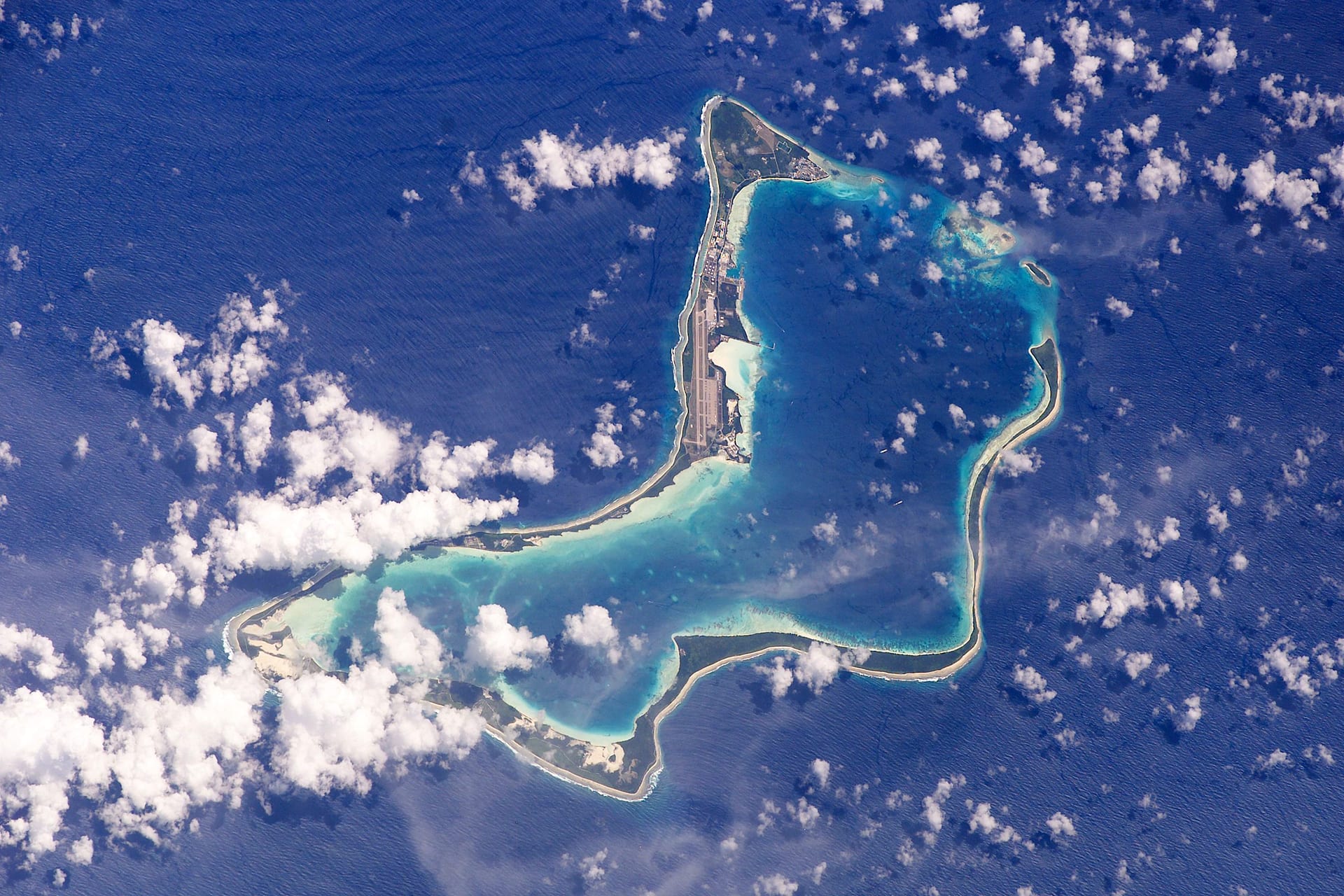
In the central Indian Ocean, 1,000 miles south of the southern tip of India—and around 5,800 miles southeast of the United Kingdom (UK)—lies the Chagos Archipelago, a small group of roughly sixty islands designated as the British Indian Ocean Territory since 1965.
U.S. President Donald Trump has marked the cluster of islands as critical to U.S. foreign policy because of a joint U.S.-UK military base on the archipelago’s largest island, Diego Garcia. Since the Cold War era, the base has acted as a staging ground for deployments to the Middle East and East Africa, allowing the United States quicker access to these areas—which has become all the more important as the Trump administration plunges forward with the U.S. war with Iran.
On March 20, Iran attempted to strike Diego Garcia with two intermediate ballistic-range missiles—more than 2,300 miles from its coast. While the attack was unsuccessful, it was the first-known targeting of the base and indicated that Iran is not limited to its self-imposed missile-range limit of 1,250 miles. The attempt revealed that Iran can attack further afield capitals across Africa, Asia, and Europe, a possibility that Tehran has previously diminished. (Diego Garcia and central Europe are about the same distance from Iran.)
For decades, “Diego Garcia [has] put platforms and munitions beyond Iran’s reach and saved scarce tanking—it is very valuable real estate,” said Jim Baker, CFR senior fellow for strategic competition. This means the Indian Ocean will become more contested as an air and maritime space, raising the stakes on U.S. and allied basing there, he added. “Despite the many difficulties associated with operating out of Diego, its use would be more, not less, important over the coming decades.”
Meanwhile, a deal for the UK to return the archipelago to the Indian Ocean island country of Mauritius, which administered the islands until 1965, has recently gained controversy in U.S. and British policy circles when Trump voiced opposition to the agreement.
Despite his administration initially supporting the deal in a meeting with Mauritian officials, Trump reversed course the next day. Following his threats, UK officials have since gone back and forth in public statements on whether the deal was happening amid discussions with the United States, whose approval it reportedly requires to ratify the deal.
Here’s a look at what’s on the table in the UK-Mauritius agreement, why Trump has chosen now to advocate against it, and whether or not it’s likely to go through.
What are the details of the UK-Mauritius agreement?
Mauritius has argued that it was illegally forced to cede the islands to the UK as part of a deal to gain independence from Britain and has claimed sovereignty over the islands for decades—going as far as pursuing a case with the International Court of Justice (ICJ) in 2019. The establishment of the U.S.-UK military base in the early 1970s included forcibly removing native Chagossians to Mauritius, the Seychelles, and the UK, and enacting measures to prevent their permanent return.
In 2022, the UK entered into negotiations with Mauritius to transfer sovereignty of the islands, propelled by increasing international scrutiny generated by the UN General Assembly and an ICJ advisory opinion asserting that British control was illegal. Then-UK Prime Minister Rishi Sunak held eleven rounds of talks with the Mauritian government over the following two years. In October 2024, the newly elected Labour government, led by Keir Starmer, reached a political agreement with Mauritius, which both parties later signed in May 2025.
The agreement grants Mauritius full sovereignty over the archipelago, while allowing the UK to continue exercising authority over Diego Garcia for an initial ninety-nine-year period. This can be extended for an additional forty years and renewed further by mutual agreement.
The UK will pay Mauritius approximately $4.5 billion over the first ninety-nine years. The agreement’s exploratory memorandum outlines [PDF] several tranches of funds, including: an annual sum of roughly $220 million for first three years; a fixed annual sum of about $160 million for years four through thirteen, and then an annual sum indexed to the GDP deflator; a sum of about $53 million for a trust fund to benefit Chagossians; and an annual grant of about $60 million for twenty-five years to promote the economic development and welfare of Mauritius and its people.
During this time, Mauritius will allow the United States and the UK to access, maintain, and invest in the joint military base. It will also bar other countries from accessing the outer islands surrounding Diego Garcia without explicit permission from the UK—a stipulation that U.S. policymakers have questioned.
Why is Trump getting involved?
While the military base on Diego Garcia is jointly held, it is primarily operated by roughly 2,500 U.S. personnel. It also hosts some of the world’s most advanced military and logistical equipment, including B-52 bomber aircraft, radar installations, and fuel storage facilities. The United States heavily relied on the base for air and maritime operations during the two Gulf Wars and in the wake of the 9/11 attacks.
Trump has emphasized the need for U.S. military installations abroad. Some experts, including Peter Harris, a Colorado State University professor who has studied the Chagos Islands for nearly two decades, think another primary reason for the recent disagreement is due to Trump’s desire for leverage over the UK after Starmer opposed his bid to acquire Greenland.
“His opposition has got nothing to do with U.S. national interests,” Harris told CFR. “The U.S. national interest is crystal clear, and that is to get legal access to the base in perpetuity, for one hundred years, and have somebody else pay for it.” Trump’s frustrations with Starmer resurfaced when the UK initially refused to let the United States use Diego Garcia and British bases to strike Iran, fueling his desire to block the deal.
Trump claims that the UK’s pending return of the islands to Mauritius is “another in a very long line of National Security reasons” why the United States should have control of Greenland, but he did not explain his rationale for this statement.
How does the deal affect the United States’ security?
Since the start of the U.S.-Israeli war with Iran, Trump has made clear he intends to use Diego Garcia as a proximal defensive measure against potential attacks by “a highly unstable and dangerous Iranian Regime.” Citing legal concerns, the UK did not permit the United States to use Diego Garcia or any other UK air bases in its initial February 28 strikes on Iran, to Trump’s dismay. The next day, Starmer allowed the U.S. military to rely on UK bases, including Diego Garcia.
While some experts point out that the islands could be important for U.S. strategy in the war, “the president’s objection is about the sovereignty of small countries, not about military utility,” Baker said. In opposing the deal, Trump appeared to be “suddenly complaining about allies who were not consulted and are now being coerced to support a war of choice,” he added.
Other analysts note that Trump also seeks to counter China’s foothold in the Indian Ocean, citing Beijing’s bilateral relationship with Mauritius and its growing interest in strengthening its regional security presence [PDF]—a concern that some UK officials have disputed. Last February, the UK minister for overseas territories, Stephen Doughty, cautioned that China or Russia could build a spy base on Diego Garcia or the archipelago’s outer islands if the deal to cede them to Mauritius does not go through, as the UK would have no legal standing to “remove them.” Other experts have asserted that Mauritius’s close partnership with India would likely cull any Chinese efforts to build a presence on the islands.
Mauritius has not yet taken any action indicating its interest in giving China access to the islands—and the proposed deal would prevent this possibility. Meanwhile, China has not expressed explicit interest in the islands, though it did support Mauritius’s claims at the United Nations, and recent reports indicate that thousands of Mauritian officials have traveled to China for “specialized courses” ahead of the planned handover, with hundreds more set to receive training from Beijing.
What is the likelihood the deal goes through?
The British government wants to see the deal through to escape the spotlight of international scrutiny, experts say. “They want to bring themselves into alignment with international law,” Harris told CFR. “The U.S. administration understands that, too. It’s very difficult to run a military base that’s housed in an unlawful jurisdiction.”
Harris described the deal as “a win-win-win” for all three countries: Mauritius gets its land back, the UK gets out of murky legal waters, and the United States keeps access to its strategically located base.
But other experts, including Richard Ekins, a professor of law and constitutional government at Oxford University, point to the general nonbinding nature of ICJ advisory opinions as evidence that the UK doesn’t have to follow through. “We’re surrendering to the abuse of international adjudication—effectively letting an ICJ advisory opinion function like a binding adjudication—when the UK didn’t consent… and yet is having that sovereign right subverted,” he said in a recent interview.
Recent geopolitics aside, experts largely speculate the deal will pass through unscathed. It currently sits with the House of Lords in the UK Parliament, and will then require formal approval from King Charles III.
“I’m pretty confident it’ll go through,” Harris said, “but you can never be 100 percent certain.”
Colophon
Data Visualization
- Lara Yeyati Preiss
- Will Merrow
- Austin Steinhart
Additional Reporting
Lara Yeyati Preiss contributed to the graphics.