Vance Announces Nuclear Cooperation With Armenia
By experts and staff
- Published
Welcome to the Daily News Brief, CFR’s flagship morning newsletter summarizing the top global news and analysis of the day.
Top of the Agenda
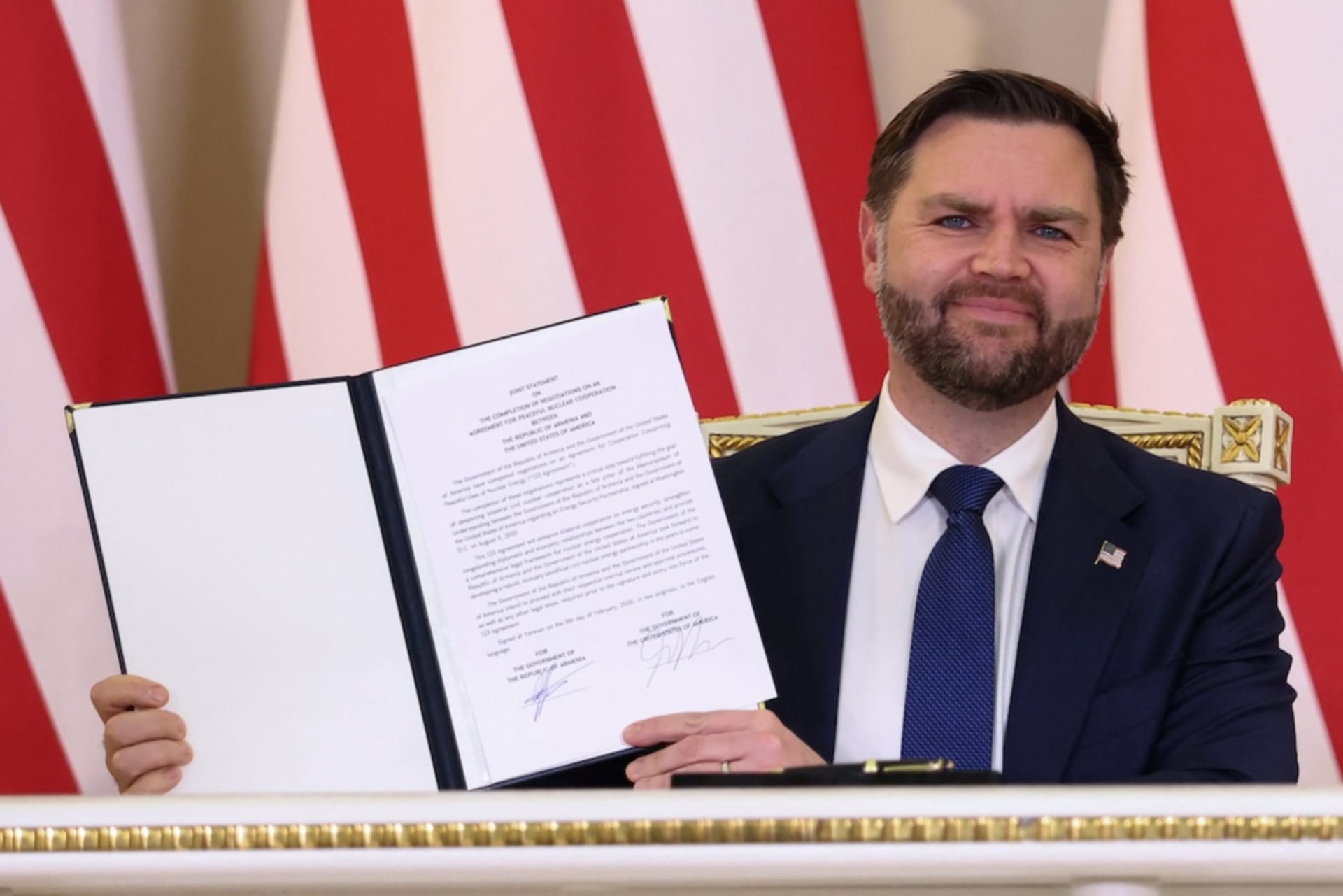
U.S. Vice President JD Vance announced new civilian nuclear cooperation with Armenia during a visit to Yerevan yesterday. He is the first U.S. vice president to ever visit Armenia and will next travel to Azerbaijan, rounding out a trip meant to highlight U.S. peace mediation. Last year, the United States brokered a peace agreement between Armenia and Azerbaijan that included pledges of new U.S. investments, though it has yet to be ratified by either country’s national legislature or signed by their leaders.
The latest. The new agreement will allow the United States to license nuclear technology and equipment to Armenia. According to Vance, it will permit up to $5 billion in initial U.S. exports to Armenia and $4 billion in longer-term fuel and maintenance contracts. Armenia has relied on Iran and Russia for energy supplies in the past but is currently in talks with multiple countries—including the United States—about building a new nuclear reactor.
In both Armenia and Azerbaijan, Vance is touting plans for a U.S.-backed, twenty-seven-mile corridor that would connect Azerbaijan to its autonomous Nakhchivan exclave bordered by Armenia, Turkey, and Iran. The corridor would also link them to overseas export markets and include rail as well as oil and gas infrastructure. Last month, the United States and Armenia announced a framework for the project that envisions the United States holding a 74 percent stake for fifty years, before dropping to a 51 percent stake.
The context. The trip is a new test of U.S. President Donald Trump’s business-driven approach to peacemaking, which the White House has promoted in efforts to end the wars in Gaza and Ukraine. U.S. interest in deepening ties with Caucasus countries has increased in recent years because of their critical mineral reserves. Envoys from Armenia and Azerbaijan attended a meeting last week in Washington where U.S. officials proposed deeper critical mineral cooperation among dozens of countries.
“As Russia has withdrawn forces and equipment from its military bases in the Caucasus and Central Asia to redeploy them to Ukraine, countries in both places are resolving conflicts that Russia has long exploited for its own benefit…The Eurasian interior may be increasingly interconnected, cooperative, and even taking steps toward peace, but it needs to keep moving in this direction if it is to resist future Russian efforts to reassert authority.”
—the Center for Strategic and International Studies’ Jeffrey Mankoff, Foreign Affairs
Across the Globe
Tariff rates for Bangladesh. The country will face a 19 percent base rate from the United States, with a tariff exemption for some clothing exports made with U.S. material, Bangladeshi interim leader Muhammad Yunus said yesterday. No such exemption has been made for clothing exports from Bangladesh’s neighbor India thus far.
Indonesia preps Gaza troops. Indonesia has preliminary plans to send between five and eight thousand troops to Gaza as part of an international peacekeeping force, its army chief of staff said yesterday. Indonesia is the first country to openly pledge troops for the mission. President Prabowo Subianto has said that as the world’s most-populous Muslim country, Indonesia should help stabilize Gaza and promote an eventual two-state solution to the Israeli-Palestinian conflict.
Pushback to West Bank steps. A White House official told reporters yesterday that Trump “does not support Israel annexing the West Bank” following the Israeli security cabinet’s decision Sunday to expand Israeli authority in the territory. The measures facilitate land purchases by Jewish settlers and assume Israeli control of certain administrative roles previously prescribed to the Palestinian Authority. Israeli ministers said the changes would “increase transparency and facilitate land redemption.” The steps are widely deemed to be violations of international law and of Israel’s agreements under the Oslo accords.
Trump’s threat to block northern-border bridge. Trump threatened in a social media post yesterday to block the opening of a U.S.-Canada border bridge later this year. He said he would not allow the bridge to open and demanded to start negotiations. Canada did not immediately comment. The bridge has been in the works since 2018, with local U.S. officials praising the project as a means of easing trade flows between the countries.
Reported EU plan for Ukraine. The EU is considering fast-tracking certain membership protections for Ukraine as part of a potential peace deal, unnamed sources told Bloomberg. A European Commission spokesperson said Kyiv’s future accession to the EU is being discussed in peace talks. Brussels has not reached a final position on the matter, with a normal—and thus slower—accession process still reportedly on the table for Kyiv.
Oil tanker inspected. U.S. forces boarded and inspected a tanker in the Indian Ocean that was allegedly violating sanctions on Venezuelan oil, the Department of Defense announced yesterday. The department said that it had been tracking the tanker—which was sailing under the Panamanian flag—since it departed the Caribbean. The Pentagon said the incident showed it remained committed to sanctions of Venezuela’s oil sector.
Migrant boat capsized. Fifty-three people are dead or missing after a migrant boat sunk off the coast of Libya, the International Organization for Migration (IOM) said yesterday. Only two survivors were rescued after the incident. The IOM called for a stronger international response to migrant trafficking in the region focused on protecting human lives, noting that more than 1,300 migrants went missing or died in the Central Mediterranean in 2025 and 484 in the first weeks of 2026 alone.
What’s Next
- Today, Sweden and Finland hold a high-level security dialogue in Espoo, Finland.
- Tomorrow, Israeli Prime Minister Benjamin Netanyahu visits Washington, DC.
- Tomorrow, Barbados holds parliamentary elections.
What You Missed: 2026 Milan-Cortina
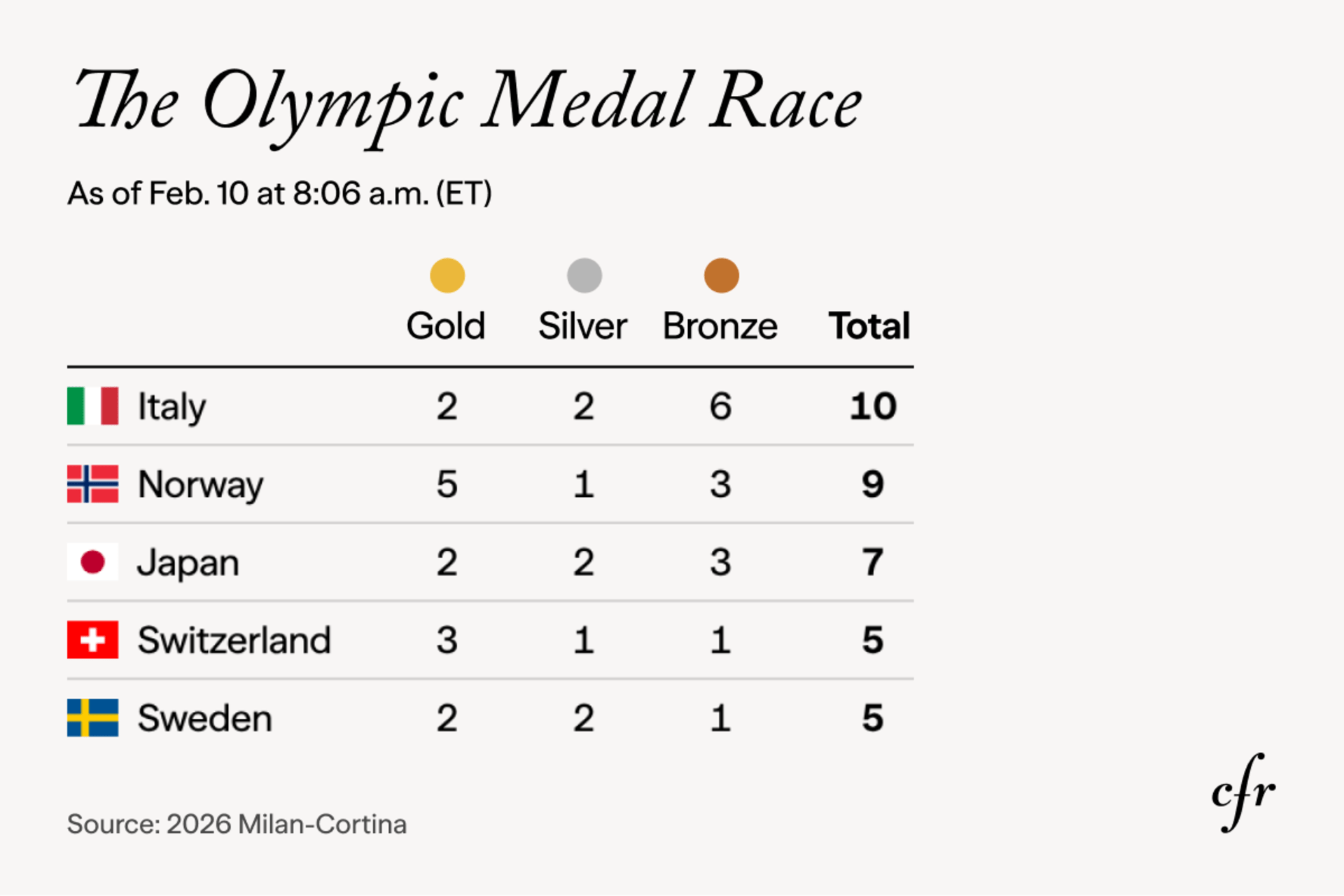
Every morning the Daily News Brief team will share the latest highlights from the 2026 Winter Olympics! Without further ado, here’s what you might have missed since yesterday.
Freestyle on skis. While complex twists and backward-facing landings are perhaps most famous in figure skating, Olympic athletes pull these feats on skis, too. In freeski slopestyle skiing, Switzerland’s Mathilde Gremaud edged out China’s Eileen Gu yesterday to earn the women’s gold by landing—for the first time in Olympic history—a so-called “nose butter double cork 1260,” which includes two inverted flips and more than three horizontal spins. Check out her run here. Meanwhile, American Alex Hall, who had hoped to defend his gold medal, finished the men’s freeski slopestyle competition just behind Norwegian skier Birk Ruud, who won gold for the first time.
Mysteries solved and unsolved. An anarchist group claimed responsibility yesterday for disruptions on rail lines near the Olympics; Italy’s deputy prime minister vowed to hold the perpetrators responsible. In a lighter investigation, victorious athletes have been puzzled that some Olympic medals have been falling off their necks, chipping or damaging the prizes. Officials are looking into the matter.
The Games and young nationhood. Slovenia consistently outperforms in international athletic competitions relative to its small population of around two million people. The Athletic wrote that after the country declared independence from Yugoslavia in 1991, sports became a key venue for affirming national identity. Post-independence, Slovenia required every school to have a good gym and to report student performance in basic physical exercises. One of their standout events is ski jumping, and Slovenian fans chanted at these Olympics: “whoever is not jumping is not Slovenian.”