What to Expect From Kevin Warsh’s Fed in the First 100 Days
The new head of the U.S. Federal Reserve takes over at a time of heightened inflationary pressures and concern over the Fed’s independence. His first one hundred days should give signs on how he will handle the central bank’s core role and political pressures.
By experts and staff
- Published
 Roger W. Ferguson Jr.CFR ExpertSteven A. Tananbaum Distinguished Fellow for International Economics
- Research Associate, International Economics
Roger W. Ferguson Jr. is the Steven A Tananbaum Distinguished Fellow for International Economics at the Council on Foreign Relations. Maximilian Hippold is a research associate at CFR.
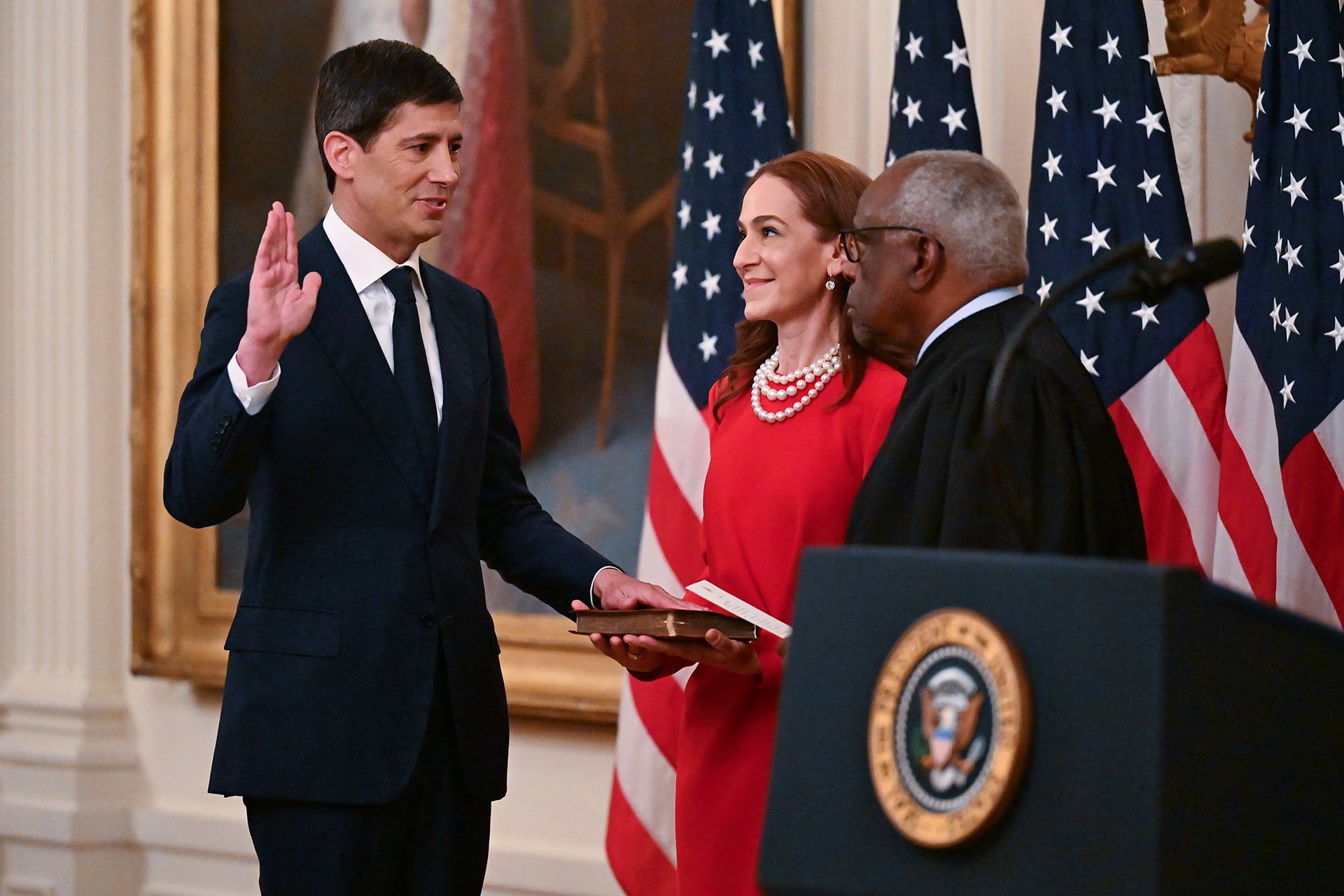
Kevin Warsh was sworn in as the new chair of the Federal Reserve on May 22, succeeding Jerome Powell at the helm of the world’s most consequential central bank. His confirmation appears to close an unusually turbulent chapter in the institution’s recent history. President Donald Trump had grown increasingly dissatisfied with Powell after nominating him during his first administration and intensified pressure throughout his second term. He publicly criticized interest rate decisions and at times floated the possibility of removing Powell, while the Department of Justice launched investigations into board member Lisa Cook over alleged mortgage fraud and into Powell himself over his handling of the renovation of the Fed’s Washington headquarters. Though the lawsuit against him has been dropped, Powell has indicated his intention to remain on the Fed’s Board of Governors until all outstanding investigations have been fully resolved.
Warsh assumes the chairmanship against this backdrop of political pressure and heightened concern over institutional independence. Both he and Trump used the swearing-in ceremony to reaffirm their commitment to preserving the Fed’s independence from the executive branch—a pledge that will be tested early. Trump has made clear his expectation that Warsh will be more receptive to rate cuts and supportive of his pro-growth economic agenda than his predecessor, and Warsh suggested during his confirmation hearing that productivity gains driven by artificial intelligence (AI) could create the conditions for lower rates.
Whether that argument will hold, however, is far from certain. Disruptions to energy supplies and other vital goods stemming from the ongoing conflict in the Middle East risk rekindling inflationary pressures, which could constrain Warsh’s room to maneuver. His first few months in office will reveal how many of his proposed reforms he can advance—and whether economic conditions will afford him the latitude to deliver on the rate cuts the president is counting on.
A period of uncertainty
Warsh inherits a period of considerable uncertainty. The threat of large-scale AI-driven job displacement—so far largely anecdotal—raises questions about both the labor market and longer-term production potential. After five consecutive years of inflation above the Fed’s 2 percent target, with cumulative price increases approaching 25 percent, many Americans continue to feel the strain of an affordability crisis. The economic fallout from the Iran war has added further pressure, and the Fed is closely watching whether the resulting supply shock will prove transitory or filter through the broader economy, driving more persistent inflation and weighing on growth. With midterm elections approaching in November, elevated inflation could prove politically damaging, risking voter backlash against the Republican-controlled Congress.
That last scenario could prove particularly fraught for Warsh: if inflation reaccelerates, he may find himself compelled to raise interest rates—doing precisely the opposite of what Trump had in mind.
Warsh’s policy priorities
Warsh’s confirmation hearing gave Americans a better sense of what a Fed under his leadership would look like. His priorities appear to fall into three broad areas:
Reinforce the Fed’s core mandate. First, Warsh wants to return the Fed to its core mandate of price stability and maximum employment. In his view, the institution has in recent years been drawn into political debates, climate policy discussions, and other areas outside its statutory remit. That critique, while it resonates with the Trump administration, may be somewhat overstated.
The Fed’s engagement with climate change, for instance, has largely been confined to assessing how banks price climate-related risk in their lending decisions and evaluating counterparty risk profiles—precisely the kind of scrutiny one would expect of a bank regulator, not unlike the Fed’s recent focus on cybersecurity risk. Similarly, the Fed’s role in mortgage disclosure and consumer protection derives from congressional legislation rather than self-directed mission creep. For those genuinely concerned about the Fed straying beyond its dual mandate, the more consequential remedy may lie in working with Congress to revisit the body of legislation that has expanded the Fed’s authority over time.
Inflation targeting. Warsh’s second priority is to overhaul how the Fed measures and targets inflation. A critic of the Fed’s 2020 shift to flexible average inflation targeting—which allows inflation to temporarily exceed 2 percent—Warsh favors reverting to a strict 2 percent target. He has called for a broader reassessment of how inflation is measured, including the use of newer methodologies. Warsh is also a strong proponent of interest rates as the primary tool for combating inflation and has indicated he would seek to reduce the central bank’s reliance on quantitative easing and shrink its balance sheet, which has expanded significantly since the 2008 financial crisis —from under $1 trillion before the crisis to more than $6 trillion today. To bring it down, the Fed has two primary tools at its disposal: allowing bonds to mature without reinvesting the proceeds or selling assets back into the market. However, implementing either tool too aggressively carries risk to the economy.
Stop signaling future moves. Lastly, Warsh wants to abandon the practice of forward guidance, in which Fed officials signal their expectations for future policy moves. The dot plot—which charts each Federal Open Market Committee (FOMC) member’s projected rate path for the months ahead—could therefore become a relic of the past under his leadership.
Additional policy priorities Warsh outlined include research into how AI could affect economic output and production potential, steps to reduce the balance sheet, improvements to the Fed’s internal payment systems, and a commitment not to pursue a central bank digital currency.
Warsh’s first 100 days in office
A first indication of Warsh’s leadership style will come at the next meeting of the FOMC, scheduled for June 16–17. The FOMC—a twelve-member body comprising seven Fed governors and five regional Fed presidents—holds ultimate authority over interest rate decisions. While the chair presides over the committee, he cannot dictate policy without securing majority support.
To advance his policy priorities, Warsh will need to build consensus. Major policy changes at the Fed do not flow from the chair alone; they require the endorsement of the broader board. Historically, significant reforms have been developed through study groups or task forces, whose membership the chair can shape but whose recommendations still require board approval to take effect.
In his first one hundred days, Americans can expect Warsh to announce working groups tasked with examining his stated priorities, including a more restrained communications posture—one that avoids the kind of detailed forward guidance on future rate decisions that he has criticized. The sweeping institutional reform Warsh has outlined in recent months will not happen overnight; it will be a deliberate and protracted process.
In the meantime, both financial markets and Congress will be watching closely. Should the Warsh-led Fed cut its benchmark rate prematurely, before inflation is definitively returning to the 2 percent target, longer term rates are likely to spike, reflecting both an increase in inflation expectations and concerns about Fed independence. Should Democrats succeed in flipping either chamber in the midterm elections, oversight of the Fed’s new direction could intensify considerably.
The scrutiny, however, will not be confined to Washington. As the steward of the world’s reserve currency, the Fed’s policy choices reverberate well beyond U.S. borders. A shift in U.S. interest rates has immediate ripple effects across global markets—capital flows realign, exchange rates move, and the cost of dollar-denominated debt rises or falls. Many countries and investors hold significant reserves in U.S. dollars and rely on stable, predictable Fed policy.
This work represents the views and opinions solely of the authors. The Council on Foreign Relations is an independent, nonpartisan membership organization, think tank, and publisher, and takes no institutional positions on matters of policy.