Trump’s Iran Deal: What We Know, What’s Contested, and What Remains Unresolved
The United States and Iran have reached a long-awaited agreement, but whether it resolves their major differences—including Iran’s nuclear and missile programs, the Strait of Hormuz, and Israel’s war with Iranian proxies—remains to be seen.
The United States and Iran reached an agreement on June 14 to settle a three-and-a-half month-long conflict that has closed the Strait of Hormuz, sent shockwaves through global oil markets, and affected global growth projections. Pakistani Prime Minister Shehbaz Sharif, who served as a mediator between Washington and Tehran, said on Sunday that an agreement will be officially signed on Friday in Switzerland.
The initial pact—a memorandum of understanding (MOU)—will start with reopening the Strait of Hormuz, a choke point for nearly one-fifth of the world’s oil and natural gas supply, according to a senior U.S. official who read the exact details of the deal aloud to reporters on June 17. Both sides will then reportedly begin sixty days of negotiations about sanctions and Iran’s nuclear program. After that period, both countries have the option to extend if they mutually agree.
Though the U.S. government has not officially released the text of the agreement, the U.S. official said the draft deal is fourteen points in total. The first three agree to an “immediate and permanent termination of military operations on all fronts,” respect for U.S. and Iranian sovereignty, and agreement that signing the document will trigger a sixty-day countdown to negotiate a “final deal.” Both sides will also agree to set up an implementation mechanism to ensure the MOU gets carried out and eventually transitions to a final agreement, which will be approved through the UN Security Council.
The administration has indicated that the memo’s full text will be released after a public signing ceremony in Geneva that will be attended by Vice President JD Vance, Middle East special envoy Steve Witkoff, and Jared Kushner—President Donald Trump’s son-in-law. Iran’s deputy foreign minister, Kazem Gharibabadi, announced that Iran would begin fulfilling the commitments made in the deal following Friday’s signing. Trump celebrated the agreement by posting, “Ships of the World, start your engines. Let the oil flow!”
Markets saw a boost in reaction to the deal, and the price of oil fell to its lowest level in three months on Tuesday, driven in part by news that Iran would be able to immediately begin selling crude under the agreement’s terms. But experts remain cautious, as the MOU leaves many challenging issues unresolved.
“We have been here before only to discover the parties cannot bridge the remaining gaps,” said Steven Cook, a senior fellow for Middle East studies at the Council on Foreign Relations (CFR). “Negotiations on the outstanding issues, especially on Iran’s nuclear program, will be long and difficult.”
Below are six topline items that have been central to U.S.-Iran talks since the start of the war and how the MOU addresses them.
Strait of Hormuz
The strait remained closed after the countries announced their MOU this weekend. Though Trump told the New York Times that the waterway would be “permanently toll-free” once it reopens after the Friday signing in Geneva, the agreement states that Iran will arrange safe passage at no charge for sixty days.
The memo further sketches out a plan for the United States to remove its naval blockade within thirty days of signing, while a broader withdrawal of U.S. forces from Iran’s proximity would follow within thirty days of a final deal. Traffic in the strait would return “in proportion to the numbers of prewar” within thirty days of signing, while Iran would agree to immediately reopen the waterway for commercial shipping, including by removing “technical and military obstacles” in the strait, likely referring to undersea mines that are speculated, but not confirmed, to be laid there by Iran.
The text also states that Iran will carry out discussion with Oman and other littoral states over the future administration of the strait “in line with the applicable international law.”
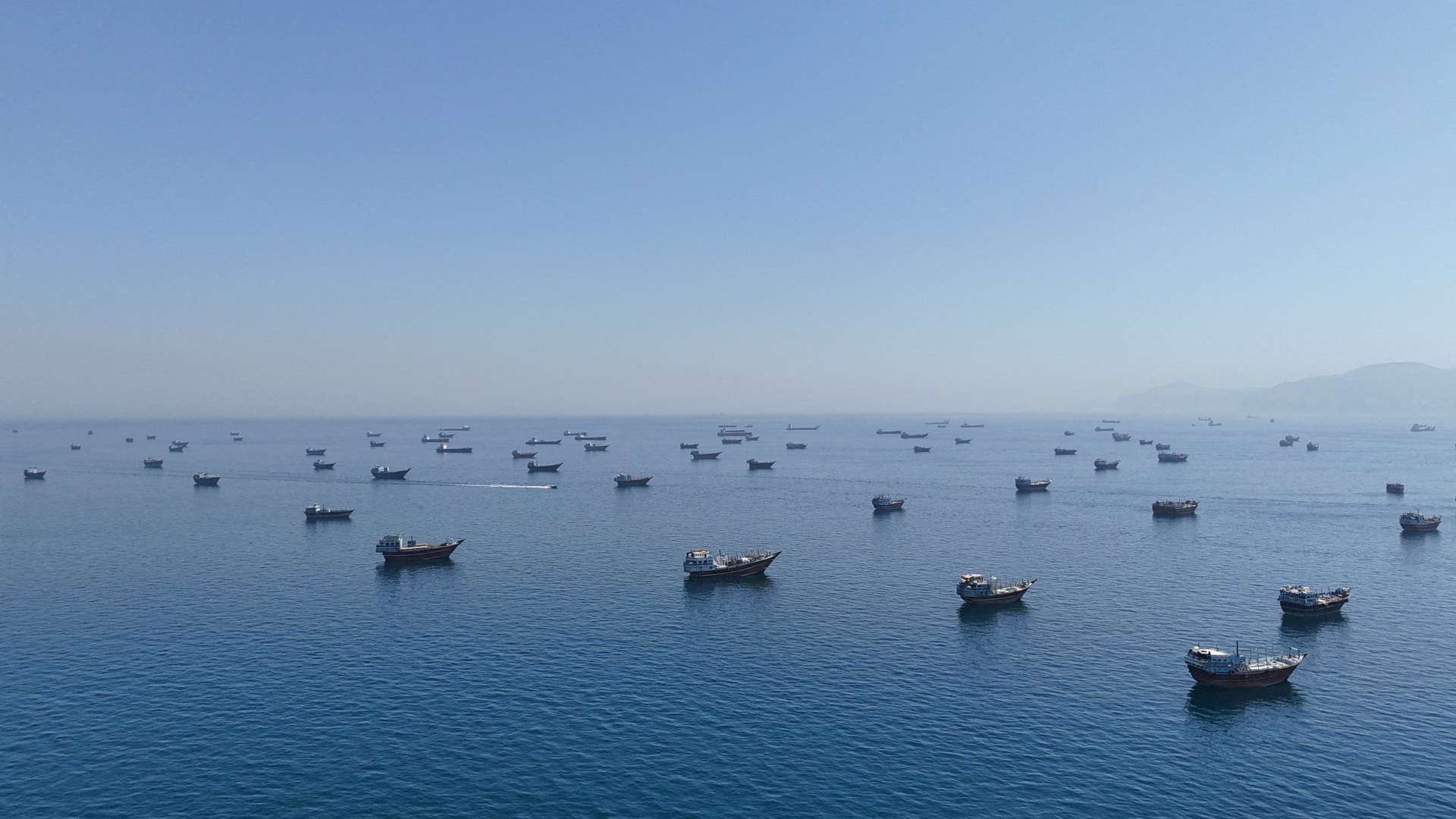
“How the reopening of the Strait of Hormuz is managed will be something to watch closely. While Iran may agree to not charge ‘tolls,’ service fees and other mechanisms have been floated,” said Elisa Ewers, a senior fellow for Middle East studies at CFR. “Getting as close as possible to status quo ante will be important for global commerce, for allies to avoid setting dangerous precedents for other waterways, and for regional partners, who will need to live with the arrangements,” she added.
Trump claimed in a social media post that ships—“many loaded up with Oil”—are already beginning to move through the strait, which was “totally safe, secure, and pristine.” Iran’s semi-official news agency Mehr, which published its own unverified version of the MOU text, said that the reopening would be subject to “Iranian arrangements,” without specifying further.
The Iranian blockade, which has been mostly in effect since the war’s outbreak in late February, has severely limited global energy supply, sending oil prices into disarray and diminishing some countries’ power supply. The price of oil dropped to its lowest point in weeks on Friday after Trump’s announcement that a deal was close, and dropped again after the weekend agreement. But experts indicated that it would still likely take several months for the flow of oil to return to normal after the Strait of Hormuz is reopened. Scouring the waterbed for mines alone will likely take weeks.
Iran’s nuclear program
The Iranian nuclear program has been one of the most contentious issues. Its facilities were the target of major U.S.-Israeli strikes in 2025 and the Trump administration cited it as an initial reason for pursuing the current war. Iran insists that its nuclear program is peaceful, despite its history of noncompliance with the UN nuclear watchdog and its enrichment of uranium to near weapons-grade.
Since Trump formally withdrew the United States from the Iran nuclear deal, on-again, off-again negotiations between Washington and Tehran on a new nuclear agreement have been unsuccessful. The United States wants to ensure that Iran never acquires a nuclear weapon, which includes Iran giving up its enriched uranium and putting a moratorium on its program. The Islamic Republic has resisted these demands.
The MOU includes two distinct nuclear commitments. Iran reaffirms that it will not procure or develop nuclear weapons, and both sides agree to negotiate the disposition of Iran’s enriched material. Separately, as an interim measure as negotiations proceed on a larger deal, Iran agrees to maintain the current status quo of its nuclear program while the United States agrees not to impose new sanctions or deploy additional forces in the region.
Iran has committed to not procuring a nuclear weapon in the past, and it has crossed that red line before. Trump claimed last week that Iran has already made this commitment. Iran, meanwhile, has not made a definitive commitment publicly, instead releasing a statement on Sunday saying that “final negotiations will be postponed until after the implementation of the other party’s commitments under the memorandum.”
The deal on the table for negotiations after the MOU signing ceremony does include Iran’s commitment to halt enrichment and dismantle its nuclear sites, but the length of the pause could be a point of disagreement. The United States is reportedly pushing for twenty years, while Iran reportedly won’t go above ten—and the final terms will have to be negotiated during the sixty-day pause. “The details matter here,” Ewers said, in terms of what the inspection and verification regime will be, what dismantlement entails in the context of facilities that were targeted in the June 2025 bombings, and several other provisions.
Iranian state news agency IRNA said that Iran would negotiate on the nuclear issue “solely within the framework of the Islamic Republic’s fundamental principles,” and wouldn’t be willing to give up enrichment—which will make a verification system critical.
“By building many small workshops containing advanced centrifuges, Tehran can challenge the prying foreigners to find them all,” Ray Takeyh, a senior fellow for Middle East studies at CFR, wrote last month. “If any escape detection, the regime has a safer path to bomb production.”
Iranian proxies
The web of militant groups across the Middle East that are supported by Iran have contributed to the escalation of several conflicts in recent years, including the Israel-Hamas war that broke out after the October 7, 2023, attacks and the Iran war. The Houthis in Yemen and Hezbollah in Lebanon have been the primary nonstate actors involved: the Houthis launched missiles at Israel on March 28, and Israel and Hezbollah were locked in conflict for several weeks in connection to Israel’s initial strikes on Iran in February.
This latest U.S.-Iran deal would stipulate that hostilities from all sides would cease, and this would include on the Israel-Hezbollah front. Iran has not yet made any statements about whether it would agree to stop funding its proxies, which has reportedly been a U.S. condition in negotiations, though it doesn’t outright appear in the deal read by the U.S. official. In the past, Iran has both opposed negotiation about its proxy network and supported stopping Israeli hostilities in Lebanon—which Cook said is part of Iran’s “effort to save Hezbollah and keep Lebanon from normalizing ties with Israel.”
Israel’s military, the Israel Defense Forces (IDF), announced an evacuation notice for civilians in southern Lebanon on June 12, citing “Hezbollah’s violation of the ceasefire agreement.” Israel is not part of the agreement between the United States and Iran, but Israeli Prime Minister Benjamin Netanyahu said that he and Trump had spoken on the matter last week and were in “complete agreement.”
Hezbollah released a statement on Monday that they welcomed a deal that halted fighting on all fronts, though the militant group asserted that it has a right to “defend” Lebanon until Israel makes a complete withdrawal.
Military limits
The limits that the United States would like to place on Iran’s missile program are, perhaps, among the most difficult sticking points to negotiate. Iran has cast changes to its missile program as an intractable red line, with Iranian Foreign Minister Abbas Araghchi posting on his Telegram channel after talks in February that the country’s program was “never negotiable,” calling it a “defense issue.”
Iran’s counterproposal, as reported by Iranian state media, focuses exclusively on nuclear issues, sanctions relief, and economic compensation—making no mention of its ballistic missile program. But Israel has continued to push hard from the outside to force the issue, and the United States has maintained that any deal should address Iran’s missile capabilities to ensure regional security.
Few details have surfaced about Iran’s missile program in reports of the deal, and the readout of the deal doesn’t contain any mention of it, either. Some analysts and experts believe that this U.S. and Israeli demand has quietly diminished as negotiations have proceeded, even as U.S. intelligence sources estimate that Iran retains 70 percent of its prewar missile stockpile and roughly 70 percent of its mobile missile launchers. There are further concerns that Iran is using the current ceasefire to steadily rebuild its military base faster than expected.
Iran has also indicated that it would like to limit U.S. power in the region as part of a deal by requiring U.S. forces to withdraw from Iran’s periphery. Trump has said he “can’t imagine” accepting that demand.
Compensation and sanctions
Iran entered the war negotiations with financial grievances due to U.S. and Israeli attacks in recent months. The Islamic Republic has called for reparations, and Iranian officials have claimed $270 billion in direct and indirect war damage since February 28.
While the United States has rejected the reparations framing, the deal commits Washington and regional partners to developing a plan that would allocate at least $300 billion toward rebuilding the damaged Iranian economy—with the implementation mechanism to be established in the final deal. It also states that the U.S. government commits to ending on “an agreed-upon schedule” all types of sanctions facing Iran, including UN Security Council resolutions, the UN nuclear body resolutions, and all unilateral U.S. sanctions.
The deal published on June 17 announces that until sanctions are terminated, the U.S. Treasury will issue waivers for exporting Iranian crude oil, petroleum products, and associated services like banking, transportation, and insurance. But on the frozen assets question, the MOU text only says the United States will make them ‘fully available for use… upon the implementation of this MOU,’ leaving the specific procedures to be negotiated. Iran has reportedly asserted in the past that it should be able to immediately access about $24 billion that the United States and its allies have frozen, while officials in Washington have previously argued that assets should remain frozen until Tehran meets certain standards and there is a final, verifiably implemented deal.
In May, top Iranian negotiator Mohammad Bagher Ghalibaf reportedly called for half of that fund to be released at the signing of the MOU, with the other half released within sixty days. Neither side has publicly shown flexibility on the timeline for sanctions relief and releasing assets. Vice President Vance told CNBC that, “We say to the Iranians, you are welcome to have access to an unsanctioned economy, you’re welcome to be re-invited into the world economy, but only if you honor the commitments that you make in this agreement.”
Iran’s economic needs are great, especially if it would like to address economic concerns that led to widespread protests earlier this year and stabilize a wartime economy running at nearly 70 percent of annual inflation.
Israel’s war in Lebanon
The conflict in Lebanon has functioned as both a pressure point for Iran and a persistent complication for U.S. diplomacy with the Islamic Republic. Iran has explicitly linked Israel’s war on its neighbor to any potential ceasefire between Tehran and Washington. The Islamic Republic even briefly suspended negotiations earlier this month in response to Israeli operations in Lebanon. The Lebanese Health Ministry reported more than 3,400 killed in Lebanon since fighting escalated in early March; the toll continues to rise, and includes both civilians and combatants.
While Iran has said that ending the war in Lebanon is an “inseparable part” of the agreement to end the Iran war, Israel has framed its Lebanon campaign as a separate and ongoing objective—one it has pursued with or without U.S. support. Netanyahu said in March that Israel was focused on “dismantling Hezbollah” as part of its wider campaign against Iran, saying the IDF had “fundamentally changed” the situation and that any Israeli withdrawal from southern Lebanon would be contingent on Hezbollah’s disarmament.
“Including Lebanon in this understanding between Iran and the United States, as Iran has demanded, is not ideal even if it was inevitable,” CFR’s Ewers said. “For the Israel government, halting its fight against Hezbollah is a tall order, especially with upcoming elections and while Washington negotiates with Tehran on the thorny issues. For the Lebanese government, which is fractured itself, it underscores that [Lebanon] could not deliver fully on disarmament commitments while Hezbollah continues to shoot at Israel,” she added.
A U.S.-brokered ceasefire between Israel and Lebanon took effect on April 16, but both sides repeatedly accused each other of violations; the agreement has been extended twice since. Israeli strikes on southern Lebanon and Beirut have continued, prompting a heated confrontation between Trump and Netanyahu that underscored how much the Lebanon front is complicating the broader Iran deal. Even as news of the MOU broke, Israel struck the Beirut area on June 14, killing three people—a move Trump criticized for threatening the agreement.
Israel, however, was not involved in the negotiation and Israeli officials appear to be unhappy with the deal. Defense Minister Israel Katz vowed that Israeli forces would not withdraw from the area it holds in Lebanon and would hit Iran “with full force” should Tehran act aggressively. National Security Minister Itamar Ben-Gvir added on his Telegram channel that “Trump’s agreement does not bind us... we are not party to this agreement. It does not safeguard our security.”
Nonetheless, the deal shared in lead-up to the Geneva signing explicitly mentioned that its terms cover an immediate, permanent stop to military operations in Lebanon and ensuring sovereignty of Israel’s neighbor.
“Hopefully, the negotiation track between Israel and Lebanon continues apace, and Hezbollah abides by whatever restraints Tehran places on it in the context of the next sixty-plus days of negotiations,” Ewers added. “Still, it will take real time and political commitment—including from Washington—to continue to keep the Lebanon-Israel process progressing.”