The Opposition Versus Tinubu
A new alliance of old and recent adversaries is figuring how to make Tinubu a one-term president.
By experts and staff
- Published
 Ebenezer ObadareCFR ExpertDouglas Dillon Senior Fellow for Africa Studies
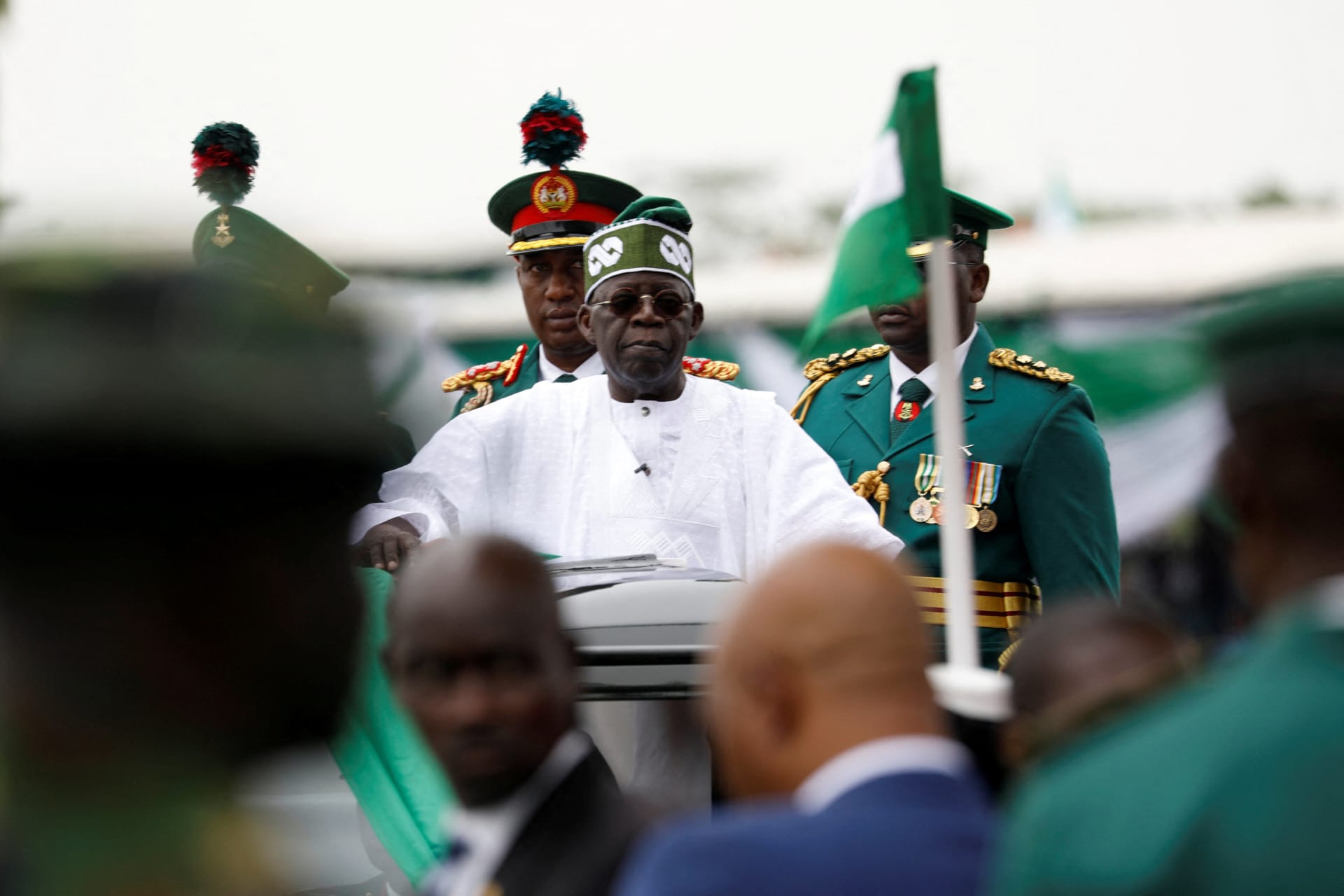
Barely a month ago, Nigerian President Bola Tinubu seemed very much in control of his political destiny. As he marked his second year in power with the accustomed bragging about fulfilled campaign promises, there was no mistaking the confidence among his closest officials that the man described as “the country’s wiliest politician in a generation” was in the strongest position possible. Apparent disarray among the opposition, indexed by a gale of defections from an increasingly bereft People’s Democratic Party, a party that, only a minute ago, was being touted as the largest if not the solidest on the continent, strengthened growing conviction that the 2027 presidential election is Tinubu’s to lose. On a recent trip to Abuja, the Federal Capital Territory (FCT), I was assured by most of my interlocutors that 2031, not 2027, is where the focus should lie.
It goes without saying that a lot has changed since then. For one thing, an opposition that seemed all but annihilated has suddenly rediscovered its mojo, agreeing, following a series of clandestine meetings, to join forces under the umbrella of an already existing party, the African Democratic Congress. For another, the announcement by presidential spokesperson Bayo Onanuga of the administration’s determination to achieve food sovereignty by “eliminating all barriers hindering Nigeria’s agricultural potential, particularly in livestock production” was widely interpreted as a panic move induced by the coalescing opposition. In any event, in a matter of days, an administration that had looked well-nigh invincible started showing signs of mortality, prompting a new round of inter-party defections amid renewed belief about the vulnerability of the All Progressives Congress (APC) juggernaut.
Will Tinubu be a one-term president?
Much will depend on how the newly formed opposition, a gaggle of strange political bedfellows united by mutual antipathy towards Tinubu, handles its own internal tensions and contradictions. While, on paper, an alliance comprising the runner-up (with twenty-nine percent of the vote) and the candidate who placed third (with twenty-five percent of the vote) in the 2023 presidential election against the winner who scored a lowly thirty-seven percent of the vote seems mathematically impeccable, it is worth keeping in mind that there is a reason why both Vice President Atiku Abubakar and former Anambra State Governor Peter Obi respectively were unable to forge a common front in the first place.
Can Abubakar, who will be eighty-one in 2027, be persuaded to give up his last realistic chance at securing a prize he has so desperately sought for more than three decades, changing affiliations in accordance with shifting political winds? How will Obi explain to the “Obidient”—assuming that that momentous coalition of young Nigerians is still intact and the ardor for their man is undiminished—that he has turned around to play second fiddle to a man he once unceremoniously dumped because of a reported disagreement over how to move the country “from consumption to production”? In the event that Obi is able somehow to get the majority of his supporters on board, a difficult prospect considering what has transpired inside the tent since the last election, will the southern portion of the Nigerian electorate really back a northern candidate, effectively rotating power back to that region so soon after wresting it from the north? Last but not least, has Obi himself done enough to repair his popularity deficit across core northern states?
Considering these obstacles alone, Tinubu should have no problem, yet again, vanquishing an opposition that, to reiterate, does not appear to have an overarching political principle beyond a commitment to dislodging him, and, worse still, continues to be stymied by formidable personal and regional obstacles.
The wildcard in all this, and the reason why, despite these obstacles, an upset in 2027 may not be outside the realm of possibility, is the figure of Nasir El-Rufai. The former Kaduna State Governor and one-time Minister of the FCT has every reason to be bitter towards Tinubu. Having played a pivotal role in the process that led to Tinubu’s emergence as the APC standard bearer in 2023, El-Rufai must have felt the pang of betrayal when Tinubu, citing unsubstantiated “security issues,” suddenly went back on a gentleman’s agreement to put El-Rufai at the head of a proposed Ministry of Power and Gas. To the extent that the sudden reinvigoration of the opposition can be traced to a single factor, that factor is El-Rufai, an ally-turned-antagonist who, at sixty-five, can afford to play the role of a spoiler in 2027 while biding his time for a crack at the presidency in 2031. While the new coalition can in no way be reduced to El-Rufai, his position within it is such that his moves on the political chessboard will go a long way in determining its success.
To worsen matters for Tinubu, his patchy record on the security and economic fronts continues to be a proverbial millstone around his neck. While his “shock therapy” has been lauded by major global financial institutions, the mood remains foul within the country, where 75.5 percent and 41.3 percent of rural and urban dwellers respectively continue to live below the poverty line. Not unlike its predecessors, the administration has barely laid a glove on the problem of widespread insecurity, highlighted by jihadist attacks and kidnapping. According to Amnesty International, more than ten thousand people have been killed by jihadist groups and criminal gangs in north and central Nigeria in the two years since Tinubu took office. This year, the country rose to sixth place on the Global Terrorism Index [PDF], below Niger, Mali, Syria, Pakistan, and Burkina Faso, which tops the list.
Even so, it would be premature to conclude that Tinubu will lose the 2027 presidential election. Despite a far less stellar record at the same point in his presidency, his predecessor Muhammadu Buhari still managed to secure a second term, and handily at that. Such, it seems, is the power of incumbency. At any rate, the election is still two years away, enough time, as we have seen far too often, for bitter political enemies to switch allegiance and become allies.
For now, the battle is joined.