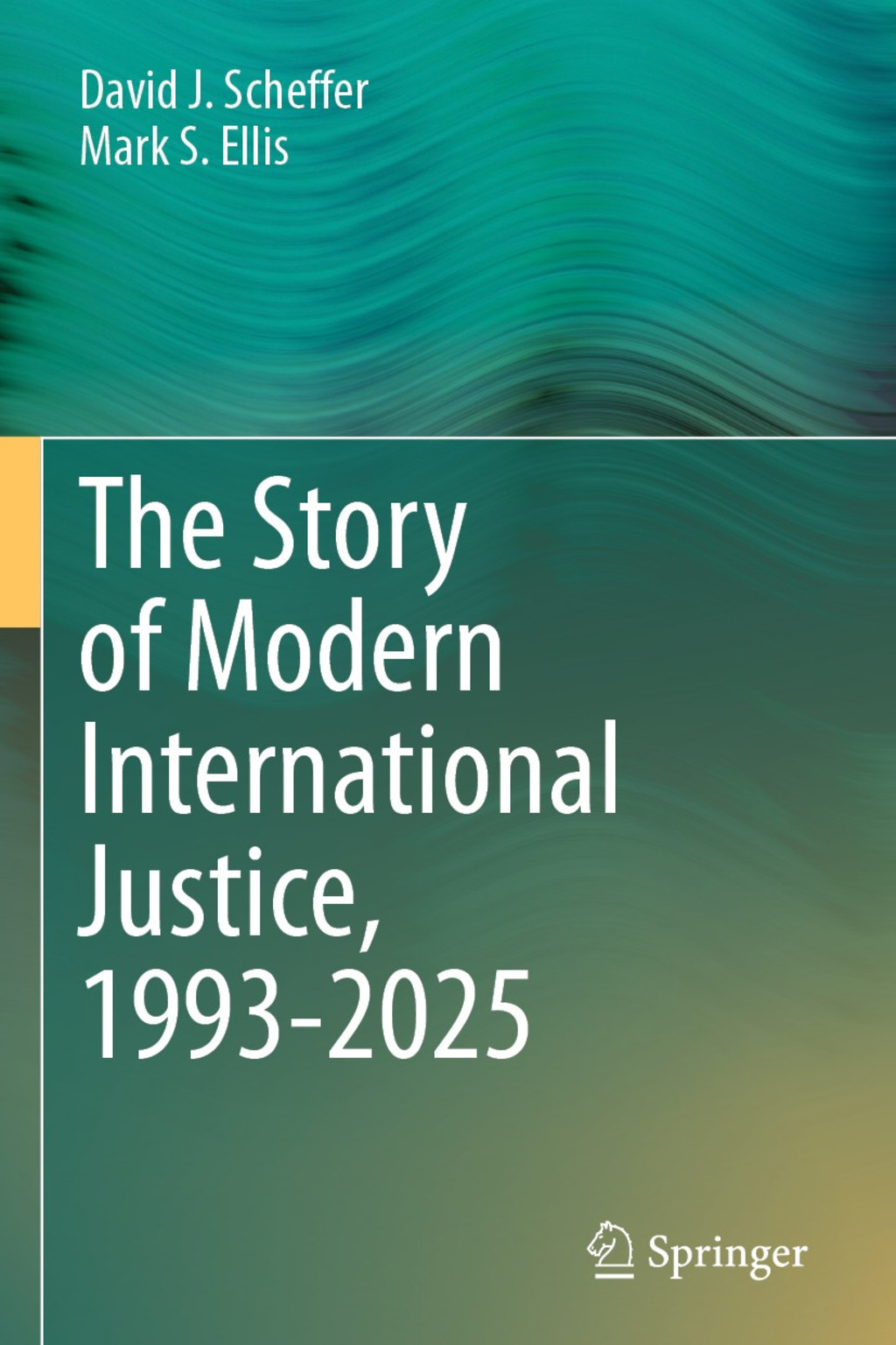
The Story of Modern International Justice, 1993-2025
David J. Scheffer and Mark S. Ellis offer a concise and accessible overview of the story of international justice during the last thirty-two years and provide readers with insight into the jurisprudence of modern courts and tribunals.
- Publisher
- Springer
- Release Date
- August 2026
- Pages
- 208
- ISBN
- 978-3032332424
This book explains the most significant cases and jurisprudence emerging from the thirty-two-year record of the judicial institutions highlighted in the book. It explains the principles of international law emerging from and being strengthened by the jurisprudence of tribunal judges. These include: the legal authority of the UN Security Council, the UN General Assembly, and regional organizations like the African Union and Council of Europe to create ad hoc or hybrid war crimes tribunals; greater precision and context in defining each category and listing of atrocity crimes, including the full range of genocide and torture and when either crime encompasses rape, the range of situations that constitute genocide and crimes against humanity, forced marriage as a crime against humanity, torture as a jus cogens principle, hate speech as persecution, and enslavement; elaborating modalities of individual criminal responsibility about command responsibility, aiding and abetting, and co-perpetration or joint criminal enterprise; developing new principles regulating non-international armed conflicts and the status of nonstate groups under international law; establishing clearer intent (mens rea) requirements for crimes against humanity and genocide; applying judicial notice to confirm the obvious reality that atrocity crimes on a massive scale occurred in a particular situation; establishing a broad range of human rights protections and the responsibility of states to ensure their enforcement.
This book tells the story of pathbreaking developments in select cases litigated before the International Court of Justice, five special purpose atrocity crimes tribunals, the International Criminal Court, and the European, Inter-American and African human rights courts, as well as what to anticipate with the newly created Special Tribunal for the Crime of Aggression against Ukraine. There also is a chapter on the important role of defense counsel before these courts and tribunals.
This work represents the views solely of the author(s). The Council on Foreign Relations is an independent, nonpartisan membership organization, think tank, and publisher, and takes no institutional positions on matters of policy.