Assessing the 70th UN Commission on the Status of Women
Event date
Speakers
- Distinguished Adjunct Professor of Law and Global Leadership, University of Pennsylvania Carey Law School
- Director of Policy, Programme and Intergovernmental Division, UN Women
Presider
- Linda RobinsonCFR ExpertSenior Fellow for Women and Foreign Policy, Council on Foreign Relations
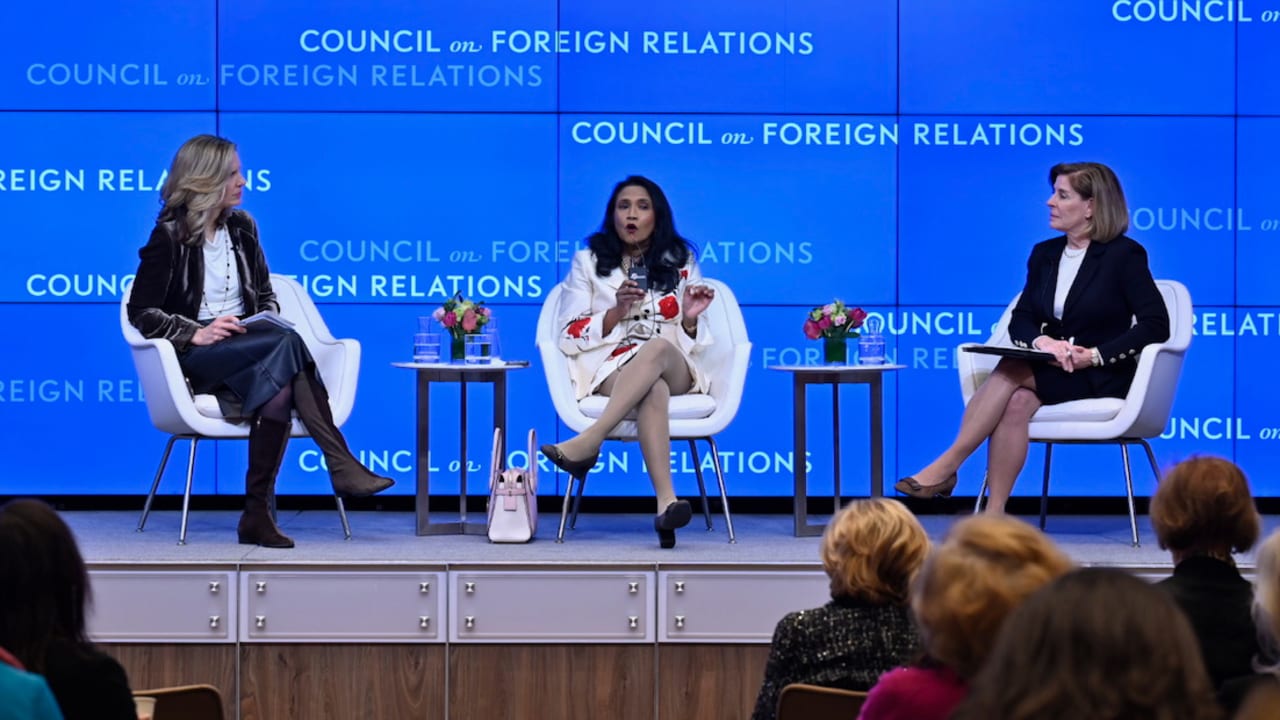
Panelists discuss the primary theme of the 70th UN Commission on the Status of Women, ensuring access to justice and addressing legal discrimination, as well as the implications of proposed UN reforms for women and girls.
This meeting is presented in partnership with CFR’s Women and Foreign Policy program.
ROBINSON: Good afternoon. I am delighted to welcome you here. I’m Linda Robinson, senior fellow for women and foreign policy. And I would like to start with the usual announcements. We are on the record today. Our session is “Assessing the 70th U.N. Commission on the Status of Women.” And it’s presented in partnership with our program, the Women and Foreign Policy Program and CFR Meetings.
I would also like to welcome the 150 or more people online to join us for this conversation. The IT department has alerted me that we’ve had a few interruptions this morning in our internet service. If you are online for the meeting and it drops off, please just come back in or pause for a moment to see if the interruption. We think the problem has been solved, but I want to let you know. Don’t give up on us. And, of course, the meeting is on the record. It will be posted at CFR.org, so you can catch up on anything you have missed.
So I am honored to welcome our two speakers today. And I would like to start by welcoming Sarah Hendriks, who is the director for programme, policy, and intergovernmental division at the U.N. Women organization of U.N. Rangita de Silva de Alwis is a distinguished adjunct professor of law and global leadership at the University of Penn, the Penn Carey Law School. And she is a member of the treaty body to the U.N. Convention on the Elimination of Discrimination Against Women. And she has been very active around the world in that capacity.
So what I’d like to do today is just start with three or four rounds of dialogue here and then go to your questions. There’s so much happening. I really want to just set the stage for questions that you may have about specific areas. This year’s commission theme—the primary theme is access to justice and the barriers that still exist in accessing justice, the discriminatory laws and policies that stand in the way of women enjoying equal rights. And some of you have probably seen the recent World Bank report that said women globally have only two-thirds of the rights of men. So I’d like to turn to Sarah first and sketch this landscape, and try to just call out for us what you think are the most prevalent or potent forms of discrimination or barriers that you’d like to focus our attention on.
HENDRIKS: Thanks so much, Linda. And, indeed, the statistic that you just raised is, in fact, a really great starting place. Because it’s quite sobering that women and girls enjoy only two-thirds of the legal rights of men. But this is not an abstract statistic. It really translates in concrete realities in terms of the ways in which women who have experienced violence choose not to report that violence, girls who don’t have a birth certificate because of legal impediments, who then are subject to child or early enforced marriage, or even women who are working steadfastly in a job but find themselves being paid unequally for work of equal value.
And let me, I think, unpack. Here at the Commission on the Status of Women in New York over the last two weeks governments have been gathering around to very much unpack these issues and this situation of inequalities in law to better understand the drivers behind those realities, and why that manifests in these ways it does for women and girls around the world.
And, first—and I have three, I think, key highlights. First is just to say that discriminatory laws today are still widespread. There is, in fact, no country in the world where women enjoy the same legal rights as their male counterparts. And just a few more statistical points. In over half of the countries of the world rape is still not defined on the basis of consent by law. In three-quarters of the countries of the world, specifically, 72 percent, there are still laws on the books that permit girls to be married as children, i.e., under the legal age of eighteen years. And in 44 percent of countries in the world there is still not legislation that guarantees equal pay for work of equal value. So you can see that discriminatory legal architecture is still very much alive and well.
My second point is that even where discriminatory laws exist, and even where more equal laws exist, the systems that surround them further reinforce the experiences of inequality. So what do I mean by that? And here it’s the ways in which justice systems are fragmented, the ways in which they are also underfunded, and in many ways often inaccessible to women and girls. I worked for many years for an organization called Women in the Law in southern Africa. And time and again women who would come for legal aid would speak about the journey to just access justice, and the constraints that they faced. So often women are facing, within a justice system, very fragmented services—from the police, to the courts, to health services, to social services. And they find themselves trapped within that context and too often give up on the pursuit of justice within these pathways. And consequently, impunity for violence often goes on and on.
And the final point I would make is just around social norms, and the ways in which social norms and biases really shape outcomes in women’s pursuit of justice at every stage. They influence really who is believed when they bring their cases forward to courts. They influence whose harm is minimized, but also who even seeks justice in the first place. So these are three ways that the experience of justice is differentiated. And all of this, of course, is intensified in the context of conflict and crises, where we see women disproportionately experiencing the realities of conflict and where access to justice is even further.
ROBINSON: Thank you. That’s a perfect springboard to the question I would like to invite Rangita to address. And you have—among the many things you’ve done, you have recently spearheaded an addendum to CEDAW that actually, describes however much this panoply of barriers is severe, you have sketched the landscape of expanding and emerging threats. So I would like to ask you to just summarize, if you could to get us started here, what the addendum does. And in essence, it sounds like it’s getting harder, and the barriers are actually growing.
ALWIS: Thank you, Linda. I have the honor of being asked to, and being charged with, drafting the addendum to the women peace and security agenda in celebration of its twenty-fifth anniversary. And this addendum is part of the CEDAW’s jurisprudence, which looks at conflict prevention, women in conflict, and women in post-conflict. Impunity, and piercing the veil of impunity, is still our greatest challenge. And I say this because this is not only history’s greatest shame, but it is also the legal system’s greatest shame. And we see this because of the fact that Security Council Resolution 2467 has unequivocally stated that it is—it is not only a cardinal offense against international humanitarian law, but that there is zero tolerance of conflict-related sexual violence.
Despite this, we find that there are very few charges that are being brought before either domestic courts or before international tribunals on conflict-related sexual violence. And this is in spite of the fact that the Rome Statute that set up the ICC, and the ICC’s own jurisprudence—most recently ICC’s jurisprudence on the Ongwen case called for reparations, reparations for children born of rape, and also defined sexual violence and rape to include forced marriage and forced pregnancy. So we see the development of the law, the development of the jurisprudence. And the translation, the transformation of these laws into the domestic legal system is the greatest challenge.
Having said that, I also want us to address the fact, Linda, that women’s bodies are not the only battlegrounds. That women’s minds are battlegrounds too. For example, in Afghanistan the Taliban’s complete denial—the systemic denial of women’s and girls’ education onwards and upwards from sixth grade is also what constitutes a crime against humanity. And that is why I often say, what is it about a girl with a book that so frightens a man with a gun? It is because an educated woman and girl is the greatest threat against misogyny, fundamentalism, and all forms of extremism. (Applause.)
ROBINSON: There you go.
ALWIS: And that is and that is why it is important for us to, while addressing sexual violence in conflict and conflict-related gender-based violence, be able to expand those categories of violence to address the ways in which power and control over women’s bodies and minds also retain and remain one of the greatest threats to peace and security.
I finally want to address the root causes of gender-based violence. And the root causes of gender-based violence look at the ways in which there is a shared responsibility, a collective responsibility, on the part of all states parties to address those root causes. And my addendum does map and does articulate the landscape of both Security Council resolutions, the International Humanitarian laws, and international human rights law that need to be harnessed to be able to address this impunity. So, for example, the Arms Trade Treaty in Article Seven calls for a gender perspective to be brought by all arms-trading parties. So all states parties to the trade of arms must understand the fact that trade in arms is a determinant of conflict-related sexual violence. And that trade in arms creates a stockpiling of arms in domestic abodes that cause a threat to women’s—is a threat to women’s security, and is a determinant of gender-based violence and sexual violence in conflict.
And then we also have to look at the ways in which the extractive industry also creates a security threat against women and conflict-related sexual violence. So, for example, the Dodd-Frank Act here in the United States calls for reporting requirements of all businesses that work on three T and G—tin, tungsten, titanium, and gold. And, as we speak, you know, everything that we hold, everything that we touch calls for—and this AI industry, technology industries are driven by the extractive industries, three Ts and gold. And it is important for us to address the correlation between extractive industries and gender-based violence as a root cause of violence.
ROBINSON: Thank you so much. This is a frightening landscape indeed. And we can come back to the problems, but I’d like to go forward to the agreed conclusions of CSW this week, and the elements I’ll just lay out for those who have not followed. The agreed conclusions include actions to eliminate the discriminatory laws and policies, access to legal aid, and coordination across all the entities within the justice system, with an expanded view to include community justice workers and others in that universe. And I would just like to know, as some of you know if you’re following the events of this week, the agreed conclusions were approved, but with the exception of one country, the United States. And unfortunately, it cast the first no vote in?
HENDRIKS: Seventy years.
ROBINSON: Seventy years. So we have an outlier, I would say. So, Sarah, if you would first, again, start. If you would just call out the action items you think are most urgent and important. That may be unfair, but it will help give people some specificity to springboard our follow-on discussion.
HENDRIKS: Thanks so much, Linda. Indeed, I think these were unprecedented agreed conclusions that have come forward on a topic that the Commission has not ever focused on before. And because of the salience of the topic of justice and access to justice it is imperative that agreed conclusions were indeed progressive and adopted at this year’s Commission, particularly because justice is where equality is so often decided, and yet far too often denied. I see that the agreed conclusions adopted for the first time by a vote in seventy years of the Commission’s operation are actually a very strong set of agreed conclusions, despite the consternation amongst negotiations. They are strong, and this is important because in this context of backlash and complexity, with political polarization across the board, having strong agreed conclusions makes all the more of a difference.
So my team has been analyzing the agreed conclusions to look at what is urgent about them, what is important for us to know that member states have agreed on, that we can and must take forward. Let me just put a profile on four things in the interest of time. Number one, member states have expanded significantly what we traditionally count as the justice system. What do I mean by that? For the first time, these agreed conclusions explicitly recognize community justice workers, legal aid and women’s access to legal aid, the work of paralegals as part of national justice systems. And this is actually a big deal. It’s a big deal because for millions and millions of women across the world, especially in rural settings, especially in the crisis settings that we’ve just spoken about, these are the justice actors who actually can help women and girls claim their rights.
Secondly, we saw member states bring digital justice onto the agenda for the first time. There is now clear language on what’s called digitally enabled justice platforms, algorithmic accountability, and gender-responsive design of technology-enabled justice platforms. This reflects, I think, a reality where justice is increasingly being mediated through technology, but it also reflects, importantly, the responsibility that governments hold to bring justice closer and safer for women and girls. Third, we are finally naming who justice systems have been leaving behind. And so for the first time, the agreed conclusions explicitly recognize women in detention, as well as the gendered pathways into incarceration. And that matters because justice isn’t just about sentencing, is it? It starts with unequal laws. It starts with unequal protection. It starts with that fragmented justice system. And this too needs to change.
And finally, and fourthly, we’ve also seen in the agreed conclusions the strengthening of the architecture for delivery. So there is a much clearer emphasis on the universal right to legal aid, a much clearer emphasis on coordination of justice actors across the entirety of a justice system, and, importantly, a much clearer emphasis on sustainable financing and investment to justice systems. I think all of this, across the line, is a consistency that closing the gap between rights in law and rights in practice matters, but it is dependent on political will, on intention, and on determination of investment. Thank you.
ROBINSON: Thank you. Rangita, I would, if you don’t mind, like to ask you to really bring to us some of the work you’ve been doing as this foremost women’s rights lawyer, and your work as a scholar. I noted in some of the—I’ve been doing a deep dive on you, and your recent session with Iraq in terms of its compliance with its CEDAW recommendations. You had specific comments about integrating the Nadia Murad Code into their national action plan. And that, obviously, given the Yazidi—this lack—the impunity that still reigns with regard to many of those war crimes suffered by them. Also, Afghanistan. You have made a very powerful case for what you called an all-tools approach to justice for women there. And specifically, I thought you might want to touch on your view about the importance of codifying gender apartheid as a war crime, and how that changes the obligations of the international community. If you wouldn’t mind giving us an insight into some of your—
ALWIS: Thank you, Linda. I will start with the second question—the second part of the question first.
During the Second World War, Winston Churchill asked Raphael Lemkin to name a crime yet without a name. And Raphael Lemkin came up with, as we all know, the term “genocide.” We are once again at a point when we need to name a crime without a name. And what we see in Afghanistan is the chilling effect of over 100 edicts that systematically deny women’s access to justice, women’s access to education—the only country in the world that denies women’s access to education and women’s access to justice. Afghanistan, through the codification of 114-page edict which is called the Law on Vice and Virtue. And this is law—where the law itself is complicit in the subordination of women—calls for public flogging and public beating for so-called moral crimes. So it is a time that calls for, again, the naming of a crime yet to be named. And this is a crime that strikes at the very conscience of humanity. It is not only about the Afghan women. It is about all of us, and the human condition that is being tested at this point in time.
As for the term “gender apartheid,” at the CEDAW committee we have used it in our General Recommendation 40. And I too have articulated gender apartheid and the need to codify gender apartheid in the draft—in the Draft Convention on Crimes Against Humanity. What I have done in my addendum is to address the ways in which the prosecutor’s office at the ICC has called for—has issued arrest warrants against the Taliban high commanders. And this is the first time that the prosecutor’s office has charged the Taliban with gender persecution as a standalone crime. So this is really historic, because previously, the prosecutor’s office has bundled gender persecution with other crimes. It is almost like gender persecution is a lesser crime. But this is the first time that gender persecution is a standalone charge.
Moreover, four state parties—Australia, the Netherlands, Germany, and Canada—have under Article 29 of the CEDAW started proceedings under its jurisdiction where it calls for negotiation and arbitration, first with the Taliban, and upon the failure of negotiation and arbitration there’s a possibility that these four state parties, that are joined by twenty other state parties including some of the states from the Global South, might file a complaint before the—before the ICJ. This, again, is historic, because it’s the first time that the ICJ will be dealing with a standalone crime on gender discrimination.
As for your question on Iraq, I was the country reporter for Iraq. And Iraq came before the CEDAW last month. And as country reporter I did raise the issue, the very fact that Iraq had acknowledged genocide, genocidal acts by the ISIS, against Yazidi women. And this recognition itself is a very important milestone, both for Iraq and for the world—the recognition of the genocide of Yazidi women by the ISIS. And in 2021, Iraq also promulgated the Yazidi women’s survival law. And this, again, was an important breakthrough law. However, what I see is that very few cases were brought under the Yazidi survivors’ law. More often the cases were brought under the antiterrorism law. What this did—what this exclusion resulted in was that women didn’t have their day in court. Charges of rape and charges of sexual abuse, those stories, those narratives were not shared in court. By 2021, there was only one charge brought on rape and sexual violence during the ISIS regime of crimes against humanity.
So this shows again—once again impunity, and the veil of impunity when it comes to sexual violence and other forms of gender-based violence for women during conflict. So, I did ask. And one of the reasons—some of the reasons for this is the fact of the shame and the stigma around sexual violence in conflict. Women are not willing to come forward with these narratives when the legal system itself is inhospitable. So I called for a survivor-centric approach to justice, a survivor-centric approach to the interpretation of evidentiary requirements and rules of procedure. And I also called for the adoption of the Nadia Murad Code, which was adopted in the U.K. by the U.K. Parliament, which calls for a survivor-centric, trauma-informed investigation and collection of evidence. Because without that trauma-informed, gender-sensitive, and survivor-centric collecting of evidence, and the ways in which women are being supported through psychosocial and other forms of services, women are not able to access justice, especially on crimes of such exceptional nature such as conflict-related sexual violence and rape.
ROBINSON: Thank you. I know that we have a lot of people in the room that have expertise and issues they want to raise. I’m going to—my plan had been to try to ask two more questions, but I think in the interest of coming to the conversation more quickly I’ll just note we’ve done a lot of work here about digital safety and the implications of AI. I know that’s part of the agreed conclusions. I know that. Rangita, you’ve done work. Perhaps we could table that to come into our discussion, as I think people in the room here want to hear what are the proposals.
But I’d like to move to the broader situation we are in now with two distinct but related questions. First, Sarah, you’re in the midst of an assessment about the proposed merger of U.N. Women with UNFPA as part of a U.N. reform process. And I think many people in the room are probably aware of it, but I think it’s worth your just describing how that assessment is looking at risks and benefits of such merger. They do have separate mandates, separate areas they’ve been working in, those two entities. And how you would suggest to make sure there’s no net loss of effort or resources that can reach the people and impact change. Thank you.
HENDRIKS: Thank you so much, Linda. And, indeed, this is ongoing, I should say, with an assessment that holds at this stage no predetermined outcome. So it is, in fact, an ongoing assessment that is part of what’s called the UN80 reform process, brought about by the secretary-general, and one of many, many different work packages that is under exploration. It is important in the consideration of a potential merger between U.N. Women and UNFPA to take a step back and to ask, why is this question even being put forward? Is it driven through the lens of efficiency? Or are there other reasons? In other words, what is the problem that is seeking to be solved here?
And in essence, when we take that step back, certainly efficiencies are always something that any reform process should address. But the more critical and imperative question that this merger assessment is seeking to address is that of impact, and in particular impact in a context of increasing political polarization, increasing organized and well-funded pushback on gender equality and the regression of women’s rights that increasingly is manifested in intergovernmental negotiations and agreements. And of course, the historic vote this past week is one demonstrable example of that. But also, in a context of increasing donor concentration. And so really the question at hand is, is the institutional configuration of U.N. Women and of UNFPA, as it currently stands, fit for the future? Is it fit—or, is it future-proofed for a world five years from now, eight years from now, ten years from now, where these political dynamics, as well as financial realities of decreasing ODA, where these are heightened even more?
And it’s—the question is positioned there, within that context. Indeed, the merger assessment looks at both potential benefits as well as a very sober and comprehensive analysis of risks. It undertakes a cost-based analysis as part of that, as well as a feasibility analysis. This has produced two documents that have been shared thus far with member states. Not the assessment yet—an FAQ as well as a baseline as-is, meaning the baseline of U.N. Women, the baseline of UNFPA in terms of its their overall organizational profiles, areas of work, financial personalities, as well as overall reach across the world. And next will be a synthesis of the merger assessment report that will go to member states from the secretary-general in a few more weeks, followed, we hope, by the fulsome merger assessment report, which is now just going to the secretary-general for his review.
We stand waiting. This decision, I should say, sits in the hands of member states themselves. It is not for U.N. entities to decide, but for the governments that comprise the United Nations. And it can only be decided by a U.N. General Assembly resolution. And that is the only forum for that decision to be made. I hope that’s helpful, Linda, in terms of more context.
ROBINSON: Yes. Thank you. And I think there’ll be certainly follow-up questions. A number of groups have submitted letters and so forth, so I’m sure we’ll get into that.
And, Rangita, I’m going to absolutely allow you for your intervention before we go to questions, to address the work you’ve done in the critical issue of AI bias. And I would say, as you’ve said and as our program here has analyzed, it’s bias in data, it’s bias in design, and it is either developer bias or at least neglect of concern for the safety of their products. So let me let you springboard some future discussion of that as we open up with your initial comments.
ALWIS: Thank you, Linda. So last—I think your question references the fact that on Monday we did refer to the fact of digital violence, and cybercrimes, and technology-facilitated gender-based violence. Especially given the adoption of the U.N. Cybercrime Convention, which, although it does not go far enough to address the gendered aspects of cybercrimes, they are written in the law aspects that are very much gendered, such as nonconsensual sharing of intimate images, cyber grooming for sexual purposes, and cyber trafficking. All three have a disproportionate impact on women and girls, although the law itself does not address those issues through a gender lens. However, on Monday and this morning I did address the fact that we need to go beyond that to look at the algorithmic bias, the data bias, as well as the developer bias.
And these three really create the perfect storm when it comes to the issue of lethal autonomous weapon systems. What we see here is that the secretary-general has called for a binding instrument by the end of the year to regulate lethal autonomous weapon systems and to ban—and to ban some of the lethal autonomous weapon systems that operate outside of human control and do not comply with international humanitarian law principles of distinction, proportionality, and precaution. Now, the first principle of distinction calls for distinguishing between civilians and combatants. So we have to ask ourselves the questions, are lethal autonomous weapon systems that operate outside of human control able to make that distinction? And are they able to comply with the Martens Clause, which called for principles of humanity.
So are lethal autonomous weapon systems trained on historically biased data? Large data sets that contain historically discriminatory biases that underrepresent certain constituents, like women, minorities, and persons of color, are they able to make that kind of judgment in times of war? And who is responsible? Who can be held accountable for mistakes in war? You know, Oona Hathaway speaks about mistakes in war and who is responsible. And I want to take that argument even further when it comes to lethal autonomous weapon systems. Whom can we hold accountable for mistakes in war, because under international humanitarian law responsibility is limited to individuals and states. So when it comes to autonomous weapons, who is responsible?
Large language models are trained on these historically biased data. And in my—in my constructive dialogues with state parties I often asked this question. And I urge state parties to address indigenous data systems, to collect data from indigenous epistemology, so that indigenous ways of knowledge, ways of thinking, can help to shape not only the data that is collected—because data is the new oil—but also can shape the algorithms that make our decisions for us. Very soon these decisions will be made—whether it is women’s access to banking, credit, or property—will be made through algorithms that need to be debiased. Thank you.
ROBINSON: Thank you so much, Rangita. What I’d like to do now is open up to questions. Remind all of you that we are on the record. And I would like to invite members and guests to state your name and affiliation and ask a question, so we can get to everyone in the room. Yes, please, in the back.
Q: Hi. I’m Dale Mathias. (Coughs.) Excuse me. I’m a member and I’m with Regenerative Carbon Alliance in Kenya.
My question relates specifically to what’s happening in the United States right now with regard to the Epstein files. And not the files, exactly, but the women. And the fact that we’re having a very hard time getting anything to happen with any of the perpetrators, who are—presumably there are perpetrators who can be brought to trial. But this is not happening. And I just wondered what you think about that. And I think it’s very interesting, in fact, the point about impunity, and the fact that sex crimes are often charged with—people who are responsible for them are charged with other crimes. I think that’s very interesting, in England in terms of what happened to the former prince. He’s charged with something totally different. And there’s been no reference to his—what is potentially sex crimes. So that’s my question.
ROBINSON: May I ask Rangita, as our lawyer on the panel, to take that on?
ALWIS: This is an interesting question. And I just want to, as an analogy, share with you a very difficult case that I had to address as a case reporter and the chair of the individual complaints mechanism under the CEDAW’s Optional Protocol. I’m not going to name names of the country, but this was a case of a(n) eleven-year-old child with an intellectual disability who was raped several times by a police officer. And because of the fact that the police officer gave her a few pieces of fruit, the charges were dropped from rape to fornication, because there was—there was the sense that she had consented to this act of rape.
And the case then went before the appeal court. And the appeal court did change the charge to rape, but still the appeal courts and the supreme court’s ruling was not implemented. So I call this very much a case of impunity. And over ten years—over twelve years the young child had to remain in a protective shelter while the police officer was at large and, you know, had many, many, many advances in his career. So it’s an extraordinarily difficult case for us to address, but this was an opportunity for me to really dig deep into rape, into what constitutes rape, and what and how consent needs to be redefined.
So in this case, the state party’s penal code did define consent in a way that you have to show signs of physical and visible harm. And as you know, we do want to redefine rape in a way that it has to be voluntary, affirmative consent. And the ways in which we have to go from no means no to yes means yes. That it is only a yes. It’s only a voluntary, affirmative consent that constitutes consent to an act of sexual intercourse. So this was an opportunity for me to really delve deep, not only into this horrific case but to be able to develop new jurisprudence on behalf of CEDAW. It was an opportunity to ask all state parties to bring their penal codes in line with new developments in our jurisprudence to handle the issue of consent.
So this, again, in the case that you’re referring to, this horrific case, again, what comes to play is the issue of consent. And even though there is no consent when it comes to children, to minors, there is no consent, that consent even among adults must be defined as affirmative, voluntary, and yes means yes. It has to be an affirmative yes. Thank you.
ROBINSON: Yes. If you don’t mind, I’ll pick up the next question, please. Yes. Wait for the mic, please. And introduce yourself, everyone. Many of us know you, Gillian.
Q: Thank you. My name is Gillian Sorensen. I had a long career in the United Nations and I’m now retired from there.
My question relates to the recent conference and to the presence, or lack of, of the United States mission to the U.N., and their decision not to sign onto the concluding document. I’d like to know here about the reaction to that among the participants. And then one other point. As we all know, the search is on for the new and next secretary-general. After nine men in a row over eighty years many of us hope it will be a woman. I’d like to hear your comments about whether that issue came up during the conference, and whether the participants spoke up, whether there is movement for that from their own home countries, as there is here. Thank you.
ROBINSON: Great questions. Thank you. I’d like to give you both a chance. Sarah, would you like to start?
HENDRIKS: Sure. Thank you so much, Gillian, for both of your questions.
And, indeed, every year, as you may know, the Commission on the Status of Women negotiates an outcome document called the agreed conclusions. And as I mentioned, this has always been a consensus-based negotiation, and the result of that. For the first time, the U.S. was indeed actively participating, but quite late into the game. And so member states had been actively engaging in dialogue on the paragraphs of the agreed conclusions far in advance of U.S. U.N.’s interventions. The Commission is led by a bureau comprised of member states that reflect equality across the various regions of the world. And I will say that they certainly sought to ensure that all member states, including the United States, are listened to, that there’s an effort to ensure that requests and asks are addressed within the context of the text itself, and that this goes to negotiations across member states.
That notwithstanding, and in an unprecedented effort, we did see seven amendments tabled on the final—the first day, excuse me—of the Commission on the Status of Women, wherein the agreed conclusions were set to be adopted. The Commission is comprised of forty-four member states. It’s normally forty-five. There’s one seat vacant right now. And across that, member states were given the opportunity to vote. And in fact, six member states did abstain. One member state voted not in favor of the agreed conclusions. And the remaining voted in support of the agreed conclusions. And that’s—they passed in that manner. So I hope that’s helpful in terms of the context therein.
That notwithstanding, we still, I think, believe that consensus-based negotiations, particularly in this time of complexity in intergovernmental spaces and geopolitical fractures, that we still must seek to drive consensus wherever possible. That this is still the aim of not only the Commission on the Status of Women, but certainly of all intergovernmental negotiations. So the effort going forward will be just that.
ROBINSON: Would you like just address the secretary-general briefly, since your founding director is one of the candidates?
HENDRIKS: Yes, so—pardon me?
ROBINSON: Since your founding director is one of the candidates.
HENDRIKS: Yes, indeed. Indeed. So in eighty years, as you all know, there has never been a woman as secretary-general of the United Nations. And in the hallways, as well as in the main rooms of the Commission on the Status of Women, this has been a common topic of energy, of focus, really bringing to light the imperativeness of parity. But also that in eighty years the argument that there is no qualified woman no longer holds grounding, that there are indeed qualified women out there. We’ve now seen various submissions of potential candidates who are, indeed, women. And certainly this is a decision for member states to make, but certainly U.N. Women sees that that women’s voice and leadership in political spaces, including across the United Nations, is a net positive value that leads to better outcomes in development, in peace and security, and human rights spaces. And we certainly hope that we will be able to say the words “madam secretary-general” for the very first time come next year.
ROBINSON: Thank you. Rangita.
ALWIS: So my much esteemed colleague, Jose Alvarez, is here with us. And he was formerly at Columbia Law School. And Louis Henkin at Columbia Law School has said, “in the cathedral of human rights, America prefers to be a flying buttress than a pillar.” And I think—(laughs)—and I think that continues to be true. And so although there were times when, you know, America was eager to join the human rights treaty bodies, including the CEDAW. And as you may all know, the America, along with Iran, are strange bedfellows in the fact that they are yet to ratify the CEDAW—really strange bedfellows that we have both U.S. and Iran as one of six countries yet to ratify a near-universally ratified Convention on the Elimination of Discrimination Against Women.
Having said that, Biden—President Biden, when he was a senator, said time is a-wasting, when he made an appeal for the ratification of the CEDAW. And I used that as my title for a law review article that was published by the Columbia Journal of International Law. And Madeleine Albright, Secretary Madeleine Albright, said, time—not only is time a-wasting, but it’s well past time for the ratification of the CEDAW. And that was also a title of an article that was published by my school, Penn. So having said that, I just want to set the stage that there have been times in the history of the United States when we have preferred to be a flying buttress. And there are times when we have been a pillar in the cathedral of human rights.
As for a woman secretary-general, I think, you know, time is—you know, is not just—it’s well past time for us to have—to quote—to borrow from Madeleine Albright, to have a secretary-general. Because the CEDAW committee calls for parity, and after eighty years it is almost—parity remains elusive, parity at all levels. And that is why, in a time when we are speaking about access to justice, it is important to note that in the historic case of Akayesu it was a single woman judge—a single woman justice who changed the whole landscape on rape as a crime of war, as a tool of war, and rape as genocide, because there was one woman justice who asked that the charges be sent back, revised, and brought back. And that the charges should include rape in the charge—in the charge sheet that, in the first instance, did not include rape.
And in the Sepur Zarco case, the first case where a domestic court translated and addressed international humanitarian crime of sexual slavery. It was a three-bench panel of women justices that brought a survivor-centric approach to reparations and historical memory. Reparations for these abuelas of Sepur Zarco, grandmothers, indigenous women, grandmothers in Guatemala, and called for historical memory and structural and transformative justice. Linda, you wanted this theme to be about transformative justice. That is not only about individual justice, but how we can change the structures that, in the first place, subordinated women and impeded access to justice.
ROBINSON: We have a question online, and then we’ll come back and get as many in the room as we can.
OPERATOR: We’ll take our next question from Alexandra Bro. Ms. Bro, please accept the unmute now button. So we’re having some difficulties there. We will take our next question instead from Olga Nesterova.
Q: Thank you so much. Olga Nesterova with global affairs platform Onest.
I’ve been covering CSW on the ground this week and last week. And what I’ve observed is that media coverage isn’t always meeting the moment, especially when it comes to capturing the depth and substance of the discussions happening here. So, from your perspective, how can media more responsibly and consistently reflect both what’s happening at CSW, and also continuous work of the institutions beyond major moments? Thank you.
ROBINSON: A short answer, perhaps, from both of you, and then we’ll catch more of these, OK?
HENDRIKS: A great question, Olga. We, historically and certainly this year, did a press briefing of the secretary-general’s report on the Commission on the Status of Women prior to the opening of the CSW. And it was incredibly well attended, with significant media presence both online and in the press room. I will say, though, to your point, that we need to see that translate into deeper coverage throughout the Commission on the Status of Women. Really eager to see journalists pick up the issues that are being prioritized and discussed by governments, by civil society, by women’s rights leaders the world over, and brought to the front pages. I’m eager to see the ways in which the CSW can be translated so that people across the world are not only aware of the CSW, its foundations in CEDAW, in the Beijing Declaration and Platform for Action, but see its relevance to their daily lived realities and their ambitions for the achievement of women’s rights and gender equality the world over,
ROBINSON: And feel free to share the link to our meeting with others. (Laughter.) So we’re going to violate the rule and ask for Rina and Maryum. And we’ll bundle two questions together and give both speakers a chance to come back. Thank you.
Q: Thank you all for an excellent discussion. My name is Rina Amiri. I’m a cofounder of the Alliance for Diplomacy and Justice, and the former U.S. special envoy for Afghan women, girls, and human rights.
I want to thank you all for how much attention you’ve given to Afghanistan. And, Rangita, you’ve put it so well that you can’t prosecute a crime you don’t name. And that is why gender apartheid is important more specifically. Also in terms of accountability, it’s absolutely critical, because, rhetorically, there’s a lot of condemnation but there are many countries doing business deals with the Taliban. But I just—I want to—I did actually have a real question. And this was, U.N. Women.-UNFPA merger. And, you know, there’s a lot—there’s been a lot of discussion, Linda, as you noted. I think the greatest concern is, what you noted, the polarization that’s taking place right now, and the fragility of the consensus around gender equality and sexual and reproductive health. The concern of opening the—opening the mandates at a time where we see where the wind is going. And it’s not just the U.S. alone. And I wanted you to speak to that. Thank you.
ROBINSON: Would you let Maryum go ahead? So I want to try to make sure we get two, at least, more.
Q: Thank you. Maryum Saifee, CFR life member.
My question is on leadership, in terms of we want a woman, we want representation in the U.N. and other areas of influence. However, you know, going back to Epstein, when we think of Virginia Giuffre, her memoir, Nobody’s Girl, she very poignantly says that Ghislaine Maxwell was Geppetto and Epstein was Pinocchio, right? So women were playing a role throughout, if you look at the repository of the files. That women were also sort of committing gender-based violence, as complicit and complacent. So how are we making sure, whether it’s a woman or a man or whoever, whatever gender identity, is actually really an advocate for gender justice, without assuming that women at the table will always necessarily lead to a more gender-just world?
ROBINSON: Sarah, do you want to?
HENDRIKS: Thank you so much for the question around mandate preservation and protection. And indeed, this is probably the number-one topic of concern as it relates to potential risks regarding this potential merger between U.N. Women and UNFPA. And here, the secretary-general has been quite clear that the protection and preservation of mandates, both mandates that these entities are based on CEDAW, ICPD, as well as the Beijing Declaration and Platform for Action, as well as the mandates of the entities themselves, UNFPA mandate on SRHR, U.N. Women’s triple mandate on gender equality, women’s rights, and empowerment more broadly—all of these are red lines. Meaning the proposed merger would not move forward if there was in any way a doubt of the protection of those mandates. The secretary-general has been both full-throated and quite clear in terms of that, recognizing that in this current context of deepened political fracturing and deepened polarization, that this does remain a question.
That notwithstanding, I think the analysis right now is that legal imperative is less of an obstacle. And this is indeed more a political question, and one that requires member states to lean in and ensure a safe passage, if, in fact, a proposed merger is seen as a strategic imperative that can address the context that I spoke of earlier. To be very clear, I think regardless of what comes out of this merger assessment. What we do know is that the world needs a stronger central gender equality entity dedicated to women’s rights, to gender equality, to SRHR, that is future proofed. We need that in a context with mandate preservation and protection. But we need it regardless of the outcome of this merger. And I think for U.N. Women, we don’t hold a position either for or against, but rather with the ambition to really see a strong entity that emerges out of the U.N. reform process overall. Thank you.
ALWIS: I want to very quickly address the question you brought up of women’s leadership. And not necessarily the very question you asked, but in an era of AI how can we preserve and expand on women’s leadership? So you know that Anthropic AI has constitutional AI, that has been trained on the Universal Declaration of Human Rights. So my recommendation is that Anthropic AI and constitutional AI, which is now being adopted by many of the more progressive tech companies, need to be trained on CEDAW, and the Beijing Platform of Action, and all of the CSW documents, in order to be able to equalize the playing field in the collection of big data.
So having said that, I do want to reference the fact that in a week—in a two-week period when we are speaking about access to justice and courts, that the Inter-American Court of Human Rights is one of the more progressive regional courts, and has provided advisory opinions on many of these cutting-edge issues that you were speaking about, including our own general Recommendation 40 on gender parity in leadership. And we need more of that kind of jurisprudence that aligns gender parity with the rule of law and democratic theory, because without that we will be speaking in a vacuum. So it is important to be able to align our own advances on gender parity and our vision for gender parity with political theory. Thank you.
ROBINSON: Thank you so much. Thanks to everyone. And please join me in thanking Sarah and Rangita. (Applause.)
(END)
This is an uncorrected transcript.