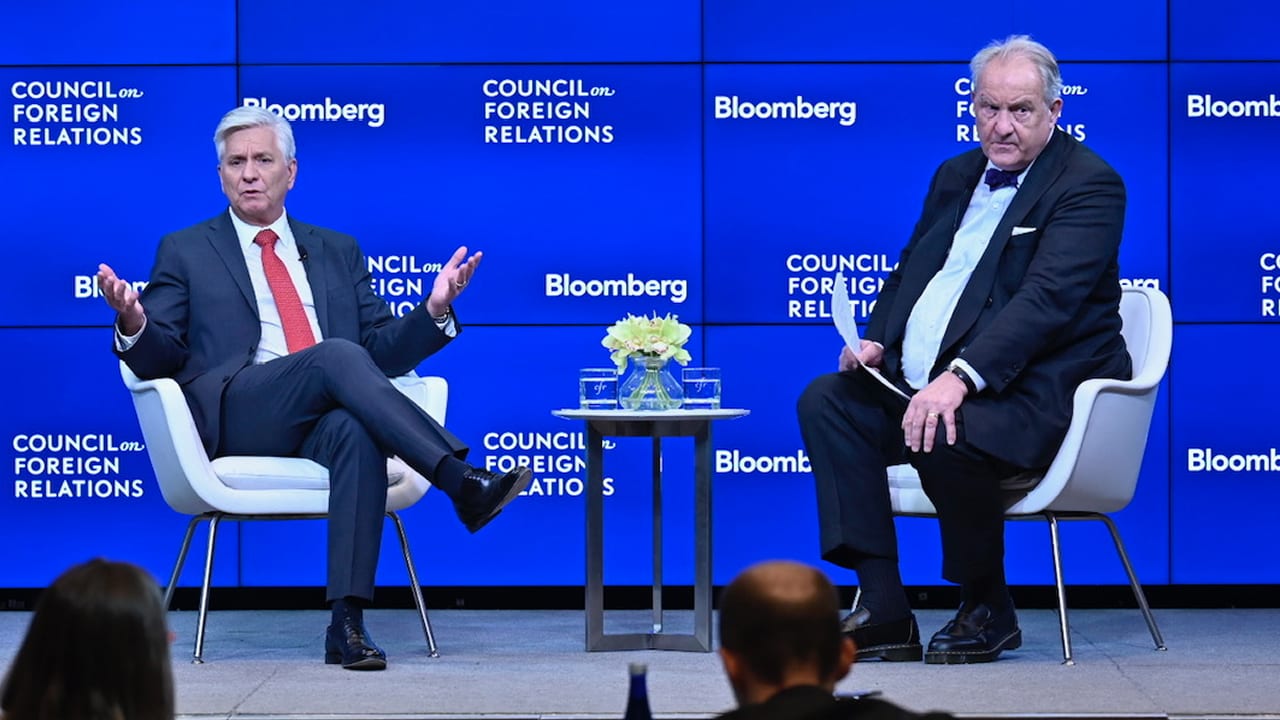
C. Peter McColough Series on International Economics With Christopher Waller
Event date
Speaker
- Member, Board of Governors of the Federal Reserve System
Presider
- Host, Bloomberg Surveillance, YouTube and Bloomberg Radio, Worldwide; CFR Member
Federal Reserve Governor Christopher Waller discusses the U.S. economic outlook in the year ahead.
The C. Peter McColough Series on International Economics brings the world’s foremost economic policymakers and scholars to address members on current topics in international economics. This meeting series is presented by the Maurice R. Greenberg Center for Geoeconomic Studies.
KEENE: Good morning. This is anticipated, to say the least. Thank you so much for being here. I’m Tom Keene. And I will sum up the notes and do a record-quick intro, because every moment is important this morning. We welcome you. It is a C. Peter McColough Series on International Economics. We welcome you. We will have Q&A. I think the governor is dreading that, but we’ll see how that goes. Important comments from the governor.
I want to make clear here, the press is here. And we thank them for their attendance today. This meeting is on the record. When we get to Q&A, we will fold this into members in attendance and also out on Zoom, the conversation worldwide. I also thank the media, and particularly Bloomberg, for true international coverage of this event, the curiosity over the views of Governor Waller.
I’m going to give you one anecdote, because I’m—my history with Bloomberg is, who are these guys? It’s like Butch Cassidy, who is this guy? And I just want to explain the seminal moment where Christopher Waller became who he is today. He was in an accounting class up in Minnesota. And the professor was ancient and literally would put the slide on the tray, and he had a putting green where then, while he was lecturing, he would sit there and putt, and then he’d go to the next tray. He said, I don’t want to do this. That’s accounting. We’re not doing that. And that’s when he became the beginning path to the economics that he is known for.
So without any further ado, the governor of the Federal Reserve Bank Christopher Waller. (Applause.)
WALLER: Well, good morning. Thanks for showing up. I was here—I think we checked just this morning—I was here in January of 2023, and had a wonderful time. And I really appreciate being back. So thank you, Tom. And thank you to the Council on Foreign Relations for the opportunity to speak to you today.
Since the Federal Open Market committee’s, FOMC, last meeting on September 16 and 17, economic data have tended to support my view of a labor market that is softening and inflation, absent temporary tariff effects, that is running fairly close to the FOMC’s 2 percent target. Based on what I know today, I support continued easing of monetary policy from its current setting, which I judge is moderately restricting aggregate demand and economic activity.
But I also see a conflict right now between data showing solid growth in economic activity and data showing a softening labor market. So something’s got to give. Either economic growth softens to match a soft labor market, or the labor market rebounds to match stronger economic growth. Since we don’t know which way the data will break on this conflict, we need to move with care when adjusting the policy rate to ensure that we don’t make a mistake that will be costly to correct. I believe that how that process plays out in the coming months will have a significant impact on the path of monetary policy.
Resolving this conflict has been complicated by the government shutdown, which has delayed important economic data that policymakers and the public rely on to judge economic conditions. Although private sector data alternatives are available, and are very helpful and they complement official statistics, they are less informative in general when they stand alone. The delay in the September employment report in particular makes it harder to know whether the labor market is continuing to soften or is stabilizing.
The shutdown also delayed today’s retail sales report for September, which would help show if household spending is continuing to support solid economic growth in real GDP, or if there are signs of slower spending that forecasters have been expecting for some time. Yesterday’s and today’s releases on consumer and producer prices were also delayed, we will get them—data that is important in judging the impact of higher import tariffs and progress towards the FOMC price stability goal. The administration has recalled some Labor Department employees to complete and release the consumer price inflation report on October 24, in time to inform the FOMC’s policy decision five days later.
To deal with this lack of public data, I spend a lot of my time talking to business contacts whose views help me inform my outlook on the economy. So far, that input tends to support, rather than resolve, the contrast we have seen between strong economic activity and a softening labor market. Employers indicate to me that there was some further softening in the labor market last month, while retailers report continued solid spending, with a bit of caution from lower income households. In the balance of these remarks, I will examine whether information we have on economic activity, inflation, and the labor market, and what it implies for monetary policy. While I feel confident, based on what I know today, that monetary policy should take another step towards a more neutral setting at the FOMC’s next meeting, the path of appropriate policy beyond that point will be influenced by how the conflict between data on economic activity and the labor market is resolved, and the expected path of inflation.
While there are times when the data are consistent and paint a clear picture, the economy is vast and complex. And it’s quite often the case that some of the data we look at will point in different—in a different direction from other data, and make the picture—that picture of the economy fuzzy. Almost every month I need to use some judgment in sifting signal from noise in the economic data. It is just part of the job of economic forecasting and policymaking. I don’t have any alternative. I have to do it. Less often, but often enough, the conflicts in the data are consequential for the outlook.
For example, if you recall in the first half of 2022 the data were creating a big puzzle. GDP was contracting for two straight quarters, yet the economy created 2.7 million jobs. Now normally that would have been called a recession, but if you have—if you’re creating 2.7 million jobs no one’s going to think you’re in a recession, even though GDP was telling you that. So these conflicting data on the performance of the economy complicated the decision on how to set the policy rate. And I believe we are facing a similar problem today.
I have been referring to the surprisingly strong data on economic activity. So let’s start there. After real GDP expanded 2.8 percent last year, it slowed in the first half of this year. GDP after smoothing through the modest contraction in the first quarter of this year and robust growth of 3.8 percent in the second, grew around 1.6 percent in the first half of the year. This pattern of GDP growth is partially a result of consumption growth that showed exactly the same pattern. Slower growth in spending in GDP made sense based on the restrictive setting of monetary policy at that time, but it was stronger than many expected with the imposition of sizable tariffs.
And after not observing the effects of tariffs on household spending in the first half the year, many thought it would show up in the third quarter. Yet, the data we have for the third quarter indicate that growth has actually accelerated. Looking across all the available data, the Atlanta Fed’s GDPNow model is projecting another quarter of GDP growth close to 4 percent, while the blue chip consensus of private sector forecast has a prediction of 2.5 percent. Even if the published estimate is closer to 2.5 percent, that is still not consistent with a labor market that has barely created any jobs since May.
One sign that GDP may be expanding closer to the lower end of the estimates is that business conditions seemed a bit softer in September, based on surveys of purchasing managers. The manufacturing sector continued to contract slightly, as it has since March. Purchasing managers for the large majority of businesses that are outside of manufacturing reported a slowdown from August to a level that is at the break-even point between expansion and contraction.
Something that will affect the growth rate of GDP in the fourth quarter is the federal government shutdown. If it is resolved in the next couple of weeks without major changes in government staffing or funding, the shutdown will lower GDP growth several tenths of a percentage point in the fourth quarter, but then it will rebound in the first quarter when the government reopens. But if the shutdown lasts considerably longer and does result in permanent staffing and spending cuts, then the drag in the fourth quarter could be larger and the bounce back smaller.
Let me now turn to inflation. Twelve month personal consumption expenditures, or PCE inflation—which is what the Fed uses for its inflation target—rose in August to 2.7 percent, and core PCE inflation was up to 2.9 percent. Now both are above the FOMC’s 2 percent target. Now, compared with an earlier era when inflation ran close to 2 percent from 2002 to 2007, core goods inflation is now running a half a percentage point higher than it did then. And research by Federal Reserve Board staff and others indicates that most of—most of this is due to the effects of tariffs.
Though a partial pass-through of tariffs will permanently raise the price level, tariffs will only temporarily affect the rate of inflation. Now, the FOMC does not target the price level, but it does target 2 percent inflation over the longer run. Since I expect tariff effects on inflation to fade in the coming months what matters for monetary policy is the rate of inflation outside of tariffs. And estimates by Federal Reserve staff indicate this underlying rate of inflation is running fairly close to our target. With market-based measures of longer-term inflation expectations apparently well anchored, and a soft labor market keeping down wage demands, I judge that inflation is on a path to a sustained level of 2 percent and should not itself be a barrier to moving monetary policy toward a more neutral setting.
Now, given this benign view of inflation, I believe the ultimate disposition of the labor market will be the more salient factor affecting monetary policy in the months to come. As I said, the broad message of all the labor market data is one of weakening demand relative to supply, even with the substantial lower net immigration and a decline in labor force participation this year. And we got very similar info from the Beige Book yesterday of a relatively soft economy. Monthly job creation went from an average of 111,000 in the first quarter to 55,000 in the second quarter. And the latest official report for August was 22,000. The numbers are nearly the same for the private sector, which I often consider a better guide to the overall labor market.
Furthermore, based on an estimate of the benchmark revision to the level of employment in March of 2025 and taking that forward for the rest of the year, when those revisions for this period are released next year it is likely that payroll employment has actually fallen on net since May. If the economy is growing as healthily as spending and GDP data indicate, I would expect that employment would recover in the coming months to a positive but not high level, reflecting the reduced labor supply that I just mentioned. However, if spending and GDP grow slow and better reflect in an economy that doesn’t seem to be creating jobs, then the labor market may continue to soften.
With the absence of the September employment report, we must rely on other data for a sense of what happened last month. Alternative labor market data for September present a mixed picture of how things are evolving. Private sector employment tracked by the payroll services firm ADP points to continued slowing in job creation. ADP estimates that private employment fell 32,000 in September, after falling 3,000 in August. The company said that job creation continued to lose momentum across all sectors in their data. Data on job postings on the online job search firm Indeed also point to a continued gradual reduction in employment, but don’t signal a significant downturn in hiring.
Indeed’s opening data are useful in the absence of the September jobs report because over time they line up closely with another report for September that may be delayed, the Job Openings and Labor Turnover Survey or JOLTS. The JOLTS data available through August have been echoing what I’ve been hearing consistently from my business contacts, which is that firms are holding on to workers but not backfilling positions or planning to expand hiring. Total separations are quite low by historical standards and both layoffs and the number of people voluntarily quitting their jobs are low. At the same time, the hiring rate has continued to fall and, outside of the pandemic recession, it is at its lowest level since 2012.
This situation may appear fairly stable, but I find this no hire, no fire stance by employers a bit ominous. It is possible that many employers who found it hard to find qualified workers during the pandemic are especially reluctant to let them go, even in the face of considerable uncertainty about demand and staffing levels in the future. But when those workers do leave, they are not being replaced. Businesses have reported that hiring and expansion are on pause. Some of my business contacts say that they can’t wait forever and will soon have to decide whether more or fewer employees are needed. Both business and consumer surveys conducted by the New York Fed signal an upturn in expectations about future levels of unemployment.
So looking further ahead, I can see two possible paths for the labor market. On the one hand, we could see a stabilization the labor market. In essence, it could move toward the story that consumption and GDP seem to be telling. Despite more than three years of very restrictive monetary policy, spending has proved very resilient. Most forecasts call for a significant step down in the pace of PCE growth this year, but that sizable slowdown just hasn’t happened. One factor that may help explain this is that the savings rate has been revised notably upward, resulting in higher disposable personal income and more support for spending. It is possible that resilience spending will help convince businesses to maintain staffing and even begin to expand hiring in the coming months, bringing about a recovery in job creation.
Another possibility is that R-star, the interest rate below which monetary policy stimulates demand, is higher than most forecasters believe, and maybe even the FOMC. If this were true, then the current setting of monetary policy may not be holding back demand and economic activity very much, which would have implications for how quickly the FOMC should lower the policy rate. Those are some reasons why the labor market may strengthen and validate the story being told based on what we know so far about economic activity in the third quarter. On the other hand, there are some reasons why the labor market continues to soften while GDP growth steps back down to a more moderate pace.
For me, one of them is how dependent consumption is on a relatively small number of high-income consumers. The highest-earning 10 percent of households are responsible for 22 percent of personal consumption. The top 20 percent of households account for a third of all spending in the U.S. economy. Their share of stock market wealth is even more skewed. And lots of research shows that these consumers are fairly unaffected by higher prices, higher unemployment, or a slower economy. The bottom 60 percent of earners in the U.S. represent 45 percent of consumption and only 15 percent of wealth. Their spending decisions are much more likely to be affected by prices, financial conditions, and job availability.
I have heard from business contacts that this group has been affected by higher prices this year and is already changing its spending plans to find better value. That view was echoed in the Federal Reserve’s recently released Beige Book, which is a survey of business contacts. The consensus view across the country is that while consumer spending inched down in recent weeks, spending by high-income households on luxury travel and accommodation was strong. Lower- and middle-income households continued to seek discounts and promotions in the face of rising prices and elevated economic uncertainty. So at what point do higher prices prompt a larger cutback in spending by middle- and lower-income households?
Now, another reason I often hear for a greater weakening in the labor market is that artificial intelligence, or AI, may reduce demand for workers. Over the past few months, retailers have told me that they will reduce employment next year because of efficiency gains from AI. Firms are saying that they can and will replace workers in call centers and IT support with AI robots. This echoes what I read recently about the largest private employer in the United States, Walmart. Walmart says that despite expectations of solid sales growth it plans to hold net employment steady for the next three years as AI replaces or transforms different roles in the company. That said, while AI adoption is widespread among large firms, it is not nearly as common among smaller firms, which account for a large share of the U.S. economy and employment.
So the impact of AI on total aggregate demand is still uncertain. The implication of this for monetary policy is not so clear. Monetary policy is designed to address cyclical fluctuations in the economy. But if AI constitutes a structural shift in the demand for labor, so labor demand is permanently lower in a significant way, monetary policy is not an effective tool to deal with that. So overall, I see AI as a short-term risk for the labor market, but in the long run—as I talked about in a speech yesterday—AI should bring productivity gains that will eventually be welfare-improving.
So where does this all leave monetary policy? Tariffs have modest effects on inflation, but with underlying inflation close to our goal and expectations of future inflation well anchored, I believe we are on track toward the FOMC’s 2 percent goal, despite recent readings. As a result, my focus is on the labor market, where payroll gains have weakened this year and employment may well be shrinking already. Labor supply has surely reduced what would be a good monthly rate of job creation, but I am very skeptical that it could be zero or a negative number. Based on all the data we have of the labor market, I believe the FOMC should reduce the policy rate another twenty-five basis points at the meeting that concludes October 29. But beyond that point, I will be looking at how the solid GDP data reconcile with the softening labor market.
If GDP growth holds up or accelerates, and the labor market accordingly recovers, it might be an indication that policy is less restrictive than I thought and the pace toward a neutral setting for the policy rate should be slower than I expected at the last FOMC meeting. What I want to avoid is rekindling inflationary pressure by moving too quickly and squandering the significant progress we’ve made over the last four years taming inflation. On the other hand, if the labor market continues to soften or even weaken and inflation remains in check, then I believe the FOMC should proceed to reduce the policy rate toward a neutral level, which I personally judge is about 100 to 125 basis points lower than it is today.
The labor market has been sending some clear warnings lately. And we should be ready to act if those warnings are validated by what we will learn in the coming weeks and months. Thank you very much for your time. (Applause.)
KEENE: I’m just as excited to extend this to 11:00 a.m. You’re warned. (Laughter.)
WALLER: My voice will be gone.
KEENE: There seems to be an excess of communication right now. Everyone is talking at the Fed within the administration. How do you interpret how everybody has to get out there and speak, speak, speak?
WALLER: Well, one of the criticisms that’s been leveled at the Fed for a long time is we engage in groupthink. Every policy decision is a twelve-nothing vote. There’s no dissents. And that if you’re all going to do exactly the same thing and think the same way, we don’t need nineteen of you. We need one. But what I always try to point out is it’s through speeches and public speaking that everybody presents their views. And you can go out and listen, and they’re not the same. So all the public speaking, the speeches, are the way for us to show our diversity of opinions and thought about the direction of policy.
This is a good thing. It’s not a bad thing. Despite people saying it’s a cornucopia of noise, it’s actually signaling where people stand. When you come to the meeting—and I always try to stress this to people—we have to make a decision every six weeks. We do not get to kick the can down the road. And what that implies is that to get a reasonable, consistent opinion, we have to kind of compromise. We have to come to a decision. And that’s why our votes are often twelve-nothing, eleven to one. It’s because we all understand we have to compromise somewhat on our positions to have a clear, consistent policy setting for markets and American people.
KEENE: Larry Meyer, Washington University, St. Louis, had a small book out of his time with Greenspan, A Term at the Fed. And he was heated about the consensus vote, the need for consensus. Should we be more like the Bank of England, which seems like a fist fight every six weeks?
KEENE: Yeah. I’d like to avoid the fist fight every six weeks. But, I mean, I personally think there’s nothing wrong with dissents. It’s a way to communicate differences in policy stances. You know, the whole complete consensus largely comes out of the Greenspan era, where it was, like, if you have a twelve-nothing vote there’s no doubt about what policy should be. Everybody agreed with the chair at that time. And that kind of tradition continued. But as the Bank of England has showed, there’s no point of having nineteen of us if we always do the same thing. So at that point, what’s wrong with having a few dissents? I don’t—actually, personally, I dissented at the July meeting. I don’t personally think that shows anything about loss of faith in the chair, or not the right policy. But that’s the whole point, is to say, look, I’m on this committee to have my own independent view and make these points. And that’s what people are doing.
KEENE: Well, we welcome all of you, again, particularly worldwide, with Christopher Waller in this audience. Ed, can I call on you first, for the first question, in a bit? I’ll let you come up with it, but I think we need to hear from Ed.
WALLER: Giving you a little time to think of it.
KEENE: He’s got a little time to think about it. And, you know, maybe—I don’t want to get in the way of his good first question.
I’m going to ask some questions about the speech. I got to keep the assembled press happy or they won’t show up again at the Council on Foreign Relations. But I want to come out of this with a little bit more knowledge about who is Christopher Waller. We’ll get to that in a minute. Number one question I get, the unemployment rate is 4.X percent. Is a 4.X percent unemployment rate now the same as a 4.X unemployment rate when you were at Washington State?
WALLER: No. I think this is where we’re in this unusual situation where we have this kind of zero net immigration instead of roughly, say, 400,000 a year. Actually, people leaving the country. And this is kind of—I said this before—it’s masking this decline in labor demand. So just think about, if it’s all immigration and you have a decline in labor supply, then the following things should happen. Employment will go down. Wages should be bid up, if you have a labor shortage. Vacancies should go up. Quits should go up. That’s what you should see with a very tight labor market and declining labor supply. When did we see that? 2022, 2021. That’s what we saw. And that was a very tight labor market.
If things are driven by a decline in labor demand, just kind of thinking about labor supply as constant, you’ll see jobs fall. There’ll be downward pressure on wages. There’ll be downward pressure on vacancies, quits rates will fall. That sounds to me more like what we’re seeing in the data. So all that’s happening with all the labor supply stuff is it’s kind of masking the weakness of labor demand. And I’ve seen some estimates that if you had just kept the labor force participation rate where it was earlier, unemployment would be 4.95 percent.
KEENE: OK. Well, that’s an important touch point. I would suggest 5 percent is a much bigger number than 4.9 percent. Do you see an immediacy at the central bank and among the staff that the real unemployment rate is five-ish, and not 4.X percent?
WALLER: Well, that’s where you got to take a position on what do you think the labor supply is doing. Is it fine that it’s 4.3 (percent), because the fact that people leave or drop by labor force that’s just a natural part of the economy? And therefore, 4.3 (percent) is exactly reflecting things. Or do you think, like I do, which is, like, we’re seeing falling labor demand. And if it wasn’t for this decline in labor supply we would be hurting. And there’d be no doubt about cutting rates, absolutely no discussion about it. So that’s where I think we’re in this weird thing. We’ve never seen falling labor demand with a big fall in labor supply at the same time, at least not in my career that I can remember.
KEENE: And that speaks to the technology, I’ll get to that in a minute, in the AI thing. You mentioned 100 basis points, four rate cuts, five rate cuts maybe is modeled in. You have to see what happens out there. Quote, “despite more than three years of restrictive monetary policy.” How many rate cuts do we need to get Christopher Waller away from the dreaded R-word, restrictive?
WALLER: Well, that’s what I said, you have to kind of pick a—what you think is the neutral rate, which means you’re neither stimulating nor contracting the economy. That’s the simplest way I’d describe what the neutral rate is. I just typically look at the SEP, the Survey of Economic Projections. And the median is around 3 percent. So for the committee as a whole, if it’s 3 percent, you know, you’ve still got 125 basis points to go to get to neutral, if everything starts coming back closer to target. And that’s where I think things are going to go.
KEENE: But the challenges you allude to in your speech—and I’m going to be aggressive here. I think of John Edwards in two Americas. Basically, there’s two R-stars out there right now. There’s an R-star for the haves, including everyone on Park Avenue assembled, and there’s an R-star for the have nots, who are flat on their back, including farmers in your Dakotas. I mean, there’s two R-stars. How do you manage that forward in a divided America?
WALLER: Yeah. So that’s actually an interesting way of thinking about it I never have. But typically, when people talk about R-star, I mean, how many interest rates are there? It’s not like there’s one, this is the unique R-star. So I gave a speech last May 2024 on R-star in Iceland. And I always have to look at it this way. For me, R-star is a policy rate. I control reserves and the banking system. What’s the closest substitute? Short term liquid government debt. So for me, that’s the real R-star that I should pay attention—not the return on capital, not the return on AI, not the return on corporate debt. The return on safe liquid government debt. That’s the R-star I’m looking at. And that’s driven by global demand for Treasurys versus the global supply of Treasurys. That’s how I view R-star.
I mean, your point is actually a very good one that what’s restrictive—if you think about R-star as being restrictive, it’s more restrictive for some groups than it is for others. That’s probably always true. It’s not just now. But it seems to be very stark this time that upper-income groups, everything’s fine. Wealth is booming. The stock market’s booming. They’ve got no problem financing stuff. I hear this from retailers. We pass tariffs through to high-income customers. They don’t bat an eye about it, because they can afford it. Low-income households, they can’t pass them through. They’ll walk out the door. So that’s the tension—again, one of these tensions that we have kind of this dichotomy in the economy between the upper income groups the lower income groups.
KEENE: Off the script, off the speech, three esteemed market economists that I spoke to all send the same thing away from a typical monetary policy speech. They’re looking at QT, QE, the state of our monetary policy forward, and the Fed’s unique balance sheet. Give us an update on where you stand with the Fed’s balance sheet and quantitative—the end of quantitative tightening?
WALLER: Yeah. I mean, I think we’re at the point where we run an ample reserves—I gave a speech in July on our balance sheet—we run an ample reserve to ensure that there’s sufficient liquidity in the banking system and the financial markets that people don’t have to at the end of the day go scrambling around looking for nickels and dimes in the couch to cover their reserve positions. That, to me, is idiocy. So you have ample reserves. The reserves are there. Nobody has to spend the whole evening looking for money under the cushions. We’re about at that point.
We had an excessively large balance sheet due to quantitative easing. We ended that. We’ve been on a quantitative tightening policy since May of ’22. And we’re basically back to where we think we should be, just for ample. All the QE stuff is taken out in terms of how much liquidity. It still has affected the composition of our balance sheet, which was part of my speech I gave in July. QE really distorted the maturity structure of our balance sheet and our next choice—even though we get the level right—our next job is trying to get the composition right. And that’ll take some time.
KEENE: I shared the stage with Jason Furman up at Harvard, boring kids in EC10 in basic economics. And he had a brilliant tweet the other day here where he said, we need to fold in the wealth effect into our consumption. You have brilliant consumption numbers in here of the haves, the upper decile. They’re trading one block over on Madison Avenue. Explain the wealth effect and how it boosts monthly consumption? You mentioned luxury travel and others. How wealth effect-y is America right now?
WALLER: Yeah. So, I mean, if you go back to kind of some basic economic theory, one kind of rule of thumb is for every $1 of wealth you get, the real interest rate—say, 3 percent, 2 percent—your consumption should go up by 2 to 3 percent for every dollar in wealth you get. So, like, two or three cents for every dollar of wealth. That’s what we mean by the wealth effect. Now, those numbers also mean that wealth increase is permanent. It’s not a one time. If it’s just a one off, you’re not going to change your entire consumption path. So this is always kind of the challenge with the wealth effect because it’s not that big of a number in terms of a dollar increase. It’s only like three cents of consumption. But that also has to be permanent. It’s not like a one off and then it comes back down. So wealth effects often, sometimes, are smaller than that. But the run we’ve had for the last few years, that’s looking pretty permanent and pretty big. It’s not just a one dollar increase, it’s a lot more.
KEENE: I’m going to squeeze in a couple more questions here. This one’s from the—David Gura gave me this question over at Bloomberg News, because he’s vicious in his questions. Should we get rid of the dots?
WALLER: That’s a good question. I mean, I personally have doubts about whether we should have the SEP at all, but I’ve been told that, what are you trying to hide then? Why would you take them away? Why would you not be as transparent?
KEENE: What would happen if the dots went away?
WALLER: Well, you’d kind of be back to 2011. And then, you know, we would see. Now, you could change the dots. I personally believe you should get rid of the calendar dating, get rid of the long run numbers, and just say, look, what’s the next optimal policy over the next six, twelve, eighteen months? That’s as good as we could do. So then it’s a rolling number. And you get away from this crazy thing that’s, like, wow, there’s three meetings left in the year. How many more rate cuts this year? Who cares? It doesn’t matter.
KEENE: (Laughs.) The media. We wouldn’t have a job.
WALLER: So if I said, OK, if the September meeting said, here’s how many over the next six months, that’s what the focus would be, not the end of the calendar year. So I would do that. And then get away from the long-run stuff. The best we can do is six, twelve, maybe eighteen months out, any kind of forecast. We’re not—we don’t have any genius insights over everybody else on Wall Street who does this. So that would be one of the critical things I would do, is change the calendar dating and shorten the horizon that we actually do it.
KEENE: One of my hallmarks is, who are these guys? Literally like Butch Cassidy. And so we’re going to find out who Christopher Waller is. I mentioned you were accounting major and you got bored because the professor was putting so you switched to economics. The Waller of 1991 is a spectacular thirteen-page paper, I think it is, on prodigious game theory. And what he didn’t know in 1991 is he would be describing the game theory of 2025. I’m not going to get you in trouble with the secretary of treasury right now, but I’m going to review this. You set up in 1991, off of James Baker’s word “bashing” where administrations bash the central bank and there’s coercion involved—the title of the paper, Bashing and Coercion.
You sub out strong administrations and weak administrations. And, no, I’m going to not ask you what this administration is. But I want to take it forward to the present day. If we have bashing and coercion, and we have to be ex ante—we’re trying to get out front of the debate. The Fed’s trying to glean what’s going on, or we go true ex post—literally in the Georgia school—where we wait for the data to come in, how does the bashing and coercion affect the monetary challenge of ex ante versus ex post? Do we come more—do we become more ex post with an administration going after a central bank?
WALLER: Well, like I said, I wrote this paper back—because at the time there was a lot of discussion about central bank independence and institutional design. And the kind of presumption was once you pick the central banker, that’s the policy and every other external influence just kind of went away. And I was kind of looking around going, that’s not what I’m hearing. That’s not what I’m seeing, back in the ’80s, right? There was a lot of criticism. And so this idea of Baker’s was, look, the administration can push the Fed one way or the other by publicly criticizing the Fed.
Now, when I wrote this paper in 1989-1990, I didn’t think I’d be the one receiving it twenty-five years, thirty years later. So when I read the intro the other day I was like, wow, what was I thinking? (Laughter.) So, but, I mean, that is kind of the situation. And it’s not just the current administration. This has been done forever. I mean, George Bush bashed Greenspan for costing him—costing him in the election, criticism had come out. This was a norm until basically Bob Rubin came along. And then it was, like, don’t talk about the Fed. And that kind of became the rule, through a sequence of administrations until President Trump came in and, in 2018, started criticizing the Fed more publicly than had been done in a long time.
KEENE: Does it change the behavior of a given central bank? If we have bashing you’re trying to get out front, the public, the media want you to be out front, omniscient, have a crystal ball? Or do you have to slam back to a massively ex-post data dependency because you’re getting crushed by whatever the executive branch is, whatever the nation is?
WALLER: I mean, at the end of the day—this is what I tell everybody—I just go to work and I try to do my job the best I can. That’s all I can do, right? A lot of this is just out of my control. You know, whether the administration’s views drive people to push one way or the other, and, you know, I can’t speak for anybody else, but I just try to the best job I can using the theory that I know, the models of the economy that I use, and the data that I use.
So, you know, the call I made in June, which was I was saying the labor market is not as good as it looks. And I was accused of being political. August 1st, that suddenly didn’t look so political. The data came in exactly the way I’d said it was going to. So what sometimes looks like—people say, ah, they were interpreting this as purely a political position, suddenly the data said maybe it’s not political. Maybe it was actually the right call. And so that’s how I kind of think of this. You can always look at something and interpret it as political when it’s not. That’s kind of the problem in what we decide and what we do.
KEENE: One more question, then I’m going to go to the floor, and also out on Zoom worldwide with the Council on Foreign Relations. I want to get this one question in. I have to ask, with your heritage of the Dakotas and the old northwest, how bad is it for the farmers right now? Soybeans is the news, but French Hill down in Arkansas is telling me, guess what, they’re flat on their back. Report on that, please.
WALLER: Well, back in the first Trump administration there was, you know, tariffs on China and tariffs—China immediately responded by not buying U.S. soybeans. And I was at the St. Louis Fed. Some of the biggest soybean producers were in our district. I heard this. We had barges of soybeans lined up on the Mississippi River that were never going anywhere. And they only have a certain shelf life before they rot and they’re gone. So we saw this. China was, I think—don’t quote me exactly, but this is in the ballpark—but China sort of bought, like, 75 percent of U.S. soybeans. Even later, when some of this came off, soybeans never recovered. China was only buying like 30 (percent)—again, don’t quote me on the exact—but, like, 35 percent. And now it’s back down to basically zero.
So they’ve just shifted their entire supply chain to Brazil and South America. And they never came back. And so that’s the one thing you want to be a little careful of, is just because a supply chain gets disrupted and then you reverse something, it doesn’t necessarily mean it comes back. Once it’s changed, it’s changed. So, yeah, soybean farmers are typically getting hammered by China not buying their stuff.
KEENE: Right. And I’ve seen the new Foreign Affairs magazine. It is brilliant. Shannon O’Neil did a great article on supply lines, which to me is the discussion in Q1 next year.
Edward Cox, please, sir, with our first question.
Q: Ed Cox, Committee for Economic Development of The Conference Board.
Governor Waller, excellent presentation. I appreciate it very much, about the data. But there are several mega things out there for which the Fed is not responsible that I’m sure are in the background or part of your consideration. And that’s the extraordinary deficits—fiscal deficits going forward, and the value of the dollar. Could you explain how those might enter into your considerations as to what the—what monetary policy should be?
WALLER: Yeah, you know, we have a kind of a longstanding view that we don’t, you know, praise or criticize fiscal policy. We take it as a given for doing our own job. But when you’re running 6 percent deficits, 3 percent primary deficits, we know that that’s just not sustainable in the long run. How long is the long run? I don’t know. The old joke, I’ll be dead before we find out. But we just know economically you can do it persistently. It’s just not going to happen. So that has general concerns. The R-star speech I gave back in Iceland was, if you think about R-star and government debt, which is the closest thing that should matter for me in reserves, it’s a race between the growing demand for U.S. treasury debt and the growing supply.
For the last forty years, demand has outstripped supply. And what does that mean? Prices go up, yields go down. At some point, if that reverses and the supply starts exceeding demand, the only way you’re going to get the markets in the markets in the world to hold this stuff is you lower the price, which means the yield is going to go up. So for me, having good, stable fiscal policy is the best way to ensure that you don’t have that happen. But, again, this is not under my control. That’s up to the, you know, Congress, White House to think about fiscal policy. And that’s it. That’s just my view on it.
KEENE: Question over here, sir.
Q: Mark Rosen, Advection Growth Capital.
Governor Waller, you talked about AI. And you said that you thought short term it could have some risks for the labor market, long term it is good for productivity. But a lot of forecasters are predicting that it will be negative for the labor market longer term, that it will reduce jobs. How does that impact monetary policy? How does it impact your dual mandate? And how do you think about it generally?
WALLER: Right, so that’s what I was saying, is this a structural or a cyclical phenomenon with AI? So if you think about it, labor demand and employment just—over time, just grows with the economy. What I worry about is AI being a structural, is there’s this one-time permanent drop in the level of demand. The question is, does it continue to grow at the same rate as before? In which case it’s just a level effect, employment growth and everything will continue on in the future. Or does it drop and then it just stays flat? It not only drops in the level, but it has a lower growth rate of employment?
I, as a policymaker, cannot do anything about that latter case. If it’s just the fact that there’s this kind of cyclical movement in labor demand, that’s what I’m designed to have some influence over. But if it’s a sharp structural drop, you know, lowering the Fed funds rate fifty basis points isn’t going to—isn’t going to overcome that. And that’s what we’re trying to figure out is going to happen.
Now, in the past, whenever we’ve seen technological change—I gave a speech yesterday down at Amazon—you know, you see jobs going away. You know which ones are going to go away. But you never know which jobs are coming. And usually there’s a kind of enough of a gap where there’s the jobs are slowly going away and the new ones are coming on. This time what I worry about is it’s so fast—it’s happening so fast that the jobs go away faster than we can figure out what the new jobs are. The new jobs will show up. I have no doubt about that. It’s just the timing may be a little more disruptive than technology we’ve seen in the past.
KEENE: Thank you for that question. I forgot to ask that. You saved me there with that question. Here’s a footnote from this speech this morning. Technology that improves labor productivity leads firms to demand more labor, not less. A huge body of America doesn’t agree with that. And to your point on innovation, with a Nobel Prize, a celebration of the last forty-eight hours of Schumpeter and, of course, profit of innovation, this new innovation, the gains are going to go to a narrow group, or do you think they will—this is a trichier word—they will diffuse out across America?
WALLER: Well, the history of technology is that they do diffuse. I mean, one of the things I pointed out in the speech yesterday, if you look back to Karl Marx’s theory of capitalism, machines, robots would replace labor to produce all the output, everybody would lose their jobs, be unemployed. There’d be this mass army of the unemployed. There’d be a social revolution. Capitalism would die. And we’d have a socialist utopia. That doesn’t happen, right? I mean, when capital goes up, machines and technology go up, it makes labor more productive. And firms like productive workers. And that’s why they want to hire them, because they don’t want to keep their output constant. They want to produce more. And they need both of these things to produce more output. This is what we’ve seen in the history, certainly of the U.S., in the last 200 years. The capital stock in the U.S. is seven times larger than it was in 1950 in terms of machines, equipment, everything. The unemployment rate is exactly the same. So employment grows with technology. It doesn’t go negative with it.
KEENE: But, to the president’s point, and arguably his election, a huge body of America feels let down. We had productivity. We had capital deepening an extraordinary amount. And the jobs went to China. That’s his theme. With AI, are we going to replicate that in some unknown way? And the jobs are going to go to you name the place?
WALLER: Well, even with the China shock total employment in the U.S. has grown ever since the China shock. It hasn’t gone negative or fallen. Just go look at the employment rate. Go to FRED, my favorite data series, pull up employment. Look what it does. It just goes up. So, yes, there are reallocations. Jobs get lost and they go somewhere else, or they get eliminated. But that’s my point. New jobs, new things came up. People reskilled, go into new areas. So when the China shock was hitting manufacturing, we had a whole IT software, phone, technology—information technology, that created thousands and millions of jobs.
KEENE: Is FRED an unfair advantage for the St. Louis Fed? Do they wake up every day different than any other bank? (Laughs.)
WALLER: FRED is one of the greatest gifts from the Federal Reserve to the planet.
KEENE: There we go. Ma’am, please.
Q: Hi. Ginger Cutler. I’m a term member at CFR.
Governor Waller, what you just said about how unemployment is the same as it was in 1950, and the China shock didn’t really necessarily affect employment, I guess I want to harken back to what you said about where wealth is concentrated in the hands of Americans, right? And how you said that what the bottom 60 percent of households own 15 percent of wealth and 45 percent of spending. I’m curious how that figures into what you just said about unemployment being the same as it was in 1950 and the China shock ultimately not really having an effect on the labor market. I’m curious how inequality factors into that.
WALLER: Yeah. So, like, I was just trying to get with employment, you get sectoral shifts. Some sector goes down, some other sector goes up. In my speech yesterday I said, look, when automobiles came up if you were making saddles or wagons, your jobs were going away. But those same skills got transferred over to producing chassis for cars, making car seats. The same skills, they just had to transfer. So those jobs went away but other jobs came up that took their place. That’s why you can’t just look at one sector and say, oh, that’s going to kill the entire economy. I don’t believe that’s going to happen with AI either.
In terms of wealth and income inequality, this has been an issue in the U.S. for the last forty, fifty years. There’s been a tremendous increase—or, reasonable increase in wealth inequality, income inequality. For me as a policymaker, I have one instrument. I can’t deal with inequality. It’s really not in my toolkit. I can’t say, here’s an interest rate for this group—as Tom was saying—I can’t say here’s an interest rate with that R-star and here’s an interest rate with that R-star. That’s not in my set. I have to look at the aggregate. It’s really my only choice. Can I look at these discrepancies and think how I might want to lean one way or the other? Sure I can. You know, we kind of got criticized for that before with our last framework, that we were kind of leaning a particular way. There’s nothing wrong with it. It’s just we only have—there’s just very little we can do about it. And that was my issue with our last framework. I could care about this, but there’s very little I can do with it for particular groups.
KEENE: I think we have a question here in the digital world.
OPERATOR: We’ll take the next question from Chris Thomas.
Q: Good morning, Governor Waller. Thank you for the time today. Ex-Intel, ex-McKinsey. Now I help global companies think about their global footprint and where they put advanced manufacturing facilities.
And the constant refrain is that no matter how high the tariff, the U.S. is just completely uncompetitive. And now it’s the most expensive place in the world to do business, especially if you’re building something. To what extent does this matter for the growth and success of the U.S. economy? And is there anything that could be done about it? I’ve heard that even if it’s 100 percent tariff it’s still cheaper to manufacture in Taiwan, or Vietnam, or Japan, or Korea, or China, than in the U.S.
WALLER: Yeah. I mean, this is—this is way outside my wheelhouse, I have to say. You know, trade policy, you know, particularly worrying about one sector over another, manufacturing versus others, this is just something I can’t make those decisions. That’s what the president got elected to do and he’s following through on his promises. Whether you get stuff re-onshoring or not, I don’t know. We’ll see. We did learn something with the pandemic that supply chain stretched across the globe are pretty fragile. And there was a lot of emphasis on getting nearshoring, maybe not onshoring, but nearshoring as a result.
Over time, you know, if tariffs were big enough, I’m pretty sure you’d bring your factory back. There is a price at which you will bring it back. It’s not infinite. So that’s what I don’t know. We’ll see how this all works out, whether there’s a lot of incentives to bring stuff back or not. Or whether the people that—you know, you bring these jobs back, whether people want to do them or not. I mean, in the U.S. we’ve moved into a much more of a service sector mentality. And the idea of screwing lug nuts on a tire for eight hours a day is not something most Americans typically want to do.
KEENE: Well, I’m not going to ask you about bananas and tariffs. I don’t think we’re growing bananas. Sir, over here, please.
Q: Hi. Andrew Watrous, with Morgan Stanley. Governor Waller, thank you for your comments.
I want to ask you to say a little bit more about what you are intending to convey with the phrase, “to a more neutral stance of policy.” In a sense, if you’re restrictive, just cutting once is moving to a more neutral stance of policy. Or is this describing sort of a process where over several meetings you have an idea of a range in mind that is more neutral, and you’re describing a process of moving towards that range?
WALLER: Yeah. I’d say it’s the latter. It’s really the process. So if you’re at neutral and you think you’re restrictive, and your policy rate is set up here, what’s going to cause you to bring it down? You think inflation is coming back to target. You think the labor market is either stable or weakening. You want to kind of bring it back towards neutral. It doesn’t mean you go below and you want to stimulate the economy. Things would have to really get bad. We’re not seeing that in the labor market, that we want to go below in neutral—or, I’m not seeing it. I can’t speak for anybody else. But the debate right now is about inflation. Inflation is running 3 percent. It’s way over our target. It’s been above target for five years, four years. Why are you lowering rates?
So you have to say, what is the outlook for inflation? And that’s what I’ve argued, that any tariff effects are going to be temporary. You look—this is a classic line in central banking—you look through those things. You think about what is going to be inflation twelve months from now, the next twelve months? So that’s what I’m doing. And in that world, I see inflation coming back down to target. I see a softening labor market. So I want to bring things back to target. I don’t want to go below target right now because inflation is above target.
KEENE: In Q&A we go to tenths of a percentage point. You were talking whole numbers up there. You say 2 percent is where the Fed is right now. What is the latest thinking you see around the raging debate to take the Taylor rule, look at the output gap, look at NAIRU, and all the rest of the mumbo jumbo, and plug in a more normal 2.2, or 2.4, or 2.6 percent run rate, versus the decades-long hope for a 2 percent inflation?
WALLER: Oh, change the inflation target?
KEENE: Yeah.
WALLER: Yeah, I mean, there’s always a good argument or debate about should you pick a point or pick a range. A lot of central banks of the world, they run with a range. They don’t seem to have big problems with that. You know, like the Bank of Canada has a range of 1 to 3 percent. So, you know, there’s often a question of you’re just as happy with 3 percent inflation as 1 percent. No.
KEENE: Should we be? Should we be?
WALLER: No. They want 2 (percent), but they’re not going to do crazy stuff to get it to 2 (percent). That’s the key point. You’ll get there. You’ll take your time. But you’re not going to do drastic policies to drive it to exactly 2 (percent). I think 2 (percent) is a good thing. I’ll give you my spiel. What’s the real value of having a 2 percent target with a particular price index? It holds you accountable. If I just said, eh, inflation in general, somewhere between 1 and 3 percent, there’s a lot of loose things that go on in there that I could always slippery slide say I did my job, what are you talking about? That happened with the money growth targeting back in the early ’80s? Eh, M1 was pretty good, but M2 was lousy, but next month M2 is—
KEENE: Remember how the world stopped, I think it was Thursday, at whatever it was, 3:30 for M1, M2?
WALLER: Oh, yes. Money growth target. So I like 2 percent because it holds me accountable. OK. Now you want to hold me accountable because it’s 2.2 instead of 2 (percent)? Eh, come on. That’s where a range kind of helps. I always like to tease my friends and things, is in the year 2000 if I had told you the Fed would keep inflation between 1 and 2 percent for a decade, everybody in the year 2000 would say, that is a phenomenal monetary policy success. But because it ran 1.7 and we didn’t hit 2 (percent), it was a failure. Think about that—1.7 not 2 (percent) was a failure. But if I’d asked you before any specific 2 percent target, you said 1 to 2 (percent), that’s amazing. That is phenomenal monetary. So that’s the danger with the 2 percent. It’s so precise that if you don’t hit it, you start saying you’re failing at hitting your target. That’s why I actually kind of like a range myself.
KEENE: I want to talk—one final question here for me—about the culture and the fabric of America and our economics. There is such a conceit and bias and a distrust, back to 1907 or even before, of three ZIP codes in Manhattan, or maybe the corridor from Washington up to Boston. You represent a part of America, some would say the backbone of America, from Bemidji—the Dakotas, Bemidji, all the way out to Washington State, and then to St Louis. How would the Federal Reserve system change under a Chairman Waller, given that cultural geography, versus every day the East Coast certitude it’s the heritage of the modern economic Fed.
WALLER: Well, I mean, this is one of the brilliant aspects of the design of the Fed. I’ve studied the structure of the Fed for forty years now. The whole idea was to say, look, you need some political accountability in D.C., but you want to have a lot of this outside of D.C. That was the typical grassroots get people away from D.C., talk to the American public. I always say we’re the one government agency that has contact with all parts of the U.S., who are twelve districts, and all the branches in those districts. Everybody can come talk to a president of the bank. They go out—they go out regularly, speak to the public. You can come talk to them. You can have a conversation with somebody. I mean, the only other institutions they have that kind of contact are the IRS in the Post Office. And we typically don’t want to have them knocking on our door.
So that’s one of the big advantages of the Fed, in our structure of having people on the outside. There has been debates forever moving more political accountability to the Fed, or moving in a way. Sometimes people’s views shift back and forth depending on what the situation is. But I believe the basic structure that we have is has served the country well, by representing all the country in the decision making process, just not a few handful of elites in Washington, D.C. So that, I think, is important. I would say, like I said, for me, one of the critical things—I’d change the SEP. I would encourage dissents. I’m not somebody who’s afraid of, like, oh, if you’re dissenting against what I’m pushing, that lowers my confidence, or my credibility.
KEENE: It would be so much better for us. Five-four votes would be—you know, it’d be—I highly recommend lots of dissents. It’ll make the Fed show better.
WALLER: Well, I just think that’s the whole point of it. That was the idea of the structure, was you put nineteen members so you get this diversity of views from around the country, coming in, different points of views. If everybody comes in no matter what part of the country, no matter what the situation is, and you always say the same thing, we don’t need it. You know, just have three governors and that’s it at the board, and you’re done with everything.
KEENE: Governor Waller, thank you for joining the Council on Foreign Relations. (Applause.)
WALLER: Thank you.
(END)
This is an uncorrected transcript.