Daughters and Sons Guest Event: A Conversation With Walter Isaacson
Event date
From Daughters and Sons.
Speaker
- Distinguished Professor of History and Campaign Chair, Emeritus Board Member, Tulane University; Distinguished Fellow and Former Chief Executive Officer, Aspen Institute; Advisory Partner, Perella Weinberg; Author, The Greatest Sentence Ever Written
Presider
- Michael FromanCFR ExpertPresident, Council on Foreign Relations
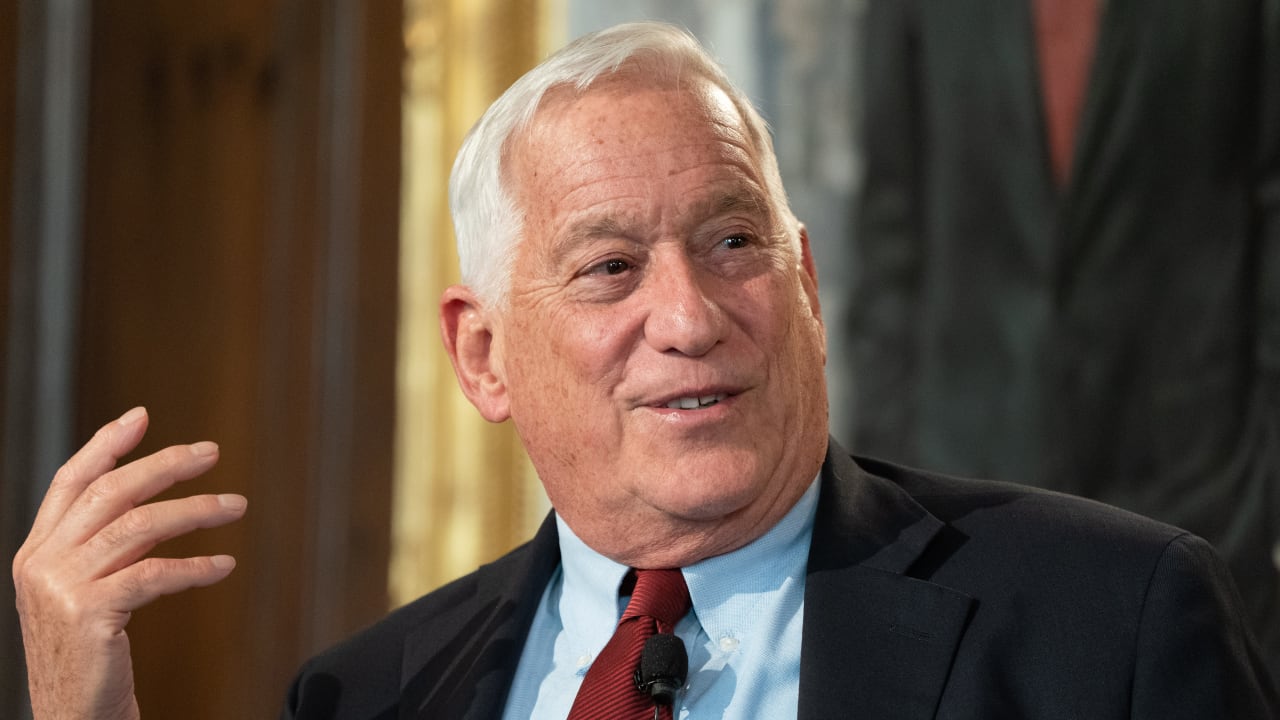
Journalist, historian, and former president of the Aspen Institute Walter Isaacson discusses his new book and reflects on America at a historic inflection point as we approach its 250th anniversary.
The Daughters and Sons meeting series is made possible by generous endowment support from The Marc Haas Foundation and the Stanley S. Shuman Family Foundation.
FROMAN: Good afternoon, everybody. Welcome to our Daughters and Sons Event. This is one of my favorite events of the year. It is so different from 99 percent of our other events this year. The average age is somewhat younger. It’s a lot more energetic. So it’s great to have you here.
We’ve been having events like this, evidently, since 1962, which, by the way, was when I was born. So not so new. But since 1971, this kind of annual event we’ve been able to have. And we’re very grateful to Stan Shuman and the Shuman Family Foundation and The Marc Haas Foundation for their support, which has made this possible. And Stan is here, and his grandson Nate, and I believe there are other Shumans on the Zoom, including David Shuman, who’s an active member here as well. So we’re very grateful to you for making this possible.
We’re privileged tonight to have Walter Isaacson. You all know Walter. He is a distinguished professor of history at Tulane.
ISAACSON: There’s no other type.
FROMAN: I can’t say—I’ve learned not to say Tulane. It’s Tulane, right?
ISAACSON: You know, I alternate.
FROMAN: Oh, OK. (Laughter.)
ISAACSON: It’s like New Orleans. You know, you could have six mayors of New Orleans on a stage, they’ll all pronounce it differently.
FROMAN: But also the past head of the Aspen Institute, the chairman of CNN, the editor of Time magazine, the author of several books, some of which we’ll talk about. Most recently, The Greatest Sentence Ever Written. And we’ve taken the liberty of putting it up on screen so that you can all see what it is we’re talking about. We have copies for purchase downstairs. We’ll talk for about thirty minutes, then we’ll open it up to questions for thirty minutes. And as was said, this part is on the record. The questions will be—will be not for attribution.
So, Walter, you’ve written several 600-page books. (Laughter.)
ISAACSON: I know, I know. Why didn’t I write a short one? (Laughter.)
FROMAN: And, you know, this one is mercifully short.
ISAACSON: Really short.
FROMAN: Very short.
ISAACSON: I’ll give you the true local honest answer, because it involves somebody you know well. Which is Leonard Lauder about two years ago said, we’re about to have our 250th. I want you to write—everybody knows who Leonard Lauder is? Yeah. I want you to write a pamphlet defending American democracy. I said, fine. But Leonard, nobody writes pamphlets anymore. Maybe I’ll do a podcast now. And if you knew Leonard, I got that cold look. (Laughter.) You know, and he’s like, no. No. So I thought, OK, what is he talking about? And I said, you know, really short? He said, if Thomas Paine can start the revolution with a sixty-page pamphlet, you can defend it with one.
I kind of forgot about it. Then I thought, OK, I got to do this for Leonard. So I wrote this as a very long special issue for Jeff Goldberg in the Atlantic. And then I showed it to Priscilla Painton and the people at Simon & Schuster, just because I was meeting with them. And they said, oh no, we want it. People love short books. (Laughter.) And I said, well now you tell me. You know, I could have saved a lot of time if I had known. (Laughter.)
FROMAN: Could have sold a lot more books.
ISAACSON: And so that was a Thursday afternoon. And just within, like, an hour and a half, we picked the cover, the font. The font is the Dunlap type of font, which is what they use for the Declaration. So I called Leonard from that skating rink in Rock Center. And I said, hey, Leonard, we’re going to actually publish it as a pamphlet. And we talked for about five or six minutes. He had picked up his cellphone, which surprised me when I called. And then he gave it to somebody. Anyway, that was a Thursday afternoon. And he died that Saturday morning. And so the first words in the book are, “for Leonard Lauder.”
FROMAN: Right.
ISAACSON: So you got a more intimate version. I usually give some, you know, oh—
FROMAN: Off the cuff.
ISAACSON: Yeah, some short books, you know.
FROMAN: But you could have written a short book defending American democracy keying off any number of things. Why pick this sentence?
ISAACSON: It’s our mission statement. And it’s also a complex mission statement, because it was not true when they wrote it. I mean, all men were not in their mind—
FROMAN: We’re going to go through it.
ISAACSON: Yeah, well, you know we’re going to get to the slavery part, I assume. And so it’s a complex thing. And I like writing about the complexities of humans. But the sentence becomes not only an aspirational statement, but a forcing mechanism. So that, you know, four score and seven years after they’ve written it, Lincoln invokes it at Gettysburg. Saying, a nation conceived in liberty and dedicated to the proposition that all men are created equal. He’s not just doing that to do a sweet Gettysburg Address. He’s burying 7,058 young men who have just died to make that sentence more true. At the Seneca Falls Declaration for women, they began with that sentence. Dr. King’s last speech begins with the sentence, and then talks about how the moral arc of history bends towards justice. But in fact, it doesn’t bend itself towards justice. Each generation has to take this sentence and say, OK, we’re now going to try to make it more true.
FROMAN: So the daughters and sons here think they’re on summer vacation, but we’re going to take them back to school for a moment. (Laughter.)
ISAACSON: Good. Instead of a Q&A, we’re going to have an oral exam.
FROMAN: Yeah, oral exam afterwards. I hope you’re all taking notes. (Laughter.) So let’s dissect the sentence a little bit. We.
ISAACSON: We is—I thought, yeah, OK, “we,” fifty-nine people hanging in Philadelphia. No, they were very much believers in the social contract theory that the enlightenment of John Locke, and Hobbes, and Hume, and eventually Voltaire have given us. And up until then, the rights of any government came from the divine right of kings, or the sword of conquerors. But you have this social contract theory that says, no, legitimate powers of government come because we were in a state of nature—which Hobbes famously says was nasty, brutish, and short, like people you know—(laughter)—and so in order to get out of that state of nature, we form a social contract. And by virtue of forming that contract, we’re all equal under that contract.
And so the first word of the sentence is the same as the first word of the Constitution, which they write eleven years later, which is “we the people.” And so it’s not just a flourish. It’s not a royal “we.” It is an invocation of the contract theory that gives America’s government its legitimacy.
FROMAN: So we hold these truths to be self-evident. That wasn’t the original word in Jefferson’s draft.
ISAACSON: No, I love—I love—because I was once an editor, I love editing a sentence. And so if you go to the basement of the Library of Congress, because they’re foolish and they keep it in the basement, you have the best document America has. Which is, Jefferson’s first draft with Adams’ and Franklin’s different edits on it. They’re all sitting in a room on Market Street. I have a little picture. You know, Market Street, the three of them there, editing this sentence, drafts on the floor there.
And so the sentence begins, if you look at it here, it says, “we hold these truths to be sacred.”
FROMAN: Sacred.
ISAACSON: Yeah.
FROMAN: Not self-evident.
ISAACSON: Right? But you can look. There’s the black printer’s pen backslashes, the way printers and editors do, crossing it out. And there’s Franklin’s handwriting, self-evident. So he’s saying, we’re trying to create a new type of nation which our rights come from rationality and reason, not the dictates of religion. And so it—and he’s also using the word—I thought, self-evident, that doesn’t sound like Franklin. It’s a highfalutin word. You know, he’s usually more down to earth. But he had been in England, as you know, in 1775, trying to hold the colonies together with the British empire. And when he failed basically, by the end of ’75, he goes up to Scotland and stays with David Hume, who is the greatest philosopher of that era.
And Hume has just written on human understanding about two types of truths. You have truths based on facts that you can observe. Like, London’s bigger than Philadelphia. And you look around and you say, OK, how many people? And then there’s another type of truth, which you call self-evident, which are true by definition alone. Such as all bachelors are unmarried. You don’t—if you want to know if that’s true, you don’t have to go around asking bachelors, do you have a wife or not? It’s self-evident that it’s true, by definition.
The reason that’s important is that it’s not true that all men are equal, or all people are equal. If you go looking around, I can look around this room, there are people are taller and smarter and shorter, whatever it may be, better athletes. But it’s self-evident that they’re equal under a social contract, because they’ve all entered into that contract. And so what he’s trying to say is it’s not like we have to observe to see whether people are equal. It’s self-evident, because we are basing this on a social contract.
FROMAN: But a few words later we have, “endowed by their creator.” So there is this weird—not weird—there is a tension there between rationality and religion.
ISAACSON: It’s not a tension. It’s a balance, which we’ve forgotten how to do.
FROMAN: Balance.
ISAACSON: Because, as you can see, self-evident, and they’re endowed with—and then there’s “by their creator.” And that’s John Adams, who’s a little bit more religious.
FROMAN: So it’s because it was written by committee we have God in there? (Laughter.)
ISAACSON: No, it was written by committee, meaning you have balance in your collaboration. There’s a creativity. And so they’re balancing the role of divine providence and the grace of our lord in blessing us with our rights, and the role of rationality and reason. And when I was first studying this sentence many years ago, when I was writing about Benjamin Franklin, I was working at CNN. And one morning I came in at, you know, 7:00 a.m. for our morning meeting. I never really believed that any good ideas happened at 7:00 a.m.—(laughter)—but this was Atlanta, so.
FROMAN: The first coffee, right?
ISAACSON: Yeah, yeah, yeah. And somebody said, oh, we have a great Crossfire show tonight. And Michael Kinsley was on the show. He said, oh yeah. There’s a judge, Roy Moore, who put the Ten Commandments on the steps. A federal judge told him to take it off, in Alabama. He’s not. They’re going to send in the marshals. Everybody’s going, that’s great. We have a crossfire. Who are we going to get in favor of the Ten Commandments? Who are we going to get against the Ten Commandments? And I’m going great. And then I go back to my loft in Atlanta. And at 9:00 p.m. I turn off the TV, because Larry King came on and I didn’t have to watch him. (Laughter.) And I—this is a daughters and sons, they don’t even know who Larry King is. (Laughter.)
FROMAN: No, no.
ISAACSON: Don’t worry, you’re not missing much.
FROMAN: It’s a history thing. (Laughter.)
ISAACSON: And so I thought, oh my god, look at us in the media and look at these politicians. We’re using the Ten Commandments to divide us, when these three drafters crafted this careful balance to bring the role of religion and the role of rationality together.
FROMAN: All men created equal.
ISAACSON: Mmm hmm.
FROMAN: You had Jefferson, who only had 600 slaves at the time, right?
ISAACSON: Yeah, a little bit—but the more interesting one is, you remember that picture I showed you of the three of them in the drafting room? One other person is in that room. His name is Robert Hemmings. Nineteen-year-old enslaved valet of Thomas Jefferson. So close to Jefferson that he shaved Jefferson every morning. They were really bonded. Jefferson, as you know, ends up having an affair with Robert’s younger sister, Sally Hemmings, and having children. And yet, there he is. He doesn’t free Robert Hemmings, or Sally, even when he dies. And yet, he’s writing, “all men are created equal.”
FROMAN: So is he a hypocrite? Or is he holding two contrary thoughts in his mind at the same time? Does he realize that there’s a—
ISAACSON: Oh, he definitely realizes it. And he writes denunciations of slavery in the first draft. The 28th count against the king is he—you know, the—
FROMAN: He blames the British for slavery, right?
ISAACSON: Yeah. And then the others take it out because they need to get South Carolina in. He is filled with dark contradictions. But, you know, Shakespeare teaches—look, Henry the Fifth. He kills all the French prisoners. I mean, he’s supposed to be the hero, but he does it. So Jefferson is one of the most complex characters in history. And he knows how bad slavery is. And he’s writing the sentence, knowing what the sentence means.
And I know that because his best friend, George Mason, three weeks earlier, in the rights of Virginia, writes that all men are created equal, and puts it—when they enter into the bonds of a—when they enter into the bindings of a society. In other words, he’s specifically excluding slaves, George Mason is. It’s slightly complex, but there’s a reason that he put those words in. Jefferson doesn’t put those words in. He knows at some point we’re going to have to get rid of slavery. But he’s just not—he has too much self-interest to do it himself. And as you know, he was poor. I mean, he was broke half the time. And all of his wealth was in the fact that he was enslaving people.
FROMAN: The “all men,” clearly it was all White Christian men who owned property, was meant by that.
ISAACSON: Mmm hmm, some nuances there. Non-property owners had many voting rights.
FROMAN: They had some rights.
ISAACSON: And Jews did too, in Philadelphia in particular. But Abigail Adams writes, John, famously, remember the ladies. Give us our rights. And. John Adams writes back, it’s in the book, that’s laughable. We’re not going to give up our masculine rights.
FROMAN: That’s what John Adams writes back to his wife?
ISAACSON: To Abigail, yeah.
FROMAN: Must have been an interesting homecoming. (Laughter.)
ISAACSON: Yeah. I wish you all had been around when Cokie Roberts was. She was one of my favorite people. But she wrote a book called “Remember the Ladies,” about the relationship between John and Abigail Adams. And so they think about it, but they do not give women the rights. But as I said, when the women’s rights movement starts at Seneca Falls, they take the sentence. And they say, OK, you got to include us.
FROMAN: Life, liberty—those seem pretty obvious—pursuit of happiness?
ISAACSON: It was the pursuit of property, in John Locke’s second treatise.
FROMAN: Property was happiness.
ISAACSON: Yeah. It was life, liberty, and property, and life, liberty, and the acquisition of property in the Virginia Declaration of Rights. Have it in there. But it was the one that George Mason does. It’s life, liberty, and the enjoyment of their properties. And Jefferson changes it, partly because he, and the other drafters, believe each person should try to define for himself or herself what their purpose in life is, and the good life. And it could be having your property and being protected. Could be serving the good Lord. It could be serving your community. There are many ways to have what Plato called “the good life.” And Jefferson read Plato, and The Republic, of course. And decided to keep it—and it’s great, because it’s a living, breathing phrase, meaning each generation gets to figure out, OK, what do we mean now by the purpose of a society? What is the good society?
FROMAN: So let’s talk about the writing, and on journalism, and where we are today. One of the purposes of this was to create a national narrative, a mission statement as you said. And it worked back then because everyone shared the same information ecosystem.
ISAACSON: Right.
FROMAN: Yeah. You’ve run CNN, you’ve run Time magazine. You see what is going on with the media today. Do you think we could agree what truths are self-evident today?
ISAACSON: No, especially now that truths on all sides—people say, well, there’s no such thing as objective truth. Which is bull. There is. I mean, you may not know it, but you can aim at it. There’s certainly misinformation. There’s no curation of information. There’s no gatekeepers. This has many good sides. When I ran Time magazine and I was at CNN, we were kind of the gatekeepers, like Walter Cronkite. We say, that’s the way it is, and everybody would share a certain set of facts. There was a real downside to having an elite that all worked within twenty blocks of here and all were members of this institution.
FROMAN: I can’t see any downsides to that, really. (Laughter.)
ISAACSON: Yeah, yeah. Being the gatekeepers. And it was kind of good when the internet allowed other people to purvey information. But it had—you know, like every silver lining, it had a cloud in it.
FROMAN: You talk about common ground and the American dream, and that those are two concepts, beyond the sentence, that really held America together. How do you assess where we are on common ground and the American dream?
ISAACSON: Well, the common ground thing is very interesting. The notion of the commons, if you don’t mind me continuing this history lesson of John Locke, is John Locke says you have the right to property. Otherwise, you don’t have your individual autonomy. He says, anybody who puts their labor to things has a right to make it private property. But he has what’s called Locke’s Proviso. Even though he’s a—you know, you consider him a true free market person. He says, as long as there is enough and as good left in common.
Now, when I first went to school up in Boston, I saw Boston Common, I saw Cambridge Common. I said, those are really nice parks. Not as nice as Central Park, but they’re nice. I realized they weren’t parks. They were the common, because 5 percent of the people, both in England and then Boston, owned almost all of the land. But under Locke’s Proviso, you had to put some land in common. And that was where the commoners, which is where the word commoners comes from, could graze their herds, bury their dead, plant their garden. So that was common ground, it was called. That’s symbolic, but also important.
And so the founders decide what should be in the commons, I’ll call it. Well, they first decide the library, of all things. That’s what Franklin does first. Then the school. Then the street sweeping corps, the police corps, the military, the volunteer fire department. They debate, should the fire department only protect houses of people who pay for it, or should it be in the common? And obviously, they choose common. We shut our government down based on health care coverage, whatever, but they tried to figure out how much health care should be in the common. They create the Hospital Company of Philadelphia, public-private partnership, serves the donors and members well, but also provide some health care in common.
We have lost that notion that we should frame our debates not as all or nothing things, but as balances. Where somebody might say, no, we shouldn’t put that much health care in the common, somebody says—it’s not all or nothing. We should frame it as, well, how much do we want to share and how much do we want to keep private? And if you’re maybe on the left, you’d say a lot more should be in common, or a lot less. But at least you don’t have to assume that one side’s communist and the other side is Nazis. You can say it’s just a question of the balance of what goes into the common. And we used to have an information common, which you already talked about, which we’ve lost.
And then there’s—sorry for going on on this question, but I’m interested in the common. We also shared a lot that we did in common. I have a picture that I love of my father at the end of 1943, dropping out of Tulane with his other people in his senior class, his five best friends, at that ROTC building on Freret Street—you know, with the gun there—so they didn’t miss World War II. And that’s when my father, who had never been out of New Orleans, is serving in the Navy with people from all walks of life, whatever. We don’t have common national service anymore.
We used to all go to Fenway Park. We’d go into the same entrances, sit in the same bleachers, eat the same soggy hot dogs. But now you have VIP entrances, you have sky-boxing of all of our stadia. Go to the airport. Separate lines. So we’re losing that notion that, as E.B. White said when he was asked, what is democracy, in 1944? It said everybody’s standing in the same line. So I think we have to be aware, even though if Mrs. Benson invites me I’m going to go to the VIP box or skybox. But we have to be aware when we lose that notion that we’re all in this together.
FROMAN: You know, you’ve written—let me talk about you as a writer for a moment. You’ve written a number of books about people who are creative and innovative, whether it was Einstein, or Franklin, Steve Jobs, Elon Musk, Jennifer Doudna. One of the common themes around the technology is what is the great potential that it provides. And right now we’re in this big debate about AI, what implications are.
ISAACSON: Yeah. And y’all were discussing that today.
FROMAN: We were discussing it today with a bunch of CEOs down in Washington. And they triggered this question, because one of them said, this would be a really good time for national service because there’s going to be this transition period where jobs may not materialize the way they did—
ISAACSON: Especially for younger people, yeah.
FROMAN: For younger people. And the jobs of the future may not yet be created. And this would be a great time for all our daughters and sons—
ISAACSON: There’s a hundred reasons why it’s a great time for national service. Another reason is that we’re tearing ourselves apart like crazy. And we don’t—you know, we don’t have a sense of a common destiny. So, yeah, national service would be—I don’t think it should be required. I don’t think we should be drafted into it. But I think it should be an option, and an opportunity, and an expectation almost, so that people say: Where are you going to do your national service?
FROMAN: And on the off chance that the daughters and sons here might be young in their career looking for jobs, what’s your view on AI and the potential implications for job markets?
ISAACSON: Well, all the technology I’ve written about ever, you know, in history, by definition, increases productivity. That’s what technology is. By definition, the increase of productivity, you’re a bit of an economist, means that there’s greater per capita wealth, right? With that, you’re going to end up with more demand for more stuff. There’s an unlimited amount of things people could want. And you will end up with more jobs because you’ll have a more productive society. I’ll give you—
FROMAN: But more productivity also means same product, fewer workers.
ISAACSON: Yeah, but also it means more wealth, which then creates more demand for—who knew you’d want, you know, UFC fight championships, you know? (Laughter.)
FROMAN: Who knew? Who knew?
ISAACSON: But we do, apparently. I’ll give you one example, which is a slight pitch. But AI allows us to gather huge amounts of information. Let me take our patron here, Stan. More than fifty years you’ve been putting together media empires and helping them pull apart, and everything else. There’s an enormous amount of material out there that could be ingested by AI. And I’ve formed a company called Boswell & Company that Tulane owns the equity state to for scholarship funds, but it takes my students—and you’ll probably know some of them—they go out and they’ll report. They’ll interview, do twenty, thirty interviews with a person, twenty or thirty interviews with their friends and former workers, using AI to gather it all, and then it creates a biography. So we write biographies or memoirs for people who, you know, just may want to pass on their wisdom or their words.
There are about 500 biographies that get published, I would say, in the United States each day. It should be 50,000. It should be 500,000. Everybody’s got a story worth telling. So someday everybody will have a biography and a documentary put together on it, because AI will offer people that opportunity. And I can give you fifty examples, just as, you know, people thought, well, they’ll never be bank tellers, because we have ATMs. Now there are more people working in branch banks by a factor of ten.
The original Luddites were called that because they were the followers of Ned Ludd, smashing the looms in England because they thought automated looms would put textile people out of work. Ada Lovelace, who began the computer revolution, daughter of Lord Byron, Lord Byron was a Luddite, seriously, because his only speech in the House of Lords was defending the followers of Ned Ludd, saying we’ve got to smash these looms because they’ll put people out of work.
Twenty years—or, thirty years after those looms came in, in the 1840s, there’s more than twenty times the number of people in the textile industry. (Background noise.) Why don’t we ask that person to please take out your phone and silence it? Thank you, sir. There’s about twenty to thirty times more people in the textile industry because of technology. OK, we’ve finished? Yeah. Thanks. And so I just think that technology—we have so many data points—
FROMAN: You don’t think AI is different than all those other technologies, because it’s approximating cognition?
ISAACSON: You know, on this stage—I’ll mention somebody’s name we don’t mention on this stage as much anymore. But I remember here for one of those—what do you all call it, the Hamilton Project? Badly named, he was—should be the Franklin Project. But there was a debate, I think, between Carla, who’s on the wall, and Larry Summers. And Larry kept saying, this time it’s different. This time it’s different. You do not—we’ve had AI now for almost three years. We’ve had press releases. Oh, we’re going to eliminate jobs because of AI. You see it in every discussion, in every panel. You don’t see it in the jobs numbers. Last month, the month before, whatever, the number of jobs keeps going up. And so I don’t think it’s different this time.
FROMAN: You’ve written this incredible array of books, biographies. Some of your subjects were dead, long dead, like da Vinci, Franklin—
ISAACSON: Well, it began in this building when I did Henry Kissinger.
FROMAN: Yes.
ISAACSON: And after I did Henry Kissinger, I said I’m going to do somebody who’s been dead for 200 years. (Laughter.)
FROMAN: That’s what I want to get to. Yeah. Yeah, because you’ve done—
ISAACSON: You would understand why. (Laughter.) Kissinger was a distinguished member of the Council on Foreign Relations. (Laughter.) In between resigning, protesting, rejoining.
ISAACSON: And he quit, almost threatened to quit, because Bill Hyland put me up to be on the board of the Council, and Henry said he would quit. And so I had to step—Bill Hyland asked me to step down from—I said, Sure. I’d be happy to.
FROMAN: It’s never too late. It’s never too late. (Laughter.) But that was going to be my question for you, which is, you had those folks, and then one who was dying, Steve Jobs.
ISAACSON: Yeah. That was really difficult.
FROMAN: And then you have Jennifer Doudna, who’s very much alive, and Elon Musk.
ISAACSON: Very much alive.
FROMAN: Very much alive. (Laughter.) What’s it like, writing for the dead versus the alive?
ISAACSON: Well, as I say, having done—every time I do somebody alive, with the exception of Jennifer who’s the nicest person ever, it’s, like, all right. I have to go back. And so—
FROMAN: Go back to your role, and—
ISAACSON: Go back to somebody. So after doing Steve, I said, oh man, I’m going to go back 500 years, and I did Leonardo. And after Elon, I said, OK, I’m going back and I’m doing Marie Curie. I’m better at living people. There are people who’ve been here on your stage who are better archival historians than I am—Meacham, McCullough, Caro, whatever. And there are people who’ve been on this stage who are probably better reporters, like Woodward or somebody. But I’m pretty good at the intersection of the two. And I can spend two years living in an Airstream trailer, you know, next to Elon’s tract house in Boca Chica, or being with Steve Jobs in his guest house. I know how to just report and listen to people. So that’s, I think, what I do better. But you just have to cleanse your palate between these living people. And so I go back into the wayback machine.
FROMAN: I remember several years ago you were kind enough to come when I was in government and speak to my team about creativity. I think you had just finished—I’m trying to remember which one of your books you had just finished, but it was about creativity. Maybe it was the Steve Jobs book. You’ve got daughters and sons here early in their careers. What advice you have for them on how to build careers that take advantage of and develop their creativity?
FROMAN: One of the things I request of all my students at Tulane is you have to double major. Major in one humanities and one hard sciences, major in neuroscience and music, major in, you know, poetry and physics. I do think that the most creative people I know stand at that intersection of the arts and sciences. That’s what Leonardo’s Vitruvian Man is a symbol of. That’s why Steve Jobs ended every product presentation with the intersection of the arts and the sciences as street signs. Secondly, is be curious. Be curious about everything. Not be curious for a purpose. Be curious for the blue sky curiosity. Leonardo in his notebook has, why is the sky blue? So does Einstein. They both put that in their notebooks. Leonardo sprays water, alcohol water, salt water, light going through it, trying to figure it out. Einstein does Lord Rayleigh’s formula, a bit more complicated. But Leonardo did not need to know that to paint the Mona Lisa. He was just curious for the sake of curiosity.
People who are curious about all possible fields tend to be the most creative. Ben Franklin, Leonardo da Vinci knew as much as you could possibly know about every subject knowable of their time, from math to music. And so that curiosity across disciplines I think is a key to creativity. When I first—I told you earlier, when I first started teaching history at Tulane, maybe five or six years ago, parents say, I’m glad they’re taking your course but I don’t want my kid to major in history. I want them to do software engineering and coding, so they can have a job. Well, nowadays you graduate having learned how to code, you’re not going to code one-tenth well as Claude is coding. But I have history students who’ve got two summer jobs and have all sorts of offers. You never know what’s going to come in handy. Which is why you should have a broad of a base of curiosity as possible.
(Break.)
FROMAN: You know, in Japan they designate certain individuals to be national treasures. I’m convinced that if we had that designation here, Walter, you would be considered a national treasure. Thank you for being here.
ISAACSON: That is sweet of you to say. (Applause.) And you would too.
(END)
This is an uncorrected transcript.