France’s UN Security Council Presidency Priorities: A Conversation With Ambassador Jérôme Bonnafont

Event date
Speaker
- Ambassador Extraordinary and Plenipotentiary and Permanent Representative, Permanent Mission of France to the United Nations
Presider
- Chair, Board of Directors, Carnegie Endowment for International Peace; Former U.S. Ambassador to the United Kingdom (2022–25) and to France and Monaco (2014–17); CFR Member
Ambassador Jérôme Bonnafont discusses France’s priorities as it assumes the presidency of the UN Security Council, in the context of the anniversary of the Declaration of New York and recognition of Palestine, the international response to the situation in Ukraine, and the operational decisions emerging from the Security Council.
HARTLEY: Great. Hello, everybody. Good morning.
BONNAFONT: Good morning.
HARTLEY: So welcome to today’s Council on Foreign Relations roundtable with Jérôme Bonnafont, ambassador and permanent representative of France to the United Nations. I am Jane Hartley, chair of the board of directors at the Carnegie Endowment for International Peace, former U.S. ambassador to Great Britain and Northern Ireland, and most importantly former ambassador to the French Republic and the Principality of Monaco. (Laughter.) I always have to say Monaco because when I was in France I got yelled at. I dropped it a few times, and the prince was not happy. (Laughter.) I’m also a long-term member of the Council on Foreign Relations, and I’ll be presiding over today’s discussion.
And I just remembered one thing, my questions are in my purse. (Laughs.) So we can start while they’re waiting to get them.
So you’re about to start the U.N.—important U.N. meeting here. France is now head of the Security Council for this term. What are the most important things you would like to accomplish?
BONNAFONT: Well, you know, first of all, I would like to thank very much the Council to host us and to give me the occasion to see you again after your Paris years, where you were celebrated as a very accomplished ambassador.
HARTLEY: Thank you. Thank you.
BONNAFONT: And I remember very well how you were representing the United States in those years. It was brilliant. And I’m happy to be in front of you.
You know, the Council has been established as the principal mechanism of the U.N. for peace and security. Therefore, what do we have to concentrate on? Being as focused as we can on reacting to armed conflicts in the world. And all of you know very well that since World War II there has never been such a number of armed conflicts in the world. And the sad truth is that during those last few years—let’s say since 2008-10, something like that—because of several military aggressions worldwide and because of polarization, the Council has not been able to react appropriately to some of the main international crises and main international armed conflicts that there were. Let’s talk about Syria. Let’s talk about Crimea. Let’s talk about a couple of situations of that sort. So our focus during these very short months—because one month is very short—is to answer to urgencies as they occur, and therefore to have the appropriate discussions, and if possible decisions, on Haiti, Ukraine, the Middle East, African crises.
And then there is to—there has to be a couple of important discussions amongst ourselves on the way to proceed in front of a couple of important evolutions. Artificial intelligence and new technologies have a tremendous impact on the way war and peace are conducted. How does the countries of the Council take that into account? What do you do with drones? What do you do with artificial intelligence? And the secretary-general has presented a report a few days ago about the future of peacekeeping and peace operations. How do we operate now in a far more complex technological world and far more complex geopolitical world? We have to have also those discussions in order to make sure that the instruments we have in the Council to react are adapted to those changes.
HARTLEY: Can I follow up on that a little bit? France has been a huge supporter of Ukraine.
BONNAFONT: Yes.
HARTLEY: And thank you. Thank you for all your efforts there. President Macron has been fantastic. But specific to Ukraine, how does something meaningful come out of the Security Council, you know, with Russia having a permanent seat and a structural obstacle to pretty much anything?
BONNAFONT: Yeah, it’s a—it’s a very annoying, to say the least, situation when one of the permanent members is the one that violates the charter and conducts a massive invasion of its neighbor, which is the exact reason why the Security Council and the U.N. have been established, to avoid this sort of situation. And that member has a veto power. So we all know that there is no significant decision to be expected from the Council on withdrawal of the Russian troops from Ukraine, because it has a veto.
How can we act? First of all, there is the fact that once or twice a month a debate takes place in the Council to take stock of the situation, denounce what is being done by the Russian forces, and support whichever mechanism that can be supported towards peace.
Second, when there is something like what has happened this weekend, with the two peace envoys of U.S. president going successively to Moscow and then, fortunately, to Kyiv, we have to start taking stock of what they have said, what they have done, what they have obtained or not obtained, and draw the conclusions of that in the Security Council. And one day, hopefully, when the Russian realize that it is dead-end situation, and that the resistance of Ukraine is not going to weaken, and that the price Russia pays for this invasion is exorbitant whereas the intent of Ukraine to remain independent and sovereign is intact, at that point there will be something happening. And we are supportive of the U.S. efforts to have this discussion with Moscow.
And Zelensky, President Zelensky, has said several times that he’s ready for that discussion. But he is ready at a condition which is a very legitimate condition, which is that Ukraine decides on what it accepts when it comes to peace. And what we say as European is that, number one, we support this deliberate will of Ukraine to be the master of its own destiny; and the second, we are ready to give Ukraine security guarantees so that whatever it signs with Russia one day is implementable with a feeling of security.
And clearly, we have to have this presence of the European at the table because the security of Ukraine is also a determinant of the security of Europe. You have seen what has happened recently in the Frankfurt airport. You have seen what is happening constantly with Balt countries. You see what is happening constantly with Romania, et cetera. Yes, Europe is—Europe’s security is directly threatened by what Russia is doing. So we have to be, as France, as Europe, on the side of Ukraine, ready to help it in the peace effort but ready to help it in its defense and resistance for the time it takes.
HARTLEY: So, a different part of the world. France has condemned Iran’s attacks in the Gulf and called on Tehran to comply with the U.S.-Iran MOU. Is France prepared to join a multinational escort mission to protect navigation through the Strait of Hormuz? And what would something like that—what would that commitment look like in in practice?
BONNAFONT: Yes. You know, the closing of the Strait of Hormuz has terrible consequences, first of all on the energy prices and on the energy flow in the world. And clearly, it affects developed countries and rich economies, but it affects even more poor economies. Because in an economy which is trying to develop, having the price of oil going up like that or gas going up like that is not sustainable.
There is a second thing which is as wonder—mindboggling, which is the food security situation. It is like when the Black Sea has been closed by the Russians in the beginning of the Ukraine invasion. Food prices are going up because grains are not exported freely. And the same situation is happening again with on the one hand the Black Sea and on the other hand the Strait of Hormuz because of fertilizers, where circulation is not possible.
And there is an international principle, which is freedom of navigation in the straits. If we let install a mechanism by which in the Strait of Hormuz a country, namely Iran, would be capable of saying, you come, you don’t come, it would be a terrible blow to the way the global economy is functioning and to the way the global system is functioning. Therefore, yes, for us, reopening the Strait of Hormuz is a priority.
I would observe that I am not sure Iranians calculated well the long-term consequences of what they have done with the strait, because what are the Gulf countries telling us? They are telling us that they are investing massively in alternative roads. And therefore, as we say in French, Les Iranians sont entre de tui la poulos de d’or (ph). They have with the strait an incredible asset, and by blocking it they conduct everybody to find other solutions. And so, when it is reopened, it will be less interesting for Iran itself.
But anyway, to your question, we have proposed and we have organized at the initiative of President Macron since a couple of weeks already a coalition of countries which are ready, when the ceasefire is sustainable, to escort civilian ships that want to cross the strait in a nonconflictual manner. We do not believe that it is possible to enter in an armed conflict armed crossing. Why? Simply because if ships are facing a risk of being attacked by Iran, simply, prices will skyrocket, insurance companies will not accept to cover the costs, and it will not work. Therefore, what we have to do is, when the ceasefire is established for a while, accompanying with appropriate deconflicting mechanism ships that want to cross in and out in order to give them the security insurance that, in case there is a problem, there is a military system that will help them.
And at the same time we are working, in particular with Oman, in order to contribute to the demining of the strait, because clearly this question of mining the strait is a big challenge to maritime safety. How can you—how can you have an insurance company insuring a ship, and how can you have a ship passing, if there is a risk of God-knows-where mines having been spread by the Iranians? And one of the questions is, how do we do that in an effective manner? And what we have decided is that the best way was to work with Oman in order to have their side cleared while they are discussing with the—with the Iranian on the general system.
HARTLEY: I’m sure you’re talking to the business community and especially insurers about this.
BONNAFONT: Yes, absolutely. Absolutely.
HARTLEY: You know, because they’ve been—
BONNAFONT: You know that there are—there are some big shipping companies, French one like CGM, which are very active, and so we have partners who can explain to us very practically how you have to address this sort of situation.
HARTLEY: Great.
OK. The anniversary of the Declaration of New York coincides with France’s presidency. What does this moment mean for multilateral diplomacy? And how does France assess the declaration’s legacy?
BONNAFONT: Well, if I may come back to the previous question, because there is a wider point, which is the place of Iran in the region and in the world. And here there is a question of the strait, but there is a question of the nuclear program of Iran, and there is a question of the help of Iran to a couple of militias in several countries—Hezbollah, Houthis, Hamas, et cetera—and there is a question of the ballistic program of Iran. And there was this JCPOA that some countries and some people didn’t like. It is off. But what do we substitute it with? And we strongly believe that we have to start again a sort of in-depth discussion beside what is being done by the U.S., which is what is going on now. In the medium—short, medium, and long term, we will have to have an agreement with Iran by which we will get insurances, assurances, that it will not continue adopt full nuclear program; it will stop destabilizing neighbors and threatening the life of neighbors—I think of Israel in particular—through militias, terrorism, et cetera; it will stop a ballistic program that is in our view illegal, and that is threatening not only the region but also more widely; and it will decide to have a policy of nonaggressive presence in its regional and in the global community. And this is something which is of capital importance for peace and security in the region.
And then I come to your—to your question on the—on the New York Declaration. Yes, it is exactly one year ago that we had this in two times, twelfth and twenty-second of September, New York Declaration on the two-state solution. What is—what is our conviction? Our conviction is that war is not going to be the way by which Israel will ensure its security and its long-term establishment in the region; and that if you want to stop war, you have to solve the question of the rights of the Palestinian people for a homeland and for a state. It is in—it is in—with an American initiative that the peace process started. It was Norway, it was Europe, and it was the U.S. And the peace process was establishing peace on the basis of the recognition of the rights of the Palestinians for a state at the same time as you recognize the rights of Israel for security.
Some progress has been made in the recognition by the Arabs of Israel, and peace has been made with Egypt and also Jordan a couple of years ago. Relationship are being established with Morocco, with Emirates, et cetera, et cetera. But there is still a core issue that is—that is a big obstacle to peace, which is the Palestinian question.
Our conviction is that most of the Palestinian people do not want war with Israel, and what they want is that the West Bank and East Jerusalem be—and Gaza—be their territory. They are ready to be demilitarized. They want to be in peace. And as long as this Palestinian question will not be addressed, there will be no peace. And then there is this de facto policy by which, through settlements, through occupation, a de facto situation is being created that would make the two-state solution impossible. We think that this fatality has to be stopped because it is an obstacle to longstanding peace between the Arabs and Israel—not only the Arabs, but also the Muslim world, because when you see Turkey, when you see— Türkiye, sorry—when you see Iran, when you see a couple of those countries, they are not Arab but they are Muslim, and for them the Palestinian question is at the core of the problems that have to be solved in the world. And we believe that we should not stop from saying that and we should not take argument of the political situation in Israel to stop saying what is the ultimate solution for us.
And so, one year after this declaration, we will, number one, try to have an assessment of what is possible or not; and, second, work with our partners on the implementation of 2803, by which the Security Council was backing the Trump peace plan on stop of the hostilities in the Gaza Strip and, hopefully, reconstruction of the Gaza Strip as part of Palestine.
HARTLEY: Good luck.
BONNAFONT: Thank you. (Laughter.) Without hope, you don’t do anything.
HARTLEY: Good luck. (Laughs.)
We talked about this briefly before, but as we look at the war in Ukraine it’s obvious that warfare as we knew it is rapidly changing as technology moves, bioweapons, drone warfare, cyberattacks. And you talked about this briefly, but how is the Security Council adapting its counterterrorism framework to meet this new landscape? And where does France see the most urgent gaps?
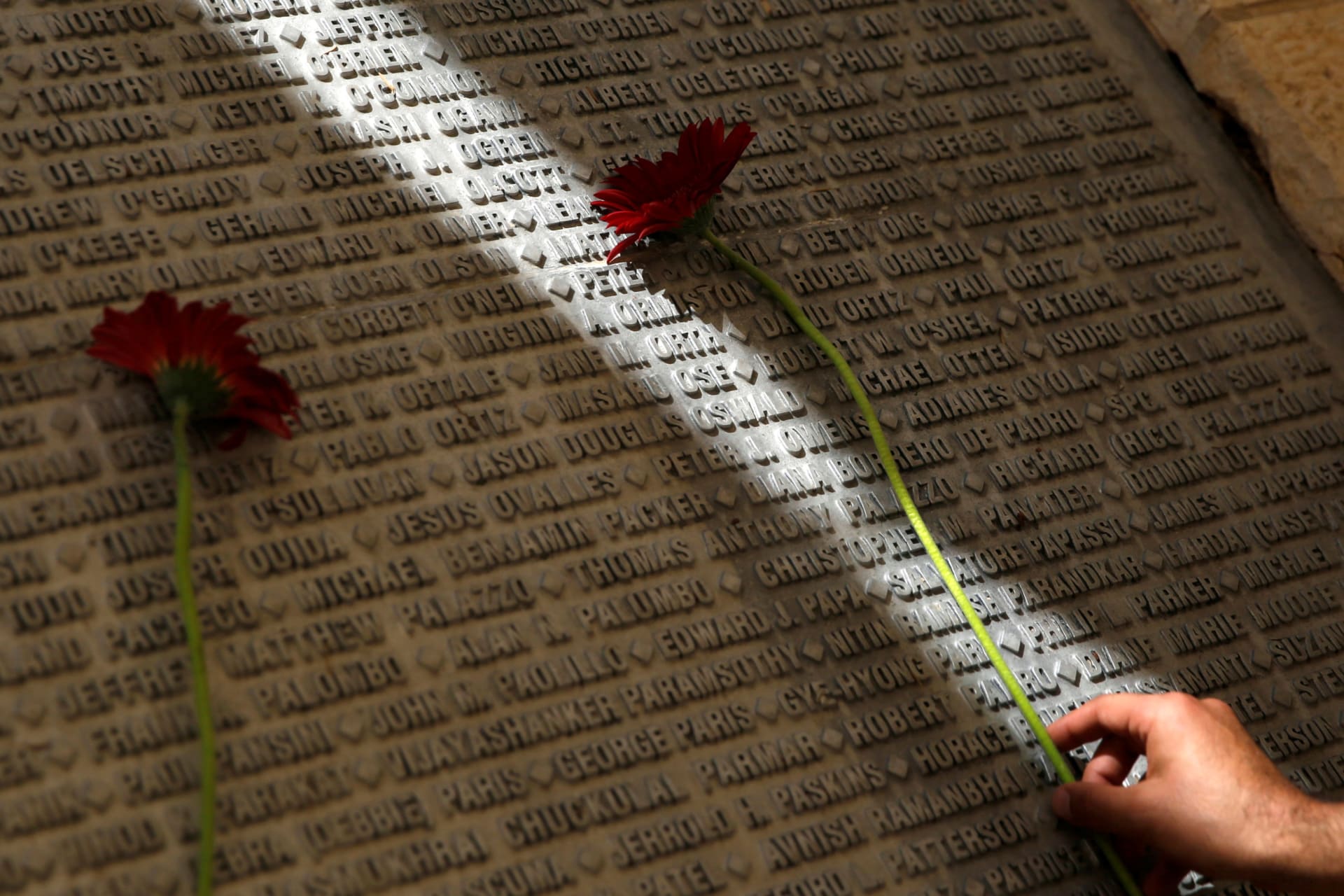
BONNAFONT: Yeah. You know, I think that in this room everybody remembers very well where we were on 9/11, and we remember very well what we were doing at that time and how we reacted to the—to the tragedy. It has been—it has been the entry of tragedy in the twenty-first century. And it has been—I remember Fukuyama and all that. It has been the wakeup call. We were with the conviction that we were building a world order that was more peaceful; that there was the possibility for peace, democracy, development to go hand by hand in a(n) almost invincible way. And 9/11 has shown us that, no, there are evil forces in the world that are active, that are present. And twenty-five years later—the coincidence runs that it was France that was chairing the Security Council on 9/11/2001. It was my predecessor, Ambassador Levitte, whom you might have met, who was ambassador to Washington after.
HARTLEY: I have. Yes. Yes, yes.
BONNAFONT: And the Security Council at that time acted immediately, and the following day a resolution was passed unanimously setting the conditions of fight against terrorism worldwide.
We have to be at the same level as they were twenty-five years ago, and we have to make sure that what we say and do in the Security Council now adjusts to the reality of terrorism today. And then what we see, that Islamic terrorism is still the main threat. We see that in Africa, Nigeria with Boko Haram. We see that in Western Africa in Sahel. We saw that in Somalia. But it is still extremely active and aggressive in the Middle East. Europe and U.S. are still being threatened regularly. And we see that new technologies are transforming the way terrorists act, but are also giving us means for cooperation which are more efficient.
And I remember very well that in the 2000s we were confronted to, number one, the fact that flow of merchandisers was making arms trafficking more easy. We did not have methods of judicial/legal cooperation among state that were efficient enough. And financial transfers were almost free, and it was very difficult to track them. Challenges that we addressed: weapons, finance, legal cooperation.
Now we have this question of technological breakthroughs that are used by the terrorists as well as they can be used by the police and the security. So what we have to do is to adapt, to see how we confront AI or drones or et cetera when they are used by terrorists, and to see how we use those technologies to better our intelligence and our capacity to cooperate.
And this is why, when we see countries saying either we should not regulate AI/internet/et cetera because it’s against freedom, or we should control AI/internet/et cetera because sovereignty, we say, no, neither of those. It is on the internet and AI the same as globally as in a national system. You have to have the regulation that are adapted to the global nature of those technologies. And how do we construct those international answers? Security Council has a responsibility. GA has a responsibility. Companies have a responsibility. Governments have a responsibility. It will have to be a joint effort. And we are starting to have a couple of interesting and productive conversations in the—in the Security Council, but also elsewhere, to see how we can address this question.
Sorry, my answers are a little bit long, but your questions are—
HARTLEY: That’s interesting. That’s a good—
BONNAFONT: Your questions are not small ones.
HARTLEY: OK. Complicated questions. OK.
As President Macron’s term draws to a close, which I can hardly believe—I was—I was there. I left maybe three months before he won. I was there when he was economic minister. I left in February; he won in May. But as his term draws to a close, how would you assess France’s foreign policy legacy? And what should the next administrations prioritize to maintain France’s influence on the world stage?
And I have a second one. You can do that first. But also, on the domestic front, will President Macron play a role in making sure his centrist policies continue, especially given the threat in France from the far right and the far left? And I think we’ve just seen the big AfD victory in Saxony-Anhalt.
BONNAFONT: Well, it is difficult for me to comment on the future and the political prospect because, being a civil servant, I have a duty of no expression on national political matters. But on President Macron’s ten years, I am now senior enough in the service to make some comparisons. (Laughter.) And I don’t know if you have noticed that there are two films on De Gaulle that have just appeared on French screens, which are very, how would I say, heavily loaded historical films, full of knowledge, intelligence, et cetera, et cetera. And the incredible thing—and they concentrate on the Second World War. Interesting thing is that in the beginning those two films did not attract the attention of the public, and now they have had, I think, 5 million—something like that—(speaks in French)—viewers, which is in French terms exceptional. Everybody wants to see those films.
So there is a—there is a sort of reference in our political imagination and political structure, which is, what did De Gaulle say? And I will come to President Macron immediately. He says we have to be independent, number one, and we have to be the masters of our destiny. What did President Macron do? He tried as much as he could to strengthen the French economy, in particular in modernizing its industrial and productive structures. Number two, De Gaulle was saying we have our solidarities—Atlantic alliance; creation of a European entity that is capable of standing on its own feet; solidarities with our historical partners, Francophone countries, emerging countries, et cetera. What was Macron doing? Number one, always warning that NATO has to wake up. You remember he had this incredible warning at one NATO summit, saying that it was in cerebral death. People were shocked when he said that. But what was he saying? He was saying that members of NATO have to take seriously the question of their security, and he was saying that Europe has to take seriously the question of its security.
And since years and years and years the French say to the European: Stop believing that the United States are going to ensure our security at no cost. We have to be self-capable of defending our security while being in this solidarity alliance with NATO and with the American. And this has been a constant objective. And the fact is that Ukraine has been a wakeup call, and that the U.S. demand that we spend more on defense has been a wakeup call. And in that way what I can hope as a French diplomat is to see Europe continuing on this trend of taking the responsibility of its own security by its own means, while remaining in the framework of NATO and this transatlantic alliance.
Now, the world has changed since De Gaulle and something has happened, which is globalization. If you limit globalization to its purely economic and financial dimension you miss one phenomenon, which is that through globalization you build an international society and you build a political system. It’s not purely economics. It’s not purely financial. It is political. And when you say politics, you say that you have to consider sharing of power, inequalities, impact of local decisions on global matters, governance structures that ensure that everybody will be part of the system—on the basis of what are the constituents of an international community, which are states, companies, civil society. So there has been a persistent effort by President Macron to build coalitions of pioneer states, I would say, companies, civil society organizations, to construct the governance and the solidarity mechanisms by which we could address better climate change, emergence of new technologies, world health, et cetera, et cetera.
And clearly, here there is always a debate with the United States on whether there is legitimacy in the U.N. addressing those questions, in states addressing economic and financial questions. It is a debate. It is a healthy debate. It is sometimes a tough debate. It is an important and necessary debate. And the written music of France, if I may say, by Macron was always to say, yes, solution has to come through cooperation.
What is the risk facing globalization now? The risk is that if you let this idea of a global—I don’t say a global government; I say of a global governance mechanism be efficient addressing climate change, protecting the right of women, fighting against poverty, ensuring food safety, then you have a law of the jungle which is the only play in town, which is exactly what President Wilson and President Roosevelt wanted to put an end to at the end of World War I and World War II. So if we want to be true to the—to the intuition of those who had fought those two world wars—and their intuition was, of course, the military element is the dominant element when it comes to war. But if you try to address the reason why it goes like that, you have to go to deeper social/political/economic roots, and you have to construct a system by which the rule of law is established in the world order as well as in the—in the national order.
And here there is a parallel. If you establish a national society, you have to have rules by which citizens are actually equal. Of course, they are not. They have not the same origin. They don’t have the same financial capacity. But they are all under the law, and it has to be the same with nations. When you have a global society, nations has to be ruled by an international order by which the behavior of one is not capable of washing away all the others. And if we have a stronger international rule based on states, based on sovereignty, based on the freedom of choice of states for their systems—but if you don’t have this rule, then you have the law of jungle, and we—law of the jungle, sorry, and we see that it is not appropriate.
So I would—I would define a little bit the ambitions of President Macron this, with Europe as the main partner, with the Atlantic relationship as the backbone of our security, and with the will to address—to have a dialogue with the rest of the world. Extremely, extremely strong.
HARTLEY: I hope it succeeds, and I do congratulate him. He was out front on this quite early.
BONNAFONT: Absolutely.
HARTLEY: So, anyway, I’ve loved our conversation.
BONNAFONT: Thank you very much. Thank you very much.
HARTLEY: Thank you very much.
Now I’d like to open it up to our members for Q&A. And just a reminder to everybody, it is—the meeting is on the record. Start there.
Q: Thank you. Thank you, Ambassador Hartley, Ambassador Bonnafont. Always nice to see you. Thank you. It’s Pamela Falk from U.S. News and World Report at the United Nations.
A little more granularity on Iran. A year ago, France, the U.K., Germany invoked or reported Iran invoking triggering the snapback. We now have a year of no inspections. IAEA has been asked to refer Iran. What happens next? And will the Iran nuclear issue, including all of these uranium enrichment stockpiles—I see you looking. There are people in this room that were very deeply involved in that—in that process. If those stockpiles that are—some up to 60 percent, no inspections. What happens next? Thank you.
BONNAFONT: Thank you very much. And I’m happy to see you here, and happy to see you in Franco-American events as well, and I’m happy to see you in the corridor of the U.N., so. (Laughter.)
HARTLEY: You’re everywhere. (Laughter.)
BONNAFONT: IAEA is discussing right now the last report of its DG, Rafael Grossi, on the way Iran is behaving nuclear-wise. And we are going to receive in the Security Council the report of the—of the director general with most likely resolution of the governors of IAEA expressing the fact that Iran is not complying with its obligations. We will have this in our—in our deliberations, and I am sure that the vast majority of the Security Council is going to want that we remind Iran its obligations, and will want that we continue the sanction regime that has been established—reestablished by what is called technically the snapback a year ago.
Now, we all know that there are two countries at least that are not in agreement with this way of behaving, which are China and Russia, which is quite unfortunate because China and Russia were part of the JCPOA agreement that was putting under control the nuclear program of Iran. I see well why Russia has this position. It’s not very difficult to understand. You think about what is happening in Ukraine and you understand. On China, I am more—I wonder why it is like that, but it is a fact that Russia and China are in the way.
So we will see what—how far we can go in this. We will work closely with our American and European partners, and with other members of the Security Council, in order to push for a decision of the Council. But whatever is said this month, the file will continue. And what is clear for France, for Europe, for the U.S. is that the idea of a non-checked nuclear program of Iran is simply unacceptable. And we will continue to work with IAEA and with the global community to make sure that the nonproliferation regime is still respected by the global community in general, and therefore that we continue to be very vigilant on critical cases like the case here. Thank you.
Q: Ambassador, thank you very much for being here. Elliot Waldman, editor in chief of World Politics Review.
I’d like to ask you about Sudan. As you know, there was a fact-finding mission that the U.N. conducted that found continued inflows of foreign fighters and materiel into the conflict. That has led to calls to enlarge the arms embargo from Darfur to the entire country. But, as with many other issues, the Security Council not quite in agreement on that. I’m curious what you—where you think the Security Council can make meaningful progress to tighten sanctions and stop some of the weapons from flowing into Sudan. Thank you.
BONNAFONT: Well, thank you. It is a very thorny question, immediate. It’s a very urgent question. We have right now in the table—and I look at her, because she is one of the experts in the Security Council on that. And she is very active on that. We have this question of how do we extend the sanction regime? There is a sanction regime since several years that was focused on Darfur. And what we say, U.S., U.K., France, a majority of countries around the table, is that we have to extend this regime to better address the fact that weapons come from many directions. And that wherever they go, they should not enter, because they aggravate the situation.
Now we have a tough discussion with our partners because some of them consider that it is not the appropriate way. Some of them consider that the Sudanese Armed Forces represent the legitimate government, the legitimate government of Sudan, and the other are rebels. And therefore, they should be able to get weapons, whereas the rebels should not. It is not our reading of the situation. And we consider that sanctions should be extended. That is the discussion we have right now. And we hope to be able to solve that within days, and sooner better.
Now, it is not the only answer of the Security Council and the global community. There are political processes, technical names like Quartet, Quintet, you know all that. What is the difficulty? The difficulty is that there are, number one, two protagonists who are convinced that they can win. And each time one is weakening, he succeeds in finding an external partner that will help him strengthen again. And one day it is Sudanese Armed Forces. One day it is the security forces of Hemedti. And it’s going on like that since now, what, four years. And unfortunately, external powers are backing each of the two sides. And who are the victims? The civilians. It is one of the most devastating armed conflicts in the world, with humanitarian impact which is absolutely massive, and with a destabilization effect in all the region that is also massive.
So what we are trying to do is to back the peace efforts that are led by the Americans, by Saudi Arabia, by the African Union, by subregional groups, to try to convince those two parties that there is no military solution to their conflict, and that they have to sit at the table to discuss. Tough, difficult, absolutely necessary, and we will not give up. We will not give up, because, I mean, war in ex-Yugoslavia lasted for several years before it was possible to put them at the table and to agree. Wars are never easy to end. And it takes a lot of patience. A lot of frustration, of course, but a lot of patience to bring the protagonist to the realization that military solution is not going to happen, and that they have to have an agreement.
HARTLEY: OK. First I’m going to go to the back to the woman in the white jacket, and then I’m going to you. OK.
Q: Thanks so much. Good morning, everyone. Thank you so much for being here. My name is Minh-Thu Pham, and I run a think tank called the Starling Institute, working on multilateral cooperation especially around the U.N.
I wanted to ask you about the selection of the next secretary-general, which is taking place this year. This happens about every then years, so it’s not a usual occurrence. I wanted to get your view on how France is thinking about it. You obviously have a veto over who that person might be. How consequential do you think it is now for us to have a new leader at the U.N.? And how is France thinking about it in terms of consensus within the council for a new leader? Thanks.
BONNAFONT: Well, as a matter of fact, it’s one of the subjects of our closed-door discussions within the Security Council. (Laughter.) And don’t count on me to give you things that I am not supposed to give you. And whatever appears on the press is simply things that appear in the press. And there is no comment to be made publicly on those things.
We have had ten years of. Antonio Guterres, which have been ten years of international chaos, with wars everywhere, with crises, with COVID, with this, with that. Name it, he has gotten them all. And during that time, the U.N. have been challenged financially, you know why, politically, by many, many countries and groups of countries. And the U.N. are facing the need for a redefinition of many of their goals and functions in the near future. Therefore, we need a strong personality. The definition of what a secretary-general has to be is extremely short in the charter, a few articles. But the reality has developed into the need for a personality who is able to have three characteristics.
The first one is to be constantly present when there are peace and security challenges, when there are armed conflicts, with two dimensions. One is his or her personal involvement in the matter. And second is the organization of the organization, so that the organization can put at the disposition of the Security Council and of those who want to do mediation, peace operations, mediation, good offices, et cetera. So first, peace and security.
Second, secretary-general has to be the voice of the global interest of humanity. When it comes to climate change, when it comes to human rights, when it comes to fight against poverty, there has to be someone in the world who says: Here is what the charter says, here are our duties, here are what we can do, here are the negotiations, and the way we can push them forward. The secretary-general does not have to substitute herself or himself to the decision of member states. Member states are the boss, but member states have to decide. But what the secretary-general can do is, I have this means to put at the disposition of the global community. There is this thing to be done in order to address this or that question. And the secretary-general has always to be at the top of knowledge, awareness, and capacity to intervene, so that those global negotiations take the right direction.
Third, and I would say last but not least, being the manager of the system. And here we have constructed, and it is a global responsibility, it is not the U.N. bureaucracy. I don’t know, no, it is we, member states, who have built this system. And what we have built is a mosaic—no. It is a kaleidoscope. You know this thing where there are pieces everywhere, and everybody does everything. We have to put some order in that. But the problem is that what we have built is a mechanism by which each of those structure has its own mandate, treaty, board, independence. It is like a conglomerate where the top would not be the boss for the rest. We have to put our own work into order. And in order to do that, we have to be inspired by someone who is an expert in looking at the system and who can say, here we have to do this, here we have to do that.
But where is the difficulty? When it comes to the powers of the secretary-general, as defined by the charter, she or he has the capacity to act. But as soon as it comes to putting together decisions that member states have to approve, here comes difficulties. I will give you one very concrete example. We are going to have in a couple of hours, we have now today, the meeting of U.N. Women. U.N. Women is an extremely important organization, in our view, to protect the rights of women, which are challenged worldwide by what we call in French a revisionist international actor who want to come back from the progress that have been made for the rights of women in the international order.
But secretary-general said, we have to merge this structure with the structure which is in charge of reproductive health, et cetera, et cetera—UNFPA, I think it’s the English acronym. I’m always at war with English acronyms versus French acronyms. (Laughter.) He said, we have to merge. And then, number one, the two structures don’t want to merge. Number two, member states are divided between those who fear that the merger is going to diminish the capacity and those who fear that the merger is going to enhance the capacity. And so we don’t agree. Next secretary-general will have to have the political strengths to tell us, member states, come on guys, put your acts together, and let’s be a little bit bold in our decision-making process.
It will be difficult when it comes to the U.N. security family, in the stricter sense here. When it comes to WHO, UNESCO, and all the twenty other international organizations it will be even tougher. And our conviction for the French is that the secretary-general has to be considered as not the boss, because he’s not the boss, but the main coordinator of the system, that has the capacity to say, let’s put everybody together. So these are the three main things we demand. And our job in the Security Council these days is to see among those very respectable candidates we have, the list not being completely closed by the way, who is going to be the best—the best choice to be recommended to the General Assembly. And the sooner the better, because we have to have someone capable of taking the system at hand on January 1.
Q: Thank you very much. Thank you, ambassadors, for this. It’s been fascinating. You spoke very eloquently about—sorry, David Rivkin, Arbitration Chambers.
You spoke very eloquently about the need for Europe to protect its own defense and to build the rule of law around the world. What more specifically can Europe do to act as a unified power, both to protect it’s—to build its own its self-defense, with the threat of Russia and terrorism, and also to project soft power around the world, particularly to fill the vacuum that’s being left by the United States, both with respect to European defense and soft power around the world?
BONNAFONT: It’s a key question for the future of Europe, how do we construct this more organized capacity to react to world disorders and to protect our—protect and promote our interests? Defense-wise, what we are trying to do is to build within NATO a European pillar that is capable of ensuring a European action when there is a threat to Europe. It is not an exclusion. It is a pillar to be built within the system. And that goes with the combination of two elements. Number one, building a collective capacity. It is what we are trying to do on research, defense research industry, on industrial cooperation, on planification, et cetera. And number two, to consider the fact that armies are national, and that therefore each national army has to be better equipped, trained, and ready. And that those armies are capable of working together.
We have many things in NATO which already allow that to be done. And what we have to develop is the European mechanism within NATO that allows this to be done. These are the two elements when it comes to the purely military dimension, taking into consideration the fact that the way wars are done are changing dramatically and very rapidly, and that there is a technological race and a challenge to military institutions to take into account the new ways war are being done with what we see in, particular in Ukraine, but also in Sudan. We are talking about that. New ways wars are made. New ways civilians are attacked. New ways sensitive infrastructures can be attacked from a distance, very rapidly and very efficiently. Not only virtually, the question of cybersecurity, but also physically with this capacity to penetrate very deeply within national systems through new weapons.
But besides this military and security dimension, there is what you very rightly say, which is how do we make sure that Europe remains relevant in its capacity to be an economic power? And here, clearly, there are several things which are to be done. We are entering into a discussion of the next budget plan for Europe for the next few years. And in this we will have to decide on some critical programs, such as the research—scientific and research program. What revenues does Europe devote to the enhancement of its research capacities? There are national budgets here again, but there are also collective budgets to be decided. Financially, we all know that the financial market in Europe is not yet completely integrated, and that it is a challenge for us. We have a very strong money, the euro, which is a tremendous success. And it might be reminded that many, many were skeptics when the euro was made. And that now you were referring to some of the political movements that are acting now. Very few of them are talking about withdrawing from the euro. The euro has established itself as a reality nowadays, today’s life.
So you see, there are many—there are many political discussions to have. What sort of institutional Europe do we want? How do we proceed with enlargement? But besides this, there are also some very practical questions to be addressed in the near future in order to establish what President Macron calls European sovereignty, which is our capacity to be self-sustainable. Climate change is going to challenge our agriculture. How are we going to react? We have seen, with the development of the Chinese industry during COVID, that we were short of some very basic elements. That the stop of the flow of merchandisers was proving threatening. Paracetamol, for example, which is a very basic thing. Sieniu (ph), which is used for anesthesia. We were short of sieniu (ph) at some point during the—how do you say sieniu (ph) in English?
HARTLEY: What was it?
BONNAFONT: Sieniu (ph), you know?
AUDIENCE MEMBER: (Off mic.)
BONNAFONT: (Inaudible.) We were short of it, whereas it was absolutely necessary during the COVID pandemic. So there are those fragilities that we have realized, and on which we have to strengthen Europe.
HARTLEY: OK. We’re officially out of time.
BONNAFONT: Oh my God.
HARTLEY: And you have been very patient, so I’m going to go to one more question.
Q: Jeff Laurenti, now with New Jersey’s Capital City Redevelopment Corporation.
Ambassador Bonnafont, a year ago when Donald Trump still seemed to be riding high, both in domestic and global politics, the Security Council entrusted to him and a Board of Peace of his choosing effective responsibility for Israel-Palestine, at least with respect to Gaza. I wonder if you could tell us how accountable, if at all, it is to the Security Council. And how you would assess how—with the freedom from the bureaucratic restraints of the United Nations, impartiality requirements and such—how effective it has been in moving the ball down the court towards peace? Or ineffective. And, given that you, France, Britain, and Canada, just yesterday have undertaken some first serious measures with regard to settler violence in the West Bank, to what extent would you have even consulted with the Board of Peace, within quotation marks, on that? Or do you see any multilateral advance of those principles of sanctions as something for the EU, the U.N. General Assembly, and not for this Board of Peace?
BONNAFONT: Well, Ambassador Hartley, thank you very much for giving the most easy question as a final question. (Laughter.)
HARTLEY: The last one. Always the last one. (Laughs.)
BONNAFONT: Yes. But I’m not surprised, because this Council is known for its expertise. And experts are not—are not always indulgent with practitioners.
What you ask is a central question. First of all, after the Board of Peace was established, the creators of the Board of Peace decided to present it to the Security Council. And the Security Council decided to entrust the board of peace with the function of ensuring ceasefire, ensuring humanitarian entry, and ensuring the start of the reconstruction, while having the Palestinian Authority progressively coming back. And therefore, it is an unprecedented mechanism by which a self-created body is entrusted by the Security Council with such a task. The eight countries that were gathered by President Trump during the GA last year told us, Security Council, it is the best way forward. Please back it. So we had the American asking for the backing. We had those eight countries asking for the backing. And we had the Palestinian Authority telling us, yes, please, it is the way—it is the way forward. Therefore, Security Council approved Resolution 2803 and this mechanism.
Now, when it comes to considering the result, it is a very mixed performance. On the one hand, even if it is not complete, the ceasefire is there and the life of the population in Gaza has come from tragic, or catastrophic, I would say, to dramatic. We are still very, very, very, very far from where we should be. We are still extremely frustrated, as France and many of our likeminded countries, by the insufficiency of the entry of humanitarian aid. We are still extremely worried by the fact that Hamas is not giving up its weapons, is not disarming, and is not giving up its political ambition towards that part of the Palestinian territory. And on reconstruction, we are still far away from where we should be. And to add to that, there are some declarations by some Israeli political leaders, members of the government, which are extremely worrying on the future of Gaza. Whether it be those who say that we should kill forty Gaza people a day, or those who say that we should empty Gaza from its Palestinian population, et cetera. et cetera. So things are not yet settled.
But the truth is that, number one, we have a Board of Peace, which is an executive mechanism of transitory nature to manage the area. And, number two, we have a Security Council which is capable of having reports on what is going on. And the truth is that we have, every two months, something like that, a report by the U.N. representative and by Mladenov, the executive of the Board of Peace, who come to the Security Council—we even had Tony Blair coming one time—to report on the situation. And it’s extremely productive, because it allows us in the Security Council to have an assessment of the situation from double perspective of Mladenov for Board of Peace and Alakbarov for the U.N.
And the truth is that they tell us things which are not easy to hear on progresses sometimes, and on all the obstacles that remain, that help us continue to press on Hamas to disarm, Israel to respect its obligations, and Palestinian Authority on the need for reform, et cetera. So the ultimate goal remains, normalization in Gaza and installation of reformed Palestinian Authority in this part of the Palestinian territory. Long-term task, but it is what we have to do. And it is our responsibility as part of the more global effort to establish a Palestinian state that would be respectful of Israel and respected by Israel in the perspective of peace between Palestine and Israel.
HARTLEY: Now, sadly, I think we have to call this conversation to an end.
BONNAFONT: Thank you.
HARTLEY: I think we want to give the ambassador a round of applause. (Applause.)
BONNAFONT: Thank you.
HARTLEY: Thank you so much. Say hello to your beautiful country.
BONNAFONT: Thank you. I will.
HARTLEY: And give my regards to your president.
BONNAFONT: And we miss you. And you will in France very soon.
(END)
This is an uncorrected transcript.