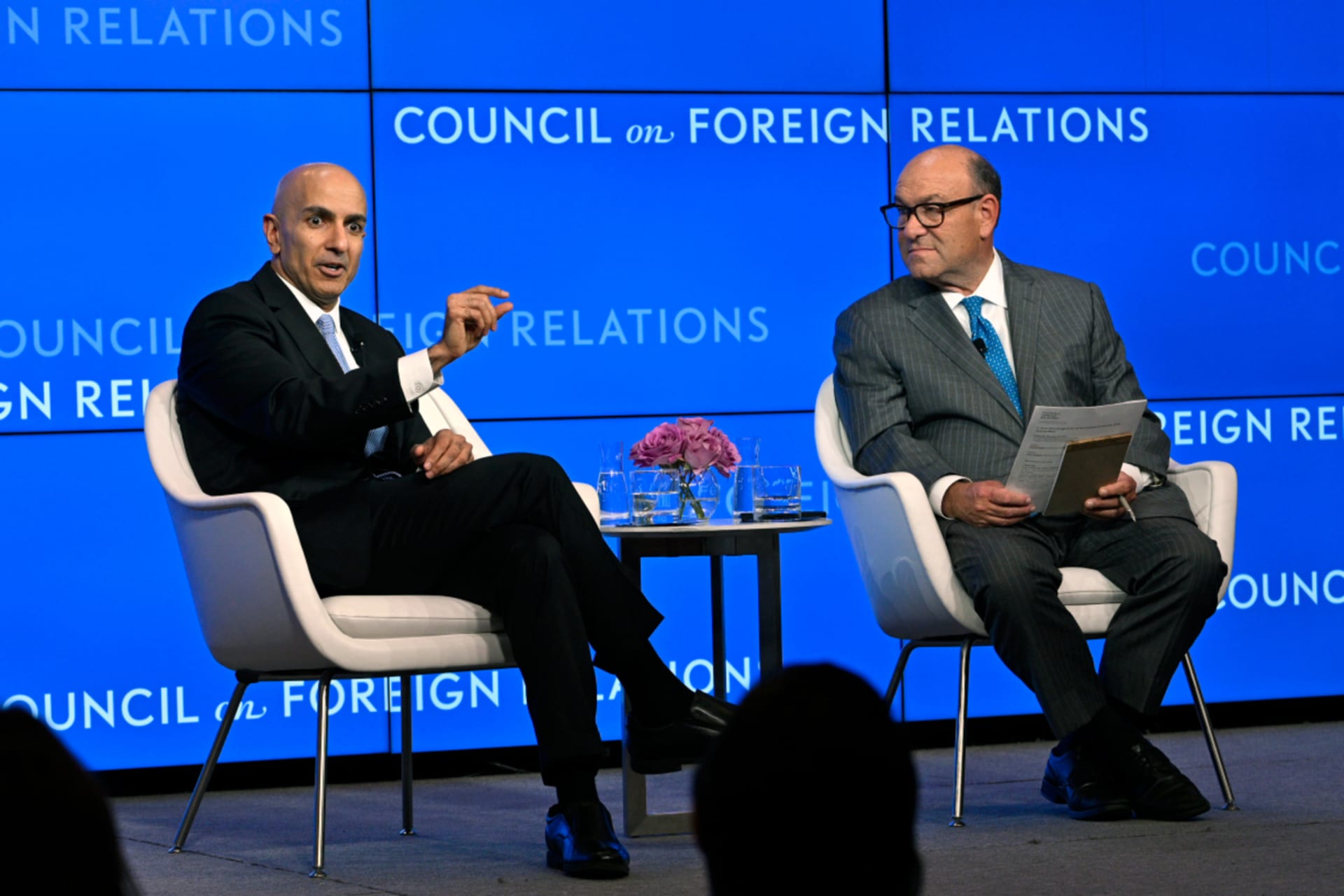
Hauser Symposium: America at 250
This symposium explores the development of the U.S.-led international order from the post–World War II era to the present, examining the foundations of American global engagement, the trajectory of the post-Cold War period, and the policy shifts of the Trump era. Together, the panels analyze how these distinct phases have shaped U.S. foreign policy, international institutions, and patterns of global cooperation and competition.
Click here to view the full agenda.
This Hauser Symposium is made possible by the generous support of the Hauser Foundation.
This symposium is also part of CFR’s America at 250 Series. To mark the 250th anniversary of the U.S. declaration of independence, CFR is dedicating a year-long series of articles, videos, podcasts, events, and special projects that will reflect on two and a half centuries of U.S. foreign policy. Featuring bipartisan voices and expert contributors, the series explores the evolution of America’s role in the world and the strategic challenges that lie ahead.
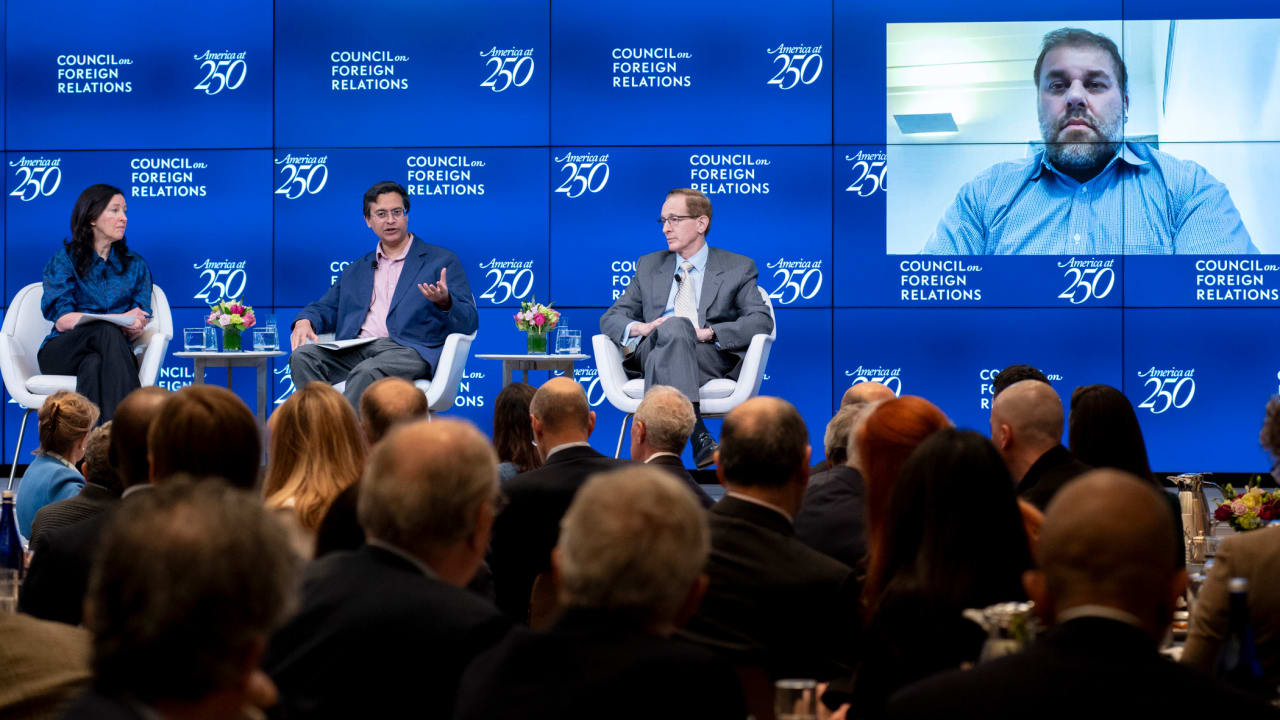
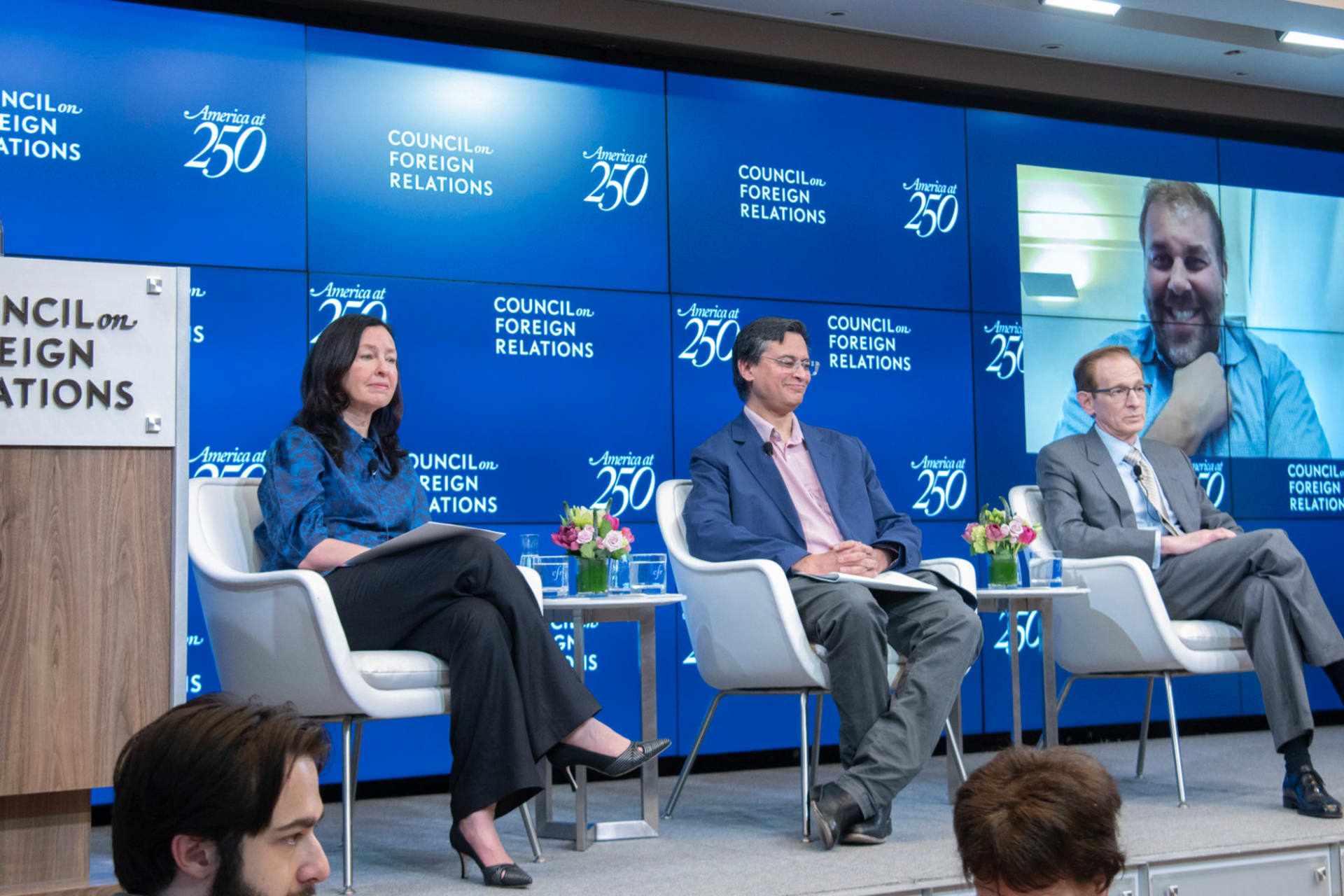
Panelists explore how the decisions made in the aftermath of World War II set the United States on a path toward active global engagement, reshaping international politics, security, cooperation, and institutions
FROMAN: Well, good afternoon, everybody. It’s great to see everybody here. Nice, full room, and in addition we have a couple hundred people on Zoom listening in as well. Welcome to this Hauser Symposium.
And first I’d like to thank Rita Hauser, of course, whose guidance and support—(applause)—makes such a lasting impact on this institution. She established the Hauser Symposium almost two decades ago to focus the Council each year on a defining challenge or opportunity facing the United States. And the subjects have ranged broadly, from the domestic evolution in China to the Axis of Autocracies. This is the eighteenth symposium, and this year’s theme is particularly fitting: America at 250. This is part of our broader America at 250 set of programming that we’re doing.
There’s no question that we’re at a historic inflection point, but the debate over America’s role in the world is in some ways nothing new. Our Founding Fathers warned against entangling alliances, and many would be called isolationists by today’s standards. The nineteenth century brought territorial expansionism and hemispheric dominance. Sounds kind of familiar. And the twentieth century offered hard lessons of its own, from the isolationist instincts of post-World War I, to neoliberalism, neoconservatism, and now America first. In other words, these core questions we’re wrestling with today have been around for most if not all of America’s 250-year history.
And of course, the Council has been there at critical moments. In the 1920s, we were founded after the First World War, after the defeat in the Senate of the League of Nations, to fight against the notions of isolationism. In the postwar period, we played a critical role in the foundation of NATO and the Marshall Plan. In the 1950s and ’60s, a young academic from Harvard named Henry Kissinger came down and worked on what became America’s nuclear strategy. And in the 1990s, at the end of the Cold War, the Council helped develop the concept of geoeconomics, the convergence of geopolitics and international economic policy.
Today’s symposium will deal with all of these issues in three panels: “Postwar Choices— Embracing Global Engagement After 1945,” “The Lost Promise of the Post-Cold War Era,” and “The Trump Era and the Future of the U.S.-Led Order.” This symposium is on the record, as Stacey said. And it’s my privilege to introduce the first panel.
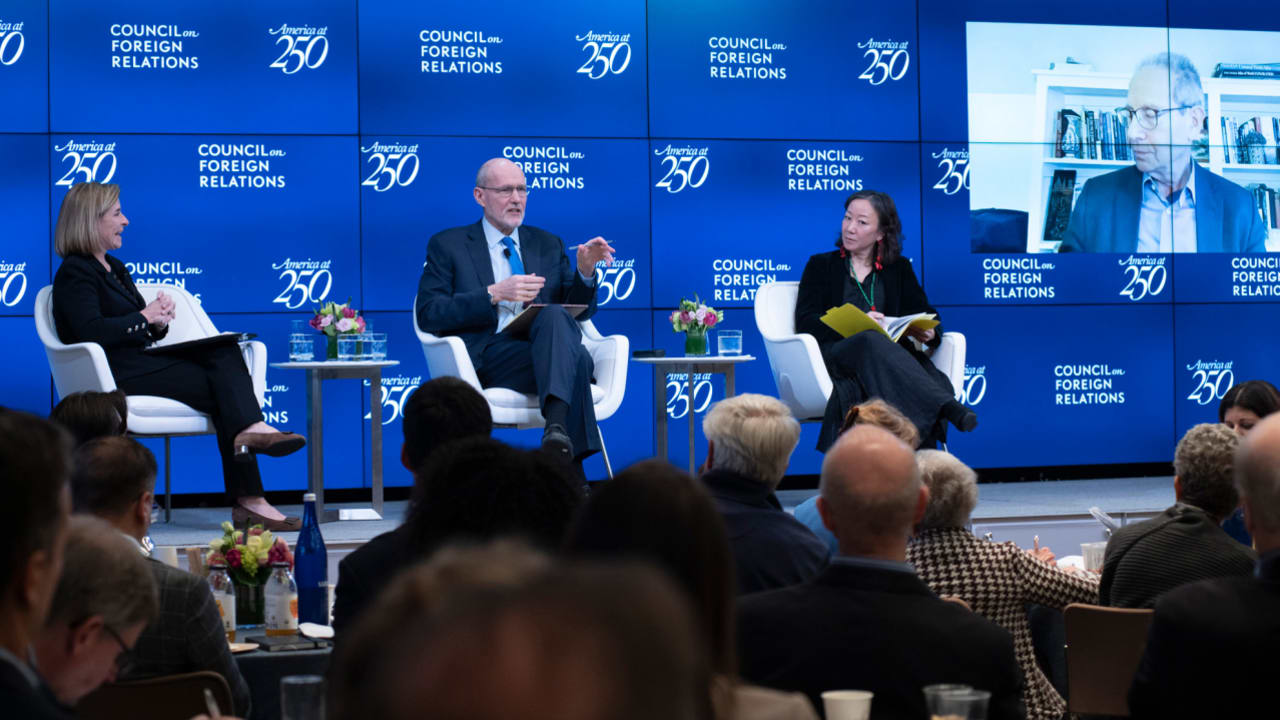
We’re joined by Rana Mitter, S.T. Lee professor of U.S.-Asia Relations at Harvard’s Kennedy School; CFR’s own Benn Steil, senior fellow and director of international economics; Jeremi Suri on the—on the screen virtually, Mack Brown distinguished chair for leadership in global affairs and professor of public affairs and history at University of Texas-Austin; and our presider. And we’re delighted to have Amy Davidson Sorkin, staff writer for the New Yorker.
Thanks, everyone, for being here. And with that, I will turn it over to Amy.
SORKIN: Thank you. Thank you, Mike. And welcome to the first session of today’s symposium, titled “Postwar Choices— Embracing Global Engagement After 1945.” As Mike mentioned, I’m Amy Davidson Sorkin, a staff writer at the New Yorker, CFR member. And I, too, would like to thank Rita Hauser and the Hauser Foundation for making this symposium possible.
As Mike mentioned, we’re—we have three sessions today which generally follow the trajectory of American power from 1945 to the ’90s and then to the present. And our part, as you can tell from the title, really sets the terms for the ones that follow. Put another way, for those who are familiar with the metaphor that Mark Carney used in his speech at Davos of a—of a sign in the window that he thought might now be taken down about a rules-based order, we’re—our session is a bit about how that sign got written, composed, and hung up in all those—all those windows.
So, with that, Benn, let me begin with you. You know, our path through this period is going to be, as the title suggests, American choices. You know, it’s choices after 1945, which was itself an incredibly eventful year—Yalta, Hiroshima—in the beginning of this flowering of international institutions. So could you help us situate ourselves? It’s the beginning of 1946. How unsettled is the world and the United States’ place in it? And was the choice that there should even be all of these world organizations even obvious?
STEIL: Yeah. 1946 really represents a watershed. It’s really the beginning of the end for Roosevelt’s so-called one world foreign policy vision during the war. This was the idea that the United States was somehow going to find a way to continue its alliance with the Soviet Union, to bring about a collective security regime, free trade, stable finance. But all that began to collapse in late ’45. The Soviets had actually sent technocrats to Bretton Woods, for example, in 1944, so you have got—’45 you’ve got the U.N. being established, the IMF, the World Bank, but at the end of 1945 the Soviets back out. They don’t ratify the agreement.
Early ’46, you have three major speeches back to back that really define the beginning of the Cold War and the end of FDR’s one world vision. And on February 9, Stalin makes his famous Bolshoi speech in which he attacks capitalism and its twin brother imperialism. Two weeks later you have George Kennan’s Long Telegram, which argues that it is impossible to have any sort of collective security arrangement with the Soviets; they are inherently expansionist, both by geography and ideology. Two weeks after that, you have Churchill’s Iron Curtain speech in which he argues that communist fronts are being created in Western and Southern Europe.
So this is—this is really a watershed moment. We have—as I said, one—the one world vision had already coalesced around some key institutions. We don’t yet have what Charles Bohlen, a Sovietologist at the State Department, would call in ’47 a two world model. So that’s yet to be created. It was created on the fly in ’47.
SORKIN: And also, because I think it’s—you know, we look at Europe now, it’s so distant from us. What was the situation like? I mean, it’s easy enough to talk about all these conference rooms, but on the ground it wasn’t just Germany that was full of trouble. The whole—
STEIL: No. It was catastrophic. You know, it was—there was a humanitarian crisis across the entire continent. The entire division of labor that these sophisticated capitalist economies had depended on had broken down entirely. And so food, to the extent that it was being produced, was not being shipped to the cities because the cities had nothing to offer in return. You had massive reprisals, one group against another, across the entire continent. Tens of thousands of people died in 1946 from these internecine rivalries.
SORKIN: Perhaps more, yeah.
STEIL: By the time you get to the end of ’46, we also have a winter catastrophe, the most brutal winter that the century had seen, which finally convinced the United States that it couldn’t remain remote from what was going on there.
SORKIN: So, Rana, 1946, specifically can you take us to January 17, 1946? The United Nations Security Council convenes for the first time in London. One of the members of the permanent five, the Republic of China, is still engaged in a civil war. I mean, we have one—you know, the world at peace, but in—but in rubble, but really the war was—there was still a war going on there. How did the early choices the United States made with regard to China shape the great-power relations that followed?
MITTER: Well, it was a crucial set of choices, Amy, because in a sense the reason why it’s important to answer that question is that it leads us through the key matter of the seminar throughout the day, where we’re going to end up, of course, with the U.S.’s choice being how to deal with China as the greatest geopolitical challenge that it has in the early twenty-first century. And yet, the China that people looked at in 1946 as one of the first members of that new United Nations General Assembly would not have occurred to anyone as a future superpower. And yet, actually the seeds were all there. That’s why it was important.
I would say, you know, picking up on what Benn’s just said, that the way to understand China’s role at that time is as an anomaly, as a contradiction, because the contradiction is that at that moment in January 1946 China was simultaneously weaker and stronger than it had been at any time in its history for a hundred years. The weak part, in a sense, is easy to see because, rather like the Europe that you described, actually tens of millions of people were starving to death in China because of the effects of the eight years of savage war between China and Japan. In fact, the same organization—the UNRRA, the United Nations Relief and Rehabilitation Administration—faced—
SORKIN: Which was a new organization as well.
MITTER: New organization founded in 1943, you know, U.S. leadership, U.S. money. But actually, I think thirty-five or forty different countries are involved. And what’s sometimes forgotten is it didn’t just save Europe; it also put huge amounts into China as well, I think about $600 million at the—at the time. But it also helped to deal with the fact that mass starvation, malnutrition, displacement were shaping China at that time. In other words, not surprising if you very briefly just think about figures that aren’t well enough known, perhaps. China fought longer in World War II than any other allied power, 1937 to 1945, two years earlier than Europe went to war. Something like 8 to 10 or even more million Chinese died, either directly or as a result of the war. That includes a famine, for instance, that killed 4 million people. And 80 to a hundred million people became refugees within China out of a population of 600 million. So this was a country that was on its knees in many ways. You can see why it’s weak.
But I also said it’s stronger at this point than it’s ever been before because it was a country that had insisted on fighting back against Japan, became part of the allied nations after 1941 after Pearl Harbor, and ended up as one of the winning allies. And therefore, not least thanks to FDR’s intervention, it was made one of five permanent members of the U.N. Security Council at that moment. So the Chinese delegates who were there knew that they were there for the long term. What they didn’t know was that a communist revolution was going to kick them out within about four years from that particular moment, and it would take a very long and winding path before China reentered the United Nations via a man called Richard Nixon, who I think is pretty familiar to many people here. And others—Mao and Zhou Enlai—would be involved in that process, too.
But nonetheless, it’s worth remembering that that entry of China onto the global top table happens at that moment in 1946, and just one very quick example of how it matters in terms of that globality. That China, under the nationalists of Chiang Kai-shek, was very insistent that not only would they think about China and Asia; they would think about the world. And they spent quite a long time talking to people like James Byrnes, the U.S. secretary of state; Ernest Bevin, the British foreign secretary; about what China could contribute to reshaping the Balkans, and Libya, and other places in that European sphere that were in turmoil. Now, Bevin and Byrnes gave Wang Shijie, the Chinese foreign minister, pretty short shrift, but the point was that even that early he made the case that if you Westerners think you can reshape Asia that’s fine, but we Asians also have a role in reshaping the world; that includes your part of the world.
STEIL: Amy, can I just jump in for a second? We often lose sight of the fact how close we came to military conflict in 1946. The Soviets invade Manchuria in August of ’45. They had claimed that they were going to leave within a few months, but they don’t actually leave until May of the following year. They rampage through Manchuria. They put hundreds of thousands of troops on the Turkish border and press territorial claims against Turkey that were a direct threat to our communications. And they refuse to withdraw troops from northern Iran, where they were seeding a separatist movement. So we have this—you know, it’s a strange situation where we’re inaugurating these great new institutions that were supposed to lead to, you know, free trade, stable finance, collective security—
SORKIN: Swords into ploughshares, yeah.
STEIL: —and Truman actually sends a military flotilla to the Mediterranean in the spring of ’46 to warn the Soviets.
SORKIN: It’s interesting also that some of these decisions about China were being made with Nationalist China in mind, that the idea of what China’s position would be, that still is so relevant.
MITTER: Well, yes. I mean, Benn wrote a fantastic book on Henry Wallace called The World That Wasn’t, which I highly recommend to everyone. And there’s actually—
SORKIN: I’m going to—I’m going to get to that too. (Laughs.)
MITTER: OK. Well, no, no, I’m just doing a plug here—a plug here for my distinguished fellow panelist. But another world that wasn’t was one that was being planned for Asia after 1945, because the assumption on all sides including on the part of Stalin was actually that Nationalist China would be around for a long time to come. And so if you think about that world, it is a world in which Nationalist China is oriented towards the United States, yet it has an agreement with the Soviets. And in fact, Stalin basically had the Chinese delegation—people like T.V. Soong, Jiang Tingfu, and others—come to Moscow in August 1945. He did the Stalin thing of waiting to start negotiations at midnight, not giving them any food, and then insisting they sign all the papers before he gave them any breakfast. So—
SORKIN: We give you all food here. (Laughter.)
MITTER: But, no, no, no, everyone gets fed here, obviously.
STEIL: (Laughs.)
MITTER: But in that world, Stalin got various concessions including port rights in Manchuria. You know, the possibility of war was real, but in the end I think, you know, he wanted to make sure that the Soviet Union could regroup as well. But he also did that on the assumption, actually, the Americans would really have the major influence in postwar China. Meanwhile, Chiang Kai-shek had already actually called possibly the most unlikely character you could think of to help him in reconstructing China, and that was General Okamura Yasuji, the commander in chief of Japanese ground forces in China during World War II who was going to be rapidly forgiven and essentially made part of an anti-communist force within China. That would have been alongside of Japan, which then as now would have been pro-American. The colonial powers, of course, were back in Southeast Asia—the British in Malaysia, the Dutch in Indonesia, the French in Indochina. That Asia is one that would have left very little space for Stalin. It’s one of the reasons he was so obsessed with making sure that Eastern Europe came under his fold. So the Chinese civil war and the Chinese communist victory in 1949 came as a bonus, but an unexpected bonus for Stalin.
SORKIN: You know, Jeremi, I just want to bring you in. It’s easy for us to talk about the United States doing this or deciding this or making this choice, but you know, we are imperfectly a democracy. Was Congress in the late ’40s embracing global engagement? Was the public?
SURI: So one of the biggest transformations that occurred after World War II was the movement of Congress from an isolationist consensus—let’s remember this is the same Congress that had passed three sets of neutrality legislation that made it very difficult for Roosevelt to aid England and Russia. It was very hard for him to get Lend-Lease aid through Congress, for example. It was the same Congress, with people like Arthur Vandenberg from Michigan and various others, who believed that the United States should first of all be fiscally careful in how it spends its money and was skeptical of an American role beyond North America. It took a lot of work for a very weak president in Harry Truman, who had come into office after Roosevelt’s death and was questioned by many in his capabilities. Truman looks much better in retrospect than he did at the time. It was very complicated and difficult for Harry Truman to convince Congress. What he did is he relied on the military establishment and the diplomatic establishment of the United States. And you had extensive conversations between people like then-Secretary of State George Marshall, who of course had overseen the military effort during the war, Dwight Eisenhower, and various other figures who worked very closely, along with diplomats like James Byrnes and others, to convince members of Congress that it made sense for the United States to make what were unprecedented commitments.
It’s important to remember the United States had not been part of an alliance formally—even though we were part of a grand alliance in World War II, we had really not been part of a peacetime alliance since the Revolutionary War. There was a strong argument, a strong dogma in American thinking particularly in Congress, particularly in places like the Midwest that the United States doesn’t join foreign alliances, and it took a lot of work to convince Congress.
What was key—and I think the point, Amy, that we need to remember—is every big decision after World War II went through Congress and was deeply changed by congressional opinion. That includes NATO. That includes the Marshall Plan. All of the major landmark Cold War decisions that I would say structured the world in a very beneficial way for the United States for the next fifty years, those all required Congress. They all had congressional fingerprints on them. It made no sense in anyone’s eyes to delegate this to an executive alone, particularly an executive like Harry Truman.
SORKIN: Is winning over Congress, though, the same as winning over the public? Was there—
SURI: Well, I mean, yes and no. There certainly was a sense that members of Congress would lead the public as much as they would respond to the public. But we also have to remember, Amy, this was a period when most Americans had been involved in the war in one way or another. It’s so different from today. The war was not something that happened over there; it was something that happened here as well as over there. And even though there was congressional leadership that was often a step ahead of the public, particularly on the Marshall Plan and certainly on what Benn has written about, most Americans were not following the negotiations at Bretton Woods very carefully. Nonetheless, there was a sense of understanding that the average American, although less educated than the average American today—a sense of understanding of war and the postwar order because of their experience either in the European theater or the Pacific theater. When you fight a long war, as we had, that is truly a popular war, you have a popular connection to the postwar order that, quite frankly, we haven’t had since then.
SORKIN: Benn, George Marshall has come up. Take us to March 1947. George Marshall is then secretary of state, gets on a plane to Moscow and spends several weeks there for a foreign ministers conference. When he returned, he had a quite striking diagnosis. He said the patient is sinking while the doctors deliberate. What did he mean by that? What did he see there? How did that change his sense of what our choices were?
STEIL: This, to me, when I was researching my Marshall Plan book, I was surprised to come to this conclusion that this is truly the beginning of the Cold War. The Soviets actually didn’t take the Truman Doctrine speech in March terribly seriously. I was surprised to see that in the Soviet archives. They viewed it as a sort of obnoxious restatement of U.S. Mediterranean policy. That was it. But Marshall spends six weeks in Moscow in March and April of ’47 negotiating mostly with Molotov and then with Stalin, and comes home firmly concluding that cooperation with the Soviets is impossible; that Stalin is absolutely determined to drag Germany and all of Western Europe into chaos, and this was a direct threat to American security and prosperity. And so when he came home, he made an address to the—to the nation in which he pretty much made clear that this was the end of the Yalta-Potsdam cooperation with the Soviets; that the United States was going to secure its interests on its own.
Interestingly enough, the Soviets had not yet become convinced that cooperation was finished. I actually found in the Soviet archives some documents indicating that as late as May of ’47 Soviet—Stalin was instructing a Soviet negotiating team to reach agreement with the Americans on creation of a unified interim government in Korea. This was not because Stalin was in some sort of kumbaya moment, but he was focused entirely on Germany. He was very afraid of the United States creating a capitalist democracy in Germany.
Well, the beginning of the Cold War comes after Marshall’s speech at Harvard, which really does shock the Soviets. Initially they’re not sure how to respond to it; maybe this will be another Lend-Lease plan where we’ll get all this free aid from the United States with no conditions. But pretty soon they come to understand that the U.S. is not, as in World War I, going to go home. It’s there to stay.
SORKIN: This is the doctors are—what are the—what’s the medicine? What’s the—
STEIL: The medicine—this is quite interesting because the idea behind the Marshall Plan is that if we give the Europeans enormous financial aid to reconstruct their productive capacity as quickly as possible, they will be able to provide for their own security. We want to keep bringing the troops home and keep them home. It does not work out that way at all. The Europeans, in particular the French and the British, were absolutely adamant that if they were going to go forward with this wild American idea to integrate the European economies they weren’t going to be self-sufficient. They weren’t going to be able to provide for their own security. What are we going to do, the French said quite reasonably, in five years’ time when you’ve withdrawn all your troops from Germany and Germany refuses to provide us with coal? This wasn’t just about the Soviets; it was fear of Germany. So, interestingly enough, a year and a day after the Marshall aid legislation is passed—so that’s April of ’48—the NATO founding act is created. NATO—and Jeremi, of course, is going to speak on this—NATO was, in effect, the military escort for the Marshall Plan aid.
MITTER: Just one word on General Marshall. When he was making that speech, he’d come, of course, off one full year of absolutely fruitless negotiations in China, what—
STEIL: Which really affected his mindset. Yeah.
MITTER: Which—this is the thing. You know, he spent a year in China trying to get the communists and the nationalists to sort out a coalition government. Dan Kurtz-Phelan of this parish, of course, has written a wonderful book, The China Mission, on that. And another historian has basically described Marshall having, quote, “a most miserable year in China.”
But the note I’ll pass it back to you on, Amy, is that Wang Shijie, the foreign minister who I mentioned before, in his diary he sees the reports of the Marshall aid speech and basically writes very, very bitterly, you know, this is what they’ll do for Europe; they won’t do anything like this for China. But of course, at that point the Truman administration and Marshall have decided essentially that if China wasn’t exactly a hopeless case, it was going to have to fight out its own disputes and they would no longer be committed there. That, then, of course, flags forward to another part of Asia, which is Korea.
SORKIN: Which is Korea. So, Jeremi, pick up there, because it’s really—when we talk about NATO, I—it wasn’t really until Korea that NATO came together as a military organization. Is that right? Do you want to talk about that birth of NATO and that—
SURI: Sure, sure, sure. It’s a really important point.
NATO comes out of the Europeans. It’s the Europeans who ask NATO. Ernest Bevin, who’s the English foreign minister, is actually the most important motivating figure behind this. And the argument by Bevin and others—Konrad Adenauer and various others—is that the Europeans need some guarantee that the United States will stay in, that the Soviets will stay out, and then they don’t say it but it’s to keep the Germans down. This is—this is attributed to Lord Ismay, the first secretary general of NATO. It captures what NATO is about. It’s initially a political alliance that is designed to provide military guarantees, but there isn’t an initial consensus as to how it will work. In fact, Dwight Eisenhower is the first supreme allied commander after he leaves his brief presidency at Columbia, right? He ends up playing the really important role in defining what NATO will be in terms of its military structure.
But the Korean War changes everything. The historian Ernest May used to say that the Korean War was really the beginning of the Cold War because that’s the moment when the United States moves from a position that’s still committed to demilitarization. We had withdrawn our forces from the Korean Peninsula. Acheson had given a speech in early 1950, the secretary of state, articulating that the United States would not get in a land war in Asia—by the way, still a pretty good position to take. And the United States was demilitarizing. The emphasis was still on going back to what would be a less-militarized posture in the world. NATO becomes central after the start of the Korean War to an effort by American and European decision-makers to create a larger standing military force, particularly a ground force, because of the perception that if the Soviets, Chinese, and North Koreans will invade in South Korea, then it’s a realistic possibility that they will invade through the Fulda Gap or some other area in Europe. And that’s the movement toward creating the Bundeswehr, which was unthinkable in 1949 but seemed necessary in 1955, that you would actually create a new West German military as an anchor, as it remains today when we think about Ukraine, in the European defense structure.
So the Korean War really shifts the emphasis and it shifts what’s acceptable. What had been verboten now becomes necessary with evidence of clear communist aggression on the Korean Peninsula.
SORKIN: So does one you—maybe, Benn, do you want to say some—a little something about that moment in, I guess, 1955 when West Germany becomes part of NATO?
STEIL: Well, that’s another watershed, of course, because just a few years earlier the French are arguing that the Germans are a major security threat to—
SORKIN: The French haven’t even—they haven’t even worked out what’s the Saarland—
STEIL: Absolutely. And the—
SORKIN: The border.
STEIL: The French, I should emphasize, in ’46 were almost as ruthless occupiers of Germany as the Soviets. The American military governor in Germany, Lucius Clay, initially started out as being strongly anti-French and relatively pro-Soviet. That, again, all changed in 1947. But it was impossible for the French to imagine in ’46-’47 that they would be in a military alliance with Germany in just a few short years.
SORKIN: Rana, part of the response to the horrors of the Second World War was war crimes trials in Nuremberg, and less well known, I think, here in Tokyo. The U.S. played a major role in both. How did those shape, kind of, the order that that followed? Both, you know, in terms of an international idea of justice and power relations?
MITTER: Absolutely. So there’s a very interesting moment that starts with much of Asia being united in that postwar moment, and then which rapidly splits. And that is the Tokyo war crimes trial. An earlier book from the 1970s, I think, called—by Arnold Brackman—called it The Other Nuremberg, to kind of make the comparison. There’s actually a recent fantastic book by Gary Bass, known to many here, I think, called Judgment at Tokyo, which does a really in-depth archival study of the judges and the context in which they made their judgments on Japanese war crimes at that time.
And the establishment of this court was a very important thing because, of course, a lot of people—including, I think, actually, General MacArthur, wanted to basically just take the Japanese leaders who have been defeated and kind of just shoot them out of hand. And it was stressed that, no, it was very important there should be a process in which justice was seen to be done. And also that there were judges from Asia, a judge from India, a judge from the Philippines, and a judge from China. And these three countries—two of them former colonies and one of them a country that had a sort of semi-colonial status, China—were very much part of that structure, showing that the old era of Western Empire simply ruling China was moving on.
And yet, although the judgment was made, with the exception of the Indian Judge Radhabinod Pal, who declared that, in fact, the Japanese leaders were not guilty. Of course, a huge scandal in many ways. That this was going to be the sort of setting place for—setting stones for an Asia that will be ruled by this kind of rule of law. And in Japan, I think it’s fair to say, that the system emerges after the end of the American occupation after 1952 brings about a combination of reconstituted democracy—Japan had been democratic before the war, but it was a new American-sponsored constitution. The idea that the constitution would outlaw war, that, of course, speaks to that sort of NATO point, because, of course, the idea that Germany would come back into a formal alliance was unthinkable in ’55. Or giving Japan arms, again, in 1952 seemed unlikely. And yet, in fact, under what was known as the Dodge Line, it became important to rearm Japan as well, as communist China emerged in that context.
So law, defense, commerce, all of these come together in a new sort of legal political structure. And yet China, of course, is in the middle of a cataclysm, because the internal civil war ended with that communist revolution, which people hadn’t foreseen, even the communists themselves, in 1945-46. And instead of, of course, becoming part of that wider American-sponsored Asian structure, instead China, in Mao’s phrase, the phrase of Chairman Mao, leans to one side. It goes with the Soviet Union. In that context, things like Japanese war crimes become part of a new method of talking about socialist justice. So in fact, part of this involves show trials and people, you know, being executed summarily, as you might expect.
Part of it, less expectedly perhaps, involves psychological retraining, xinao, brainwashing, as the term has become, in which war criminals, Japanese war criminals as well as KMT nationalist war criminals—war criminals is a term the communists use; I’m not endorsing it, merely passing it on—were put through reeducation systems that essentially forced them to kind of reassess their own action. And this was shown as a way of trying to suggest that they weren’t just engaging in revenge, but creating a new socialist human being. And that was part of the way in which China was trying to present itself as not just different from the West, but also actually from the Soviet Union—a division which would eventually lead, of course, to the split between those two communist superpowers.
SORKIN: You know, you mentioned commerce. You know, we’re going to go to questions from members in a moment, but, Benn, I want to just go to you for a second. Where a lot of times when we talk about the rules-based order, a lot of people what they’re talking about is trade. And that emerges in this period. But, you know, the development of the General Agreement on Tariffs and Trade, or GATT, it’s not quite as simple as having a conference and everybody sets it up. It’s a bit different than the other institutions or the other financial institutions that emerged from this period.
STEIL: It is. So the original idea, which was developed during Roosevelt’s third term, was for an ITO, an international trade organization, that was in many ways even deeper than the WTO. It got into areas like labor market operation, that are—have been long considered toxic today. But by the time we get to ’47 when the GATT is agreed, it’s much narrower in structure, in terms of what it actually covers. It doesn’t have much institutional support.
But very, very important in distinguishing it from the WTO, and in my view is the reason for its longevity and success—remember, it endured for half a century and then was promoted into a World Trade Organization—is that the United States, by the time we get to ’47, insists on some systemic compatibility. That is, we welcome the Soviets in but only if they meet the rules. The purpose of the GATT is to integrate market economies. So the Soviets will have to agree to meet nondiscrimination rules, will have to agree to tight transparency provisions, no export subsidies, et cetera. And the Soviets are not going to meet these terms. So they’re kept out.
So the GATT is a much smaller organization than the WTO. It only has twenty-three members. But it’s cohesive because of this systemic compatibility. And I think as we—you know, we’re going to have a session on contemporary—the contemporary world later. But I think the big lesson we can learn as we look to the future of what the WTO might become is the importance of this systemic compatibility.
SORKIN: Now, just keeping on our theme for a moment, what are the American choices in that development that you would highlight? Was there even a choice, a moment when we decided, this is how it’s going to look? Because you mentioned the WTO being a promotion. Is it a promotion, or is it a lateral movement, or?
STEIL: Well, the WTO is definitely a promotion. It deepens the organization significantly. It expands its remit into intellectual property, into services, et cetera. But most importantly, it creates a supranational element that had never been experienced in these international institutions before in the so-called dispute settlement mechanism. This is a completely independent body. This is not just negotiations and mediation, but it makes decisions independently. And over time it sort of developed its own common law, which you might look at as being a positive thing from one direction.
In other words, you know, the negotiating parties behind the WTO weren’t able to agree on concrete language. So the judges on the appellate body for the dispute settlement mechanism were basically creating their own law over time. Eventually, that led to resistance from the United States, which was arguing, with some fairness, that if the WTO can’t discipline China’s behavior you have to give us leeway to respond to that in order to protect our own industry. You, the appellate body, should not be writing new law in order to restrict our ability to defend ourselves.
SORKIN: I feel like we’ve barely gotten started, and yet—and yet—we’re not even at Vietnam—and yet—and yet it’s time to turn to members. But, Rana, it looked like you had—
STEIL: Jeremi also had—
SORKIN: Yeah, let’s—
MITTER: Let’s have one line from each of us just to—just to say that, when we talk about American choices, the alternative you can see is what happened to Mao’s China at that time. Where it joins Stalin’s world socialist economic system, which essentially turns into barter. China at that time needs steel to build, you know, railways, roads, all the things that a new, growing state needs. It basically buys the steel by selling the Soviet Union frozen pork. In other words, it’s almost good for goods. And that’s the alternative to being embedded in the world of the GATT, Bretton Woods, and so forth. That’s one of the choices.
SORKIN: It’s barter.
MITTER: It becomes barter at times, yeah. Frozen pork for all.
STEIL: Comecon is essentially barter as well.
MITTER: Exactly so.
SORKIN: Jeremi.
SURI: So, I mean, I just wanted to double down on your question about choices, because I think it’s very important that as good historians we recognize there were choices. Things didn’t have to turn out the way they did. This was not some teleology, some end of history, at the end of. World War II—or at the end of the Cold War, for that matter. There was a long and deep line of protectionists that remained powerful within American society through the 1950s and ’60s, and a strong line of quasi-isolationists. Not isolationists in the Charles Lindbergh form, but still quasi-isolationists. One could imagine a world where, if Dwight Eisenhower had not run for president in 1952, where Robert Taft, the senator from Ohio, was elected president, who was partial to tariffs in some mechanisms and was also somewhat isolationist as well. And you could have had a very different trajectory to American politics.
The Bricker Amendment almost passed, and it led to a point where the United States would have been congressionally mandated to withdraw forces from Europe. There was a very strong undertow to American internationalism. And this does not justify any of the Trump behavior today, but it is to say that that undertow has been there. And what we’re seeing of it bubble to the surface today is not all historically created in social media. Much of it is there from an American public, particularly in certain regions of the country, that distrusts the military commitments we’ve made overseas and distrust the world of free trade that is connected to deindustrialization. That’s there at the end of World War II as much As the internationalism that we’ve been talking about right now.
SORKIN: It’s such an important note to go into questions on. So at this time I would like to invite members in New York and on Zoom to join our conversation with their questions. And a reminder that our meeting is on the record. We’ll take the first question here in New York. And say who you are when I call on you.
Michael, to you.
FROMAN: President’s prerogative, I guess. (Laughter.) One historical comment I wanted to make, and then a question. And just to build on something Jeremi talked about earlier, Dwight Eisenhower, as you said before, between being general and being president was president of Columbia. Which proved not to be a great job, even back then. (Laughter.) But while he was president of Columbia he ran a study group here at the Council. And the purpose of the study group was to say, what more should we do with Europe beyond the Marshall Plan? And what they came up with—now, first of all, he was a terrible leader of the study group. They could hardly ever meet. They couldn’t reach consensus. But what they came up with was the idea of NATO. And he became the first Supreme Allied Commander. So at least he got a job out of it—(laughter)—and sent him out of the country for a couple of years before he came back to run for president.
My question is, maybe to Benn primarily, during this whole time, you write about in your book, there’s still this view out there that we should share our nuclear knowledge with the Soviets—with others, including the Soviets. And that was a stream that was going on in American politics. And lots of scientists and others promoting that, precisely at the time that we were coming to a different view of the Soviet Union. How did that come together, where the changing perception of the Soviet Union meets the desire to share our technology with other countries, and brings that to an end?
STEIL: So that all comes to a head—back to the beginning of our discussion—in 1946. The Truman administration creates the so-called Baruch Commission to look at precisely this issue, how do we control nuclear proliferation? And they come up with a scheme that, looking back on it today, was really quite sophisticated. Basically, it would be a phased agreement, where the Soviets would agree to international inspections in return for which, stage-by-stage, the United States would first put its weapons into some sort of U.N. quarantine, eventually, they might be dismantled. But it was tit for tat, stage for stage. But as you can imagine, the domestic debate in the United States blew up.
On the left you had people like Henry Wallace, who were claiming that the United States was refusing ever to denuclearize, while demanding that the Soviets, you know, open up the most intimate aspects of their society to American interrogation. He got that, as I found in writing my book, from Pravda. (Laughter.) The people who were advising him when he was commerce secretary for Truman were Soviet agents. On the right, you had people who argued that we should absolutely not be giving up our atomic knowledge. And, given Soviet behavior, it is absolutely essential that we maintain our weaponry. Interestingly enough, Henry Wallace, after the beginning of the Korean War, said it was a jolly good thing that the United States had not given up its atomic weapons because we may need them now, and wrote a fascinating piece in the New York Times in 1952 called “Why I was Wrong.”
SORKIN: Alex.
Q: Hi. Alexandra Starr with International Crisis Group. Thank you. This has been terrific.
In terms of lessons learned, what we can bring to this particular moment, it did seem, Jeremi, that your comment about the role Congress played—(laughter)—the role Congress played in the formation of the Marshall Plan and NATO, does that hint that, perhaps, this isolationist moment we are in in the United States, one way potentially out of it down the road is to make sure that the legislative branch plays a more robust role than it certainly is playing now, but even more so going forward?
SURI: Yes. Yes, yes, yes, yes, yes. (Laughter.) How much more can I say that? Look, the founders never intended for presidents to be able to conduct war willy-nilly on their own. They expected that presidents would, at times, have to react to a truly imminent threat. Even during the Whiskey Rebellion, Washington had to go, hat in hand, to states to get volunteers. He couldn’t just send his own forces in. Since 1945, one of the really negative consequences in the militarization of American policy, and all of us as experts have to some extent contributed to it, is the centralization of power in the executive.
We all like working with the executive because you can get things done faster. State Department is always bureaucratic. The Defense Department is a behemoth. I can’t even find my way around the building when I’m there, right? So there’s clearly an expedience in working with executives, particularly when we like those executives—whether they’re named Obama, or Trump, or whoever else. But in reality, this is undermining our democratic system. And at the end of World War II, we see a moment where Congress really did play a central role. And I think we should be coming back to that, especially for those who are critical of U.S. foreign policy.
SORKIN: Jeremi, I wonder if you could draw those two first questions together, in a way. How much is the story of the growth of the executive tied to the growth of the bomb as the—one of the central points in war, in diplomacy—Congress doesn’t have a guy with a nuclear football following it—following it around.
SURI: Well, yes. This is the justification given in the National Security Act of ’47. And it is one of the dynamics. But I would say it’s more of a rationalization than a driving force. The true force you find in the archives for the centralization of executive power for foreign policy is the desire of presidents to have—to be able to make decisions without consulting Congress, often decisions that have nothing to do with nuclear matters. And, quite frankly, the desire of members of Congress not to have to take a tough stand on any particular issue. The Korean War is front and center in this. Robert Taft—I feel like I’m the advocate of Robert Taft today and I’m usually not—(laughter)—but Senator Robert Taft criticizes President Harry Truman for not coming to Congress for a declaration of war. And he says, this takes us down a road where Congress will play less and less of a role.
Taft is astounded to find—and this will echo in today—that many members of Congress are happy for Truman to take this on without coming to Congress because they don’t want to have to vote on this. That is a dereliction of duty by the first branch of our government. And, back to Alexandra’s question, regardless of what side you’re on our foreign policy will be stronger and more democratic if we have more congressional activity and congressional consent. We lose many wars and we don’t win many wars because the American public is not behind them. You can’t get the public behind the military engagement if you don’t have Congress involved. I thought we learned that in Vietnam. It seems we have to learn that lesson again.
STEIL: Let me just point out that Truman, as of ’46, had no choice but to cooperate with Congress because it was Republican controlled. But having said that, Arthur Vandenberg, who was chairman of the Senate Foreign Relations Committee, who had been a staunch isolationist, was absolutely instrumental in pushing through the Marshall Plan. Without him, it would never have been legislated. And, going back to Jeremi’s point earlier, he actually improved it. And he was absolutely central to the creation of NATO and building the credibility of a military alliance with the American public. It could not have been done without him.
Q: Thank you. Earl Carr, representing CJPA Global Advisors. Thank you for a fascinating discussion.
The United States used a nuclear bomb in 1945 to bring the war to an end sooner. Were nuclear weapons ever thought of being used in the Korean War?
SORKIN: Jeremi, do you want to—do you want to take that?
SURI: Sure. I’ll be happy to. So there was some discussion. They were never seriously considered by President Truman. But he did have some sloppy rhetoric. There is a press conference he gives—Benn will remember the date; I think it’s October—where he’s asked by a reporter: Will you use nuclear weapons—atomic weapons in Korea? And Truman says, every weapon is on the table. And Clement Attlee gets on a plane almost immediately and flies from London to Washington, which is the last thing Harry Truman wanted. In fact, there was no one he wanted to meet with, less than Clement Attlee at that point. (Laughter.) And there were individuals, of course most infamously General Douglas MacArthur, who spoke about using atomic weapons there. But there was never any serious consideration at the level of actual policy. It was all contingency planning and rhetoric.
And the main reason was there just wasn’t a feasible way to do this. What were you going to accomplish? Were you going to radiate—you know, make North Korea radioactive? There were still American forces there. What were you going to do? And this has been the problem throughout the Cold War. How do you make nuclear weapons usable? Perhaps Vladimir Putin has figured that out. Perhaps Israel has. But it’s never been usable as a weapon for the United States.
MITTER: One additional line on this. One of the things that happens in the Korean War in China, as temperature—you know, war temperature rises—is that rumors sweep the countryside that young men and women are being kidnapped and their bodies are being used to create atomic bombs. Now this, of course, has absolutely no basis in reality whatsoever, but it’s an example of the way in which a very poor, agrarian country, in which communications were still in some ways very basic, nonetheless heard about the atomic bomb. The rumors of this extraordinary new technology made their way even down to the peasants in the Chinese countryside. But they built them into folk tales and superstitious stories to try and fit them into their own worldview to explain other events that were going on around them that they couldn’t quite fathom.
SORKIN: Including the mystery, in a way, of American power.
MITTER: That too, although actually part of it, just to add to that, is that it was the beginning of suspicion with the Soviet Union. One of the rumors was it was Soviet agents who were actually going around the countryside kidnapping little boys and girls and turning them into atomic weapons. So even early on they weren’t quite sure what all these Russians were doing there.
SORKIN: All right. Right there.
Q: Mojubaolu Olufunke Okome. I teach political science at Brooklyn College.
And I’m just wondering about the fact that the world has changed since the ’40s and ’50s. So there are new players, or the old players, you know, their force structure has changed. And then, you know, the whole new rules-based order question, it never included all the actors. It’s just about the very powerful countries with hegemonic power. So, I mean, what kind of responses are rational for the other non-powerful actors in this system? What kind of commitment should they have to the system that has never considered them as important, only as, like, pawns in the big powers games?
MITTER: So that’s—a quick word on this—because actually the Cold War, the period we’re talking about, the ’50s, ’60s, ’70s, is an extraordinary moment for the beginning of those alternative systems of governance which we now think of as the Global South. I mean, it’s panel is about the Cold War so we’ll stick to that, but when China—when China’s communists won in 1949, as is well known, they were not included in the U.N. system. In fact, Taiwan held the seat until 1971 at the U.N. So the PRC, the People’s Republic of China, had to find other ways to develop into the world system. And there’s a lot of interest even now, in 1955, not just because of NATO and the entry of Germany, but the Bandung Conference, which was the first gathering of Afro-Asian countries, the postcolonial countries that were mostly, at that stage, actually Asian, but African countries were beginning to get independence too.
And in that world, it was China and India that were fighting for leadership, whether it would be a much more doctrinaire communist path, backed up by the Soviet Union, but already with the idea in China’s mind that they would be leading as a non-Western power, in the way that they didn’t quite believe the Soviets could do. Particularly under Khrushchev, who Mao did not respect as a leader. Famously, Mao invited Khrushchev to his swimming pool in Beijing. And Khrushchev had to kind of be there in his swimming trunks on the side paddling because he wasn’t very good at swimming, whereas Mao actually swam many lengths and—
SORKIN: And put in that—work into that, that idea about America’s role in that, which is ambiguous, to say the—
MITTER: It’s actually—it’s ambiguous to some extent, but it’s also absent in some ways. Because when India, for instance, puts itself forward as a potential leader, it does so with the idea it’s going to be a neutral player. It’s a democracy. And, of course, you know, America has that relationship, people like John Kenneth Galbraith in the Cold War is sent as American ambassador. He’s sent as an American ambassador to India. And yet, they have a warm relationship with the Soviet Union as well. So I think a lot of leaders—the Kennedy administration certainly found India a sort of troublesome actor to deal with in some ways. But even more than that, in 1967 Richard Nixon, who’s then a candidate for president, publishes, perhaps, one of the most famous essays in Foreign Affairs, coming out of this building. And it says, “Asia after Vietnam,” in which he says: We cannot afford to leave China forever out of the family of nations.
And the point is that—I would say that, you know, that made great sense in terms of the U.S., but actually China had not been left out of the family of nations at that point. It was having different conversations with the Vietnamese, with the Indians, with the postcolonial countries like Indonesia. And it was bringing it back into that international system with the U.N. And finally the U.S., relatively late in the day in 1979, reopening relations, that really marked that Cold War reorientation where the U.S. and China would finally be talking to each other again.
SORKIN: All right. Any—
SURI: Amy, can I come in on that for a second? I’m sorry. Can I come in for a second?
SORKIN: Uh-huh. Yeah.
SURI: Yeah, I just wanted—I just wanted to make the point, in response to that question, that I think it’s a fair—very fair criticism of the Cold War, post-World War II world order, as Rana and others have written about, right? That it is weighted in the direction of the United States and American interests. But I would also say that one of the key transformations is the recognition among American policymakers that other parts of the world that are not great powers matter. They might not matter equally, but they matter to American thinking. America cares about the General Assembly in the United Nation. World opinion, as Wilson had called it decades earlier, matters. Maybe not as much as the opinion of great powers, but it still matters.
And what’s striking about the world today is not that it’s uneven in its distribution of power and influence. That should not surprise anyone. But that the strongest power, the largest power, is acting as if the opinions of three quarters of the world don’t matter. That’s a real reversal of the last eighty years. And to a historian, that’s particularly striking in this moment.
SORKIN: You know, we have about one minute left. Oh, we have ten minutes left? Oh, we’re fine. (Laughter.) Henny. Sorry. Thank you.
Q: Congratulations on this amazing panel.
One of my favorite events that we did at the CFR recently was examining the best and the worst policy decisions, which was also fantastic. I wanted to ask you two what-if questions, Rana, as long as we have you here. One is this, there was actually a very big debate in Japan. And it wasn’t inevitable that Japan, albeit fascist at the time, would do the tripartite agreement and end up on Germany’s side. Were American policies that led to the so-called ABCD surrounding Japan—
MITTER: American, British, Chinese, Dutch.
Q: Exactly. That alliance is against us. And that was the paranoia that led to that? Question one. Question two is I spent most of my adult life in Hong Kong. And I had always been led to believe, when I was first a student doing my graduate work, that the KMT was the most corrupt organization on the planet. I now go back to Beijing and people always say China would be better off today if the KMT had won. Do you agree with that? (Laughter.)
MITTER: So Henny, you’re putting the tough questions. Because of time, I’ll give you very brief answers to those, but if you could grab me during the coffee break I’d love to hear your answers to those same questions.
Q: Thank you.
MITTER: Very briefly, the first one, I mean, people here will know, but that’s actually about the prewar period, actually, and the lead up to Pearl Harbor, and the ultimate—
Q: And the tripartite package was in the fall of—
MITTER: I’m going to talk about that. But my short answer to you is that I don’t think that’s where the trigger point comes. Because essentially, Japan, even during its democratic period in the 1920s, was already using military power to become, informally but actually in practice, highly dominant in much of north China—Manchuria and North China. And that encroaching sense of not allowing China to develop as a stable nation-state was really the point of origin of much of the American decisions. In the end, the oil embargoes, the things that finally put Japan over the edge to launch the Pearl Harbor attack in 1941 are happening because the FDR administration, Cordell Hull and others, are pushing much harder on saying: You’re pushing too hard on China. You need to end the war there. You need to let China actually be an open door, as John Hay said in an earlier era. And Japan said, no, this is our backyard. Going to deal with it that way. So that was, you know, part of that second thing.
Second, in terms of whether China would be better or worse off, I’d love to have names of who this person in Beijing who told you was that there—
Q: Many.
MITTER: Many? OK, well, perhaps, since it’s not a closed door session I’ll ask you the names in private at the coffee break. But I would say that actually one of the—the way I’d put it is this. I’ve written in one book, and I’ll say now. If the ghosts of Chairman Mao and Chiang Kai-shek were or are wandering around China today looking at the skyscrapers, and the high-speed railway, and the kind of, you know, way in which the country’s converted to this sort of, you know, extraordinarily technocratically competent but highly authoritarian place, Mao, I think, would be holding his hands and saying, no, no, that’s not what I meant at all. Whereas, Chiang Kai-shek was saying, yeah, that’s kind of what I intended. (Laughter.)
SORKIN: Right here.
Q: Yes. My name is Tony Carnes. I’m with a journal called A Journey through NYC Religions.
I noticed that—or, my question is, based on—Truman framed conflict and engagement with the world of faith versus totalitarian atheism. You also have the Church World Service work with the Marshall Plan and the Vatican work to establish Christian democratic parties. So I’m wondering if the panel could, since this is in part about global engagement after the war, talk about the role of religion in that global engagement.
SORKIN: Jeremi, do you want to take it?
SURI: Sure. Sure. I mean, religion was important. There have been a number of good books on this by William Inboden, and Andrew Preston, and various others. Religion was important to American policymakers because they believed that the West represented something that was philosophical and eschatological, not just material. But religious doctrine, theology, was not important to them. So they were not fighting a Christian war. They were fighting what they saw as a war to protect Western civilization, that had Judeo-Christian—and those who were more sophisticated recognized also Muslim elements to it. But they were not fighting a religious doctrinal conflict in any sense of the word.
These were men who were general believers, talking about Truman, Eisenhower, and others. They were Presbyterians in many cases. Most of the CFR early membership were Presbyterians, in fact. And they—you know, they believed—they believed in a sort of monotheistic world that the United States was somehow defending, but they didn’t think that religious doctrine was what this was about. And they never believed they were defending a Christian nation. Not at all. Why on earth otherwise would we be a multicultural entity, in contrast to the fascist world that we were—that we were fighting? So it was religion, but not in a doctrinal way. It was more to sort of general set of monotheistic Judeo-Christian beliefs.
SORKIN: You know, with your permission, I want to maybe expand your question to what you might call civic religions as well. There was definitely an idea that some of the necessary postwar institutions were cultural ones. You know, UNICEF, the idea of World Heritage world sites. Can you want to—Benn, do you want to talk, or—
STEIL: I’ll let Rana go on that one. I might put in a few words on the domestic relevance of religion. I was quite struck in writing my Wallace book how often religion came up in the debates about who could or could not be vice president, for example. In ’40 and ’44, I was surprised to see how strongly FDR wanted Jimmy Byrnes from South Carolina, who was a conservative southerner. But twice he was ruled out because he was a Catholic who had married a Protestant and converted himself. And this was seen as being offensive to millions of Catholics in the United States. And believe it or not, FDR and his advisors thought that this could cost him the presidency. But if they had not had these debates, I’m quite sure that Roosevelt would have won in ’44 anyway. And Jimmy Byrnes, rather than Harry Truman, would have become president on Roosevelt’s death in April of ’45. And that too raises quite interesting counterfactuals.
MITTER: And Christianity inserts itself in some rather unexpected ways in America’s Cold War engagements in Asia. Because if you look hard enough, there are a lot more Christian leaders than you might think. China was ruled by a Christian leader called Chiang Kai-shek, who was a Methodist. He was a Confucian as well, but actually if you read his diaries, his Christianity which he was converted to when he married Madame Chiang Kai-shek, was extremely sincere in terms of reading Psalms, thinking about how they were important to his understanding of a new kind of civic religion. Which in some ways he thought might be pleasing to the Americans.
Bảo Đại, of course, there was a Christian elite in the context of—a Catholic elite in Vietnam, which, of course, stands in strong contrast to the Buddhist masses. And that division was one of many things that split the ability of the United States to be able to create any kind of regime that would last there. If I remember correctly, Syngman Rhee. I think, in Korea was Christian, I think, as well. Which, again, is a larger grouping within the Korea of that time, but Christianity turns up in unexpected and I think politically important places in that American Cold War project in Asia.
SORKIN: And you suggest, in the example of Vietnam, that may have kept us, in some ways, from being completely clear about—
MITTER: I think it is certainly the case that the Catholic elite in the Vietnam, or the South Vietnam of that time, found itself separated from the wider population for a variety of reasons. But the Catholic-Buddhist divide was certainly one of those reasons. And I think it was known about, certainly, by the CIA and others, but how to navigate it became the problem.
SORKIN: Now we’re just about—we have now just about a minute left. So if there’s a super quick question that we could still get from anybody in the room? Yeah.
Q: I’m Tom Walsh. Sorry. Tom Walsh, HJ International Graduate School.
Was there enthusiasm about the U.N. in these early days, a honeymoon period? Or was it already seen as this is going to be a tough job, with these permanent five and the kind of Cold War emerging? Just trying to get the feelings of that time.
SORKIN: So give, like, one word answers on this. (Laughs.)
MITTER: My one liner is, the fact that we had the Korean War as a U.N. police action was a product of the fact the Soviet Union was boycotting the Security Council at the time, which suggests that even quite early on relations were not entirely friendly. So, yeah, a lot of it sets in early.
STEIL: The first major Security Council conflict comes in the spring of ’46, when the Iranians complained that the Soviets won’t take their troops out. And it was influential. The Soviets did not enjoy that attention. And it is one of the reasons why they did decide to back off and withdraw their troops.
SORKIN: This has been a great session. And thank you so much for all of your questions. (Applause.)
(END)
This is an uncorrected transcript.
Panelists discuss why the optimism of the early post-Cold War years, marked by hopes of a unipolar global order, liberal convergence, and expanding globalization, gave way to renewed great power conflict and growing global rivalry.
ROBINSON: Good afternoon. We’re going to get started right away. Welcome to Panel Two of the Rita Hauser Symposium, “The Lost Promise of the Post-Cold War Era.”
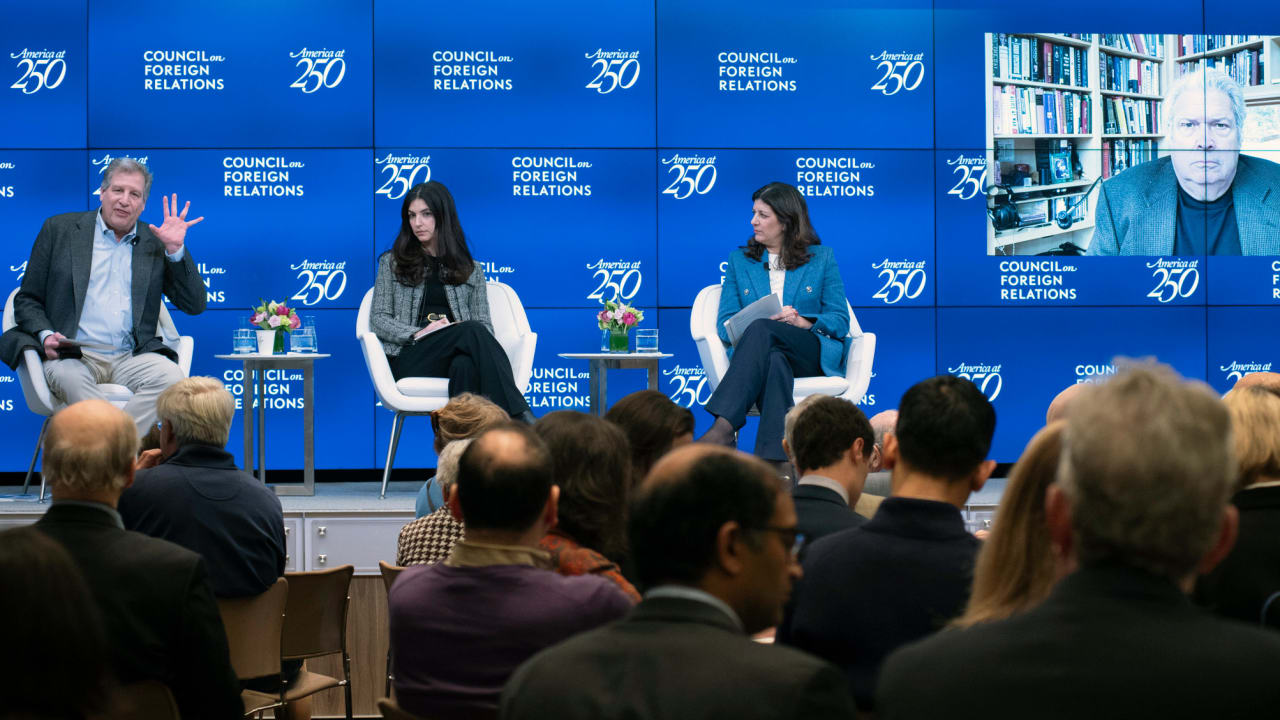
We’re privileged to have three distinguished speakers here to address this period. First, we have Hang Nguyen from Columbia University; Steve Walt of Harvard Kennedy School; and Charlie Kupchan on screen, who’s our senior fellow as well as a professor with Georgetown University.
I’m going to take a bit of an issue with the title as “The Lost Promise” because I think what we want to do in this session is really tease out some of the nuance in the different periods of this thirty years since the end of the Cold War.
So what I’d like to do is start by asking the panelists to discuss the immediate post-Cold War period, namely, the Bush—George H.W. Bush and Clinton administrations to just try to tease out some of the things that they were presented with, what they did, what worked, and what didn’t.
And I’d like to start, partly because I know the last panel did not get to the Vietnam War—to start and ask Nguyen to ask—to talk about both the legacy of the Vietnam War and how you think that affected the disposition to use force or not in those two administrations.
But also very critically, at the end of the Cold War with the collapse of the Soviet Union and the Soviet bloc, how did that reposition U.S.-China relations?
Thank you.
NGUYEN: Thank you, Linda. It’s a pleasure to be here.
And I’ll just say I feel like I’m mismatched for this panel. I should have been with my colleagues in the last panel, but I’m very honored to be here in particular with Professor Walt and Professor Kupchan because I’ve been longtime fans of them as a historian.
So even within my field and my discipline of history, I’m known a little bit of—as an archive rat. So I know the Vietnamese language documentation quite well and was one of the first to get into the Nixon Library, but I feel like I’m one of those splitters.
I’m not a lumper, as my advisors at Yale wanted us all to be in the international history program. They wanted us to be lumpers and to take big questions, but I was—I was fixated on the Vietnam War, the history of the war, and in particular how North Vietnam defeated the United States.
And so I spent a lot of time in the archives, but as a result have somewhat of tunnel vision. So I enjoy having these sorts of discussions, and what they told me at the Council was that it was just great timing because I just became a member, and when I first became a member they’re, like, great, we’re going to put you on with our leading political scientists, those who really influence public—educated public opinion, Professor Walt, Professor Kupchan. I’m, like, great. OK, you’re throwing me in the deep end.
So with that, I mean, one of the things that I teach both when I was at the University of Kentucky and then now at Columbia was a two-semester history of U.S. foreign relations, and so I always ended in 1991 and so that is because I was a—I’m a global Cold War historian.
But my final lecture is always setting the stage in terms of the end of the Cold War and what that meant for the United States and foreign policy and domestic public opinion, and one of the things that struck me about 1991 was that it was very similar in certain ways to 1945, and when I talk about that, it was basically that with the end of the Cold War so much of what we would say of the sort of Cold War imposed order just disappeared.
And so in many ways, what U.S. presidents, starting with George H.W. Bush, had to deal with was with that gone what took place, what basically came about, and that were two processes, fragmentation and integration.
And so one of the things that I always say to my students is that can you imagine that, you know, this—the Cold War that they were living under, this East-West ideological rivalry, gave way and what you had was transformational change, and so with the sort of, again, these two processes of fragmentation and integration you also had an explosion of conflicts, and by 1993 there was no less than forty-eight.
I think New York Times counted forty-eight conflicts, and this was, again, very similar in many ways to the wars for decolonization that took place almost immediately at the end of 1945 at the end of World War II.
But in another similar way, if you also look at the United States and where it was positioned by 1991, it was basically the U.S. economy was 40 percent larger than that of the second ranked nation. Its defense spending was six times of the next six countries in terms of their defense spending.
And this—I ran across a quote from you in terms of the promotion of soft power, the United States had enormous influence, and it didn’t know what to do with it and didn’t put much effort into expanding it.
Do you remember that quote, OK, Professor Walt?
WALT: Sadly, no. (Laughter.)
NGUYEN: So we were—this was the unipolar moment. But at the same time, again, as a historian of the Vietnam War, one of the aspects that I teach my students is about the impact of that war on U.S. foreign policy.
And while we now know that the rise of the right, the populist right, began with what many have called the silent majority pretty much under Nixon’s administration, that they were just below the surface during the Vietnam War and came into basically full emergence under the Reagan administration.
So one of the things I say is while there was the death of the imperial presidency with Watergate, what you also have is another current that’s underlying in U.S. foreign policy, which is the rise of this populist right.
And so what happened under Reagan, while there was basically distaste for foreign interventions, military interventions, on the part of Ford and Carter, moving forward, under Reagan, you had what was rollback and so you had what was in many ways, you know, basically the second Cold War.
So we cannot ignore that in terms of laying the foundation for then what would happen in 1991. Basically, at this point, if you’re George H.W. Bush, we’re victorious. We won the Cold War against the Soviet Union. This is the dissolution of the Soviet—of the Soviet empire including the communism in Eastern Europe.
But at the same time, you have an American public that’s just tired of overseas intervention and you have a victorious, basically, population. Like, we don’t need to do this anymore. So unlike the loss of 1975 and to the fall of Saigon, what you have is a public that is we won—there’s no need for any more foreign entanglements. And so that’s the kind of context I hope that we remember as a historian.
ROBINSON: Thank you. I want to go next to Charlie, and thank you for laying many of the threads I think for this conversation.
And Charlie, certainly, I’d like you to give us sort of a short take on how you evaluate the use of the peace dividend by these two administrations. But I’d like, if you will, to specifically touch on a couple of points.
You’ve been critical of NATO enlargement as creating concerns for Russia, and also in terms of the use of force it’s quite interesting that, as you have written and others, that Clinton strove mightily to avoid entanglement in the Balkans, hoping that European diplomacy would do a—of course, wound up with the Kosovo air campaign. And I think also you might—I would argue, that Bush, those two main interventions, the largest since the Vietnam War, the Panama intervention and Desert Storm were, compared to what would come later at least finite, relatively successful.
So, Charlie, over to you for your take on this moment of the early years of the post-Cold War.
KUPCHAN: Thanks, Linda. Good to be with everybody, and greetings to Rita, whom I haven’t seen for a long time.
WALT: Charlie, you’re muted.
KUPCHAN: Can you hear me now?
ROBINSON: Yes.
KUPCHAN: OK. Thanks, Linda. Great to be with everybody, and greetings to Rita Hauser, whom I haven’t seen for a long time, but hello and thanks for bringing us all together today.
You know, I do think that, having served in the Clinton administration first term, I definitely felt what Hang was talking about in terms of the reluctance to get involved, the kind of legacy—the post-Vietnam legacy, which also had elements that were left over from the bombings in the Middle East, and just a general sense that we’re not going to get involved in these weird ethno-national conflicts anymore.
We’re not going to do mountains. You know, we fight big armored division warfare, and I think that partly explains why President Clinton, who came into office wanting to get involved in the Balkans, didn’t really do so until 1995.
But I think that the story that I want to tell that’s more relevant for the panel is in some ways the opposite, because I do think that it was during the 1990s that the United States began to engage in a combination of what I would call strategic overreach and liberal overreach, and by liberal I mean neoliberal market orthodoxy, that to some extent explains where we are today and the sort of populist backlash against the establishment.
And I think that the—there really was an ideological self-confidence—maybe hubris would be the right word—that took hold in Washington after the end of the Cold War. Our system worked, and as a consequence the goal is to universalize that system, and I think the United States embarked on a process of expanding NATO, expanding the EU, bringing Russia into the G-7, bringing China into the WTO, that in some ways caused more harm than good.
And that was sort of the era of what I would call the liberal interventionists. The neocons took over after 9/11, but I don’t think in the end there was that much difference between liberal interventionists and neocons when it came to this idea of forcibly expanding and propagating Pax Americana, and I do think that that is what got us into what we now call the forever wars.
Americans, I think, soured on the internationalist cause because those wars in the Middle East did not go very well, and in many ways Trump’s “America First”—
ROBINSON: We’ll get to that.
KUPCHAN: His promise to kind of pull back from these wars was one of his calling cards in the election, although obviously given the war in Iran he—
ROBINSON: Yes.
KUPCHAN: —he seems to have backtracked on that.
And then there was also during the 1990s and in particular after the 1994 election I think a pivot toward deregulation, financialization, let the market rule, open up U.S. economy to free trade, that in some ways exacerbated the socio-economic dislocations that were already occurring because of automation.
And in my mind, if I were to sort of say tell me where Donald Trump came from, I would put my finger on the hollowing out of the middle class that was the product of this fierce combination of automation, globalization, and the loss of—particularly Americans without a college education, of their well-paid jobs on the manufacturing production line.
ROBINSON: Thank you. Definitely I’m going to get to globalization in the next segment. Thank you so much.
Stephen, I would like to ask you to comment on this early period and what you see as if you agree planting the seeds for the later overreach, but also what you see as, perhaps, some missed opportunities or things that did produce infrastructure useful for the future.
WALT: Sure. So I want to go back and actually put in a good word, at least two cheers, for the George H.W. Bush administration, the sort of—I would characterize as the last realist administration we’ve actually had.
Remember that they are dealing with a remarkable period of change, things happening that are really quite dramatic. They’re having to rethink a lot of what the United States is doing. This is the phrase that I first remember hearing there, the new world order, the way they talked about it.
But look at what they did. In response to the Iraqi invasion of Kuwait, they go to the United Nations, they get a Security Council resolution, and they’re able to forge a very large coalition to wage that war. They also have the good sense not to go to Baghdad to wage war with limited aims explicitly because that was not authorized by the U.N. Security Council resolution and, in fact, the Bush administration understood that if you were trying to establish a rules-based order you had to follow those rules, at least most of the time.
They also managed the end of the Cold War remarkably well. You can think of lots of ways in which the breakup of the Soviet empire and ultimately the breakup of the Soviet Union could have gone south much quicker and in much nastier ways, and they managed that quite well. And in the aftermath of the successful Desert Storm, they managed the Madrid Conference. They put together a constructive multilateral engagement to try and start moving the entire region towards a more peaceful order.
So you look at all of that, that actually looks remarkably good. Not perfect. You could find things to criticize throughout. Every administration makes mistakes. But I think the record of Bush forty-one in foreign policy is a textbook case of the sort of judicious use of American power, leaving us in a remarkably favorable position.
But, and there is always a but, if you read the president’s and Brent Scowcroft’s joint memoir A World Transformed, there’s a passage in there where they talk about finding themselves at the pinnacle of power with the rarest opportunity to remake the world for the benefit of the United States and all mankind.
And to me, it’s that sentiment that is the segue into what Charlie talked about, the hubris that then becomes the Clinton administration where suddenly the United States believes we actually have the magic formula that we can spread around the world and, moreover, that the rest of the world is eager for, ready to embrace it. They want to become like the United States.
People love to point to Frank Fukuyama. I always like to point to Tom Friedman’s book, The Lexus and the Olive Tree, where he talks about DOS capitalism 6.0. It’s sort of invented in America. If you’re going to survive in a globalized world, you basically have to become like the United States of America, and I believe that’s the attitude that pervades the 1990s and lasts well into the aughts, well into even the Obama administration.
For a previous book, I once went and looked at a series of task force reports done by various think tanks, bipartisan commissions over a twenty-five-year period, and what’s remarkable about these task force reports is they all basically say the same thing, that the United States’ mission is to keep spreading these liberal values around the world and they do that in the ’90s. They say it again in 2007-2008, after the financial crisis. They do it again later after the Arab Spring.
No matter what the condition of the world is, in short, the United States is going to go out and fix it and there was remarkably little learning in that whole process that some of the things we were doing actually weren’t working particularly well.
And that, it seems to me, exactly as Charlie pointed out, what ultimately opened the door to a(n) anti-elite, populist, anti-expert, we think we know how to do better, let’s disengage from the world approach that we are now seeing in spades.
Just because things were bad in this disappointing unipolar moment doesn’t mean we can’t make them worse. (Laughter.)
ROBINSON: Thank you. Well, we’ve previewed some of the thoughts about what happened with 9/11 and the subsequent involvement in what turned out to be very long-running wars, the longest wars in our history, and I think that it’s important here.
I’d just like to ask for some, perhaps, brief reflections. This was not foreseen, right? And, you know, Donald Rumsfeld, the idea was go in, get rid of the Taliban, get out. In the case of Iraq, which I spent a lot of time in both countries, it was an idea you would bring in some of the expats, Ahmad Chalabi, some other people out in a tent in the desert after I finished covering the major combat phase, and I thought, this is really not going to work very well.
They hadn’t been in the country for years. So we got step by step drawn in to trying to remake the countries as these insurgencies really prevented the possibility of an exit with anything like a mission accomplished, as the original infamous banner said.
So I just wonder if there were some additional reflections about the difficulty of getting out and maybe for—Charlie, let me start with you on this because I think you wrote very well about your experience in the Obama administration mightily trying to avoid that latter period, trying to get out of Afghanistan.
He was talked into the surge there. Had to go back into Iraq when the ISIS Islamic state caliphate came about, were talked into Libya. I just wonder if you could reflect on the most sort of adamant, don’t-do-stupid-stuff president winds up really getting sunk into a lot of these conflicts.
KUPCHAN: Yeah, Linda, I mean, I think it’s—in some ways I think that that Barack Obama wanted to break the mold that we’ve been talking about, and I did sit in on lots of meetings where he questioned the narrative, where he questioned whether this idea that everybody around the world wanted to sip from the cup of American values and the American-led order, and he struggled mightily with that issue when he was generally surrounded by people who were sipping from that cup and who came out of that era that we were talking about earlier, the ’90s, the 2000s.
And so I do think in some ways Obama ended up in a situation where he did things that probably his gut was telling him he shouldn’t have done, including getting into Libya. I think Syria he struggled with hugely, with a lot of pressure from some of the people in the room to get more deeply involved.
But he was looking at what happened in Libya, Afghanistan, and Iraq and saying, you know, I don’t really want to go there. And, you know, in some ways, I think that Steve is right that the one party that comes out of this story looking pretty good is George H.W. Bush simply because they seem to have had a certain pragmatic, realist approach and they kept the ideology in check, and they didn’t bring down the regime.
They used military force to achieve military ends, and I think they kept in check the mission that George W. then wanted to complete, which was getting rid of Saddam Hussein and the Iraqi regime.
But I do think in the end of the day, you know, Obama wanted to get out of the Middle East and the Middle East wouldn’t let go, and that’s exactly what Donald Trump is finding out.
ROBINSON: So, Stephen, let me follow up with you and ask you, because sort of whose—the difficulties of retrenchment, of getting out, of, you know, trying to limit your objectives. I know you have articulated the critique of the blob, but I would also add the foreign policy blob, the foreign policy wonks that have maybe contributed to aspirational foreign policy.
But also I think if you give the military a mission, they’re always going to try to come up with a new plan to achieve success. So, really, the buck does stop with the presidents. But how do you look at the difficulties of actually implementing a restrained policy?
WALT: Very good. So the biggest problem with the forever wars is we had forgotten how difficult it is to create a liberal democracy that actually works. This was a process that took hundreds of years in the West. It was a very contentious process. This is a process that was actually difficult here in the United States to create what we think of as twentieth century American democracy.
We fought a civil war. And by the way, we forgot about our experience with Reconstruction, which was in fact a military occupation which didn’t ultimately achieve its aims, and that was in a country that we knew pretty well, our own, right? (Laughter.)
So the idea that you could bring in government in a box and do this in a place like Afghanistan, which couldn’t be more unfamiliar to Americans, was I think, you know, really quite remarkable.
The second problem, and this gets at the why couldn’t you get out—and I’m fascinated to hear what you have to say about this—is an echo of what Daniel Ellsberg called the stalemate machine, that in Vietnam presidents understood it wasn’t going well, but the idea was not to be the president that loses and pass it on to your successor, right, and this is what happens in Afghanistan and Iraq as well.
People have collected the list of the number of times that political or military leaders told us that they had finally turned the corner, a quotation that recurs over and over and over from 2006 on. The corner was never turned, right, and each president ultimately found it easier to order a surge, to say they were going to do something slightly different, and then eventually hand it off to their successor.
Even Donald Trump in the first year of his first term actually did a little mini surge in Afghanistan as well. So this was a recurring problem.
I think, Linda, you’re exactly right, that once you give the U.S. military a job they do not want to tell you that they can’t do it. That’s understandable. You sort of want that can-do attitude in your military. But you combine those things it made it extremely difficult.
And finally, last but not least, who was the one American politician who was skeptical about the mission in Afghanistan from 2009 on? Joe Biden. He was right, and when he became president he took the very difficult step of withdrawing. It was chaotic. It was always going to be chaotic because it was a house of cards we were propping up, and as soon as it was clear that the United States was leaving, the house of cards was going to collapse.
He took enormous political heat for that in his first year as president, even though it was in fact the right decision, and the fact that he took that heat is evidence of why all of his predecessors had said, no, I’m not going to try and get out. I’ll just kick it down the road.
ROBINSON: Thank you. Thank you. I would like to ask Hang to actually address the other big piece of this period, this story, which was the repeated declarations of a needed pivot to Asia, which did not happen partly because of this.
NGUYEN: Yes, I’ll definitely answer that and the issue of China pretty much after 1991, the end of the Cold War.
But I want to, again, repeat something that I always say to my students is that the United States rarely gets to dictate the origins, the evolution, and the end of any overseas intervention. So once again, this loss of promise of the unipolar moment.
I would say it wasn’t for the United States to be able to dominate and dictate and control through even to the end of the century to the next, and I think that’s one of the lessons that I wish my students would take away is that the answers don’t just come from Washington, D.C., that you have to look at our allies and how they read our actions.
You definitely have to understand and look at our enemies and see how they are interpreting what we do, and then at the same time realize that the United States can’t control all. There’s agency with the rest of the—that belong to the rest of the world and the United States forgot that with Vietnam.
It forgot it through, I would say, the—with the Reagan doctrine, and then in the lost promise of the unipolar moment, because that’s not how it works. I mean, I think that is something that, again, the twentieth century Cold War taught us.
In terms of the—you know, the sort of—this lost opportunity with the pivot to Asia, I would say one would have to look at the People’s Republic of China and what was going on there if there was any lost momentum with this non-pivot to Asia—that it is something that if you align it with what was going on, whether it is under Deng Xiaoping to a certain point, which is hide and bide, then to Hu Jintao and then Xi Jinping, that there were already domestic considerations that China had to make with regard to the actions it took, particularly after 2000—well, first I’ll say after Tiananmen, but then also 2008 that, again, had—there was a response in terms of what the United States was doing, but there were also domestic drivers.
There were party drivers, and that’s the one thing that I think American policymakers and presidents forgot. They were in many ways, again, repeated with regard to the end of the Cold War and moving onwards. What they did during the Vietnam War was they manipulated public opinion. They fed the American public lies, and so there was one sort of response that the U.S. public could make with regard to the Vietnam War because they were only given a certain amount of information.
And the same, I think, applies in terms of this period in which if you look at particularly the Clinton administration, the manipulation of, OK, we’re entering here for humanitarian reasons but we’re entering here because of the threat to national security.
But if everything comes from the way that the United States and policymakers are able to basically manipulate public opinion, they’re not—the American people never had basically the real set of facts. And now this is another, of course, territory that we’re entering in terms of the Trump administration. But that definitely took place at the end of the Cold War into the ’90s and into the 2000s.
With regard to China, I would just say one of the things that deeply troubled Beijing was basically after Tiananmen Square, they saw what the United States did with regard to Eastern Europe and they saw Russia’s response. They saw Putin’s response. They saw what happened in terms of what Putin took away with Kosovo under Clinton.
And I think one of these—again, we only see it in terms of the U.S. public opinion spectrum and what Clinton was trying to do. But there were ramifications and reverberations in Moscow and Beijing that I don’t think our policymakers, our presidents, took into account, and that happened with regard to the Vietnam War again and again with regard to Hanoi and Saigon.
ROBINSON: So I think I want to raise two points for kind of two quick lightning rounds because this issue—and Charlie’s already raised the globalization—this is a very important question, and I’d like to add—make it in kind of a specific way.
It wasn’t just trade liberalization but the fact that it was carried out without fulfilling the commitments to address needs for worker retraining. There are other related issues of deindustrialization, automation. It was a very complex period where the economy was changing and U.S. policy did not, arguably, take account of that.
And for Charlie, I’m going to come back to you because you write in your terrific book Isolationism you have six different sources of isolationism. You have said you consider this the most important, I think.
But what were the missed opportunities, in your view? What should the U.S. have been doing at what juncture for this to have dampened the isolationists where American workers and Americans generally are most impacted by this far more than the wars that we fought, I would submit.
KUPCHAN: Yeah. I think it’s a combination, Linda, of the external and the internal. That is to say, when things are not going well abroad and where the United States seems to be engaging in policies that aren’t working out, you get a popular backlash as we did with Vietnam and as we seem to be getting now with Iran.
But the sensitivity of the American public to what’s going on abroad I think is heightened when there is economic insecurity and economic dislocation at home, and in some ways I think this is—this is the piece of the puzzle that I think many of us did not see coming.
You know, I, Steve, and others were worried back in the ’90s and in the 2000s about NATO enlargement, about overreach, about attempting to preserve the unipolar moment rather than channel what comes next.
But I think very few people saw the kind of—the economic, the inside, the domestic piece of this, and I do think it’s a combination of forces that are unstoppable and uncontrollable. That is the advance of digital technology, of automation, of social media.
AI is going to make this problem worse, coupled with I think a kind of hands-off approach to the domestic economy because I do think that we could have done things, and you mentioned some of them, Linda, such as worker retraining, such as education, such as getting more broadband internet into those parts of the country that are deindustrialized, place-based domestic investment that would have eased the impact.
And then we open the doors to free trade at the same time that automation is picking up, and by some estimates China’s entry into the WTO got rid of 4 million manufacturing jobs in the United States. And so we’ve gone to a country—from a country in which, roughly, 40 percent of the workforce was on the production line to today where about 8 percent of the workforce is in manufacturing.
And I think that is, in some ways, the kind of canary in the coal mine that we need to figure out if we’re going to address what I would call the kind of stumbling of American democracy, the rebuilding of the middle class, and the restoration of a political center.
ROBINSON: Have a—
WALT: Yeah, I’ll be very quick. I think there’s several dimensions to all of this.
I mean, let’s not forget the 2007-2008 financial crisis, hugely important and also another setback for which nobody really was ever held accountable, right, and this played into populist critiques later on.
Second, we missed—and Charlie alluded to this—we missed the distributional consequences of globalization. Globalization was terrific for the economy as a whole. It was terrific for people in a variety of places. It was good for Harvard professors.
But it wasn’t good for the people who were losing their jobs and the negative consequences for them were far greater than the positive consequences on an individual basis for all of us, and it generated some of the anger.
As Ben said earlier before, we began to see that there were some design flaws in the World Trade Organization. It didn’t know how to handle the specific nature of Chinese capitalism and the relationship of firms to the state there, and the dispute settlement mechanism continued to not be able to handle that as well.
And finally, and this gets back to our earlier discussion, there was a huge opportunity cost involved in this. You know, my colleague Linda Bilmes likes to estimate that the cost of the forever wars was somewhere around 6 (trillion dollars) or $7 trillion, right? You could have done an awful lot with that money here at the United States, especially in an era where interest rates were incredibly low, and some people were saying this is the time to do a lot of infrastructure investment here in the United States.
It didn’t happen for a variety of reasons and partly because we were spending a lot of money creating really nice air bases in Bagram, Afghanistan, and not necessarily creating as many really nice airports here in the United States.
NGUYEN: Pay off all those mortgages.
WALT: Yeah, pay off mortgages, leave more money in consumers’ pockets.
ROBINSON: Do you have a brief comment, Hang, you’d like—
NGUYEN: I guess all I would say is that I think the problem with, as we saw in 1991 to get to 2016, is the promise of neoliberalism combined with neoconservatism that basically lost—I don’t know, I’m going to mangle this and they’ll probably revoke my membership to the Council of Foreign Relations—but that there was something about pushing neoliberalism to our allies across the world, and they did not—it wasn’t what they wanted.
And I think it was without the support system, was without democracy, and that what basically happened was basically expand the haves and the haves not within these countries and globally.
ROBINSON: Good. Well, I will open up, but I do want to try one more time a real lightning round to just plant the seeds for maybe further discussion and, Steve, I want to start with you because it is clear, I think, to many of us that the restraint community, if I may call it that, has gained traction and for good reason. People want a better match between policy goals and means.
But I think there is—it’s important to note that at least some of that community does not reject the use—the need for international cooperation and the need for reliance on diplomacy and the mere fact of the interdependence in dealing with the systemic challenges, whether it’s pandemics or climate or other things.
So perhaps just a quick note about whether you think that has their disputes, perhaps, about which form it should take and so forth. I’d note a recent poll shows support for NATO is still very strong, even the support for its Article 5 provisions to repel any invasion of Russia into Europe. So just maybe quick thoughts about the utility and the support for such mechanisms.
WALT: Yeah. I think—so the way in which the restraint community is often caricatured is that it’s a bunch of isolationists, which is completely false, right. All the restrainers I know believe the United States should be actively engaged economically and diplomatically and, in some cases, militarily around the world.
Most of the opposition is to the kind of foolish uses of military power that we’ve done in the past that have not worked out well. So people in that community are just as upset by what’s happening today as we were upset by what was happening in Afghanistan, Iraq, and elsewhere.
Would like to see much greater reliance on diplomacy, which tends to work out much better for the United States overall, and until we shift back from thinking that the way to solve political problems in distant places is to blow things up and focusing more on devising political solutions that might be able to actually address some of these problems in a more lasting way, we’re going to find ourselves continuing to do the same sorts of things we’ve been doing in the past.
It is really striking, and I still don’t have a completely satisfactory explanation in my own head, but why we seem to be repeating this under very different presidents. I mean, you couldn’t ask for a different set of people than Bill Clinton, George W. Bush, Barack Obama, Joe Biden, Donald Trump.
And yet, all of them in that period found that there were political problems that were best solved by sending a cruise missile, sending a plane, sending something, blowing something up, and then hoping you could talk your way through the problem afterwards.
And I think until we get the balance shifted back a bit more towards what are the politics here, what are the political issues at stake, what does the other side want, how much are we permitted to even contemplate letting them have—even if we get 80 percent, can we allow them to have 20 percent of what they want, et cetera?
The sorts of diplomacy that worked well in the early Cold War, the first panel, that worked well in the Bush administration forty-one, et cetera, we’ve lost sight of that, it seems to me, and that’s part of the lost promise of the unipolar moment.
NGUYEN: Could I jump in with my final thoughts?
ROBINSON: Yes. Yes, please.
NGUYEN: And while I’m a historian, one of the things that I’m doing now is trying to apply my historical research to current policy and in particular play in this U.S.-Vietnam reconciliation space, and one of the things I always say when I meet with, and I provide them a platform to meet—a channel for them to meet and have basically frank discussions about Vietnam’s position regionally but also globally and strengthening U.S.-Vietnam relations.
As I always say, we, our shared histories—the U.S.-Vietnam—suffered the most in the twentieth century. That is—you know, that Vietnam, again, was the biggest loser of the post-’45 era, having three wars and still emerged victorious but suffered in peace, that the twenty-first century, the U.S.-Vietnam Comprehensive Strategic Partnership has the ability to actually maintain peace in the Asia-Pacific region.
And I always say that. I’m, like, we can rectify the wrong of the twentieth century in the twenty-first century. And the Vietnamese always say to their American counterparts, look, while—whatever you do, different presidential administrations, don’t forget us. Don’t make us choose sides. We want to continue working with you, despite all of this going on with the tariffs, but just hear us out.
And I think one of the things that I always keep saying is that we’ll keep the communication lines open and so here’s one of the ways that, despite whatever happens, just listen to our allies, and watch what they do and see how they respond.
ROBINSON: Thank you.
Charlie, would you like a quick word on what you think is the most important international institution to not throw out with the bathwater?
KUPCHAN: Yeah, just two final comments.
One is that I’m—I have a less charitable view of the restraint camp than Steve does. I think it’s all over the place. I think there are isolationists out there. Many of them are in part of the MAGA movement, and I do think it’s something that those of us who are what I would call selective engagers need to be mindful.
I think there’s a sweet spot between doing too much and doing too little and we need to find that.
A final comment, I’ll just pick up on the comment that you made, Linda. One of the things that most worries me is not, you know, war or not war, who do we bomb next, but the erosion of multilateralism, the erosion of cooperation, particularly across ideological and geopolitical dividing lines, because, you know, the big issues of the day may well be things that can only be tackled through broad initiative, whether it’s climate, whether it’s nuclear proliferation, whether it’s global health.
We need to figure out how to work together with countries even if we don’t agree on how they govern themselves. Otherwise, we’re all going to sink together.
ROBINSON: Well, with that, I want to remind everyone that we’re on the record, and invite members and guests and those on Zoom as well as in the room to come forward with your questions, and we’ll start here.
Yes, please?
Q: Thank you. Adrian Karatnycky
Just very briefly, I think the panel would have benefited from a little bit more ideological balance, but I welcome the expertise of the panelists.
But I do want to make a couple observations. First, I do—and invite your comment. It is a myth that, you know, impoverishment in the United States and jobs at the lower end have been shrinking.
What has happened, as statistics show, is the expansion of the upper middle classes, and I think in the rather uncharitable discussion of the spread of liberal internationalism, we forget the hundreds of millions of people who’ve ended up in freedom.
And also the periodization of this panel, which basically excludes the Reagan era from the beginning of the march towards liberal democracy, its promotion and expansion, therefore, also excludes, you know, what happened in Argentina, what happened in Chile. OK. These are not perfect societies, but they’re societies where freedom was expanded.
Central Asia, the progress our allies made in places like Korea. So it seems to me that we need to have a little bit of an element of balance between it’s not just all—it wasn’t all about intervention—military intervention. It wasn’t all about arrogance.
I think there was a kind of a humanitarian impulse and I think American people support it. And MAGA, by the way, 90 percent of people in MAGA, according to the latest polls, support the attack on Iraq.
ROBINSON: Thank you. I think that your points are very well taken, and democracies have grown and benefited in various regions, as you point out.
Maryum, please.
Q: Maryum F. Saifee, CFR life member, and I’ve been a Foreign Service officer for close to twenty years.
My question is for Professor Walt. I started my career under Obama and have seen sort of—in your Foreign Affairs piece you talk about the United States as a predatory hegemon and this cycle of sort of the military expansionism.
How do we break free of the cycle for a day after a future administration, especially kind of grounded in the realism and the restraint of the George H.W. Bush era, and going back to sort of expertise and a foreign policy that’s sort of grounded in humility?
WALT: Let me try and take a swing at both of those together.
Many of your points are valid. One of the things you could also give credit for the period we were asked to speak about, so the post-Cold War period, was that, you know, at least a billion people around the world were lifted out of the lowest levels of poverty. So globalization had real benefits for some parts, and that’s not a bad thing, right, in and of itself.
On the spread of freedom, that’s much less clear in this period. The first ten years look pretty good. Eastern Europe looks like it’s moving democratic, some countries in Latin America. According to both Freedom House and the Economist Democracy Index, democracy has been in retreat for twenty years now.
The number of people living in a free society and number of countries that are truly free, et cetera, has declined steadily since the early to mid-aughts, and that’s something that ought to disturb us.
Also, and I stand corrected if you know more about this, but my feeling of how the United States handled South Korea, which was a military dictatorship for decades and yet a close American ally, is about right, right?
We did not try to impose democracy upon them. We nudged in the gentlest possible way. We let South Korea decide it wanted to become a democracy of its own sort, and one could make the argument that South Korean democracy is looking a little healthier than our own right now. So you might reflect about that.
In terms of predatory hegemony, I mean, you’re going to have to have a different administration because this is an administration that wants to act like a predatory hegemon, and by that I mean a country that is trying to take advantage and reap unequal benefits from everyone.
All great powers are predatory towards their adversaries. They want to get the better of a deal. They want to look for advantage all the time. A predatory hegemon does that with your allies, too. Turns to the most pro-American countries in the world like Canada and Denmark and tries to take something from them or take advantage of them in a variety of ways, and I don’t think this administration is likely to change that policy. You’re going to have to have a different administration to do that.
ROBINSON: Hang, would you like, or Charlie, would you like to speak on the, perhaps, under emphasized benefits of globalization and democratization?
KUPCHAN: I would just say that, I mean, I agree with Adrian writ large that over the course of its history the United States has made the world a better place and has succeeded in replicating the American experiment in many parts of the world that had no history, no experience, with liberalism or with democracy.
But that doesn’t mean that we didn’t overdo it, particularly in the period that we’re talking about, and as we’re trying to figure out how we ended up where we are today, I think we need to speak soberly about what we got right and what we got wrong.
And I also think, Adrian, that I just have a very different read on what’s happened to the American middle class. Yes, I mean, inequality has gone through the roof. Yes, globalization and automation has advantaged some.
But, you know, I grew up in Wisconsin. Most parts of Wisconsin outside of big cities right now are dead and that’s simply because they have been de-industrialized and a lot of the rest of the country has been de-industrialized, and those workers are hurting.
ROBINSON: So I’d like to take one more question in the room, and then if we have any on Zoom. Please, in the middle here.
Q: Thanks. I’m Robyn Meredith. I’m with Morgan Stanley and author of The Elephant and the Dragon, which is about India and China.
We’ve been talking about the politics and the history of the—you know, the lost promise of the post-Cold War era. But one of the things I wanted to go back to was, you know, one of the big promises of the peace dividend was rising incomes, hopefully, around the world, a rejuvenation of the U.S. economy.
Of course, it hasn’t quite worked out that way or hasn’t worked out evenly for all sectors of the economy. As you point out, lower segments, manufacturing workers, et cetera, have come out as losers. The rich have gotten much, much richer, et cetera.
What are some of the solutions is my question. We’ve talked a lot about what we shouldn’t do militarily. What should we be doing to help workers at all levels, particularly those who’ve been the big losers, that we’re not doing?
ROBINSON: Who’d like to take that on? We don’t have an economist on our panel, so I want to not push anyone.
WALT: I’m going to stay in my lane and say if I start prescribing economic policy for the country, things could get even worse. (Laughter.)
KUPCHAN: I’m more or less in the same boat as Steve except I will say this much. I think the course that we’re headed down is the wrong course and that the idea that somehow we’re going to put tariffs on everything that’s coming in from abroad and Americans are going to get their jobs back on the production line, this ain’t going to happen and, in fact, it’s going to make things worse because those workers are not only not getting their jobs back on a production line but they’re paying 20 percent, 30 percent more for what they buy, and now 50 percent more for gasoline.
And so in some ways, I think the $60 million question is, you know, what is the future of work in the digital age? What can we do now to educate Americans, both young Americans but also those Americans that have been on the losing end of globalization, and what can we do to educate them for the jobs that are going to be out there?
I don’t know the answer to that question, but I think the person who does know the answer will be richer than Elon Musk.
NGUYEN: I’ll just jump in. I had a very interesting conversation with a CFR member who was presenting in front of countries in Southeast Asia, not Singapore, and he was pushing superannuation, so the Sovereign Wealth Fund, the pre-distribution of wealth as one route that these frontier markets could take, and how the state could play a positive role.
ROBINSON: Thank you. And if we don’t have anyone on Zoom?
Yes, we do. Good.
OPERATOR: We’ll take the next question from Jeffrey Price (sp).
Q: Hi. Can you hear me?
KUPCHAN: Yes.
ROBINSON: Yes.
Q: Thanks. Just I’d like to just pose a couple points in defense of the foreign policy of the 1990s.
First, it doesn’t seem to me that it’s fair to lump the liberal internationalism of the ’90s with the neoconservatism of the 2000s. For one, there was a concerted campaign in 1998 for a forcible regime change in Iraq. The Clinton administration considered that.
The analysis was, among other things, that it might cause civil war, instability. It would be hard to get out. Change the regional balance, and the biggest beneficiary would be Iran. So I think very different from the policy of the 2000s.
But more current point, NATO’s open door. It seems to me that—well, I guess the question for Steve and Charlie it seems to me that the world is a safer place because Poland and the Balts are in NATO. But I would invite, you know, your analysis on that point.
WALT: So, I mean, I think in some respects Bill Clinton was an extraordinarily lucky president in many ways, one of which was that the negative consequences of some of his decisions didn’t come down the pike until after he was president, right, and I would point to two.
I believe NATO enlargement was a mistake and the partnership for peace was a smarter approach, the approach that the Defense Department, for example, initially favored.
Why? Because it did a lot of the things that enlarging NATO would have done but it also was open to Russia. Russia was actually considered, you know, a potential member of that and I think that could have led to a much more ultimately stable European situation than what we had.
The second one, which we haven’t mentioned at all, was the policy of dual containment which was adopted in the early 1990s where the United States says we are going to simultaneously contain Iraq and Iran even though, of course, they’re rivals with each other. We’re going to contain both of them. And that required the United States to keep a lot of military forces in Saudi Arabia, which is one of the reasons that Osama bin Laden gave for why he wanted to attack the United States of America.
So if you want to play counterfactual history, imagine no dual containment in the 1990s, a policy, by the way, that was opposed by people like Zbigniew Brzezinski and Brent Scowcroft. No dual containment, which means no 9/11 attack, which means no global war on terror, which means probably no war in Iraq, et cetera, et cetera.
So dual containment is—to me was a strategic mistake that ultimately had negative consequences but after Clinton left office.
KUPCHAN: Yeah, I would add that—I mean, I probably agree with you, Jeff, that we’re probably being a bit too hard on the Clinton administration.
I think they got a lot right, and I also think that our narrative of that period is being heavily colored by what happened after 9/11, and had it not been for the invasion of Iraq, had it not been for the ever wars, our reading of the 1990s would, I think, be quite different. So I think it’s important to make that point.
On NATO enlargement, you know, just a couple points. Number one is that, you know, had it—had it been stopped with Poland and the Balts or maybe a few more, I would have less heartache about it. But the fact that it has gone through seven waves of enlargement, that NATO in 2008 said they’re going to bring in Georgia and Ukraine, this just strikes me as asking for trouble, right. Any country would not like it when the largest, most impressive military alliance in history gets closer and closer to your borders.
And I’ll just offer one anecdote that reflects the conversations that I had. I was in the Clinton administration at the time, fighting not for NATO enlargement but for the partnership for peace, as Steve said.
And one conversation I had that’s always stuck with me was I was arguing with one of the principals that was driving forward the policy and he said to me, Charlie, I’d rather leave geopolitics out of it, and that sort of has led me to believe that there really was a kind of moralistic, ideological view about righting the wrongs of Malta, doing the right thing in a way that I think lacked realist sobriety, and I think that lack of realist sobriety came back to haunt us.
ROBINSON: Thank you. So we have time for a couple of more questions. Let’s take this woman here.
Q: Thank you very much. Mojúbàolú Olúfunké Okome, professor of political science at Brooklyn College.
You know, I—the celebration of this virtuous relationship between democracy and development and globalization being good for all of us, it wasn’t good for Africa. It’s still not good, you know, and I think if America was more aware of the criticisms from Africans, from Global South countries, that were not benefiting from the hyping of democracy and globalization being put together, you know, the country would be better off now.
So I’m always very puzzled about why what’s happening in the rest of the world matters not even in a tiny way to the obsessive concerns about what this country is doing and why it’s the best thing for the world, and how come those people are not making this happen or they’re mistaken.
The problem with the Olive Tree book is its real, you know, obtuse focus on the presumed success of globalization and blindness to the havoc that was being wreaked in the lives of many people. If there’s any gains it was mostly in India and China, you know, where a huge middle class emerged, and that was also at a cost.
So why is this not important and we’re just talking about policy and the U.S. and, you know, hegemony?
ROBINSON: Thank you. I think, perhaps, both of you have a word about this. I know you’ve written, Stephen, about the public opinion of others.
WALT: I think we should take—if we—yeah, if we have—if we have time for one more question, we should take them both and then just—
ROBINSON: This gentleman.
Q: Khalil Byrd, KB, life member. Kennedy School grad.
And what did we lose out on because we didn’t see an H.W. Bush second term? You started talking about it a little bit, but I want to hear what would he have done in that—in those four or five years?
ROBINSON: Why don’t we start here?
WALT: All right. So I’m very sympathetic to the first question of that the United States has routinely, going back long before the period we were talking about, neglected much of what was going on in the Global South. We were East-West focused during the Cold War. We became sort of, you know, transatlantic obsessed.
We’ve gotten more interested in Asia and India, some other places, but Africa has always been trailing behind, arguably, even behind Latin America, which we also tend to neglect. I think one can make a case that some aspects of globalization did, in fact, improve economic conditions in some parts of Africa, countries that have been able to attract foreign investment and do good things with it. But I am not an expert on Africa, and I know enough to know that that record is certainly an uneven one.
I have no idea what Bush would have done in a second term. I suspect he would have had a different team eventually over time because teams tend to recycle, and if you read Jon Meacham’s biography of the elder Bush, it does make it sound like he was tired. He was out of gas by the end of his one term as president and didn’t run the greatest campaign, et cetera.
And so I worry that, in fact, a second term would not have been all that wonderful in various ways. Again, I think he had—he and his team had done a remarkable job dealing with a very turbulent, very different international environment. But I’m not sure they had a lot more left to do. Maybe in the Middle East but I’m not even sure about that.
ROBINSON: I can quickly add that Jim Baker was very involved, though, in the Iraq study group in trying to find an alternative to the surge in Iraq. So I think that’s a good question.
Let’s just wind up with final comments from Charlie and then we’ll end with Hang.
KUPCHAN: Yeah. My only comment would be that I do—I do think that things are changing when it comes to the developing world or the Global South, whatever the appropriate terminology is, and one of the features of the kind of global landscape that I find most striking about the last few years is how many countries out there are not taking sides.
They’re not with us. They’re not with Russia and China. India is, in some ways, the gold standard here, Modi practicing what he calls multi-alignment. He comes here for a state dinner, then he flies off to Moscow and he hugs Putin, and then he’s in Beijing with Xi Jinping.
And I think there is a degree to which countries like India, Nigeria, South Africa, UAE, Turkey, they’re playing the field now in ways that I think we really haven’t seen in the modern era, and I think it’s partly because they have options because all roads don’t lead to Washington anymore.
And I think that in some respects is a good, positive development and it will mean that countries that have more agency will be able, in the end of the day, to pursue policies that do them better.
NGUYEN: I’ll be very quick, and I echo your sentiments, and the only kind of optimistic outlook I can have if we are in a twenty-first-century Cold War is I think China’s Belt and Road Initiative and reaching out to countries in the Global South, not winning the countries in these regions over.
So that’s, again, outside of America’s control, but that’s something we have to our advantage, that I don’t see there being a choosing of sides, particularly and including Africa but also the countries in Southeast Asia that would choose to go and resemble the PRC.
The only thing I’ll say, we never play with counterfactuals in history because we’re terrible at them, unlike political scientists. But I would have loved to have seen a second term for George H.W. Bush because at least he was—and, again, it wasn’t that Clinton didn’t know foreign policy but he was a much more domestic politics person, and as a diplomatic historian and wanting some—a grand—like a grand strategist, I think that a second term would have been great if George H.W. Bush had been reelected.
So it’s more an answer to that there wasn’t a coherent strategy under Clinton and plus, because personalities matter and because he had his hands full with what he was doing and Monica Lewinsky. We wouldn’t have had that. So I would think it would have been—it would have been better.
ROBINSON: So our next session will actually deal with the future and the Trump era. So after the break, you’ll begin back here at 3:15. Thank you so very much. (Applause.)
(END)
This is an uncorrected transcript.
Panelists assess how Trump-era policies altered the international system and what comes next for the U.S. role globally.
ROSE: Welcome, everybody. My name is Gideon Rose. I’m an adjunct senior fellow here at the Council. And welcome to the third session of our Hauser Symposium. This one will be on “The Trump Era and the Future of the U.S.-Led Order.”
We’ve heard a lot of really first-rate historians and policy analysts; and we’ve talked a lot about contingency, and about the choices that were made and couldn’t be made, and some of the things that might have been done differently. And I think all that is true and all of this has been a really interesting discussion, but there’s also a structural context in which all these policy choices that we’ve been talking about have been made. And I think it’s actually useful to step back, especially for this final panel, to look at the larger structural context because we may be at one of those hinge points in history in which we’re not just making choices about an individual issue or an individual situation or with individual policymakers, but we may be confronting one of these large structural chances in international relations in a new era which will guide all the choices that people make.
So what do I mean by that? Modern international relations, I would argue—this is the way I teach it—has had three periods, fundamentally different periods, so far, and we may be entering a fourth.
From the mid-seventeenth century to the mid-twentieth century—three full centuries—Europe’s order, it was defined by the end of the Thirty Years’ War, which ends up giving European states dominance in the international system. And you end up having 300 years in which you have multipolar state conflict as the normal state of affairs in the system. You fight each other in Europe. You colonize outside. You end up getting sort of a balance of power and imperialism. And the world is run this way for several hundred years.
That goes down in a blaze of self-immolation in a second thirty years’ war, from 1914 to 1945, in which European civilization and European great powers blow themselves up. And the multipolar modern international system shifts into a postwar bipolar system in which two new offshoots or two new powers, the Soviet Union and the United States, essentially divide the major areas of the world between them with their alliance systems and structures, and there’s a third area that is the developing world, the postcolonial world—we now call it the Global South—but somewhat outside. And you have the second era, which was our first panel, essentially, the Cold War era, a bipolar system in which the Soviet Union acts like all other predatory powers have always acted, creating a system in its own sphere, and the United States chooses to do something different. After 1945, with the advent of nuclear weapons, you also have the advent of the liberal international order or some version of it in which the United States chooses to play international politics as a team sport rather than an individual sport. And so you get in the American side of the Cold War alliance system a much different kind of pattern of international relations than you ever had in history before. We rebuild our allies via things like the Marshall Plan. We protect them with things like NATO. And we play as a team in our area.
Then, in 1989 with the end of the Cold War and 1991 with the end of the Soviet Union, you segue into the post-Cold War era, which is also the unipolar era, in which that American system now spreads to the world at large, and you take the institutions that you built in the American sphere and you essentially say now there’s no barrier to spreading them globally.
And so you had multipolarity for 300 years, you have bipolarity for forty years plus, you have unipolarity for thirty years plus, whatever, and now we may be heading into something else. It may be a return to multipolarity. It may be a new bipolarity with China. But whatever it is, it’s something different than it has been.
And the reason it’s important to talk about this is because a lot of the individual policy choices that have been made by American decision-makers which seem deeply contingent, which seem deeply personal, which seem almost random—oh, if you have this guy in there or that situation, it could go totally differently—in fact, there have been pressures and incentives from the system guiding you towards different things. You couldn’t put the policies in the bipolar era in place back in the nineteenth century. And when you had the post-Cold War era, you had a world that was geared around American power that continued a system that was essentially playing as a team. Now there is both international and domestic resistance for the continuation of the order that has been in place, essentially, in one form or another since ’45. But we don’t know what is going to replace it.
And so the Trump phenomenon, whether you want to date it from 2016, whether you want to date it from 2024 or 2025 or somewhere in between, whatever, there’s some new kind of situation starting in which the United States seems not to be playing by the rules that it has played for for the last two sets of those cycles. It didn’t play—it played by a set of rules during the bipolar era and it played by a set of rules during the unipolar era, but in both of those eras and the entire postwar stretch—all of today’s times—it has seen itself as the guardian of the system in general, and it has seen itself doing that as leading a team of others in which it wanted the world to be stable and essentially avoid great-power war, have a relatively open trading system, and move somewhat gradually towards a common view of democracy and markets and freedom across different spheres.
Steve Walt said, oh, Korea was different because we didn’t try to impose regime change, we didn’t try to make it a democracy, and that’s absolutely true. On the other hand, it became one anyway, so we took that. Korea, I would argue, is the poster child for the American era because it ends up becoming a sort of liberal capitalist democracy even without constant pushing just because it’s included in our sphere. But that entire sphere is now disintegrating, and we have lost faith in it and others have lost faith in it. And that is the context in which Trump comes to power and starts to try things that are different.
And so to talk about what Trump is trying to do differently, and what—whether that will succeed and what will come in the future, we have three extraordinary panelists. You know their backgrounds. They’re in your papers there. I’m not going to waste time reading them. But we have Bob Kagan, we have Rebecca Lissner, we have Leslie Vinjamuri. These are experts who are going to tell us how this era we’re entering in now is different from all other previous eras. Mah nishtana halayla hazeh? Why is this era different from all other eras? And it’s not because we get to recline at the Council. (Laughter.)
Bob, why is this era different?
KAGAN: (Off mic.)
ROSE: You’re not—we can’t hear you. Unmute yourself. First thing—first time that’s ever been said to a Kagan. (Laughter.)
KAGAN: I was muted by the organization, so that really wasn’t me.
ROSE: You’re still muted. Oh, now you’re on. Loud.
KAGAN: OK. Thank you, Gideon.
First of all, thank you, by the way. Thank you, CFR, for having me here. It’s wonderful to—I’m sorry, not really literally here, but be on this wonderful panel.
I was just saying I don’t believe—it’s not clear to me that we are entering something that’s completely different. It seems to me that we are entering something that looks a lot like what existed before 1945, and, you know, when we really had a genuinely multipolar world, and when it was pretty much everybody for himself. Interestingly, the United States in the ’20s and ’30s was the most powerful country in the world. It was certainly the richest country in the world. So it isn’t so much a question of whether the U.S. is powerful or not; it has to do with what the U.S. wants to do with that power.
And so—and the—and the characteristics of this world I think people need to understand clearly, because sometimes international relations theorists talk about balance of power and the stability of a multipolar world but the truth is a multipolar world is historically highly unstable and very aggressive. Even in what some people describe as the long peace of the nineteenth century, the great powers were almost constantly at war with one another. So imagine a world in which the United States, and Russia, and China, but also Japan, which is a former great power and likely a future great power, and perhaps Germany, and who knows how else—who else—imagine a world in which we are pretty much once a decade engaged in a war with one or more of those great powers. That is what a multipolar world has always looked like. That is what we’re returning to, only, of course, with much greater destructiveness.
And as far as the Trump administration is concerned, getting to this world is a conscious policy. It’s not an error. It’s not a failure to understand. It is a conscious policy. The administration and many Americans of both parties concluded that maintaining this world order that you described so well, Gideon, is, you know, too expensive, too much of a burden, not really in our interests. And I think people have forgotten what the actual alternative is, but it’s been very much a conscious decision. This is—you know, people have said, you know, great power is a choice, you know, and we have chosen not to now play this role. And we’re already reaping the consequences of it, and I’m sure we’re going to talk about the effect of the Iran war on all of this. But one clear effect has been the further driving of wedges between the United States and its traditional allies, and I would say a strengthening of the two sort of have-not expansionist great powers, Russia and China. So I think that, actually, the United States is suffering a strategic setback overall as a result of the Iran war, but it’s only a continuation of the course that the Trump administration had already set us on.
ROSE: OK. I’m going to stick with Bob for 200 for a second because I want to follow up very quickly. One thing that’s been different is the advent of nuclear weapons. So there are some who would argue that you can’t go back to a pre-’45 multipolar era in exactly the same way because there are now nuclear weapons in the world, and so that’s going to either provide deterrence or raise war.
The second thing is, to the extent that you’re right about the badness of the multipolar world—which I agree with, which is why we created all this different world—will—as that reality that you just described becomes more obvious to people, will that create a homeostatic pressure to pull the United States back into a more hegemonic, theme-building, benign role in order to head off what you’re talking about?
KAGAN: Well, that’s—the latter one is a very interesting question, and I think—but it seems to me the answer is no, and nor am I sure that we can ever go back. I don’t—you know, so much of the order that we have been living in since 1945 was based on trust—trust that the United States could be trusted with this enormous power and not abuse it, especially in its relations with its own allies; and trust that the United States would, in fact, make good on its security commitments. Both elements of those trusts are now gone. The United States is using its great power to bully, including its closest allies, and it has also withdrawn effectively the security guarantee that everyone has depended on. So that—you know, I don’t see how, especially if we’re going to have three years of this—you know, a lot can happen in three years. A lot has already happened in one year. So I don’t really think, if I were another—if I were one of America’s allies, I would not trust the United States again the way I have trusted it before.
And now I’ve already forgotten your first objection.
ROSE: Nuclear weapons, but we’ll get back to that. OK.
KAGAN: No, actually, I want to say something on nuclear weapons quickly, which is that I think we should not assume that great powers can’t go to war in a subnuclear fashion. The United States and China are planning for that kind of war every single day. I conceive it possible that the United States could be in a war with Russia that would not go nuclear. Before World War II, they said the bomber will always get in and airpower has made war unfeasible. And that turned—that has often been said about many modern weapons, and it’s often turned out not to be true.
ROSE: That’ll be a fascinating experiment to run. We’ll see this, actually.
KAGAN: (Laughs.)
ROSE: Rebecca. Rebecca is leading a giant project at the Council, a(n) all-Council effort on the future of American strategy. So, Rebecca, how much of the strategy we have put in place over the last seventy-five years, eighty years is salvageable? And what needs to change?
LISSNER: Well, thanks, Gideon. And it’s great to be here with Leslie and Bob and with you for this symposium, which has been a really interesting discussion over the course of the day.
So let’s just start off with this idea of the liberal international order, which I think it’s easy to rhapsodize about but it’s also easy to critique, right? The liberal international order was never completely liberal, it was never totally international, and it was never completely orderly, right? And so it’s easy to caricature that concept and what it delivered for the United States, and yet this was a system that was constructed out of the embers of World War II that was largely in service of American power, American preferences, that we constructed in large part with our allies and partners, but really did put American interests at its center. And what I think is so novel about the experiment that we’re seeing the present administration run is the decision to dismantle that system, as Bob said, as a matter of policy.
So Secretary of State and National Security Advisor Marco Rubio, when he was testifying before Congress to be confirmed in his role as secretary of state, said, “the liberal international order isn’t just obsolete, it’s a weapon being used against us,” right? And so the Trump administration has set out to dismantle that order, and in doing so has done something that’s really historically unprecedented. Gideon referenced, usually orders fall through great-power war. Occasionally they fall because empires collapse under their own weight. I would posit that never before in history has a reigning hegemon taken the choice to dismantle a system that it built to serve its own power and preferences and was flawed but still delivering results. And so this is something that, you know, in my personal writing, you know, I’ve called, “a stunning act of superpower suicide,” right? (Laughter.) The United States has basically decided to dismantle its own system that it has built and that was sustaining its own power, albeit with important flaws and albeit with a real need to be renovated.
So what does that mean we’re entering into? I think that it means that we’re entering into a new world disorder, rather than a new world order. We’re seeing these acts of tremendous destruction, but without a real sense of what comes next and what we’re building towards. That could come. That could still come in the future. But I haven’t seen that coming out of U.S. policy in recent years. And so there are a few features of this new world disorder. One is violent conflict. There were quite a few—I forget exactly the number—something on the order of seven interstate conflicts last year.
I think the United States has now bombed seven or eight countries under this Trump administration. The norm of nonaggression has been patently eroded in consequential ways. And so we are just entering into, and frankly have already entered, a much more violent period of history than the one that we have been living through in recent times. And the United States is very much a participant in that, right? We don’t see our use of military force as being constrained. And if anything, has sort of taken the choice to unshackle it, including, most dramatically and recently, in this new war with Iran.
Another feature is economic nationalism. I think we see that every country is really out for itself. And the idea that we were living in a system that had universal rules, for example, to govern trade under the WTO, well, the United States is no longer participating in that system. And it’s encouraging other countries to defect from it, too. And there are some very good reasons for that. I think the admission of China into the WTO, frankly, broke that system and made it very difficult to sustain. But that’s the world that we’re living in now, where great powers are sort of making up their own economic rules, or competing with one another for resources, such as critical minerals and so on.
And so then this sort of begs the question, who’s going to fill the gap? If the United States is no longer an order builder, will it be China? But it’s not clear that China wants to provide that kind of system-level leadership, that kind of public goods provision that the United States has done since World War II. So I don’t think that China can fully step into that void. Nor have they shown evidence that they want to. And we heard the Carney speech at Davos from the prime minister of Canada. There’s been this impulse amongst middle powers to come together, but it’s not clear that they really have the cohesion, or, frankly, the power to sustain either the old order or to build a new one.
And so cumulatively I think we’re just entering a phase where, for the foreseeable future, the international system is going to be substantially more disorderly, unpredictable, chaotic. And that’s just the world that everyone’s going to have to adapt to.
ROSE: Excellent. (Laughter.) Leslie, what did Bob or Rebecca get wrong or leave out?
VINJAMURI: Well, Rebecca got it all right. (Laughter.) And—
LISSNER: Sorry. Bob.
VINJAMURI: I should start by saying, Rita, thank you. It’s tremendous to be able to participate in this. And I know you’re the person who’s made it possible, together with everybody here at CFR. And I’m a member and I love this place. It’s great to be in New York as well.
So I guess a couple of comments. Maybe—and sorry if I’ve misinterpreted some of your opening remarks—but I would push back against this idea that this is all structural. I know you weren’t quite saying that, but it’s a good, you know, thing to knock back against. I’m one of those people who think that President Trump is very much an agent, not simply a symptom. And that, of course, there are structural changes, and Charlie on the previous panel talked about some of those economic changes within the United States polity that sort of have given rise to a populist pushback.
But I think President Trump is very much an agent. He’s very much a leader. And he has transformed many things within the United States and globally. And within the United States I think you can look at the data on polarization. Pew looked at this going back to 2017, and there’s no doubt about it, he’s really cemented and magnified and accelerated polarization of the United States. He’s also jumped on a trend, the executive authority of the president. And he’s sort of driven that forward in phenomenal ways. Partly through violating norms, but also through tactics of intimidation. And I think it’s important to note that fear and intimidation that’s pervasive across much of our ruling classes right now. So I’d sort of—you know, Trump’s agency, I think, is a really important part of this story.
The other—I guess, another thing on the—on the can we go back? You know, are we in a moment where we’re necessarily, for structural reasons and for reasons—structural reasons being the rise of China, other middle powers that have a significant part of the global economy and some autonomy, that we’re necessarily structurally moving into if not multipolarity, an era where multi-alignment is certainly going to be the norm? The other part of can we go back is that trust is broken, therefore we cannot go back. This is something—I think it’s extremely important.
And my view on this is that we have seen a number of very important countries do very destructive and damaging things in the last—if you go back eighty years, right? And thinking the Second World War. And the thing that makes it possible to rebuild trust has everything to do with the transition. Right now, our transition is likely to be something that takes place at the ballot box. If the next U.S. president, regardless of whether he or she is Republican or Democrat, wins on a knife edge against a candidate that is aligned with those things that have led others to distrust us, then I think it’s going to be very difficult to rebuild trust because the world will look at us and they’ll say, OK, we get four years of, you know, this, and four years of that, and you have a polarized society, and forget it.
If, however, we have a transition, whether it’s at the electoral box or whether it’s a broader transition, that begins a national conversation in our civic organizations across our country at the highest levels, at the lowest levels, grassroots, that says to the rest of the world, we’ve done some certain things to you that are not fair, we recognize it and we want to rebuild, I think that there’s everything to play for. So I think we should really be careful not to be deterministic about the future of our relationship with our allies. The other thing I would say when it comes to, can we go back, is that Europeans, as we know—I mean, look at the papers today. Look at the news for the last, what is it, fourteen months, are struggling.
My view—I just spent twenty years living in the U.K. My view is that many Europeans would give nothing—they would give every limb possible to never have to depend on the United States ever again. But, guess what? The world is about alternatives, especially the world of great-power politics, and the world of, you know, a rising China, an assertive Russia, and a very destructive—potentially productive but potentially destructive—technology that the United States and China have the upper hand on. And that’s obviously AI, but there’s also quantum, the robotics. There are lots of things coming their way. So you don’t just walk away from a bully who happens to be a little bit more aligned with—or, frankly, a lot more aligned with you, because it’s a bad patch. Doesn’t—so the search for alternatives is real, but those alternatives are radically inferior, just materially speaking, to what is on offer still from the United States.
And I’d like to believe—but, trust me, the headlines are very upsetting. (Laughs.) When Philip Stephens published his Substack yesterday, and I’ve forgotten exactly what he was arguing, but I immediately took umbrage because he said, the Americans, they’re not really our friends. And I wanted to say, but please differentiate between the American people and the American leadership. And this was—this has been an issue for Europeans for a long time, right? In the middle—after the first Trump administration the line on the street was, we’ll give you a pass once. If you do it again, we’re going to take you seriously.
Twenty-seven—you know the numbers are—there are different polls. But I think about 27 percent of Americans support the strikes right now on Iran. So there’s a difference still between the leadership and the people, right? So I hope that that also becomes part of the equation in can we go back. There are layers to our society. It’s incredibly important more now than ever before in the history of our country, I believe, that those layers are embedded transnationally and that we don’t let the story of America be captured simply by one of our very—admittedly very important—institutions.
ROSE: OK, let me push back on Leslie for 200. You said, the Europeans would do anything to not be dependent on the United States. Anything, that is, except work a little longer, lower their pensions and social security, buy an actual strategic autonomous capability, and so forth. So the things that—Europe could basically get its economy, get its military in great shape relatively quickly, unify, create a common energy and services market, create financial markets, buy weaponry, do all sorts of things. They don’t want to do that because it would be expensive and it would be difficult and it’d be scary. We may push them into doing that.
But the question that I’m asking you is, yeah, there’s been a lot of loss of trust. And, yeah, we’re pushing the boundaries of the relationship. We cheated on our relationship partners. But there’s still these things, peace and prosperity, the kids, that we want to sort of stay together. And the apartment we’re both living in is so expensive that we can’t move out. Neither one of us can afford a new apartment. Our entire defense industries are integrated. If Europe were to be strategically autonomous, if we were to be strategically autonomous from Europe, we would have to fundamentally restructure the purchase and deployment and strategic operational rationales for all of our defense industry. Is that actually going to happen? Is the trust deficit that you’re talking about so great that we’re really going to have a strategic divorce across the Atlantic?
VINJAMURI: Yeah, so I actually think we agree, because, you know, the second part of the point was—first of all, the trust deficit, we have a huge amount to play for. We can rebuild the trust and we can actually have a much stronger partnership. Where actually, when the U.S. president says to its key European allies, we have a problem in the Strait of Hormuz, could you help us out, they at least quietly say we’d like to. We didn’t really want to be there, by the way, but here we are. And they quietly try to develop plans for what can be done at a moment of profound crisis for all of us, right?
But the point I was trying to make was that the other reason, the negative reason why this relationship is likely to hang together, is because there are not great alternatives. I think, to be—you know, to be fair to the debate that’s taking—and the investment that’s taking place across many of America’s NATO allies—there is increased spending on defense, as you know. This is a live and active not only conversation, but investment. And they are running up, as you also know, profound domestic divisions, slowed growth. And the story, I think, is probably quite well known amongst this audience. There are huge barriers. But I think that the intention is running in the right direction.
We haven’t really been on the right side of this always. You know, when Bridge Colby traveled to the Munich Security Conference this year he made it very clear he doesn’t want—and I think he made it actually very clear on this stage too—he doesn’t want Europeans to have an independent nuclear capabilities. That NATO is going to—it is a—the United States is pushing a reform agenda with respect to the multilateral organizations, not a get out of town agenda. Yes, the United States got out of sixty-six multilaterals, but not the U.N., not the WTO, not the IMF, not the World Bank, going down the list, right? So, you know, all in all, I think the Europeans are trying. There are a lot of structural difficulties. There are a lot of domestic political difficulties. But we’re likely to be in this together because there are no great alternatives. So we might as well try to make it as good as it can be.
ROSE: You know, it’s interesting, you know how far we’ve come when Bridge Colby is the leading liberal internationalist in the administration. And you know how far we’ve come when you have to go to the sub-Cabinet level to get a serious discussion about foreign policy and strategy.
So, question to you guys. As you mentioned, Trump today, oh, we need to work with our allies. Why aren’t other people helping us? If the Trump strategy of purely go it alone clearly can’t work to the realities of the 21st century that we’re in now, and if there really doesn’t seem to be domestic American support—put aside foreign support, but certainly domestic American support for keeping things going as they were—all three of you, last question before we turn it over to our panelists here—to our participants here. Is there something that is a sort of liberal international order-light? A unipolarity-light? An American team that has less dominance by Michael Jordan and more distributed passing and shooting from other members of the team? Is that a possibility? And is that what the next post-Trump administration should shoot for? Bob, to you.
KAGAN: Look—(laughs)—we could talk all we want about what may or may not happen, et cetera, but I don’t—I think that that’s a distraction, honestly, from what is actually happening. And just to look at the effect of the Iran war already. You know, I mean, for Europe this isn’t about—with all due respect—this isn’t about them working harder, or what. Europe faces an existential threat now in the form of Russia. That is what they feel. Russia has committed aggression against a European state. Here in the United States we used to believe that Russia’s goals did not end in Ukraine, but only began in Ukraine. But certainly, that is the European view. So here we are in a situation which I think, you know, since World War II America has been sort of primarily concerned with precisely the crisis that Europe is facing right now, OK?
The war on Iran has been a strategic disaster in this existential crisis for Europe. It is providing tens of billions of dollars, and for how long the price of oil remains above 100 who knows, to Putin, at a time when Putin was suffering from terrible budget deficits. This has bought him time in the war. This has extended his ability to continue fighting. And, at the same time, the war has depleted the stocks of vital weaponry, particularly Patriot interceptors and other interceptors that Ukraine depends on to defend its population centers in this conflict. So this has already been a major strategic setback for Europe. And it is not surprising to me that Europeans are not rushing to send their ships into the Gulf to deal with a crisis that the United States has absolutely created all by itself, and detract from the fact that what they need to be doing is defending themselves against Russia.
And so what we’re looking at is the prospect of—and, by the way, China is also benefiting from the Iran war in many—and particularly in strategic respects. And it’s harming Japan and Korea, who were highly dependent on the oil, et cetera, et cetera, et cetera. So we are not—we can talk about the day when we start to pull out of this, but right now we are—(laughs)—we are not pulling out. We are still heading down. And I think it’s going to continue to get much worse. And that’s the reality that we need to be talking about right now, in my view anyway.
ROSE: Agreed. Although I hope we can get beyond orange man bad for a little bit, because there are things that will happen sort of down the road. And, Rebecca, so is there a possibility, even theoretically, between—something that is a third alternative from the thesis of liberal international order to the antithesis of America first. Is there some synthesis that is a more moderate restraint version of the order that could potentially, in a post-Trump world, gain both domestic and international support and be a strategic option for the U.S.?
LISSNER: Absolutely, yes. I think if you look at the public opinion polling that Leslie’s organization does, that others do, if you go out and talk to Americans, which is something I’ve been spending quite a bit of time doing, in places like Detroit and Phoenix and Atlanta, the picture that emerges quite clearly is that the American people want global engagement. There’s actually not a lot of support for this idea of what we used to think of as America first, kind of isolationism or global retrenchment. MAGA voters want to see the United States globally engage, for the most part, traditional Republicans, Democrats, independents. There’s actually very broad support for that. And even if you look at the polling on alliances specifically, their most recent poll from the Chicago Council shows that 91 percent of Americans—which I think is a historic high—think that alliances are a useful tool of statecraft, in many cases more useful than many other tools.
But all of that needs to be juxtaposed against the finding that Gallup, for example, has, that almost every single year since 2006 the majority of Americans have reported dissatisfaction with the United States’ role in the world. And so you have this kind of continued support for certain key pillars of American internationalism, for the idea of international engagement, because I do believe that there’s very little constituency for weakness when it comes to America’s role in the world. And I also believe that the American people want the United States to be a maker and not a taker of international rules and international events. But that does not mean that any president has a blank check when it comes to the use of force, when it comes to aggression overseas, when it comes to expenditures of American blood and treasure, and really when it comes to entanglements. Because that’s the other consistent finding that you see across time, and certainly in the post-Cold War era, is that American people really don’t like getting bogged down in prolonged, costly overseas wars.
So to me when you take that all together it means, yes, there’s absolutely a future path for the United States, where we are both globally engaged and disciplined. And the only viable version of that strategy is one where we’re working together with our allies and partners. Because when you combine the United States with our allies and partners, whether it’s our share of global GDP, whether it’s our share of global military power, whether it’s our share of global economic power, our regulatory power, it’s just massive. And it dwarfs the China threat. When you just take the United States alone, then the competitive landscape becomes a lot more difficult. So I think the post-Trump task is going to be how do you create new alliance bargains? And they’re not all going to look the same.
I think Leslie’s right, in Europe, frankly, the lack of a viable alternative path for Europe, on the one hand, is going to foster continued dependency on the United States, at least in some areas. But on the other hand, you know, they are doing more. And so the United States is still going to be by far the most powerful country in NATO. It will be hard for NATO to sustain itself as a credible collective security organization that deters Russia without the United States in the near term, at minimum without our nuclear deterrent. But they’re doing more on their own. And that’s going to create new forms of friction. And so I think that’s where we get back to this trust question. What is it going to look like for the United States remain immensely powerful as an actor in the European security architecture, but with some diminished influence and with greater friction in trying to get our allies to do the things that we want them to do—for example, helping us to reopen the Strait of Hormuz?
In the Indo-Pacific, it’s a different situation because there I think our allies have even fewer exit options, right? The idea of Japan trying to kind of hedge with China is pretty hard to conjure at this point. But they don’t have the same collective security architecture that our European allies do. They don’t have any nuclear powers within the region, the way that U.K. and France, as we’ve seen with the renewed extended deterrence debate in NATO, can provide that function. And so in the Indo-Pacific, I think there’s an even more stark lack of alternative, which means that they want to continue to be our allies. And we need to figure out on what terms.
That gets me to this final point, which is what are the terms that we want? And I do think this is a place where President Trump has created more space. We now have allies that are willing to do more. And so I think the question for the future is, how do you build on that in a spirit of rebuilding trust, but also in encouraging our allies to continue to foster greater capabilities? And part of that is going to have to be recentering these alliance structures so that they’re not centrally predicated on what the United States can do for our allies, how we can extend American security guarantees to our allies, but how do we nest that within an alliance structure that shifts some burdens to allies, that also puts technology and technological cooperation more towards the center, that centers more economic cooperation, including on supply chains and other things that matter to Americans?
All of which is good for the United States strategically, is good for our allies strategically. We’ll put these on a founder strategic foundation for the future, but also can help us make the case to the American public why these alliances aren’t just a handout or some form of charity that the United States is doing for these sort of luxuriating Europeans who are on their endless August vacations, but rather something that’s actually grounded in the strategic theory of the case that delivers immediate benefits to the American people. So I’ll just say there’s absolutely a third way. And I think the task is just to begin to craft what those terms are and be very clear about how they benefit Americans.
ROSE: President Trump has created a space for new discussions. It sounds like you think that the president, like alliances, is a useful tool. Leslie, same question to you. Is there a space—is there a possibility for reestablishing trust in some collective way among the United States and its allies that would be acceptable to them, appropriate to the problems, and domestically palatable here?
VINJAMURI: I think it depends. I mean, I very much agree with the kind of longer-term vision that you gave, but I think, you know, there’s no way around it. We’ve got to go through it. And so Bob’s comment, like, we are in a phenomenal, and not in a good way, moment of radical destruction. And so I do think that this war isn’t just sort of a blip that we’re going to get through. It’s going to make the—you know, the entire geopolitics, obviously, of the region, but of many of our key relationships with partners and allies, probably much more fraught. It’s going to make it harder to think of Trump as—you know, I was sort of more in line with the argument that that President Trump, for better and for worse, was giving us a moment of opportunity to restructure and rethink the balance of power within our alliance structure.
And I think we’re kind of at a moment of decision and choice. And it does matter how we get through this, what the answer to that question is. So, yeah. I’m very much in the not—there is no determinism. If I were on the outside of American power, and I think I am, actually. I think many of us are, to be very honest. If I were not a U.S. citizen on the outside of American power, I would certainly be looking to diversify my options. We know that folks are doing this. India seems to, you know, be playing this quite well, the strategy of multi-alignment. When I was at the Raisina Dialogue in India about ten days ago they hosted U.S. Deputy Secretary of State Chris Landau, who told them off. And then they hosted the Israeli foreign minister. This is a few days—a couple of days after the strikes were launched. They hosted the Israeli foreign minister on Zoom. Then the next morning they hosted the Iranian deputy foreign minister in person.
And guess what? They just got two ships through the Strait of Hormuz. And—but here’s the thing. For a long time I was thinking, gosh, it’s like—it’s playing all sides. It’s playing all sides, this multi-alignment. And I had a kind of aha moment when, you know, a couple of different Indians, the foreign secretary and the foreign minister at different points of the dialogue, said: Our number-one adversary is poverty. It’s not China. It’s not America. It’s not Russia. It’s poverty. And so multi-alignment is the strategy that we use to make sure that we can continue to access what we need to access so that we can get the growth that we need, which needs to be 6, 7, or 8 percent, because if it isn’t we will not conquer—we will not continue to lift people out of poverty in our country. I mean, it seems pretty smart, actually.
So I think that, you know, for the rest of the world, diversification, multiple partners, multiple partners. And the question for the United States is whether it can somehow get through this not just moment, this war, which is spinning certainly out of the president’s control, and somehow either in these next three years, or the president’s successor, or the people of America and our institutions, can make a compelling case for why to, you know, give America kind of more than just what it would get on the basis of the fact that we have a whole lot to offer materially.
ROSE: I put a picture of the meeting with Modi and Putin and Xi, that was on the front page of the Times, in front of my IR class in the fall. And I said, the question here is couple, throuple, or situationship? These are interesting questions, and why we are at a potential inflection point in the system. At this point, I want to go to our members and guests in New York and on Zoom to join the conversation with questions. A reminder, this reading is on the question, first—on the record. First question right over here. Wait for your microphone and please state your name and affiliation, and a quick question.
Q: Thank you. Toby Gati. I worked in the Clinton administration on Russia, and then in INR.
I thought the title of this panel should have really been: The Trump Era and the Demise of the U.S.-Led Order, because when—for those of us sitting here for the first panel and now for this, think about it. We had a foreign policy elite that worked together. Nobody said, what’s in it for me? What deal can I do? People felt they had a stake in the system. They weren’t running away from it. saying I got to keep my job in Congress. So why don’t we view things that way? There’s no more deference, obviously, to Congress. The private interests, frankly, are what’s directing where our foreign policy goes. And no one has mentioned that, although we kind of all represent in some way that private interest.
So how does this influence foreign policy? And the question that’s sort of the elephant in the room, how does it influence our domestic system? Because the difference between Vandenberg and others is profound. I mean, we heard this morning that Truman and others couldn’t have done what he’d done if Congress hadn’t approved it. And we’re not even able to get Congress to vote anymore. So my question is really, how are these domestic and international factors connected? I think it shows that they are. For example, the Iran war is connected to the Epstein files. Are they really—is it really connected to anything else?
ROSE: Maybe we can get into that. OK, so question for the panel. Why are American elites so scummy? Like Pogo, have we met the problem and it is us?
Q: And so we really could reach a crisis in weeks, not in years. And I know we like to think that, but our political system is really quite fragile.
ROSE: Why are American—why have American elites declined so much from the august heights represented in this room?
LISSNER: Well, I can start. I mean, not to—not to frame this as a defense of the elites, or any of the kind of behavior that you described, but I think the simple answer is partisan polarization, right? I mean, we can overstate the degree to which there was ever a Cold War consensus, the degree to which politics ever stopped at the water’s edge. Of course it didn’t. But if you look from the 1970s, roughly the Vietnam era, onwards, there have just been dramatic trends of Republicans and Democrats sorting into increasingly ideological, consistent blocs, and that their foreign policy views are becoming increasingly aligned with their views on other political matters. That’s being further exacerbated by the rise of effective polarization, where it’s not just that you’ve self-sorted into groups but you actually have negative feelings towards people who are in the other group. And so as a result, we have this just highly polarized political system where the number of voters up for grabs in the middle are pretty small. The upside of bipartisanship is pretty small.
In order to succeed within certain, you know, more partisan-aligned elite structures, you need to show your bona fides. And it also makes it harder to break with your own party because there’s not really another home. And I think that’s part of how you get to a place where the Trump administration can be as kleptocratic as it is, because there’s just not so much of a structure within which at least members of the Republican Party are willing to, or able to, criticize. And so to me, it’s incredibly difficult because there are no good solutions for how you begin to reverse this long-term trend. We can talk about civic education. We can talk about civil discourse. All of that is important. But it really is a long-term structural trend, and one that doesn’t just affect the standards to which our leaders are held and doesn’t just affect our ability to pass bipartisan legislation.
It also affects our ability to act as a credible global actor, because when any country is negotiating whether an Iran nuclear deal or a trade deal with the United States of America, they’re now thinking in, at most, a four-year time horizon, and often shorter. Which means that it’s just going to be harder for the United States to do diplomacy when there’s an expectation that we have such highly volatile politics such that every time the White House changes hands you’re going to get a dramatically different set of policies that are potentially captive to an entirely different set of interests. So the effect on our foreign policy standing can’t be understated either.
ROSE: Leslie or Bob, any comments on scummy elites?
VINJAMURI: I’ll go after Bob. (Laughter.)
KAGAN: (Laughs.) Look, I mean, at the largest level we’re suffering from a major elite failure, purely on the—even before you get to foreign policy, on the domestic issues. It’s one of the most striking things about this period, the cowering of almost every institution in New York, I would say, you know, from the financial community to the legal community, and then, of course, needless to say, the political class in Washington. How to explain this elite collapse? I don’t know. It probably goes deep into, you know, what’s happened to the American character, or something like that. But I wouldn’t even attribute it simply to polarization. A lot of it is what I think was mentioned earlier. There’s a lot of fear involved. And that’s because we have a president who would like to rule as a dictator and is trying to rule as a dictator.
I mean, we have these nice foreign policy discussions. And I’m glad somebody brought up the domestic situation because it’s impossible to talk about foreign policy—American foreign policy is always driven by domestic political and ideological battles. And in this case, it’s definitely being driven by the fact that we have a regime that is trying to dismantle the elements of democracy in this country, and who, in my view, are not even intending to allow a free and fair election this year. So, you know, that’s part of why I have a hard time with the I can’t wait till the Trump administration is out of power so we can fix everything, because I’m not at all persuaded that we’re going to get to that point.
ROSE: Quick comment on—
VINJAMURI: Yeah. I think one of the reasons is because, actually, at the headline a lot of the truths are true, right? That Maduro was a truly terrible, destructive, horrific leader that did horrible things to his people and to his economy. The ayatollah who the U.S. has assassinated, was responsible for the murder of large numbers of people on the streets of Tehran and a brutal dictatorship over many years. Trade has been unfair to American workers. I mean, go down the list, right? We haven’t gotten—the United States hasn’t gotten a fair shake on many of the multilateral deals that it struck. And so then the question is, you know, how do you—what’s the remedy? And the debate is about the remedy.
And in order to debate the remedy, first you have to have two things. One is, you have to have people that understand highly complex situations well enough to have a view, while they’re doing their day jobs. And, secondly, they have to have the channels of influence. And so we’ve sort of eroded our education, and we’ve also eroded our channels of influence. So I think that’s a—and then we have people who are taking advantage across the whole of society at the elite level. And then finally, I don’t think people are scummy. I think people are afraid, concerned, intimidated, and worried. And so I think that most people are good. Not everybody, but I think the vast majority of people are good, have the right intentions, but they’re not being—you know, we’re not set up to succeed right now. The question is, how do you get from here to there.
ROSE: I used to think that. I’m not so sure now. Over here we have a question from Zoom, from the cloud.
OPERATOR: We’ll take the next question from Katherine Hagan. Ms. Hagan, please accept the unmute now prompt.
ROSE: OK. In the meantime, we’ll go to one over here. Yes. Hold on. Wait a second. Wait for your mic.
Q: I’d like to go back to you, Rebecca.
ROSE: Identify yourself, please.
Q: Henny Sander from BlackRock.
I’d like to go back to your question about are changes reversible, in one specific context. Which is about innovation and the new world of autonomous weaponry, and the deterrent effect when a drone can take out a battleship. And how you see the balance of power changing. And, in a world where everything is dual-use technology, is all the research cuts in innovation also going to be reversible or not?
ROSE: Very interesting question. Bob, you want to start with that one, or no?
KAGAN: She asked Rebecca, and Rebecca’s the right person to answer. (Laughter.)
ROSE: Rebecca, you go for it.
LISSNER: I may or may not be the right person to answer, but I’m happy to take a swing at it. So, look, I think this is one of the tectonic shifts that we’re seeing in terms of the strategic environment in which the United States operates. Where you now have these very low-cost technologies that can inflict the kind of kinetic damage that was previously reserved for certainly the most advanced militaries. And there are sort of the happier versions of that story. Like, if you look at what Ukraine has been able to do, particularly in building up its indigenous defense industrial base and its production of drones, and increasingly drones without any PRC-origin components, and the destruction that’s inflicted on the Russian military. That’s a very good-news story, I think from a perspective of U.S. interests, at least as I conceive of them.
And yet, you’re also seeing the proliferation of drones to actors whose interests are opposed to ours, whether that’s, you know, Russia, whether that’s Iran, I mean, Russia with Iranian drones. But you’re also seeing drones being used in, you know, conflicts, like the ongoing civil war that we see in Sudan. And so just the barrier to entry when it comes to these is a reality that we’re going to have to contend with. Again, there’s a potential upside story where the U.S. military, if it wanted to invest in this kind of, like, high-density, attritable mass concept, there’s a lot that we could do to learn from that, and it would be much less expensive than buying aircraft carriers and a lot of the high-end exquisite systems that we’ve grown accustomed to. So there’s still a lot of adaptation left to come.
I think, you know, a lot of this is coming out of the private sector. And so in that sense, I think there’s a short-term/long-term story when it comes to the R&D cuts. In the near term, I mean, I think any country in the world, potentially with the exception of China, would be over the moon if their R&D base looked anything like ours. Like, what the United States is producing as a matter of innovation is truly stunning, and particularly when you look at generative AI. But it is also the case that that is the result of decades of public investment that is far, far, far upstream. But as we’re doing much less of that and especially investing much less as a federal government in basic research and basic science, I think over the long run if you ask the people who study this much more closely than I do they’ll tell you that over the long run that will impede our ability to remain the most innovative economy and country in the world. And so that will have ramifications for national security, but it will also just have ramifications for productivity and prosperity in the United States. And so those are—that’s one of the ways in which I worry that this administration, even as it is putting on these bristling and stunning displays of American power, could in parallel be taking measures that are eroding the wellsprings of our power, whether that’s rule of law and democracy or whether that’s our science and innovation base, over the medium to long term.
ROSE: Out of curiosity, I just asked chat whether current developments in military technology are favoring offense and defense, and its response was today the picture is mixed but many analysts argue that several emerging technologies currently tilt the technical and operational balance toward defense, even as some technologies simultaneously empower precision offensive strike. So, actually, the world of advancing technology, and what it is going to look like, and what its strategic effects are, very interesting subject.
On these and other kind of topics in general, there is no better place to look than Foreign Affairs to track—not because we know what the hell is happening, because we don’t—(laughter)—but because whatever smart people think at the cutting edge of serious discussion on these issues will be featured in Foreign Affairs pretty quickly because that’s what its job is. So if you want to continue this discussion—because it’s not really a matter of opinion; it’s a matter of tracking and adapting to what’s actually happening on the ground—continue to come to Council events and read Foreign Affairs.
Another question? Yes, over here.
Q: Paul Sheard.
Is there any role for the United Nations, and particularly the Security Council, in the future of a U.S.-led order, or whatever order may be coming for that matter?
ROSE: I would say no, but I’m sure our panelists might have an answer to that. Any of you think the U.N. has any role to play?
VINJAMURI: Of course. I mean, of course. Of course it does, because, I mean, you can’t explain—and the Security Council, obviously, but the UNGA, people keep coming. They turn up in September. Why do they turn up? It doesn’t make any sense, right, in terms of, you know, actual impact. And yet, it matters. People turn up. They think it matters. They want to have the conversation. They believe that the discussions, that the deliberation is significant. They believe that the side conversations are meaningful. They believe that it takes people to move things top to bottom.
Does the U.N. Security Council need to be reformed? Clearly, obviously. Will it be? Obviously not. But you know, I think we’ll keep it and we’ll build other—I mean, it’s happening now, right? Plurilateral, multilateral, important piece. You know, lots of other things are going to spring up. But, yes, of course it matters.
ROSE: Leslie or Bob, do you think the U.N. matters?
VINJAMURI: I’m Leslie.
ROSE: Sorry. (Laughter.) Rebecca or Bob, do you think the U.N. matters?
LISSNER: Bob, go ahead.
KAGAN: I mean, it matters, it’s just, you know, the U.N. Security Council is only as good as the relationships among the—among the permanent member great powers. And you know, when there have been moments when it’s been possible for them to cooperate—I mean, the Soviet Union voted in favor of the First Gulf War—but that was—I think those times are few and far between. And basically, if the—if we’re in a multilateral competition, that competition is not going to be settled or managed at the—at the level of the U.N. Security Council, so.
ROSE: Another question? Yes, back here.
Q: Thank you. I’m Aaron Ermani (ph). I’m a finance professional here in New York, so I’ll ask an economics-related question.
A key tenet of the pre-Trump world order was the U.S. dollar being the reserve currency of the world, and of course the kind of tradeoff there was if everyone’s buying dollars than U.S. exports are less competitive, which means industries here erode. President Trump has seemed to kind of turn that on its head, and in the interest of bringing industries back is kind of throwing the baby out with the bathwater and saying, you know, the reserve currency of the world being the U.S. dollar no longer really matters. Why is this not as much a part of these strategic conversations as in my opinion it should be? And is it really even subject to that kind of strategic consideration?
ROSE: Great question. Will the dollar actually risk losing its status as a reserve currency? We’ve heard about this threat again and again, decade after decade, but it hasn’t yet happened. Will it happen or is it happening now? Any of you want to tackle that?
LISSNER: Bob? (Laughter.)
ROSE: Because economics is your forte.
KAGAN: What did I do to deserve this? (Laughter.)
No, I mean, look, it is, in fact—the only thing I—and because I don’t even know what it takes—because I’m not an economist, I don’t know what exactly it takes for the dollar to stop being the currency. There have to be alternatives. But if the dollar’s preeminence follows the fact and existence of a fundamentally unipolar world in which the United States is sort of managing this global security structure that everybody trusts, I would say if that is a prerequisite to the dollar being the reserve currency then we are losing that. I mean, everybody is going to be looking for ways to un-depend themselves on the United States because the United States has proved itself not only unreliable, but dangerous to them. So if they have an option of eliminating the dollar as a reserve currency, they will do so. I just don’t happen to know technically what it takes to be able to do that.
LISSNER: I guess I would just pick up on Bob’s point about alternatives, right? We’ve been fearing the loss of dollar dominance for a long time. There was a view that the U.S. was, you know, abusing its exorbitant privilege in such a way that was leading others to seek alternatives. Certainly, there have been attempts to create alternatives, but none of them have really coalesced, right? So much about dollar dominance has to do with network effects, which no other country or currency has been able to create in the same way.
That said, we are seeing the advent of alternative payment mechanisms that are creating more opportunities for countries to do transactions in ways that don’t touch the U.S. dollar, don’t touch the U.S. financial system. There are strategic costs to that for the United States when it comes to financial intelligence, when it comes to our ability to track the financial flows, when it comes to our ability to exercise power via sanctions. So I think that could matter quite a bit, and it’s certainly something that the Russians and the Chinese and others have been looking at very closely in terms of, you know, creating at least a structure that enables them to have an alternative set of pipes, so to speak, should they need it, even though they still very much—China in particular—transact and hold dollars.
Then the other thing to watch here—and the finance professionals in the room will be much more sophisticated on this than I am—but it is dollar-pegged stablecoin. And I think that is a way in which U.S. dollar dominance could actually be further entrenched at the same time as the U.S. government’s ability to exert power over those flows is actually diminished. And so I think you could see the dollar continuing to be a very important feature of the global financial system even as it becomes much more difficult for the United States to, you know, shape how financial institutions that are using those kinds of stablecoins comply with sanctions regulations. And it will require a new kind of architecture of coercion that doesn’t exist right now, or at least hasn’t been adapted into that format, in the way that—the way that we exercise sanctions in particular has become a very well-oiled machine where, you know, OFAC even just kind of indicating that it’s taking a look at something can be enough for financial institutions to choose to de-risk and basically do our work for us.
ROSE: I’ve seen—I see Mike coming into the room, which means that our time is coming up. I don’t want to talk about future Council financial plans, but there has been talk about a CFR memecoin as the thing that will save the Council’s finances. (Laughter.) But we’ll talk about that.
Lightning round. Well, last quick question. We’re clearly in a tunnel. It’s clearly dark and the future is not particularly great. Is there light at the end, or is it darkness all the way down?
Q: (Off mic.)
Q: Let’s have a vote. (Laughter.)
ROSE: Vote. Well, you know, the question of what to vote on. There’s too many things to vote.
OK. Well, actually, you know what, this is a great question for discussion at the cocktail hour, which will start now because even though it’s 4:15 it’s 5:00 somewhere. (Laughter.) And I want to thank our panelists, Leslie and Rebecca and Bob. Thank all of you for attending a whole day. Ongoing. (Applause.)
(END)
This is an uncorrected transcript.