Next Steps on Ukraine Reconstruction
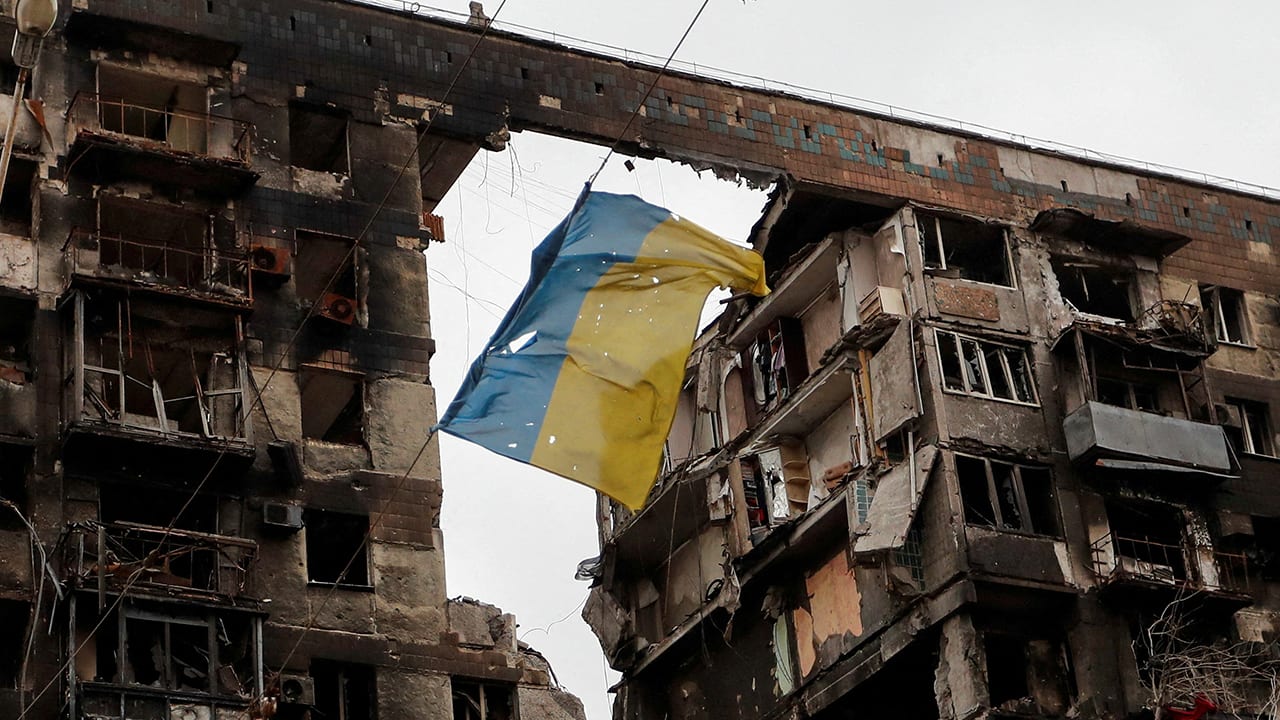
Event date
Speakers
- President, European Investment Bank
- Minister of Finance, Ukraine
- President, European Bank for Reconstruction and Development
Presider
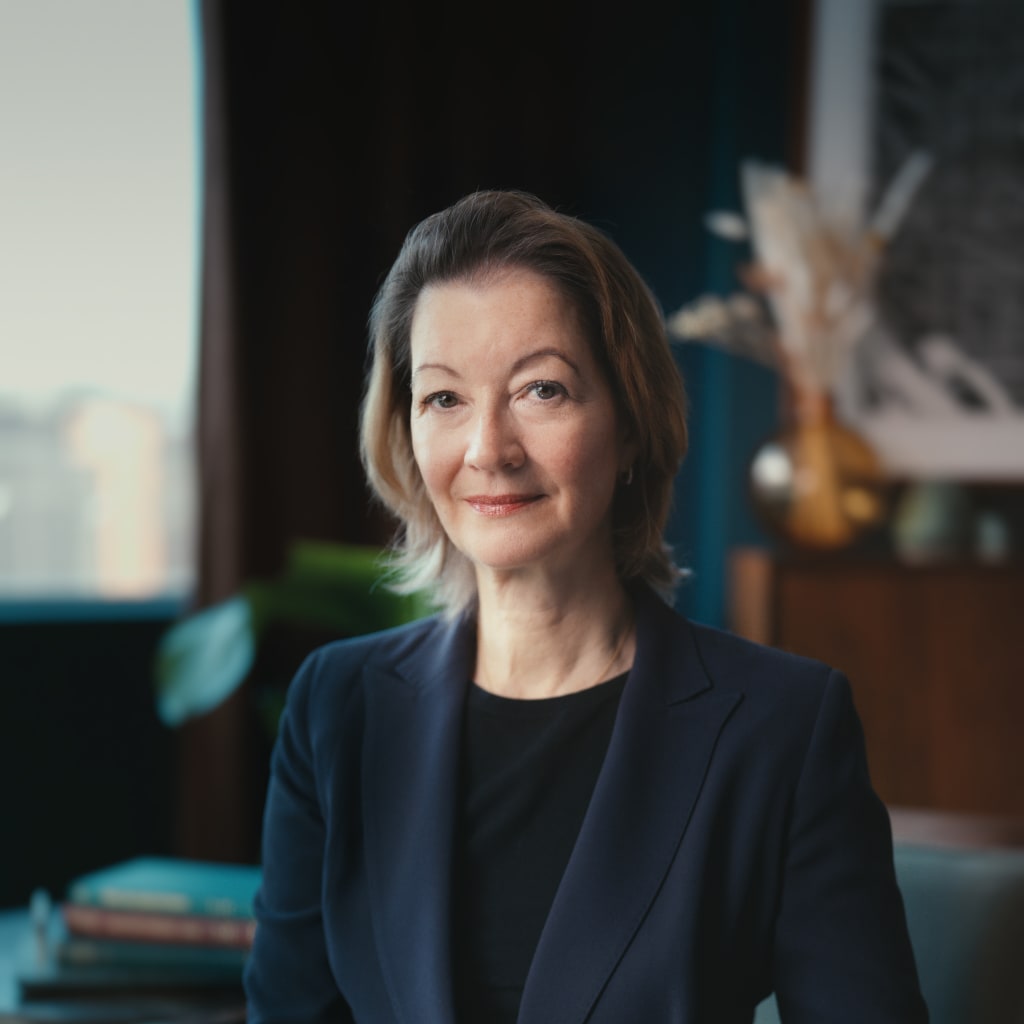 Heidi E. Crebo-RedikerCFR ExpertSenior Fellow, Center for Geoeconomic Studies, Council on Foreign Relations
Panelists discuss international financial initiatives to support Ukraine’s reconstruction and revitalizing its infrastructure and economy in the aftermath of Russia’s military aggression.
This event is part of the Council’s Special Initiative on Securing Ukraine’s Future which provides timely, informed analysis and practical policy recommendations for U.S. policymakers and the American public.
CREBO-REDIKER: So welcome. We are delighted to have you all here in person today for this panel on “Next Steps on Ukraine Reconstruction.”
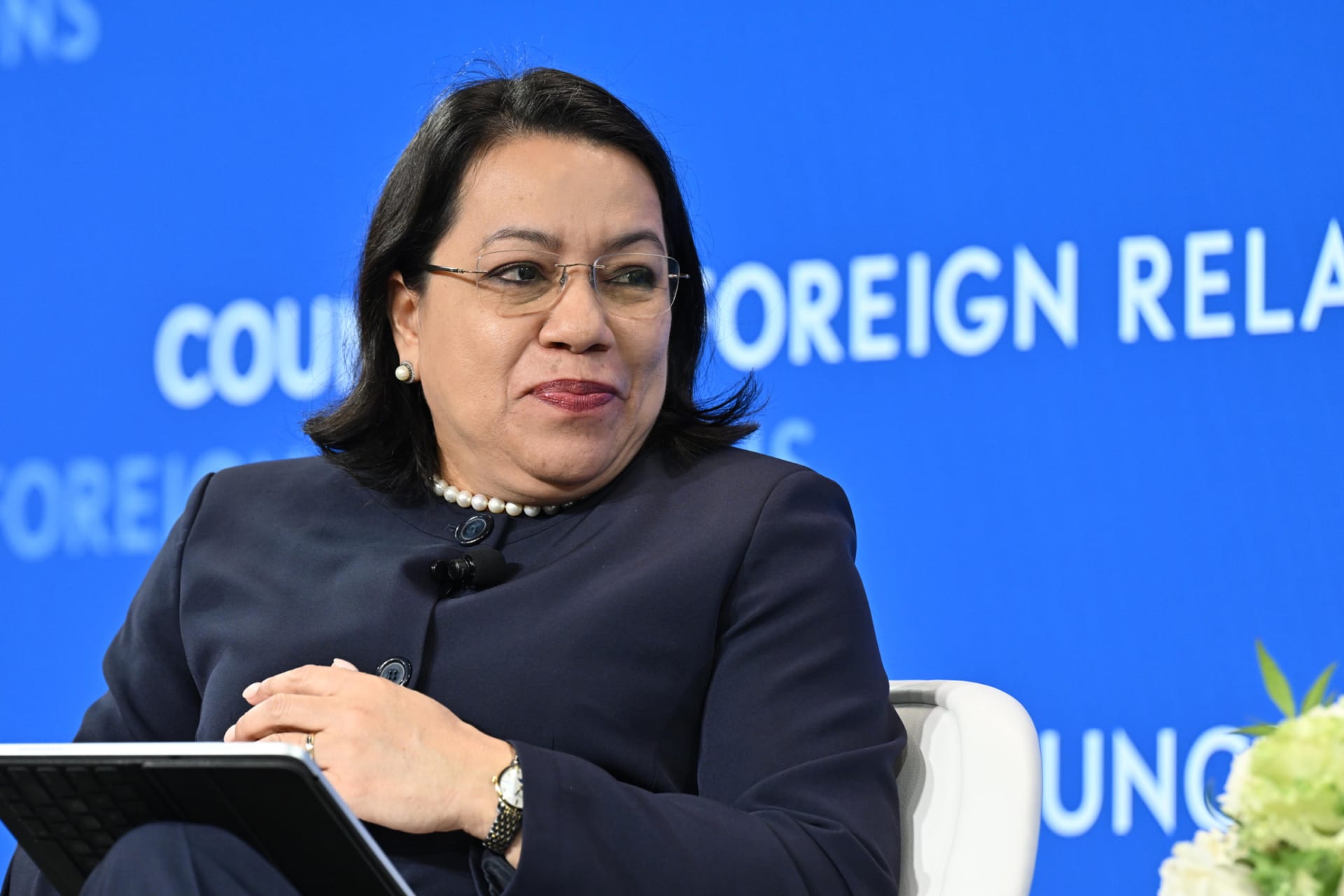
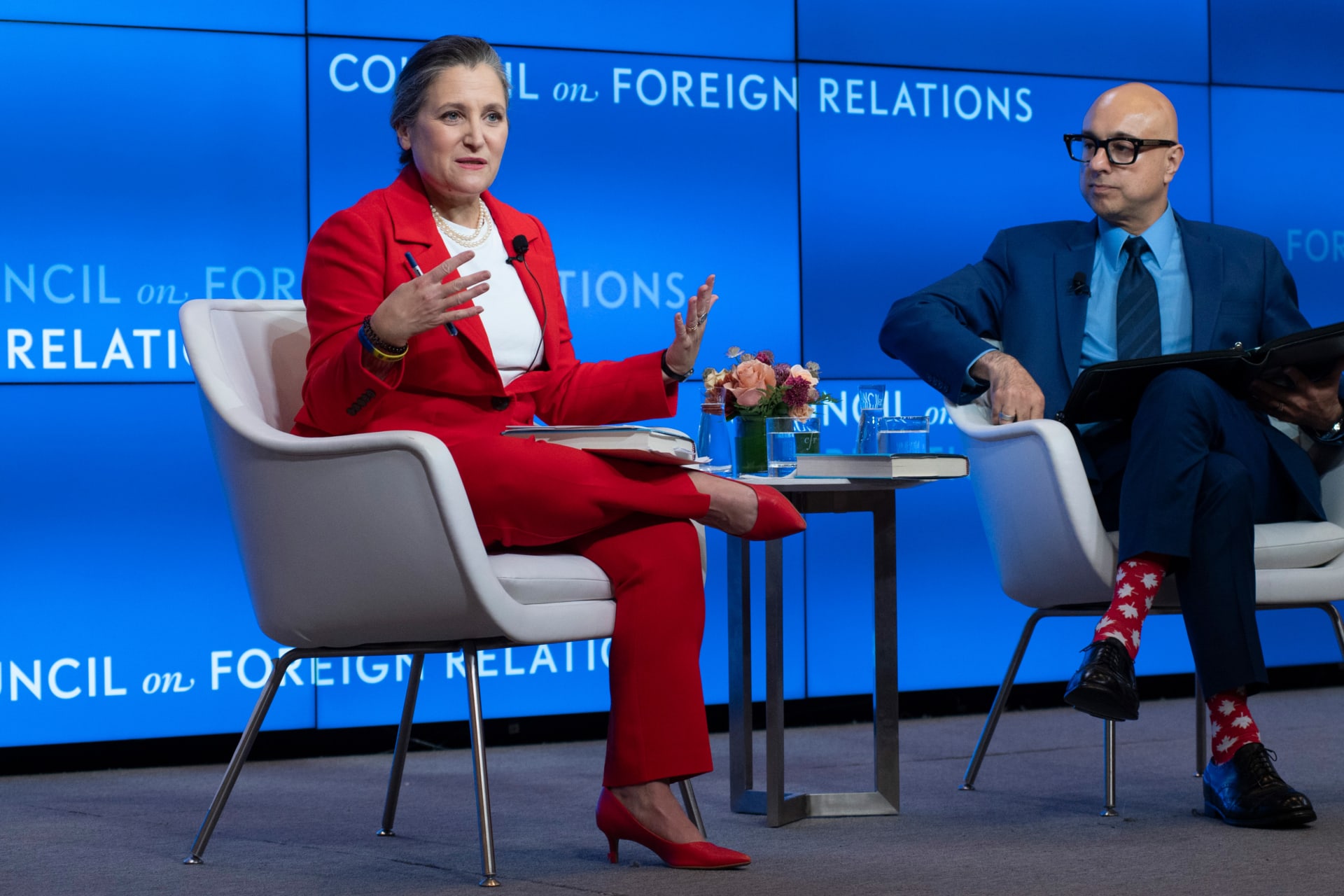
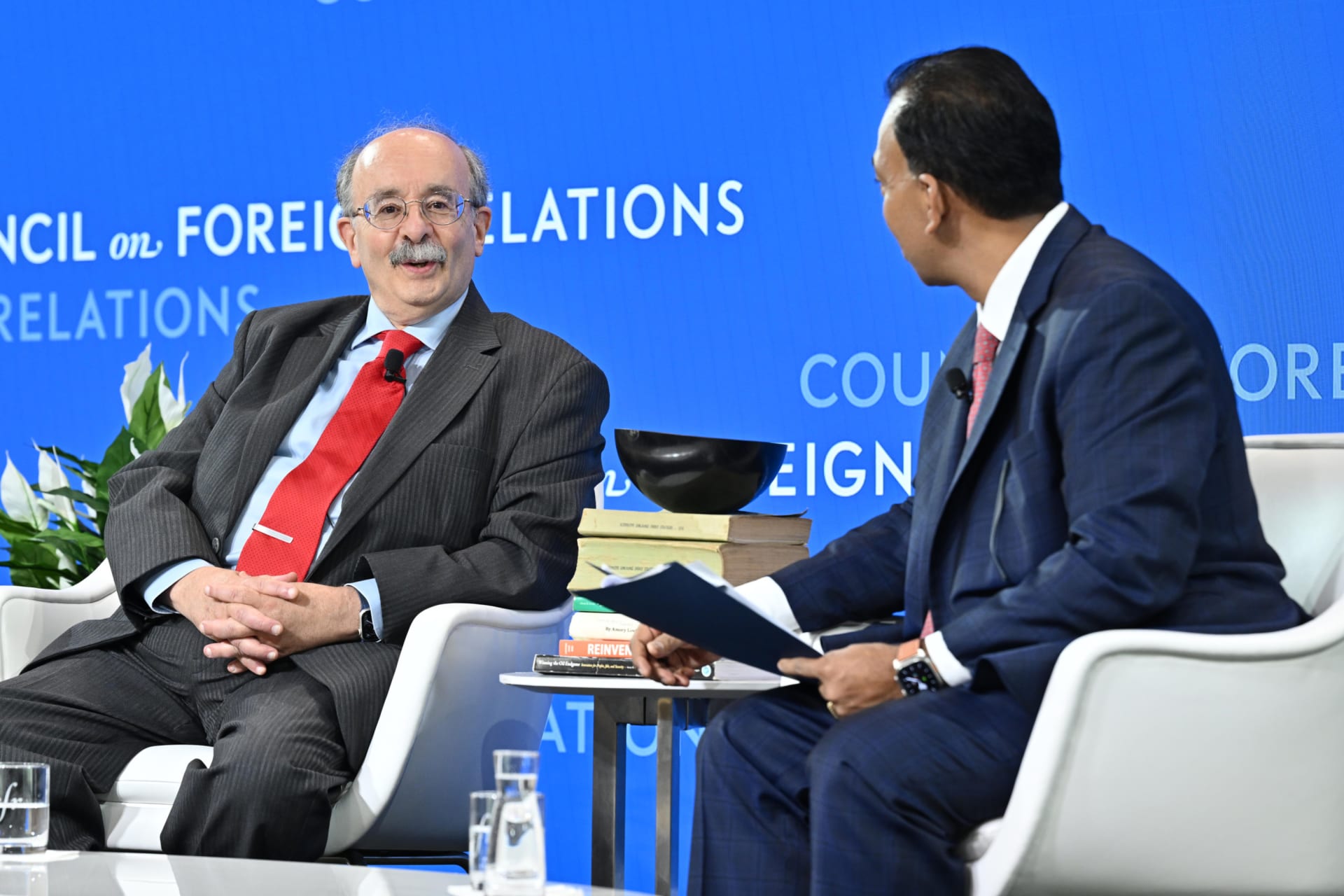
This seems to be a running IMF and World Bank conversation that we’ve had both with the government of Ukraine, this year represented by Sergii Marchenko, who’s the minister of finance. We’re delighted to have him. We have president of the European Investment Bank Nadia Calviño; and Odile Renaud-Basso, who is the EBRD president and someone who has a longstanding experience in Ukraine. My name is Heidi Crebo-Rediker, Council on Foreign Relations senior fellow.
And this is an on-the-record conversation. And what we’ll be doing is having a thirty-minute conversation between myself and our guests today, and then followed by some questions from you. And so I would like to sort of prompt you now to think about what you want to ask when we get to that point in the conversation. So with that, this is part of a session that we are doing, a special initiative at the Council, called Securing Ukraine’s Future. And so we are delighted to have this. We just had another private session immediately prior to this on a specific topic related to Ukraine, and this is our public event. So we’re delighted to have you here.
I would like to start with the minister. This is obviously an important time in Ukraine’s economic future. You’re here meeting with the IMF and the World Bank. There are ongoing conversations about rising—you know, rising challenges and meeting your budget needs. And I think, you know, we all are hoping that you are able to, you know, in the absence of much greater U.S. funding that is now absent, or, you know, quickly going away, that you are able to find the resources that you need and work with the IMF to be able to secure funding for ’26 and ’27. Can you tell us a little bit about the conversations you’ve had in Washington? And what do you expect those conversations to deliver?
MARCHENKO: Thank you very much for inviting me to be here. It’s a second time. Last time it was in during spring meetings. And we have the same composition of my partners in crime, let me say, in a way, how to deal with Ukrainian case. And but situation is different—completely different in comparison with April. Now we try to secure the necessary funds for Ukraine’s budget for 2026 and beyond. And now we are talking about a new program with IMF, because, let me tell you, that current one is not—it’s naturally expired because of—because of assumptions that war will last until the end of this year, is not—not so valid. Of course, some good things can happen every time. We expect good negotiations, of course. And we welcome any support, specifically from the United States, to help us to reach lasting in fair peace for Ukraine.
If you’re talking about this week and discussions we have, predominantly we discussed new program conditions, revenue mobilization efforts of Ukraine. We also discussed probable launching of reparation loan from the European Union. And we really welcome this incentive. It’s very important because it’s very—to be honest, it’s a very strong signal for Russia that Europe is strong and ready to step up in support of Ukraine. And it’s really significant amount we can expect to come to Ukraine to cover our military and budget needs. And I think this is a key element of our current discussions with our partners and countries which help us to build these coalitions.
Our messages for our G-7 allies were, let all of G-7 countries to participate in reparations facilities, the same as Europeans colleagues are eager to provide. This is our key message, because we think that it will be fair enough to use and utilize frozen Russian assets, which is different countries and different—which is frozen. It should be used to help Ukraine’s current perspective and probably future. Because if you’re talking about reconstruction of Ukraine, I would like some of these funds to be used to reconstruct Ukraine, of course, after the peace in Ukraine. But if we are only thinking about military, it’s also not so far. That’s why we should think how to better and reasonably use these funds, which are rather limited. And we can’t use this twice. There is only once we can use it.
And we had ERA loans, which originated in 2024, to help us to get everything well in this year and next—probably partly next year. But reparation loan is the only one loan which is—not can be replicated. That’s why it’s an idea and task for all of us and our partners to reasonably distribute this money through the period of time. Of course, military situation, definitely creates condition to think about further support of military. But I am talking about flexibility of usage, how we should use these funds. Let me pause here, because I just described your general atmosphere of our discussions.
Of course, probably the point which I want you to know it’s gas and we need additional gas procurement in Ukraine, because Russia launched—constantly launching attacks on our infrastructure, on our production of gas infrastructure, pumping of gas infrastructure. Just recently, through the night they launched eighty drones and twenty missiles attack on our infrastructure. So it’s like the dialogue we also have with our development banks, our partners. They helped already us to secure enough and sufficient fund to procure gas. But, well, war is not something we can predict. That’s why we need to think boldly and practically enough, and to procure enough gas for our next heating season. Let me pause here.
CREBO-REDIKER: Can I just—before we move on, you mentioned the negotiations on the reparations. This has been a topic—a very, you know, heightened topic in the United States, as well as in Europe, because I think this is a moment where the U.S. is passing the baton. It’s passing an economic baton to Europe in terms of supporting Ukraine. It’s passing a security baton to NATO. And so the question that I would have for you is, how much—how much input are you actually getting on those—on those negotiations? Because we hear voices from Germany saying it’s going to be used for investment in European defense manufacturing. And I keep thinking, actually, if Ukraine doesn’t fill its budget hole, then you can’t actually access the IMF funds. And so I feel like there needs to be a role. And I’m hoping that you’re going to tell me that you’re having that input.
MARCHENKO: Well, at this particular stage I would like to prevent any unnecessary discussions what particular armament we should procure and in what particular countries, because before we secure a reparation loan—and it’s not secured yet, there’s a lot of internal discussions within Europe—I would like to avoid answering questions how to distribute this money. And from our perspective, of course, it should be Ukraine who decide what’s better to procure and to prioritize this procurement, because who better knows what works in the battlefield. But again, we are ready to cooperate with all of our partners, specifically with European ones, to identify very crucial and important armament, which we needed. But again, at this particular stage the most important thing is to prepare all necessary decisions in European soil, and then it will be enough in sufficient time to decide how to better utilize this money.
CREBO-REDIKER: Very well said. I think I’d love to turn to President Renaud-Basso from EBRD. EBRD, I remember when it was first created. It’s had a long history in all of the former Soviet states, as well as Central and Eastern Europe. And with that comes a great deal of experience in how to look at providing support. But you’ve also been primarily a private sector convener, catalyst for private sector investment. And post the most recent invasion, you’ve really turned to both doing public investment as well. Can you talk about how you balance those two needs? Because it’s a bit different than what your traditional mandate has been, specifically with regard to Ukraine.
RENAUD-BASSO: So, indeed. I mean, we do both, in the case of Ukraine. Basically since the beginning of the war we invested—we deployed 8.6 billion euros, all in the real economy. So we are not supporting Sergii’s budget and the government budget, but really the real economy. And when we look into the volume—so half of it in the in the public sector, infrastructure financing, and half of it is in the private sector. But when we look at the number of projects, the bulk, I mean, 80 percent of the projects are in the private sector. But by definition, they are of smaller size, and smaller—so they’re by this effect. But all—I mean the purpose of the public sector project we are doing is really to keep the economy running, you know, to keep energy flowing, to keep transport available, infrastructure functioning, repair roads when needed, and so forth.
A lot of what we’ve been doing have been in the energy sector. And it remains in the energy sector because of the attacks of Russia on the energy sector. And we were—one month ago I would have told you where we are quite confident about the winter, everything has been prepared. There are some gas storage and so forth. Unfortunately, what happened ten days ago is a new big challenge in terms of energy security for the months to come. And so we are thinking about—we are allocating some project into to help buying gas and improving the storage capacity, so as to keep the system functioning. But a lot of our investment have been focused on the energy sector, which required a lot of flexibility because you need to adjust to the circumstances. The attacks come. You know, the network system has been attacked several times at different points, and so forth. And you need to find the way to help quickly to recover.
And it’s what I found, absolutely amazing, the resilience of the companies, of the people working in these companies. When you go to see Ukraine ERGO, for example, with the network and how they manage the reparation, emergency reparation for—to keep the electricity flowing and so forth, this is absolutely, absolutely amazing. So a lot of focus on the repair and keep things going. Some support, however, including in the energy sector, on new project. And that’s also a good story. And that’s a reality that you have new investors willing to—I mean, ready to invest in Ukraine now for the time, in the current juncture, with our support, with some political risk insurance to cover the risk of destruction by the war. But I think this is also a very strong signal that it’s not, like, it’s huge amount of—huge, but there are some positive signal.
On the private sector, what we’ve been doing is working with our clients and a lot to cover the needs. And there were different nature—I mean, a lot of working capital to keep the business going. But also some investment for relocation, for reparation, of buildings destroyed, for new investment. And in all sectors—maybe in manufacturing, steel sector, agribusiness. And we work a lot, because SMEs, we cannot touch them. I mean, we can—it’s too complex for us to deal directly with SMEs. So we put in place a portfolio with sharing framework with the banks, which help the banks, because the banks lend—they have a lot of deposits, lots—they’re very liquid. But their capacity to take risk and to lend to SMEs was very limited. So there are government programs, but we have also put in place some portfolio risk sharing, where we cover 50 percent of the risk of the banks when they lend to SMEs.
And that has allowed us to deploy something like 3.6 billion euros, which represent a very large chunk of the credit flows to private sector SMEs, without—I mean, outside of the government program. So—and I think that’s in the current juncture, continuing to work on both sides, the public sector, including municipalities, also some project at the local level, and private sector is what it needed to help the economy. I mean, and to be fair, the economic situation is amazing when you think about the war. So after the big shock, the growth remains positive. It’s not—you know, it’s not full recovery, but still remains positive, with some investment and including, as I was mentioning, foreign investment in the energy, but also in sectors like the telecom. Last year, we had a very big investment in telecom, which was also showing some appetite. And some people are having a long-term view about Ukraine—investing now in Ukraine makes sense, because of the prospect of reconstruction.
CREBO-REDIKER: Thank you. Thank you so much. There are a couple of threads I want to pull on what you were talking about, and basically how you’re balancing the different—the different needs, and particularly in infrastructure. And EIB has to balance another challenge, which is you have the immediate financing needs for the stabilization and the ongoing reconstruction in infrastructure. But also, in looking to support Ukraine in its EU accession process, you have to look at the transportation networks, at the energy systems, and try and make them EU compatible moving forward. Big challenge. How do you actually balance the immediate needs and how you’re—how you’re playing a role there with the longer-term needs of actually, in the middle of a brutal war, trying to bring Ukraine into the European Union eventually?
CALVIÑO: I will come to this in a moment, but before I do I really want to—because, Sergii, the minister, he’s very modest. And I would like to share with you, actually, my experience in the last two weeks, where we had the ECOFIN, that’s the council of ministers meeting of finance ministers of the twenty-seven member states, and this week, when we had the roundtable of financial support to Ukraine. Because I was very impressed by a couple of things. First, by the unanimity. So there is unanimity of the twenty-seven member states to support Ukraine. And there is unanimity of the eighteen countries, plus the multilateral institutions that met this week, to support Ukraine. And after three years of war, this unanimity is impressive.
And the second thing that I found impressive is that everybody admires and recognizes the resilience of the Ukrainian people and the ability of the government to—as Odile just said—to keep the economy going as normal as possible, in a context of war. And to do a management of the budget that is also as correct and responsible as possible, knowing that, of course, you have abnormal expenditure needs due to the war. And I want to pay tribute to Sergii in particular, because he has been there, and he has, what everybody will agree, is the worst job for a finance minister in the world, you know, to be dealing with a war. And he is respected and admired by everybody around the table. And I think this is really—I want to pay tribute to this. (Applause.)
And this is the mood. So you asked, what is the mood? The mood is this one. There is determination to support Ukraine. There is determination to continue to do it, and to find different options to support them. So there is the reparation fund, there are different budgetary instruments. And the twenty-seven member states are united in this. I want to send this very strong message. Then secondly, what we are doing—together with the Ukrainian government—because we have set very useful tools to prioritize projects and to make sure that the different financial institutions are complementary. So we are not competing with each other. We have a quite coherent approach whereby we rely on each other and we support each other in this process.
And I think that that is allowing us to deal with the immediate needs without losing sight of the long-term strategy. So just to give you an example, we have already agreed a 300 million loan to ensure the replenishment of the gas storage. Of course, this was before the attacks. So now we’re exploring how to top it up, how to increase it, how to also channel grants to Ukraine. And so dealing with the immediate needs. And it may also mean that we are dealing with municipalities, services, water provision, hospitals, schools, kindergartens, protection of infrastructures. But we are also recovering and repairing the infrastructures in a manner that already facilitates the accession.
So I think four weeks ago we inaugurated the train connections with the caliber and the standards of European requirements already. So we are not losing sight of the long-term objective, not long-term, but, you know, the midterm objective of facilitating the accession of the country, and also supporting the green strategy and the sustainability strategy of the country. And that coherence, I think, is of the essence, because once the war is over I am strongly convinced that there will be a very strong bouncing back of the Ukrainian economy. Because for the three years since the war started we have been actually building a strong basis for that recovery. And because we have seen how the Ukrainian people are resisting, resilient, and how determined they are to actually have a very strong recovery. And I hope, you know, that the whole international community will come together and support them in this endeavor.
CREBO-REDIKER: So I absolutely—first of all, I should have started with applause for not only Minister Marchenko, but for all of the work that your country has done under extraordinary circumstances. But I am going to push you a tiny bit more. We were talking ahead of this meeting about what is different about this time coming to the Council and talking about the same issue, about providing the support to Ukraine. And I think this is really a different conversation, because the burden is more on Europe to actually provide that support. And without a unified funding mechanism, other than those immobilized Russian sovereign assets—I mean, EIB has a unique position. You’re the—you’re the most prolific consolidated funding entity in the European Union, and have a huge—correct me if I’m wrong—but it’s about a 500 billion euro balance sheet.
Do you have additional capacity to actually step in and support Ukraine? Because with all of the goodwill and the—and the morale that we find, and the moral support, I think there is a reality check. Which is that the U.S. has been a primary supporter of Ukraine in terms of funding for the past couple of years. And I think they are real concerns that, without additional focus from Europe, not just in terms of moral support but actually putting money in, that Ukraine is really at greater risk. So I’m hoping that you’re going to tell me that the institutions in Europe who are able to fund and really put balance sheet at risk are able to maybe do a little bit more moving forward. Is that something that you’re talking about right now?
CALVIÑO: Well, I am very grateful for your question, because that allows me to clarify that actually Europe has been the main supporter of Ukraine. And the numbers are quite similar when we are comparing what the U.S. and the EU have been doing. If I don’t—I don’t have a—I’m sure Sergii has much more detailed numbers. But most importantly this kind of conversation I heard, I don’t know, six months, one year ago. Now we are in a different reality. There have been major breakthroughs regarding the leaders in Europe, in terms of the immobilized—well, frozen assets—mobilizing those frozen assets, actually. There is a unanimous determination.
The European Commission has put on the table a number of proposals so that there can be a provision of grants and so financial support, which is non-repayable, which is obviously a totally different ball game, to what the European Investment Bank can do, which is—Ukraine is our top priority and we will do whatever it takes, you know, on the basis also of the European guarantees. That’s the way we have been working so far. And I do see—let’s say, there’s no hesitation around us at this point in time. And I think that’s what you feel, Sergii, every time there is a conversation with European finance ministers and, of course, with leaders.
CREBO-REDIKER: So I’m going to hand it to you and ask, what is it that you would like to see that you think is within the realm of possibility from not only Europe, but from the G-7 and other—and other likeminded countries, to provide additional support moving forward? Because you have a huge—you know, an audience both, you know, in the room but also online here. And this will be—this will be posted on our—on our website. They want to see you succeed.
But we also are very—we’re realistic about what the U.S. is not putting forward right now. And so what is it—what can you do with other partners to make sure that you are—and your economy is in a good enough stead to survive the next however long it takes to get to a place where you’re—whether it’s a ceasefire or frozen conflict, whatever you need to actually succeed moving forward, or to win, whatever that—whatever that means? I think we need to—we want to make sure that you can get there. What do you—what do you need? How do you think we can all help you?
MARCHENKO: Well, you know, you were talking about modesty. Well, we need a rod instead of a fish. We need road to catch fish. We are able and capable to catch this fish by ourselves. I believe that—(applause)—this is something we really needed. We are not talking about additional money, military supplies. We understand it’s like for survival matters in different times we need different things. For example, in 2022 we urge to just support Ukraine. We just asking support Ukraine for three months period. We ask in this breach because we don’t understand even how come we can continue this war. Right now, we are talking about our strong will and determination and unwavering support of our allies, specifically in Europe. And unanimous support. It’s like all European—practically all—practically all European countries are with us and helping us to be part of Europe.
It’s our goal number one. We know what we want. We want to be part of Europe. If you’re talking about our internal processes, we just finished our screening process. It’s a fast and record-breaking process as ever with any other countries. So we finalize accomplish screening process. And we know what we need to do to bring our legislations towards European standards. And also, it’s necessary to admit that now our economy is quite different in comparison with what we have before the war and during first years of war. We have rather developed military industrial complex. We can manage to fulfill up to 40, we believe up to 50, percent of our military needs by ourselves. It means that Ukraine’s—we are creating new Ukraine during the war. And probably the war, in some way, if you look at it, it’s just big, big, catastrophic situation for Ukrainians, for citizens of Ukraine. But it’s a big opportunity for us to—very swiftly to transform ourself, to transform our mindset, and to be better ourselves.
And I think it’s a good chance for us all to create future for Ukraine. And I think this is something we really needed. Again, I’m not—we’re not talking about additional support, because we believe that the transparency we have right now is something that’s very valuable. The trust which we created is where the most valuable thing we have. Because if you’re talking about our needs, nobody ask if there is some correct estimations of our needs. This estimation is quite correct because of accountability and trust which we created during these years. And I really value this. And I don’t want any events or some unnecessary political decision can question this. Trust is something which Ukraine really needed between us and our partners.
CREBO-REDIKER: Well, I think that’s a great—a great launch pad for opening it up to discussion here, and to some questions. I wholly salute your, you know, rod not fish, in terms of I think we all would like to make sure that you have the investment and the private sector. And particularly, you know, we’ve tried at CFR to convene and bring together a lot of our corporate partners, particularly on the mining sector, but also to help your defense industrial base. But I think that’s actually the most important message to leave with everyone here. Can I just start—I saw Mike Froman raise his hand first. And he has the prerogative here to always ask the first question. (Laughter.)
Q: Yes, it’s totally random, the selection of questions. (Laughter.) First of all, thank you all for being here, again. It’s great to see you.
It’s a question for the—for the minister, but both of you should feel free to chime in. And it really builds on what Heidi was just referring to. It’s hard to get big foreign investment to come into a country while drones are still flying and bombs are landing. But would be interested in your perspective on where you see the greatest potential for foreign investment. What kind of conversations you’re having with foreign companies or foreign investors about Ukraine post a ceasefire, post a peace settlement, and what you think the greatest opportunities are there. And related to that, Ukraine wasn’t the easiest place to do business before the war. Corruption, a variety of other factors. How confident are you that coming out of this experience the business environment in Ukraine is going to be fundamentally transformed?
CREBO-REDIKER: Great question. Minister, please.
MARCHENKO: Well, let me answer the first part of your question. Of course, we have big, undeveloped opportunities. So I’m talking about infrastructure. I’m talking about other sectors of economy. If you’re talking about perspectives, we have military industries which is quite successfully help us to defend ourselves and develop very rapidly. We have a very developed IT sector in Ukraine. And also traditional spheres, like agrobusiness, like mineralogical sphere. So but, again, if you’re talking about future, I would like we think about new manufacturing production in Ukraine creating some kind of schemes with additional value, added potential. But again, it’s not—we are, like, list of paper. What you want to have, you just write down what you want and you can achieve it. It’s nothing. Nothing can prevent you from dreaming about this.
And also you ask about obstacles which were in Ukraine before the war. Of course, same obstacles still happened in Ukraine during the war, which prevent business to look at perspective to invest Ukraine. But if—you know, the scale of investment can create conditions for all businesses to forget about problems which some problems with corruption and governments. What I mean, that if it’s a—if you’re talking about several representatives from the United States, it’s a several voice. If it’s a hundred representatives, it’s a hundred voice which can be very vocal and active. And if you combine it with European business, with business from Japan, Canada, and others, it definitely can change this environment, for sure. Because if it’s several people which try to protect themselves, it’s—of course, sometimes it could be problematic. But if it’s a strong voice of business which are represented in Ukraine, definitely can be very meaningful.
We had several associations of businesses in Ukraine, American Chamber of Commerce. We have a European business association. We have other business representatives. And their voice is very loud. If they want to resolve any disputes with Ukrainian government, believe me, they can. But just—I just admit that probably it’s not sufficient. You should be represented not only in the central level, but in local level as well. Because to do business in Ukraine, you should to deal with local authorities. And, you know, that Ukraine is decentralized country. And not all decision making process is in central level. We have—so enough responsibilities at local level. Sometimes people forget to define who creates problem for business. Is it central government or some problems in the local level? That’s why if it will be thousands—a thousand entrepreneurs from different countries which eager to invest in Ukraine, definitely it will change situation. And you will not ask about corruption anymore.
CREBO-REDIKER: So, please. I saw that Nadia wanted to chime in, then both Odile and Nadia. So please go ahead.
CALVIÑO: I just wanted to say a couple of things. That when we are talking about preserving a strong basis for the reconstruction, I mentioned the public sector infrastructures at central level, at local level. But as Odile said, we are already also supporting the private sector and a vibrant economy, real economy, whether it is through the intermediated loans through the banking sector, whether it is by supporting exporters from the EU exporting to Ukraine. So we have launched a 300 million facility, a guarantee, so that through the export credit agencies of the different member states we can provide those guarantees, those European guarantees, for exporters dealing with SMEs, small and medium sized companies, in Ukraine.
We have already signed deals with ten export credit agencies. And that is really showing the interest of European companies in already building those trade relationships. And then thirdly, and this is new, actually, we have just signed a capital investment, 25 million euros in one of them and 15 (million euros) in another, private investment funds. Horizon is the name of one of them and Phoenix is the name of the other. So private investment funds that are already investing into startups and companies in Ukraine so that we can start building that ecosystem that will serve as a basis for this new economic model once the war—the inglorious war—those are the words of President Trump this afternoon, very, very appropriately, I think—is over.
CREBO-REDIKER: So just a quick—a quick follow up on that, because I know that you have—you are able to invest in dual use. And one of the greatest startup communities in the whole of the European Union right now is actually in Ukraine. Whenever I have conversations with Europeans about not having innovation there, when I look at Ukraine that’s where you have your innovation. It’s in the startups. It’s in the technology. It’s in the defense tech. Are you able to support those startups as well?
CALVIÑO: We are, actually, very active in the area of security and defense within the European Union. And we are supporting companies, drone manufacturing companies, for example, that are active in Ukraine. And there is an increasing interrelation between Ukraine and a number of member states that are actually currently doing that production. Let me just tell you, since we last spoke here we have gone beyond dual use. We are financing pure military—military facilities, military mobility, military infrastructures. (Applause.) Without—except for weapons and ammunition. But all the rest of pure military facilities, infrastructures, research, drone manufacturing, et cetera, we are already financing inside the European Union. We’re going to be tripling our financing this year. And I think we will continue on that—on that trend.
CREBO-REDIKER: Odile, please.
RENAUD-BASSO: Now, to come back to the question of the private sector, I wanted just to take an example, which is we’ve been working with IFC on a public-private partnership for a port in Chornomorsk, which is quite strategic port with our position. And you have a lot—so we put it for open—I mean, open tender, and there is quite a lot of interest for international investors to invest in this port right now. So it show that it’s not, you know, black and white. And there are areas where already you have interest from foreign investors to start investing in Ukraine, to put them there in order to be ready to support the country. I think part of it is also sort of—but also to be ready when reconstruction and benefit from the reconstruction.
And in terms of sectors, the defense industry will certainly be—when you see the increase of expenditure in European countries, with the objective of the NATO 5 percent target, the need—Ukraine defense industry will certainly benefit from a lot of interest and a lot of potential, which is not already fully—today fully used, to build the military and to develop military capacities. Agribusiness is, of course, traditional, very important sector for, but energy will be because the energy sector is so much affected by the—by the war that there will be a lot of needs for energy investment in the country on—I mean focusing, for example, in renewable, as we already see, but also, I mean, more broadly in the grid system and so forth. So there will be—there are a lot of sectors that will benefit from opportunities of investment and will be attractive. Another example is, for example, the banking sector. After the war I think there will be, and there are already work and reflection about privatization of banks. That will be an area for investment, for creating opportunities for investment.
On the business environment, I think one of the—of course, they were challenged before the crisis, before the war, they are—challenges remain. But the two elements, I think, are important to note. The first one is the drive towards EU accession and transformation of all the regulatory legal environment, towards EU accession, which I think is a very important drive for reform in Ukraine. And the second one is the role of civil society. And I think that it was very striking to see what happened in July. You know, the reverse on law on anticorruption bodies, and the change of the law after very strong reaction from partners, but also from the civil society. I think this is a very strong signal of internal dynamics in the country that will contribute to transformation.
CREBO-REDIKER: So, just because mining didn’t come up, and we just hosted the minister from Ukraine who is responsible for critical minerals and mining downstairs with a whole number of mining companies, mining tech companies, all of these that are very interested from the United States in actually investing alongside the to be—you know, to-be-launched, but soon-to-be-launched U.S.-Ukraine Reconstruction Investment Fund. So I think that that is actually one of the big areas of interest where we already know, just from our conversations an hour before, that there’s tremendous interest there as well.
I saw Toby’s hand up first. Introduce yourself, please.
Q: Sure. Toby Gati. I served in the Clinton White House on Russia policy, and then in the State Department.
It’s a flip side to the question that Mike Froman and others have asked. I really applaud your efforts to do what you’re doing in a very difficult situation. But it’s much easier to destroy than to build. And the Russians are great at destroying. Are you coordinating at all with the military or with NATO to ensure that some of the destruction stops? I mean, I hear you saying you’re building, and then your next sentence is, you’re rebuilding. Well, at some point how do you protect your—what’s being built? And how do you protect the nuclear plants? How do you get those back? How do you guard foreign investments? Heidi just talked about critical minerals. How do you prevent them from becoming a Berlin, surrounded by Russian forces, in some cases, or able to be attacked? So what are you telling the military that you need for them to build so the economy that you are financing will last?
CREBO-REDIKER: Thank you.
MARCHENKO: Well, you know, it’s like—it’s very convenient point of view that Russia can occupy additional kilometers of our territories. It’s impossible. It’s probably the most impossible thing now for them to occupy even kilometers of our territory because it’s not convenient for—it’s a different reality. And now in a close line of contact, forty kilometers controlled not by people, but drones. It means that if even Russia launch another offensive and try to occupy some territories, it will cause them tremendous losses of people’s life. And they really understand. And they don’t bear enough to do this, and—brave enough to do this. And that’s why it’s not—it’s not a risk anymore.
The problem is the biggest risk is—and you are right—and it’s a drones attacks and missiles attacks and developments we have during last year. It’s like constant competition between what is stronger, air defense system or missiles? It’s a competition which is probably at some way or another will be equalized when we have sufficient air defense system. Ukraine can be able to protect all necessary infrastructure and businesses. And now, of course, we need to replenish what is destroyed. We need to repair what is destroyed. And we constantly and determinedly do it, day by day, repairing what was destroyed. We are not waiting until another attacks, just repairing.
Of course, it could be destroyed again. But this is our job to do, to just to bring necessary air defense and try to repair what was lost. We did it from 2022. And we will not stop to do it again. And of course, business can lost their possessions, can lost their facilities. But another question, what we should do to bring insurance companies in Ukraine, which can cover this risk, which can cover the war insurance risk? Because, you know, starting from 2022 we discussed a lot of opportunities when who can—who can mitigate this wartime military risk? But it’s still a question mark, because the scale of this insurance is not covered yet. And I have some minor examples when MIGA and other insurance companies are able to provide coverage, but it’s still question which is very, very necessary to resolve.
CREBO-REDIKER: Was there anyone else who wanted to comment from—nope? OK, I saw Dan Runde next, and then—
Q: Thanks for hosting. This is super relevant and super timely. Thanks—
CREBO-REDIKER: Can you introduce yourself?
Q: I’m Dan Runde. I’m with Deloitte. And thank you for your important public service, Odile and President Calviño.
I have two questions. The first is, could I ask the two of you representing the two European-based institutions to speculate on how quickly you think that Ukraine will join the European Union? I think this is really an important thing. So I know there’s lots of statements about this. If I was in the Trump administration, I would be pressuring the Europeans to do it before the end of President Trump’s term. And when I speak to Trump administration officials, I say to them, you should be pressuring the Europeans to do this before January 2029, because that’s when the real money is going to be released. Because, I mean, I’d hope that we get this frozen assets unfrozen, but I’m not sure how long that’s going to take. But I do know that there’s—Poland got $300 billion for EU money when it joined the European Union over a twenty-year period. So that’s real money. And so in my mind, I’d be curious your speculation on that.
And then second, I’d ask you, President Calviño, you could you double-click a little bit more on terms of what you’re doing on defense tech? I saw that you announced this earlier this week. It’s great. And then I’d love to hear from you, President Renaud-Basso, about could you imagine the EBRD investing in defense tech in Ukraine at some point? And if so, what would it take to get your shareholders to support that? So thanks. So those two questions for the two of you, thanks.
RENAUD-BASSO: So on the date for EU accession, I will not give you. I mean, I think the process has not formally even started, so, I mean, there is some—there is some challenge, I think, to start. But it’s—I think that there also a solution will be found to make progress in the negotiation. I mean, I think—I agree—I agree with you that the sooner the better. But it’s a two-way track. I mean, it’s also—it’s a huge effort on the country to, you know, take (all the key ?) and so forth. So I think there will be steps. There will be some—maybe some intermediate step participation to some policies. Already Ukraine joining the European network for electricity, all this. But what is the target date, I cannot tell you. I think maybe Nadia has more—(laughs)—than me around that. I think there is a deep understanding that it’s very important for Ukraine. It’s very important also for Moldova, who is in the same process. And but it’s a complex process.
Q: And on defense tech?
RENAUD-BASSO: And on defense. For EBRD, it’s very difficult. We can invest in dual use and very, but it’s—we are a multilateral institution where we have a very wide range of shareholders, which sometimes fight against each other. So starting to build, invest in military possibilities in one country, which may have—and you know, we were—now the conflict is solved—but Armenia-Azerbaijan, for example, both are countries of the bank. So it’s a challenge. So we are—we have a policy which allows us to do something, but with some limitation in terms of role of how much of it for pure military purpose and so forth. In a way, the support we provide to the banks, for example, who are investing in the military expenditure—in the military defense themselves, is an indirect way of supporting that.
CALVIÑO: So, in our case, we have moved from virtually nothing in this area to dual use last year, and 1 billion euros in terms of finance last year. That was a major breakthrough. And this year it will be—
CREBO-REDIKER: That was for the whole of the EU?
CALVIÑO: Sorry?
CREBO-REDIKER: That was for the whole of the EU?
CALVIÑO: Yes.
CREBO-REDIKER: OK. Sorry.
CALVIÑO: And this year it’s 3.5 billion euros that we will be financing. And that covers—for example, and that’s a very important infrastructure, a military campus in Lithuania, very close to the Belarusian border, that’s going to host a NATO Bundeswehr brigade. So a German brigade, at the beginning of a European defense. And it’s a very important facility. We are very much awaiting the discussions next week of the European Council, so those are the leaders of the twenty-seven member states, in terms of identifying top priorities and ways forward, maybe coalitions of countries, that—and we are awaiting that European Council to identify priority projects, for example, having to do with military mobility corridors on the eastern border, having to do with defense systems against any enemy drones. All these elements are being currently discussed.
And we have—I have personally sent a letter, actually, to the president of the council, President Costa, to say, we stand ready to support. And I can—that’s why I said I expect the trend to continue in the coming years that we will be increasing our finance. But there are many institutions—not many—but there are different institutions. And each one is playing their role. I see a breakthrough in terms of defense ministers in Europe meeting, and meeting, I mean, with the concrete deliveries in terms of a European capacity. I see the European Defense Agency also being called to play a more important role. And the European Investment Bank is playing its role as the investment in large infrastructures and also innovative research centers, research projects. I mentioned a couple of examples.
And facilitating finance for the ecosystem of small- and medium-sized companies in Europe, which have a very important role to play in supporting the whole value chain of the security and defense industry in the European Union. I see that things have moved enormously, obviously, in the—everything is relative—but the movement is really impressive when one compares to the situation we had two years ago. Unfortunately, because of the reality, you know, on the other side of the border. And then on the accession, I will not speculate. I’ll just say, we are going to be a key partner supporting Ukraine in the path to a successful accession. And we all hope it will be, of course, as soon as possible.
CREBO-REDIKER: Very well put. Christopher Smart, please.
Q: Thank you. Hi. Christopher Smart from the Arbroath Group.
Can I take another crack at the EU accession question, but maybe ask the minister. You’re arguably—clearly today your biggest concern is the security issue and coming to ceasefire terms with Russia. But arguably, the day after that it will be the negotiations with the European Union. What do you expect will be the hardest things and the most difficult things? Europe is very supportive of your—of Ukraine right now, but when the peace comes there are going to be a lot of difficult conversations around agriculture, perhaps, or industrial subsidies, or the corruption and transparency issue.
MARCHENKO: Well, you know, our border encounters, let me say, are not waiting until we will have peace in Ukraine trying to show us how to—what Ukraine—how strong Ukraine should be in Europe to compete with our neighbors. And it’s not something unusual. But again, we are ready for discussions on the way how to get access to the European market. It wants to be compatible enough. And we want to apply all necessary rules and standards which now applies in Europe. But probably not all European countries are ready for us to apply the standard so quickly. Not all.
And that’s why it’s not question you should address to us what we are ready to do to convince them to accept our accessions, but what they should do to think practically, in a way, how to bring Ukraine towards European future. We want—we have something to give instead of our European integration. We have created quite significant security capacities which we also are eager to provide as a service to Europe. And it’s not just granted that this is the experience which we’ve got during these years. And it’s quite a valuable asset of Ukraine right now. And that’s why it should be fair treatment of Ukraine. We just not such neighbors which very eager to be part of Europe. We want to be equal. And want equals as European was created.
CREBO-REDIKER: So we have one more question right here, and then we’ll wrap it up.
Q: Thank you. Anna Fratsyvir, the Kyiv Independent.
So I have actually a question on frozen Russian assets, both from the European perspective do you think there will be change on the position of the EU countries? And maybe, if we can speculate, when? And Minister Marchenko, from Ukraine’s perspective, what is the best-case scenario on the use of those assets? Thank you.
CREBO-REDIKER: So I would—I think we talked about that a little bit earlier, but if there are any other further thoughts you want to share, please go ahead.
MARCHENKO: Well, if Europe structure your reparation loan, we have done with assets. So there is no dialogue between seizure of assets because I don’t believe that Russia will pay reparation to Ukraine. If they will pay, of course, we will repay the reparation loans. But I don’t believe it will going to happen. That’s why if you’re talking about frozen Russian assets, it will be frozen for a very long time.
CREBO-REDIKER: So I will—I will end on one very positive note. In addition to thanking our distinguished panel today, I will say that the hour before we came up here there was such tremendous enthusiasm, not only from the mining investment community about the potential for Ukraine, but also the security community looking at the chokehold that China has been ratcheting up in the critical minerals and rare earth space, and the technology space. And particularly because Ukraine has a secret weapon, in that it has mining, like, technology, and they have mining metallurgists, and a lot—a long track history of working in mines and mining, and have the best tech out there.
So I think that there’s—particularly for those—for those focused on that area, you have a really great future. For those focused on defense, the defense industrial base, you have an amazing future. And that’s coming from American companies, not from the—not necessarily from the government. So I think, you know, as long as we continue to look at Ukraine as an opportunity, rather than any kind of a drain on resources, that’s really—that’s where we really crack the nut for you. And so I hope that we can help you with that here at the Council. You always have this platform for whatever you want to do. We’ll help convene everyone we can to support you. And I’m looking at Mike right now, and so he’s going to nod his head and say yes. (Laughter.) OK, good.
I want to thank you very, very much. Again, this was an on-the-record conversation with Minister Marchenko, President Calviño and President Renaud-Basso. They’re tremendous. They’re all doing their best to support Ukraine, both through this war and hopefully even more so on the other side of it. But thank you for joining us today at the Council. We will continue this conversation in the spring meetings. (Applause.)
(END)
This is an uncorrected transcript.