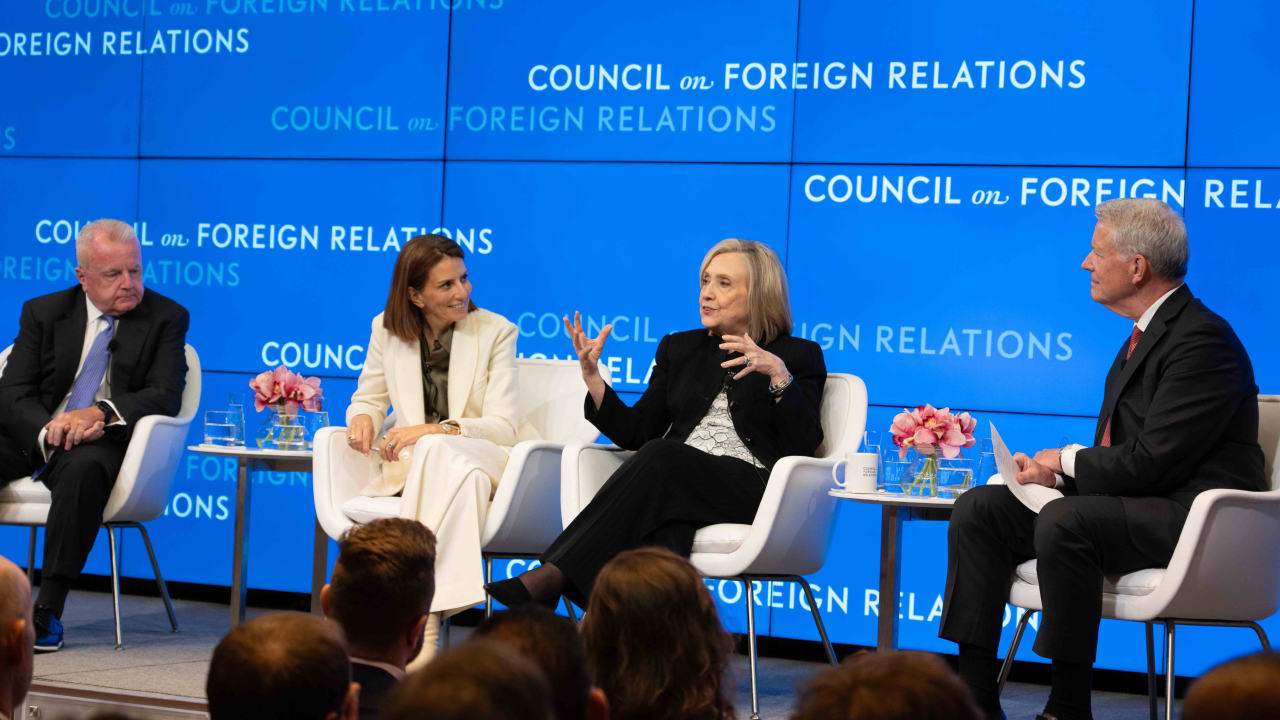
Secretary Hillary Rodham Clinton, Dean Keren Yarhi-Milo, and Ambassador John Sullivan on ‘Inside the Situation Room’
Event date
From David A. Morse Lecture.
Speakers
- Dean and Adlai E. Stevenson Professor of International Relations, Columbia University School of International and Public Affairs (SIPA); Cofounder and Faculty Advisory Board Member, Institute of Global Politics, Columbia SIPA; Editor, Inside the Situation Room: The Theory and Practice of Crisis Decision-Making; CFR Member
- 67th U.S. Secretary of State (2009-13); Former U.S. Senator from New York; Professor of International and Public Affairs, Columbia University School of International and Public Affairs; Cofounder and Faculty Advisory Board Chair, Institute of Global Politics, Columbia SIPA; Editor, Inside the Situation Room: The Theory and Practice of Crisis Decision-Making
- Partner, Mayer Brown; Former U.S. Ambassador to the Russian Federation (2019-22); Former U.S. Deputy Secretary of State (2017-19); Carnegie Distinguished Fellow, Institute of Global Politics, Columbia SIPA; Contributor, Inside the Situation Room: The Theory and Practice of Crisis Decision-Making; CFR Member
Presider
- Anchor, Bloomberg Wall Street Week, Bloomberg; CFR Member
In partnership with Columbia University’s School on International and Public Affairs, panelists discuss what effective crisis decision-making looks like in practice, how to understand America’s adversaries, and lessons for future leaders navigating crises in national security.
Secretary Hillary Rodham Clinton and Columbia SIPA Dean Keren Yarhi-Milo’s new book, Inside the Situation Room, offers a window into how presidents and policymakers weigh risks, build consensus, and communicate their decisions to the wider public. Blending fresh case studies with insights from political science, and inspired by their popular class at Columbia, the book offers a framework for understanding leadership under pressure and the art of managing crises in real time. Copies of Inside the Situation Room will be available for purchase during the event.
WESTIN: So welcome, all. We have members of the CFR here and also virtually. So, welcome. It’s good to have you all here for what I think will be a wonderful panel. Thank you all for being with us.
I’ll start off with introducing the person who needs it the least. (Laughs.) That’s Hillary Clinton, who is the former, of course, secretary of state, also former senator from our great state of New York, and, as I recall, ran for president. (Laughter.)
And then I’ll introduce her boss, actually, who is the dean of the Columbia School of International Public Affairs, who’s a well-known author in public affairs, a really distinguished author, and as well as being dean. And basically, they worked together on this course that they’ll tell us about, about the Situation Room, which gave rise, as I understand it, to the book that we’re celebrating.
And then Mr. Ambassador Sullivan, John Sullivan, who has spent half of his time as a lawyer. I’m a recovering lawyer. He is still a lawyer. (Laughter.) But half of his time has been in public service, with a lot of very senior positions, including as deputy secretary of state as well as ambassador from the United States to Russia at a critical time, fair to say, in the build up to the Ukraine war.
So thank you all so much for the book, for the course, and for being here.
So I will start with you, if I could, Secretary Clinton. You teach this course on the Situation Room. Why do you do it? (Laughter.)
CLINTON: That’s a really good question. You know, David, I am thrilled to be at Columbia, at the School of International and Public Affairs, with my colleague and friend the dean, teaching a course about decision-making. Especially crisis decision-making, but really decision-making in a way that I think our students—and we have a very big class of, I guess, nearly 400 students—that is aimed at trying to unpack what goes into making decisions, the human elements that are at work, whether you’re the president or in business or in a personal situation trying to think through what is it that is influencing you that you’re not even aware that it is? How do you sort through your own preexisting biases, your own assessment of the information that you’re being given to act on? How do you make a decision in a stressful situation?
It seemed to me that that was a pretty timely subject that we should spend some time thinking about and exploring, both in preparing the course and then in teaching it. So it’s a ninety-minute course. And we spend seventy minutes going over the material for that class. You know, obviously the students are also in sections where they can dig deeper into all of our subjects. And then we take twenty minutes of questions. And it’s been fascinating to hear from the students themselves. This is our third year teaching it.
YARHI-MILO: It’s our third season. (Laughter.)
CLINTON: Yeah, third season. And I have learned a lot. I’ve learned also how it would be beneficial for both academics, theoreticians, researchers, practitioners, leaders, policymakers, to have more of a dialogue, to actually learn from each other. I think it would benefit the work in academia to have more insight into what it’s like actually being in the Situation Room. And I know, from my own experience, it would be beneficial to have names to put to some of the reactions and the discussions that we’re having. So it’s been a great—a great experience for me personally.
WESTIN: So you pointed to one of the key, I think, issues in the book, of practitioners and academics, theoreticians, as you said. You obviously are a practitioner, of the first order. Keren, you’re an academic. So talk about that side of it, because we study these things, we read about them in Foreign Affairs and other places, we read about them. And it all seems like a lot of law, international law, there are institutions, there are power—but there’s also some people involved. (Laughter.)
YARHI-MILO: Yeah, exactly. And this—so, I have to say, this has been such a great honor for me, and an incredible experience. So, obviously, I’m a scholar of international security, of psychology, spend a lot of time in presidential archives reading the transcripts of the meetings. And then—you know, and in the scholarly community we have theories, the kind of questions that we ask about how—what is the pattern of behavior that we see across time, across space, as we study foreign policy decision-making? So sometimes we look at particular cases. Sometimes we look at, you know, can we see trends over time, or patterns? Then you bring it with the practitioners that bring the experience and expertise from being in the room. And in many cases, what I found to be, in the conversation with Hillary, is that many times we’re focusing on similar questions, but we have very different language, or the way that we think about or talk about it if you’re a scholar versus you’re a practitioner.
But many times there’s a big disconnect between the scholarly community and the policymakers about what are the right set of questions, how do we need to think about it? And so the gaps are very important to explore. And this is what we were doing when we wrote the book, because there was no collection of essays of the current state of what we know, what we think we know, what we don’t know, that brings both the scholars and the academics. And in particular, if you look at the literature and the scholarship on the role of psychology and how much that explains foreign policy decision-making, how much the psychology of the individuals in the room drives those decisions, and why it is that we keep getting surprised by the behavior of our adversaries, and we keep getting it wrong? It’s the policymakers, sometimes it’s the intelligence community. So what is the source of that?
And if we want to really understand that, the answer is not—you know, it’s not in rational choice and hyper-rationalist expectations. That’s actually what fails us again and again. But it’s in our inability to really either empathize, to put ourselves in the shoes of the others, or understand our own biases, beliefs, and misperceptions. And there is a really interesting body, and growing body, of literature, starting with my own mentor Robert Jervis, but the work of Kahneman and Tversky on heuristics and judgment that we bring into the analysis. And we showed it to students, both in theory, why it matters and how it works, but also how it explains real cases. And this was one of the things that I loved talking to Hillary about, because when we talked about prospect theory for the first time, she went like, oh, wow. That explains so much of how I think about Putin’s behavior, and now Benjamin Netanyahu, and so on. So there’s just a lot that, similarly, I think we gain by bringing those insights and focus on the human elements, the patterns and the biases that get us surprised at the end.
CLINTON: Give a quick explanation of prospect theory, because I want everybody to go, aha! (Laughter.)
YARHI-MILO: Well, this is one of the insight that came from the work of Kahneman and Tversky. And the idea is about loss aversion and biases that when you are in a domain of loss you are much more likely to run risks to recover losses, than compared to when you are trying to—when you’re in a domain of gains. And that explains a lot of why we all of a sudden see change in the pattern of behavior, leaders willing to run more risks to recover losses, compared to a situation of gains. And we were talking about this in the in the context of you want to understand the Ukraine, the decision to invade Ukraine, what’s driving this, you have to really understand Putin’s psychology, and the reference point, and how it all about, in his mind, regaining the Soviet empire. You want to understand Benjamin Netanyahu’s willingness to run risks after October 7, as opposed to being very risk averse before, that also explains a lot of it. So that’s where—I think the gist of it, I would say.
WESTIN: So. Ambassador Sullivan, it strikes me when we talk about practitioner, you’re a practitioner twice over—of law as well as of diplomacy. And it’s fitting that you are here particularly, because this is the David A. Morse Lecture, which is done in the memory of David A. Morse, who was a lawyer, a practitioner, as well as a public servant and internationalist. So—you’re a loyal number of CFR, I should say. So give us your perspective, as a practitioner. And as I’m listening to the dean, she’s talking about how we go into a situation assuming rational. You’ve dealt with President. Putin. How rational was that? (Laughter.)
SULLIVAN: My own choice to go to Moscow? (Laughter.) I had two different presidents tell me, I was irrational. (Laughter.) But Putin is very rational. I once had a conversation with my then-boss Secretary Blinken. And we were talking about what Putin is like. And, you know, he’s often compared to a gangster. And I didn’t want to make an ethnic reference, or if I made one it would be one that would be from my own tribe. So I’m from South Boston. And I started talking about Whitey Bulger. And I mean, you’ve got to understand, you can’t understand Putin unless you really understand where he’s from, what he’s about. He’s a tough kid from Leningrad, right? And not understanding who—his sense of grievance, his sense of loss.
But to get back to your original question, I hadn’t thought I’d be talking about this today. But I was often asked by law students, by more junior officers at the department, how my training as a lawyer helped me as, well, you know, that meant, you know, all of your work, you know, going to law school, as a law clerk for Justice Souter, et cetera, wasted on you at the State Department? And I said, absolutely not. I’m an advocate. And I was an advocate when I was deputy secretary for the department, for the secretary. My very first meeting as deputy secretary, we’re sitting around my big conference table. And the big team of—and we’re and we’re in the midst of the Nuclear Posture Review. Very complicated issues. And we’re working through them, and what the department’s view is.
And somebody at the table—and we’re talking about what the department’s view is. And someone said, yeah, that’s the department’s view. But I’m pretty sure I heard Secretary Tillerson say the opposite. (Laughter.) And I said, whoa, whoa, whoa, whoa. The secretary’s view controls what the department is. That’s my client. You think about representing a company—the CEO, the board. My client is the secretary. And if the secretary—if that’s his view, I could try to convince him if they think he’s wrong, but I then go to the interagency and advocate for him. And, of course, for the United States, for the president, in international fora. But then, as ambassador, again, advocating for the United States, for wrongfully detained Americans in Russia. Very much a case of advocacy, both publicly in the media and with the Russian government.
WESTIN: Secretary Clinton, it does strike me, you know, obviously Secretary Tillerson was the secretary of state, in charge. But not alone. There are an awful lot of people surrounding the secretary of state. It’s not just the leader. It’s the team. How does that interplay work? And when does it work well? When does it not work quite so well?
CLINTON: Well, in the book one of the issues we address is who’s in the Situation Room. You know, it’s not just a place. It’s a metaphor as to how you gather the people that you’re going to listen to, that you’re relying on, and your advisors, your team is a big part of that equation. And, you know, listening to John talk about, you know, running a deputy’s process on Nuclear Posture Review, you know, you bring people who have something to contribute. You bring people with expertise, with experience, with historic awareness and knowledge. And in our teaching, we talk about who do leaders listen to? And what makes a good process and what makes a failed process? And, you know, I can speak to the processes that I was part of. And one of the things that I appreciated about working for President Obama is that he welcomed different opinions, different perspectives inside the Situation Room.
And we would have vigorous debates that sometimes would, you know, permeate the rest of the government. You know, they came up from the bottom as opposed to coming from the top. But it was a very robust conversation. And I read something the other day where people said, you know, you can take different routes if you know what your destination is. And if our destination is having the strongest nuclear posture, you know, position for the United States government, or—in one of the best examples of presidential decision-making I ever participated in—you know, the decision the president made to go after Bin Laden, which was written about in the book by Leon Panetta, who at that time was director of the CIA. What was good about the processes that the Obama team ran is that we really did have an open mind to listen to what our colleagues were saying.
Obviously, I don’t think it’s a good process if people are afraid to say what they believe, if they’re afraid to share unwelcome news, if they aren’t aware of their own biases. You know, I had an experience in the Bin Laden process, because I was one of the very few people that were read into it and it was a very small group that met for weeks to make a recommendation to the president. I was, you know, one of the senators from New York on 9/11. I had strong feelings about what had been done in the attack on our city, our state, and our country. I wanted to get Bin Laden. It was one of my, you know, personal hopes that it would happen, maybe under the Obama presidency, of which I was going to be a part. And I made that clear to President Obama from the very beginning, that I thought it was unfinished business that needed to be pursued.
So I had to be aware when I was reviewing the intelligence we had that my bias was going to be I wanted to see a very positive route forward to the destination of getting Bin Laden. So when the red team on the intelligence came back and said, we think there’s a 40 to 60 percent assessment as to whether this compound in Pakistan is housing him—you know, that’s not 90 (percent). It’s not even 80 (percent). (Laughter.) And so I had to be aware of my bias, my bias in favor of action, my bias in favor of, you know, going after the person who had ordered the murders of, you know, 3,000 human beings in our city. So it was—you know, I wasn’t as conscious of that, and all of the psychological profile of decision-making, that, you know, Keren has studied and that others have provided a lot of research data about. But we had a very vigorous debate in that room, because there were people with different experiences.
You know, Bob Gates had been the deputy director of the CIA when President Carter sent the helicopters in to try to rescue the hostages in Iran. And it was a disaster. And so he’s sitting at that table thinking, I am not going to be part of recommending another action that results in the death of Americans, that results in embarrassment. So he carried that with him. We had the chairman of the Joint Chiefs and the, you know, deputy chair. They had all of this great technology, Predator drones, cruise missiles. Why would we risk American, you know, military personnel if we could just drop a Predator drone on that compound? Well, then we wouldn’t know if we got him. But, we wouldn’t risk any losses. So this was the kind of really open debate that went on for hours, that we had to work our way through. And then, you know, individually make a recommendation to the president.
But it went to the kind of decision-making that I thought at the time was exactly what was called for. And now, having taught the course and actually read the syllabus—(laughter)—I have a better understanding of why what was done was the right way to do it. (Laughter.)
WESTIN: And, speaking for myself, good job.
CLINTON: Thank you.
WESTIN: Osama bin Laden, that was a good one. But that’s an example—Ambassador Sullivan, that’s an example where it’s our goal. We want to make sure we take out Osama bin Laden, right? What about when it’s the other side’s goal? Like, for example, just to take one at random, President Putin in Ukraine, where there’s a threat assessment. There’s a major theme through the book is threat assessment, what goes into that, where can it go wrong? Did we get the threat assessment wrong when it comes to Putin and Ukraine? Certainly President Zelensky, as I recall, late on was saying, we don’t think he’s coming in.
SULLIVAN: Yeah. And Zelensky subsequently explained that by saying, well, what did you want me to do? Say that the country is going to fall apart when the Russian military comes in? I mean, instill panic? So he was in a difficult place himself. But on the one hand, the intelligence community, which, as Secretary Clinton knows much better than I, rarely comes to a consensus on any particular issue, whether it’s the Havana syndrome or you name it. But on what Putin was going to do to Ukraine, starting—and this was as of the end of October beginning of November of 2021, there was consensus. We knew what he was going to do. And I went with Ambassador Burns when he met with Putin and with the senior Russian leadership.
It’s one thing to know and to see the facts. But it’s another thing to internalize it and say, this is going to be a catastrophe. We’re going to have to deal with this. We were trying for months to talk the Russians out of it. And the Russians, in real time it was occurring to me, this is sham diplomacy. They are just giving us a stiff arm. They’re pretending to negotiate with us. They’re reading from prepared talking points. They’re making outrageous demands. They gave—they handed me two draft treaties in mid-December of 2021, only in Russian, and said: We want a U.S. negotiating team in Geneva in two days to negotiate these. Why? Why is there a crisis? You understand how long it’s going to take me to get these translated so the president, then the secretary of state can read them, and you want to negotiate?
It’s all—and if you go back in history and you look at the crisis diplomacy, for example, that that Hitler used in in the summer of 1939, the same thing. You create a crisis. He did it with the Sudeten Crisis. The Sudeten Crisis was a crisis because Hitler created it. Ukraine was a crisis because Putin created it. And then impose outrageous deadlines and demand satisfaction, claiming that if he’s not satisfied it’s an existential threat to the Russian Federation. And what do I back that up with? The largest stockpile of nuclear weapons in the world. Other than that, it was—(laughter)—
WESTIN: It went just fine. It went just fine. So, Dean, you have done the academic work of threat assessment. What goes into threat assessment? Where does it go wrong? How can you try to get it back on track? What do you learn from that?
YARHI-MILO: So, and we’ve—I’ve done the work, and it’s a big part, as you said, of what we teach and what’s in the book. So we talk about threat assessment as having several components. But let’s simplify it as capabilities and intention. My first book was, what are the common biases that policymakers—that, you know, exist when policymakers try to understand the intentions of an adversary? And what are the common biases that the intelligence community has? And we see—we see this pattern again and again. Take, for example, the idea of what I mentioned before, mirror imaging. The idea that you would tend to think about the adversary thinking in exactly the same way that you do, right? This inability to empathize, put ourselves in the shoes of the other. There are a lot of different—so we go through the different kinds of patterns and biases that we tend to see that make us, you know, misunderstand and misperceive the intentions of the adversary.
And we also talk in the book about the role of emotions and how much they affect—in a way that we not even understand—how much they affect and shape our willingness to take risks, the way that we choose what course in action to pursue. And if you look at October 7, for example, and threat assessment in the context—we don’t talk about it as much in the book—but obviously, as we all know, these are exactly the same. The same pattern of behavior and biases that the Israeli intelligence and policymakers failed because it was a set of—or a conception, or a set of beliefs that nobody questioned—and we can go onto why nobody questioned it—that repeated itself, you know, exactly fifty years after the previous major intelligence failure of 1973.
And so why is it that, you know, we’re not learning the lessons and we’re not looking at ourselves to understand why it is that we keep letting those biases get in the way, and not—not just about not having a Team B to do this kind of red teaming assessment and tell us where the vulnerabilities are and how we think, but the process. There’s just not enough of a debate about the underlying—the fundamental assumptions that are all—you know, our foreign policy is built upon. And that’s what happened in Israel. It happens in the United States, repeatedly.
And that’s why we are asking our students at the end of the class to write a post-mortem as a group. You know, take a decision. It doesn’t matter at the end if it was a failure or a success, but we want them to focus on the process. Do we see the kind of debate, the kind of discussion, the kind of examining and re-examining our assumptions and beliefs? And what happens if—you know, what—you know, what happens as a result? And this is—it’s beautiful to see what the students come up with. And sometimes we have great processes that at the end result in a failure. That’s OK too. That happens too. But that’s part of the process.
WESTIN: Secretary Clinton, for some reason I can’t imagine predictability coming into the national discourse in recent days. You and the dean have written recently in the New York Times about the role of predictability in foreign affairs. And in fairness, as I was reading it I thought, well, Nixon did write in his memoir that he thought there was a—he wanted there to be some percentage that the Soviets, at that point, thought he might just be nuts, right? Because it just came off then. So tell us about your theories about predictability, when it’s good, when maybe it’s overrated.
CLINTON: Well, we did. We wrote a piece that was in the Times a few weeks ago about the over-personalization of foreign policy. And it is a temptation that is impossible to resist for every leader to believe, however that leader came to the position of power that he, and occasionally she, have—(laughter)—that you are able to read people. You are able to, as George Bush said about Putin, look into their soul. You’re able to write them a letter, like Trump did with Kim Jong-un. And you’re going to dominate and shape world events. Now, occasionally, that could happen. Occasionally. I think it did happen when Reagan met Gorbachev. And Reagan basically said, I think this guy is a different kind of, you know, Soviet Russian leader. I think we can deal with him. And let’s take a different approach. So it occasionally can happen. But it’s been our experience, and certainly the research shows, that you introduce, through this over-personalization, volatility. And really, the volatility becomes a greater driver than your credibility, your ability to really read this person, to manage this person, to try to shape the events.
And Nixon we mentioned in the piece. He had this theory that he wanted to appear unpredictable, the madman theory of leadership. He wanted to throw his adversaries, in those days, obviously, the Soviet Union, Communist China, kind of on their back foot. They wouldn’t know what he would do, and therefore they couldn’t plan. They couldn’t, you know, really deal with him. And he would have a clearer path toward, you know, achieving whatever his goal was. And he even went so far as to put our nuclear forces on a high alert, because he thought that that would send a message of unpredictability. Don’t mess with me. You’re never going to know what I’m capable of doing. According to the research, and I’ll let Keren, you know, finish on the research, you know, it wasn’t perceived that way.
YARHI-MILO: Yeah. And that’s—so we were—so this is a theme that we talk about in face to face diplomacy. And I have to say, so we say, you know, Trump is not different in many ways in this kind of inclination that to feel that this is—and this is—again, it’s a common bias. We call it the vividness, again Kahneman and Tversky is the neuroscience literature that explains this, why leaders tend to think that, you know, in this face to face they can read the adversary, they know who they can trust, you know, they think that they can trust them, and so on. And so in many ways, with Trump we see this on steroids, in some ways. So, and there’s not necessarily a strategy attached to this face to face diplomacy, in the way that we saw with Nixon.
He does like—and I just wrote about it in Foreign Affairs—he does like predictability—unpredictability. He likes to kind of—he says it multiple times: I don’t want anybody to know what I think. But it’s not—but the implications, and this is where we’re talking about in the class, is the implications on—the impact it has on credibility. And because credibility relies on this idea that there is predictability, that there is the idea that, you know, you keep your promises, you keep your assurances. There’s understanding of what to expect. That vulnerability that comes from his own intuition and emotions coming from in and out of meetings with other leaders makes it extremely difficult to look at the United States and look at it as a credible, reliable ally. And that is, in the long run—maybe in the short term he can claim some victories. But in the long term, in the long run, we’re losing U.S. credibility, which will make U.S. foreign policy much, much costlier in the future.
WESTIN: I have just two questions before you all have to ask questions. So think of them right now. This is your warning. First of all, Ambassador, looking at it from a long, long way away, as neither a practitioner nor an academic, is Putin almost the opposite of President Trump in predictability? Isn’t Putin actually quite predictable in his behavior and what he’s going to do, whereas President Trump is not?
SULLIVAN: Well, and it’s not just President Trump. I think it goes back decades in the United States. Putin has been nothing but—and this is from a self-described KGB man, right—he’s been nothing but forthright in telling us what he’s about and what he’s going to do. He is committed to the proposition that the great geopolitical catastrophe of the twentieth century was the demise of the Soviet Union. We in the West scoff about it, eh, and misunderstood. He doesn’t lament the demise of Soviet communism. He famously says, if you’re not nostalgic for how we lived in Soviet days you don’t have a heart, but if you want to return to Soviet communism you don’t have a brain. I mean, it’s hard to be the richest person in the world with a billion-dollar palace in Sochi. I guess you can reconcile that and be a communist. But no, no. It’s the demise of the Russian Empire, which he equates with the USSR, which is not accurate historically or factually. That’s 315 million people.
And so, anyway, but Putin is very upfront about that. But he’s—and he thinks we’re predictable. We’re predictably weak and unreliable. We won’t stand up for our principles. And it’s not just Trump. He is convinced—he was convinced on February 24, 2022, that there wouldn’t be a sufficient response in a U.S.-led West that would really damage the Russian Federation in ways that wouldn’t justify his invasion. He’s still confident. It’s taking him longer. He said he met with—the then-Israeli Prime Minister Bennett was there in Moscow in April of ’22. And Putin, in speaking with Bennett, said, yeah, we weren’t as good as we thought we were, and the Ukrainians are tougher. It’s just going to take longer. One thing he wasn’t—he doesn’t think he misunderstood, and that was the United States. He thinks he knows us. He thinks we’re weak and not worth the power.
WESTIN: So, before we turn to the audience, Secretary Clinton, I do have a question. To go back to the book and the course, Situation Room. How important is the Situation Room itself? And, I mean, basic things, do other people have situation rooms like that? And who decides when you go to the Situation Room? Because that may be an important decision in and of itself. (Laughter.)
CLINTON: I think some other places do have, you know, secure rooms where they meet, where they are debating or gathering information, looking at intelligence. But our Situation Room, you know, which really has been around since the Kennedy administration in various iterations, and it was, you know, recently updated. It’s got great technology for all kinds of video—secure video conferencing, and the like. And, again, I can only speak from, you know, my experience, although George Stephanopoulos wrote a book, The History of the Situation Room, and he talks about different presidents and how they used it. And, you know, he says that, like, for example, President Johnson was in there, like, all the time.
We used it for not just what were called principal meetings—namely, secretaries and heads of various agencies along with the president and the vice president—but for deputies meetings, for other kinds of policy discussions that would then either be decided at that level or brought up to, you know, the next level for a decision. So the Situation Room was not only used for crises, like whether we go after Bin Laden or not, but after the Haiti earthquake. How do we respond to something as devastating as that, for example? Do we—does President Obama surge troops into Afghanistan shortly after he’s elected? You know, he said that was a good war. Does that mean he’s going to put more troops in? The Defense Department wants more troops. I mean, those are the kinds of issues. What are we going to do to respond to the Arab Spring? Do we call for Mubarak to step down or not? I mean, there’s just a lot that happens in the Situation Room. And because you have access to video conferencing you can, you know, talk to the ambassador in Moscow, find out, you know, what he thinks. Or, you know, turn on TV and find out what Al Jazeera is saying about the Arab Spring. You can, you know, gather a lot of information.
So the decisions are really made by the National Security Council, which is the gatekeeper to the Situation Room. The room itself is run by career people, primarily DOD and CIA and NSA, other intelligence professionals. And, you know, it’s 24/7. It’s a constant hub of information coming in. You know, if a—you know, if a plane is attacked in Turkey, you know, that will get to the Situation Room, and that will then be conveyed to, you know, the NSC, and maybe to the president. So it is a place. Now, when we traveled we often had makeshift Situation Rooms, which usually consisted of tents in hotel rooms with ambient noise to try to, you know, interfere with microphones pointed our way, but to try to keep cameras from picturing us or any material that we were reading. We would sometimes huddle in limousines after they’d been screened and searched for any kind of listening or video devices.
So, you know, but the actual Situation Room, obviously, is in the basement of the White House. And that remains the kind of—you know, the hub of all sorts of activity. And, you know, maybe we’ll find out how this administration is or isn’t using it. But, you know, people have used—presidents have used it in different ways over the last, you know, X number of years, since the Kennedy administration.
YARHI-MILO: They have a Signal chat. (Laughter.)
SULLIVAN: Well, my perception, from the first three years of the Trump forty-five administration, was we would have to drag the president out of the Oval to—
WESTIN: President Trump.
SULLIVAN: President Trump. And it was because he just loved being in the Oval. It was bright. He could sit behind the Resolute Desk. And being in the Situation Room, at least—I guess it’s been remodeled since, but I haven’t been in the newly remodeled one—but being down in the basement, no windows, he was—you know, he was not as enthusiastic.
CLINTON: John, I’ve always wondered, because I—you know, I know when I used to get my CIA briefing, and I’d get, you know, the PDF, the presidential daily—the PDB, the presidential daily brief. You know, they would tell me in my house I had to get briefed, you know, behind closed doors, with drawn drapes, with, you know, no potential for microphones, which can pick up sound from a long distance. You know, long distance cameras, and everything. So, you know, the Oval has a lot of glass.
SULLIVAN: Absolutely. (Laughter.) Absolutely.
CLINTON: I’m just saying. I mean—
SULLIVAN: But it’s his stage. And he’s behind the Resolute Desk.
CLINTON: He decorated it.
SULLIVAN: Yeah.
WESTIN: It is pretty. It is pretty. (Laughter.) OK. So I’ve enjoyed it enough. It’s time for you to have some fun. Yeah, so just—there’s a lot of hands. We have microphones, right? Do we have microphones here? So here. OK. So why don’t we just pick—here, right here. The gentlemen with the glasses right there to your right, two in. Please identify yourself. This is on the record, for everyone. And also, we welcome questions from the virtual audience too. Please go ahead.
Q: Thank you very much. Raul Gallegos from Morgan Stanley.
First of all, thank you so much for speaking to us tonight. My question is for Secretary Clinton. We’ve seen a military escalation in the Caribbean right now. And we’ve seen that the Trump administration has also advanced legal argumentations to declare drug trafficking organizations terrorist organizations, and to target specific individuals as well, sort of laying the path for us to engage the way, say, we’ve done in Yemen, right? So my question to you is, given the math in Congress right now, the fact that pushback hasn’t seemed to be that great, what are the realistic obstacles in the path of President Trump sort of engaging? And do you see that happening, say, in Venezuela, on sort of—with a thinking of regime change? So, thank you.
WESTIN: Could everyone hear that question? No? It’s about the Caribbean and President Trump escalating in the Caribbean. What are the realistic possibilities or impediments of him going forward. So this is—as I come out of this business now I can’t believe I do, hold the microphone up to your mouth, everybody. It’s a tip. But go ahead.
CLINTON: I think this is a really serious problem that apparently the majority in Congress is determined to ignore. I think that in any other setting that I can imagine where you have no predicate laid, where you have no briefing, where you have no information, we have no idea whether these boats were fishing boats, cruising, you know, family boats, drug boats—we don’t have any idea. And neither do they, is my assessment, because if they did have an idea they would at least share that information. They are laying the predicate for some kind of military action against Maduro, in my opinion. And I think that the Congress has abdicated its responsibility on everything with the president. And in particular without any demand that, you know, Hegseth and others show up and show them, you know, why they are destroying these boats.
You have a small boat—the biggest that I’ve read about is twelve passengers, right? You have major naval forces in the area. Plus, you can also call on the Coast Guard. Stop the boat. Get on the boat. Find out what’s on the boat. I mean, that’s the way you’re supposed to do it, as based on, you know, everything we’ve done in the past. But I do think that there seems to be a desire on the part of the administration to confront Maduro. And maybe their thinking is that if they, you know, blow a lot of these boats out of the water, and they send a message, they can intimidate him into somehow leaving, or giving up power.
We have to be really careful about this. I mean, I read a very thoughtful piece about Venezuela last week that said it would make Libya look like a normal country after the fall of Qaddafi. There are military forces, militia forces, drug cartels. So if we’re going to have some kind of foreign policy goal we want to get rid of Maduro, what comes next? And who takes responsibility for that? And are we going to have a giant Somalia on the coast of South America? So I think this is not well thought through. There’s not even really a lot—I mean, if the goal is to get rid of fentanyl, it doesn’t come from Venezuela. It doesn’t come from that side of Latin America. It comes from China to Mexico. So I just feel like, you know, there is a larger goal in mind. And I don’t think it’s very well thought through.
WESTIN: OK, next question. Fellow right down here in front, please. And hold the mic up to you.
Q: There we go. Thank you very much. Looking forward to reading the book. Manish Walther-Puri, IANS Research.
I would love to hear from each of you the last time you were genuinely surprised. And I don’t mean like the percentage was off, or it was more likely or less likely. But the scope, scale, or speed of the outcome genuinely changed. You had to go back and revisit the rubric by which you were evaluating. And then, what you learned from that. Thank you.
WESTIN: Thanks.
CLINTON: You want to start?
SULLIVAN: Well, sure. I mean, that’s really an easy one for me. I knew that Putin was going to invade Ukraine. And it wasn’t going to be a minor incursion, right? It was going to be an honest to goodness, full-scale war. I, along with my colleagues, I think, across the administration were convinced that Ukraine would collapse. That, as Hitler said at the start of Operation Barbarossa about the Soviet Union, it’s a rickety old shack. All we need to do is kick the door in. That’s what Putin thought about Ukraine. We thought, everyone thought, that Zelensky, at best, was going to be like Dubček, right, and taken to Moscow and re-educated, and then repatriated to Ukraine, if he were lucky. More likely than not, he wouldn’t survive it. I was really surprised by how the Ukraine, both—and Putin said this himself, as I mentioned before, in April, how bad the Russians were, the conventional military and the FSB, and how good the Ukrainians were.
And that first—the first time I realized it was a day or two into the—into the so-called special military operation. There’s this famous YouTube video of an older Ukrainian woman in a little town just north of Crimea. And the Russians are moving through, combat troops moving through her village. And she walks up to these paratroopers who were kitted out with automatic weapons. And, you know, she’s swearing at them in Russian, you know, what the F are you doing in my town? You know, you effing fascists. And she reaches into her pocket—and the sunflower is the Ukrainian flower—she picks a handful of sunflower seeds, holds them in his face, and says: Here, put these in your pocket, so when you’re killed and buried here something good will come out of it. And I called my colleagues. I’m like, you got to see this. (Laughter.) If this is how the Ukrainians resist, Vova is in trouble. (Laughter.)
WESTIN: Dean?
YARHI-MILO: For me, I have to say it was October 7. And the reason is—and I was really thinking on October 6 I had a very—I had a meeting with an Israeli official who also comes from the Israeli intelligence. And we were talking about the normalization with Saudi Arabia and how—you know, what’s going to happen to the Palestinian issue. And that is not going to just be, OK, we just have to live with it. My assessment at the time was that we might be seeing a third intifada coming in the West Bank as a result of that, something like that. It did not occur to me that this would be coming from Hamas, not because you didn’t think about the intentions or the capabilities of Hamas to do that, but it was from—my assessment at the time was that the Israeli intelligence, based on what I understood or thought that I understood in terms of the collection of intelligence and their ability to really respond in real time. And that, to me, was where—it was a big surprise, in terms of what—how the intelligence in Israel has been operating, you know, during the years leading to October 7.
WESTIN: Well, I have to agree with both of them. I mean, I think that I was terrified that Ukraine would fall, and thrilled when I saw the resistance and the pushback. I think it was fascinating because, remember, Putin flew to Beijing the week before the invasion and, from what we know and assume, basically told Xi Jinping the same thing. I’ll be in—I’ll be in Kyiv in a week. We’ll have the whole country conquered. And, you know, that was the assessment. And I was surprised at how poorly the Russian military performed. And it just goes to show, do not politicize your military because you get corruption, you get yes-men and -women, you get people who forget how to fight because they’re too busy looking over their shoulder to see who’s going to promote them and take care of them. And that’s the story of the Russian military.
The second big surprise was October 7. And what I didn’t know is what I learned from Keren, who served in the IDF, served in intelligence. And among the many lessons she had learned was what happened with the Yom Kippur War. You know, Golda Meir’s government had an agent inside Sadat’s office. And that agent told the Israelis, the Egyptians are going to invade. And the Israelis said, that’s ridiculous. You know, they have no air force of any, you know, note. They’re not going to invade. Discounted it, underestimated, did not see the enemy as the enemy saw themselves. So with October 7, there is no doubt that there was a massive intelligence and leadership failure in Israel.
And maybe someday, if the war finally stops, we will find out what it was. And just like Golda Meir resigned six months after the Yom Kippur War, after it was resolved, and was held accountable, along with her military leadership, somebody needs to be held accountable in Israel as well. But that can’t happen until it stops, which, you know, is hopefully going to happen soon. So I think that in real time those two examples for—you know, from my perspective—were very big surprises.
WESTIN: So how about a couple questions from this side, for a change? How about way back there? Yeah, you. Just identify yourself, if you could, and speak into the mic.
Q: Hi. Daniel Drezner, The Fletcher School at Tufts University.
Looking forward to finishing your book. And thank you all for contributing to it. There’s an underlying premise in your book, which is—it’s a question of how policymakers or thinkers take intelligence information or threat assessments and perceive them or misperceive them. But the implicit assumption is that there is actually some intelligence that they’re looking at, that there’s reasonably quality data that they can analyze. And I’m looking at the federal government now, and the denuding of INR at State, the elimination of the Office of Net Assessment at DOD, the elimination of the Global Trends Exercise. So to push you a little bit, what happens if there is no intelligence or raw data to analyze? What do—what do policymakers do then?
CLINTON: Well, I think we’re seeing it. (Laughter.) I think, Daniel, it’s a great and really important question. And, obviously, we know it applies to, you know, unemployment figures, and, you know, the Bureau of Labor Statistics and their reporting. We know it applies to health data. I mean, if you are a government that wants to impose your will on the people, you have to control the information environment. And you don’t want too many facts or too much data out there that would contradict what you are attempting to achieve. And so in the foreign policy intelligence arena, I think we’re going to see a lot more decision-making based on gut and emotion, a lot more ideologically driven decision-making. Maduro’s is a bad guy. We can get rid of him. That’s good for everybody. No real thinking through, no real intelligence about what that means or how you would even go about doing it. So I think this is all part of the game plan. You know, deprive people of information, and they will be much less able to contradict you or argue against you, because what’s the basis for their position? They don’t have it.
WESTIN: Professor Sullivan, it strikes me that, although President Putin came from the KGB, does he have good intelligence? He certainly controls the media throughout Russia. But does he have good intelligence he can rely upon when it comes to what’s happening in Ukraine?
SULLIVAN: Well, I mean, I’ll give you a lawyer’s answer. It depends. (Laughter.) Yes and no. He was let down by his guy, by the FSB, with this. I believe that the failures of the special military operation was really a failure of the FSB. The FSB was integrated into the Russian conventional military units in ways we hadn’t seen before. You know, the FSB, the principal successor to the KGB, is responsible for Russia’s near abroad, the former Soviet republics. The FSB is Ukrainian territory. Starting before 2014, Putin dedicated billions of dollars—not rubles, dollars—thousands of FSB officers to weaken Ukraine so that it would be susceptible to the special military operation. And, B, relying on the FSB’s advice that that was the right time, boss.
So people think, well, you know, so he would—so the FSB didn’t want to tell Putin bad news. It was more than that. Putin’s response would have been, what did—over the last ten years, all those billions, and those thousands of FSB officers we sent, and you’re not ready? I mean, they would have been—you know, they wouldn’t have kept their positions, let us say, if they had given him that advice. So Putin was let down by his people, right? But in thinking about, as we’re examining both from the U.S. government, the Israeli government, I don’t believe there is this type of assessment within the Russian government, what went wrong in 2022?
And I wrote about this in my book. How do you improve if you can’t—who’s held responsible? Yeah, there were some generals who were fired, those who weren’t killed because they were using their cellphones in the battlefield and the Ukrainians killed them. But there isn’t that type of assessment. It took years for Shoigu, the defense minister, to finally be replaced, and moved to replace Nicolai Patrushev at the Security Council. So he’s got good tactical information, but on the bigger picture I don’t think he necessarily gets a good view.
WESTIN: I’m told we have a question, right, from the virtual audience. So go ahead. Just identify yourself, if you could, please, and speak up.
OPERATOR: We’ll take our next question from Simone Williams.
Q: Hi. Good afternoon, evening. Thank you guys for an amazing presentation.
I’m glad to hear that we’re thinking through the decisions—like, how we think through decision-making. I took a class in grad school on it, so it’s great to see it’s passing through. My question for our coauthors and teachers is, more often than not we look at—we look at the theories of decision-making by looking to the past and looking at how we thought through these decisions. But what can we do to use this moving forward, and in a proactive way? For example, like, is there training we should have for senior leaders? Are there other ways we can use these tools to help advance and improve our decision-making? Thank you.
WESTIN: Dean, I think that’s what you do very well, isn’t it? (Laughter.)
YARHI-MILO: Well, I think—so, look, I mean, in our world I think both the scholarly community can and should do more, and I think both policymakers can and should do more. And I’ll explain what I mean. For us, the community of scholars who write about decision-making and foreign policy, many times we write as academics to the academic community. From the way we write it, the way we publish it, the way we are in our own world, in an ivory tower. And it’s very convenient and very easy. But what we say and what we do is really important. And it’s important today more than ever because the questions on foreign policy and everything else are quite complex, and because we have a unique advantage of going into looking at it from the past and thinking about the implications for the future. So we in academia, and this is what we do this in the policy school, and this is a big part of what we do at SIPA, is to produce things that are academically relevant and that engage with the world, engage with policymakers from across the political spectrum. And say, here’s what we can offer based on evidence and data and whenever it is also science. So I think we need to do more.
Policymakers, on the other hand, going back to Daniel’s question, they have to be willing to invite us in, and to engage, and to understand that they don’t know everything, and they might be biased, and that there is a way for the communities to work together. Because they cannot do it all. Even the State Department today, you know, they are not equipped—and not under Biden and not now—to handle everything that is happening in the world, and do this long-term strategic analysis, and assessment, and planning for different things. So there is a lot of room for more people to be part of the process and bring their expertise. So that’s how I’m thinking about as two communities. And in terms of training, yes, sometimes training works. I think that I see this with our students, when you teach them about biases in decision-making you become more aware of it. It doesn’t eliminate it, but you’re just more aware of your—of what it is that, you know, is really at the back of your mind driving your analysis, what information you pay attention to, what information you don’t, and why. So that’s—by teaching and talking about it, we become more aware. It’s never going to eliminate the problem.
WESTIN: OK, I think we have a question. Time for about one more question. We want to come right down here in the front.
Q: My name is Lucy Komisar.
WESTIN: All the way up to—sorry.
Q: My name is Lucy Komisar. I’m a journalist.
I was very impressed with the dean’s analysis of how one should look with empathy and look at the other side. And then I saw in the discussion of Russia absolutely the opposite. I didn’t hear anybody talk about Kissinger and Kennan talking about not moving NATO one inch to the east, the 2014 American-sponsored coup that threw out an elected Ukraine head of government because he was too pro-Russian, the new government bombing the Russian speakers for eight years.
WESTIN: There’s a question here, right? I’m sorry, ma’am, is there a question in here? Is there a question? This is a speech. I’m sorry.
Q: And then Ambassador—yes—Sullivan’s utter misstatement of Putin, who said—
WESTIN: Yeah, a question has to have a question mark at the end.
Q: Let me finish. That the Soviet Union, anybody that wanted it—that talked about it being collapsed, that it was a tragedy, but anybody that wanted to have it come back had no brain. Why did you not talk about any of these facts? And instead of that do a lot of armchair psychologizing about Putin and his motives?
WESTIN: OK. Thank you very much. Who would like to respond?
CLINTON: Well, I will. (Laughter.) First of all—(applause)—I reject the premise of your question. I think you have gone into a lot of misstatements. (Applause.) I don’t agree at all about a lack of empathy and understanding. You know, both John and I have spent a lot of time with Putin trying to understand. And what we finally understood is that he wants to destroy the West and destroy the United States. And you may disagree with that. You may have a more benevolent view of what he did, invading—you know, first of all, making up Chechen war, invading Georgia, invading Ukraine twice, threatening his neighbors, being Assad’s air force. I could go on and on. So you have your view. I do not think it is the view supported by history. And certainly not the view of what we’re seeing today.
I would commend to you, if you’re willing to read it, a recent study out of the University of Munich talking about what if Putin could win. Because there’s no doubt, with his latest drone activity and what he’s trying to do to intimidate everybody from Poland to Romania to Denmark to Italy, he is sending a message that you had better back off from supporting Ukraine, a free and independent country that has every right to chart its own sovereign future—just like Poland did joining NATO, just like Estonia, Latvia, and Lithuania did joining NATO. Putin and Russia don’t have a veto over what free and independent nations can choose for themselves. It’s time he understood that and got over both his history and the greater history that has kept him imprisoned and kept Russia poor, an extractive commodity market that could do so much more on behalf of its own people. And you and I have a disagreement. (Applause.)
WESTIN: I will add only that I am so happy for the Council and for the United States of America where we can have this sort of discussion.
CLINTON: Absolutely.
WESTIN: There are a lot of places in the world we could not have had this sort of discussion, which is only beneficial. Look, thank you very much, Secretary Clinton, Dean, Ambassador. (Applause.) But, no, no, no, most important—most important. Copies! Copies of Inside the Situation Room: The Theory and Practice of Crisis Decision Making, are available for purchase right out there. Thank you very much.
CLINTON: Thank you all.
(END)
This is an uncorrected transcript.