How Significant Is the Latest U.S.-Saudi Embrace?
The first visit of Saudi Arabia’s crown prince to the White House in seven years affirmed the importance of the two countries’ partnership in the Middle East, but questions remain over how much influence Saudi Arabia has in broader regional peace efforts.
By experts and staff
- Published
 Steven A. CookCFR ExpertEni Enrico Mattei Senior Fellow for Middle East and Africa Studies
Steven A. Cook is Eni Enrico Mattei senior fellow for Middle East and Africa studies at the Council on Foreign Relations.
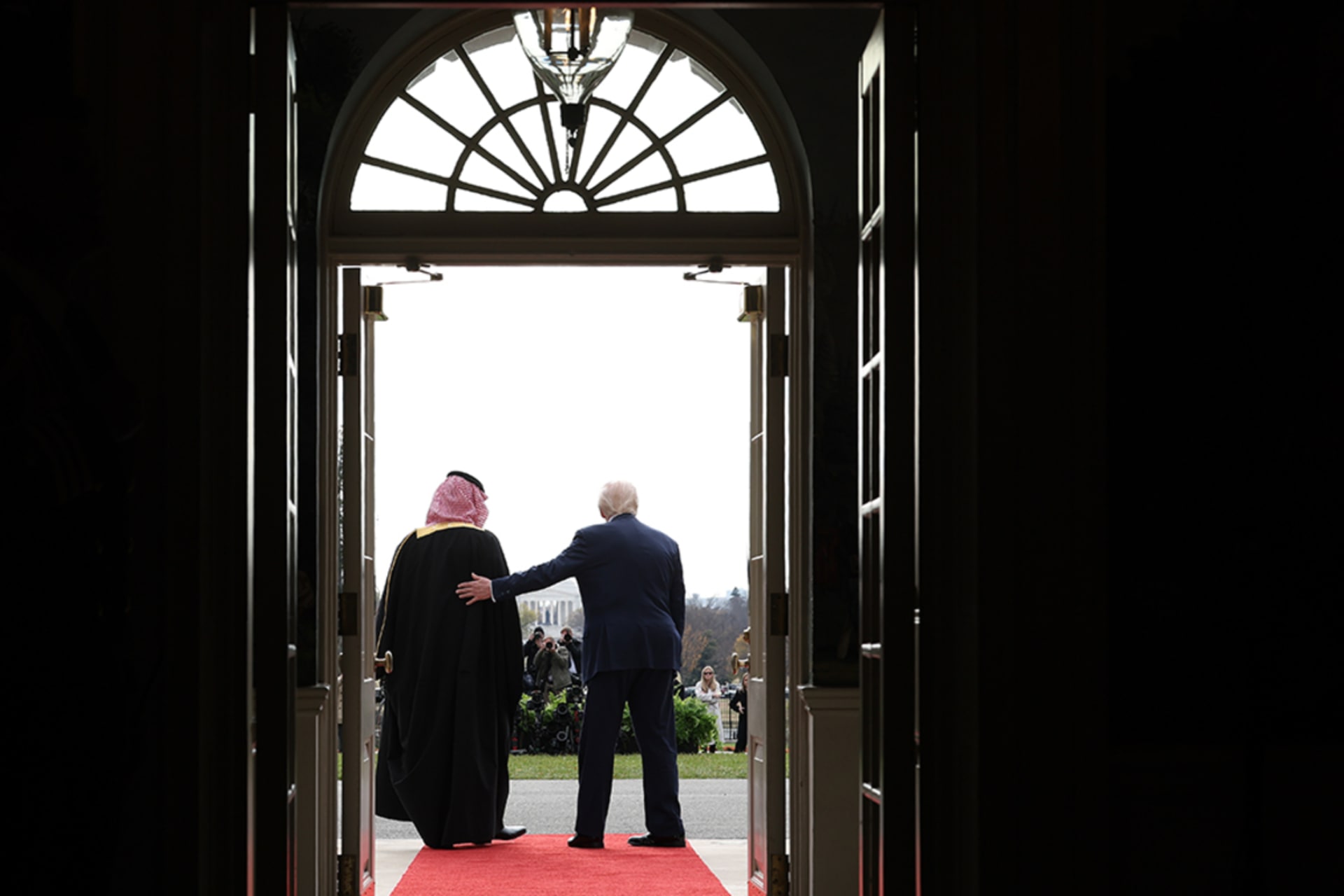
The extraordinary pageantry surrounding the visit of Saudi Arabia’s de facto ruler, Crown Prince Mohammed bin Salman, to the White House raised expectations that the pomp would be matched by some of the economic and security agreements announced during the trip. They include the elevation of Saudi Arabia to the status of “major non-NATO ally,” an agreement to sell F-35 fighter jets and Abrams tanks to the Kingdom, and the Saudis’ pledge to up their investments in the United States from $600 billion to nearly $1 trillion.
U.S. President Donald Trump also offered strong personal support to the crown prince, including an assertion he had no role in the killing of Saudi dissident and Washington Post columnist Jamal Khashoggi in October 2018. But signs of progress on a major Trump administration regional priority—the signing of a normalization agreement between Saudi Arabia and Israel—were unclear.
Mohammed bin Salman was greeted at the White House as one of the United States’ closest allies. Why?
Any president entering the Oval Office for the first time in January 2025 would have quickly concluded that Saudi Arabia would have to be an important partner to the United States in the Middle East. After more than a decade of tumult, traditional regional powers in the region including Egypt, Iraq, and Syria had either turned inward, were unstable, or failing. There are limits to what Turkey, a powerful NATO ally with myriad interests in the region, can offer as both a partner and competitor to the United States and other U.S. allies in the region. Jordan, Qatar, and the United Arab Emirates are all influential but are generally too small to be the United States’ primary regional partner. In contrast, the Saudis have the resources, influence, and desire to play a critical role working with the United States to foster a secure, stable, and prosperous region.
The Trump administration also clearly sees tightening of ties between Washington and Riyadh as a way of outmaneuvering Chinese influence in the Middle East. The Saudis are not likely to give up their robust trade relations with China, but a U.S.-Saudi security agreement, which were part of this week’s discussions, would ensure that the Kingdom remains a U.S. partner no matter how much Saudi oil China purchases or the extent that Chinese companies are building Saudi infrastructure.
That is why President Trump’s intention to sell Saudi Arabia F-35s is so important. The proposed sale is a down payment of sorts for the modernization of security ties, which are currently based on the Carter Doctrine that committed the United States to defend the Gulf oil fields and energy resources from regional and external threats. Those commitments have frayed over the last four decades, especially after President Trump decided not to respond to an Iranian strike on Saudi oil facilities during his first term in September 2019. The Saudis would now like a formal pact with explicit American security guarantees. They seem willing to pay for it in the form of a promise to invest close to $1 trillion in the United States.
Overall, despite the hype leading up to the meeting and the important-sounding announcement that Saudi Arabia would be designated a major non-NATO ally, the outcome of the crown prince’s visit was less than meets the eye. There was no appreciable progress on normalization with Israel, a security pact has been under discussion since the second year of the Biden administration, and if Saudi Arabia ever acquires F-35s, it will be years from now. In addition, commitments to invest $1 trillion in the United States are just that. If history is any rough guide, there could be Saudi investment, but it will likely fall short of the gaudy numbers the president and crown prince have invoked.
What is the prospect that Saudi Arabia will join the Abraham Accords with Israel, and why does that matter for the region?
The prevailing view in Washington is straightforward: If Saudi Arabia were to normalize relations with Israel—whether part of the Abraham Accords or through some other agreement—it would effectively end the conflict between Israel and the Arab states. Yet it would do nothing to address the Palestinian problem, which is why the crown prince, known as MBS, requires a “clear path” to the establishment of a Palestinian state.
Although the Saudis have long supported and pushed for a two-state solution, prior to Hamas’s attack on Israel on October 7, 2023, the crown prince was ambiguous about the price Israel would have to pay for normalization. That is because the Saudi leader considers Israel—a global leader in agricultural, health care, and security technologies—as a critical part of his vision for regional integration and the development of the Kingdom. The war between Israel and Hamas has, however, complicated MBS’s approach to Israel. The images of the war, especially the suffering of Gazan civilians, have made it harder for MBS to move forward with Israel without a firm commitment from the Israeli government to negotiate an end to the Israeli-Palestinian conflict. Currently, the Saudis do not have a partner. Israeli Prime Minister Benjamin Netanyahu, his government, and about 60 percent of the Israeli public oppose the establishment of a Palestinian state. After October 7, many Israelis do not trust that Palestinians want to live side-by-side in peace.
Trump dismissed questions about the crown prince’s involvement in the murder of Jamal Khashoggi. Does that amount to a rehabilitation of the crown prince’s global image?
Despite seeming to be particularly fond of the crown prince, Trump has not broken any new ground in the Saudi leader’s global standing; his rehabilitation on the global stage was accomplished long before this meeting. Some of his harshest critics around the time of the Jamal Khashoggi murder have had to come to terms with MBS. That includes Turkey, which originally pressured Saudi Arabia to investigate the killing at the Saudi consulate in Istanbul. Turkish President Recep Tayyip Erdoğan, though he has long been a prolific jailer of journalists, played a leading role trying to undermine the Saudi crown prince on the world stage. Yet Turkey’s economic troubles forced him to make amends with MBS in April 2022. Shortly thereafter, the Saudis and Turks entered several economic arrangements to help strengthen the Turkish economy and health of Turkish banks.
The crown prince’s rehabilitation was not complete until then President Biden visited Saudi Arabia in the summer of 2022. During his campaign for the presidency, Biden called the Saudi government “beyond the pale” and once he took the oath of office, he declared MBS essentially persona non grata in Washington. Yet, the exigencies associated with China’s global ambitions and the political toll high gasoline prices were taking on Biden’s popularity compelled him to visit MBS in Jeddah in July 2022.
Still, President Trump’s assertion that “things happen” in relation to Khashoggi’s murder was extraordinary given the finding of the American intelligence community, which concluded that the crown prince was complicit in the killing. Clearly, Trump wants to put the episode behind the Kingdom and the United States so the countries can deepen and strengthen their cooperation.
This work represents the views and opinions solely of the author. The Council on Foreign Relations is an independent, nonpartisan membership organization, think tank, and publisher, and takes no institutional positions on matters of policy.