Is Trump’s Ukraine Peace Deal a Faustian Bargain?
Trump’s proposal would cross multiple Ukrainian and European red lines, but there could also be opportunities for further negotiations.

Liana Fix is a senior fellow for Europe at the Council on Foreign Relations.
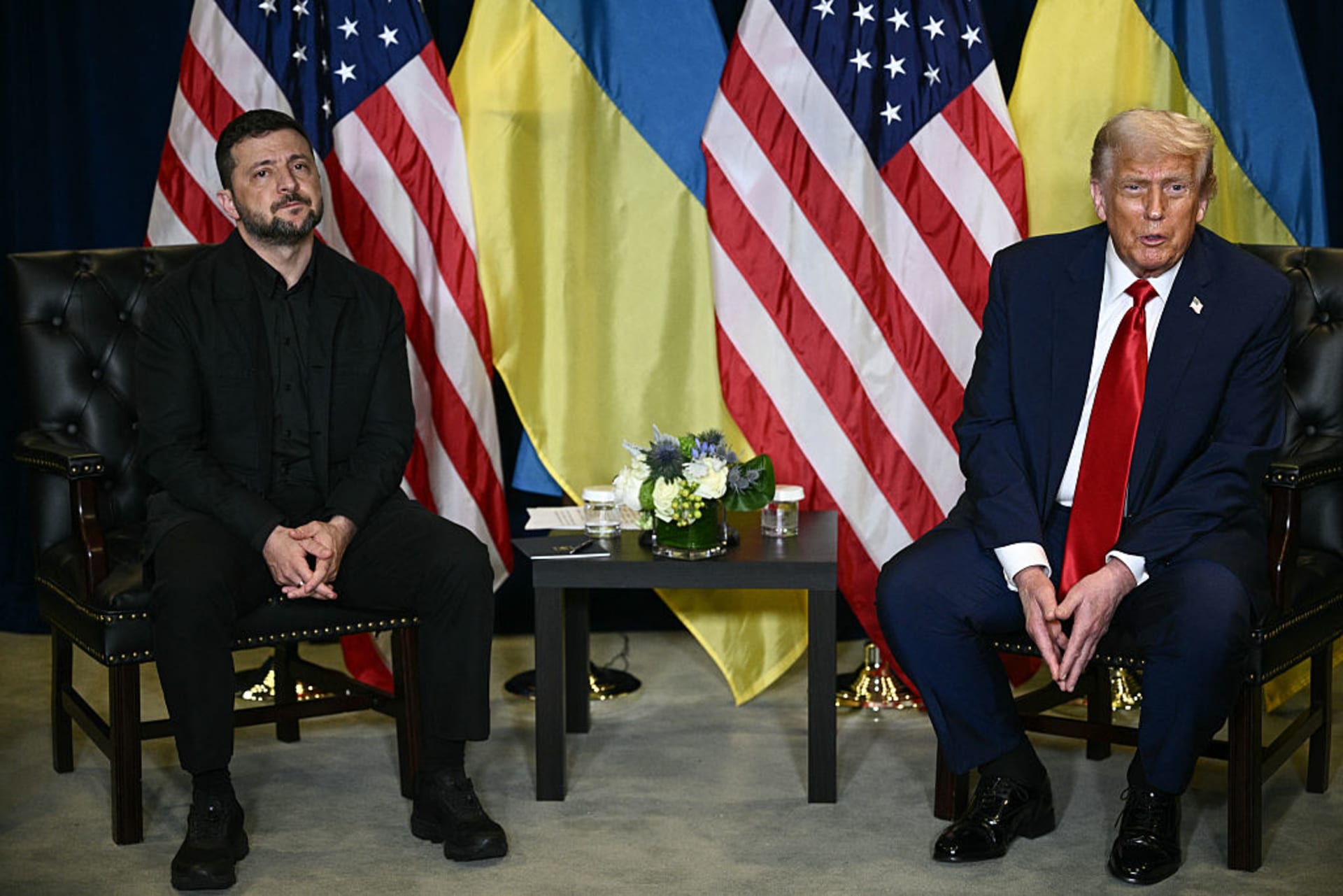
President Donald Trump has thrown his support behind a new twenty-eight-point peace plan, the White House’s latest attempt to move ceasefire discussions forward between Russia and Ukraine. Initial attempts, such as the talks in Alaska, have stalled in the face of Russian intransigence. With the Russian military grinding slowly forward in eastern Ukraine and U.S. military support for Ukraine foundering, Russian President Vladimir Putin is simply not interested in genuine negotiation.
But this proposed agreement, modeled after Trump’s Gaza peace plan, is a useful tool for Russia. It allows the Kremlin to up the pressure on Ukraine and avoid further pressure from the United States and Europe. This plan comes at the worst time for Ukraine and its partners, as the sanctions bill in the U.S. Congress finally makes some progress after months of waiting, and simultaneously, the Europeans engage in much more serious deliberations on the use of frozen Russian assets in the coming months. At minimum, Russia will try to put the blame on Ukraine for preventing peace in the eyes of Trump.
Much depends on the extent to which the latest proposal is final or still malleable. Many points are vague and unclear. Ukraine and European partners are already in discussions on how to shape and push back on some of the provisions, but time could be short with Trump placing a Thursday deadline on the deal for Ukraine. This time pressure, and Ukrainian President Volodymyr Zelenskyy’s response to Trump’s plan suggest, however, that this could be the most serious attempt so far by the administration to force Ukraine into an agreement.
So what are the red lines in the proposal that Ukrainians and Europeans should push back against? And what points could be developed for further negotiations?
Red Lines Crossed
Territorial concessions. The withdrawal of Ukrainian forces from territory in the Donetsk Oblast—territory they still control—and the international recognition of this territory as Russian (provision 21d) is entirely unacceptable to Ukraine. It would surrender Ukraine’s most formidable defenses and hand over territory that neither belongs to nor has been conquered by Russia. Even if it is to become a demilitarized buffer zone, there is no mechanism in place that could prevent Russian encroachment. Past conflicts in Georgia and Ukraine have demonstrated that Russia does not respect demilitarized zones.
Limitations on Ukraine’s military. A reduction of Ukraine’s armed forces to 600,000 troops, down from the roughly 900,000 that it sits at now, is a nonstarter for Ukraine, too. Even though Moscow has moderated its limit upward from the start of the war, any limitations to Ukraine’s military will make it vulnerable to a future Russian attack given Russia’s bigger population size and advantage in manpower.
Security guarantees. The U.S. security guarantees in the proposal include a “coordinated military response” and the reinstatement of Russian sanctions in case of a renewed attack. This is not what Ukraine hoped to see as a U.S. security guarantee. Kyiv would have liked a promise from Washington that it would come to the defense of Ukraine in case of a renewed attack, similar to NATO’s Article 5 mutual assistance clause. According to a report from Axios, this may be still under discussion. At minimum, Ukraine hopes for a promise of permanent U.S. military assistance to Ukraine—which Trump has rolled back almost in its entirety. In addition, the provision that no NATO troops should be stationed in Ukraine also precludes the possibility of a European military force in Ukraine that was widely discussed earlier this year as a deterrent and a way of providing Western security guarantees, with a United States “backstop” to it.
Russian veto on NATO enlargement. The plan would require NATO to enshrine in its statuses that it will never accept Ukraine as a member, and Kyiv must agree that it will never join the alliance. Ukraine can decide for itself not to become a NATO member, but a general “no” to NATO enlargement would amount to an unacceptable Russian veto over NATO policy beyond Ukraine. The alliance has long had an “open door” to all countries that meet the criteria and are unanimously accepted.
Points for Negotiation
Lifting of sanctions. Lifting sanctions in “stages” and on a “case-by-case” basis instead of sweeping away all sanctions, as the Russians demanded in the past, could be a useful approach. Ideally, it would be constructed as an automatic “snapback” mechanism to avoid lengthy and controversial political discussions between the United States, Europe, Russia, and Ukraine over a violation.
Russian frozen assets. Using Russian frozen assets as suggested in this plan will partly benefit Ukraine, and partly U.S.-Russia corporate relations, but the proposal would also deprive Europeans of a funding source for future Ukraine support. Importantly, the peace plan does not foresee just returning the assets to Russia, which can be useful in negotiations—if Russia actually agrees to it.
Dialogue on de-escalation between NATO and Russia. This is a vague provision that could lead to years of negotiations. It reflects Russia’s longtime desire to roll back the U.S. presence in Europe and to discuss broader European security, in addition to Ukraine. The U.S. position in these provisions as a “mediator” between NATO and Russia is unacceptable to Europeans and any European participation in such talks. It is a worrisome reflection of the role that the United States seems to see for itself in the future of European security.
New START. Although the peace plan talks about START I, what is likely meant here is Russia’s proposal to prolong New START for another year. This can be a useful starting point for negotiations under certain conditions.
Elections in one hundred days. This is a rapid timeline for Ukraine to conduct free and fair elections, especially if it has to define how to deal with voters that live in Russian-occupied territory. Russia will want to rush this to delegitimize Zelenskyy and to create mischief in Ukraine domestically—as it has in previous elections.
All Carrot and No Stick
The structure and scale of the twenty-eight-point peace plan suggests that the Trump administration believes it can convince Ukraine to accept some of the red lines in return for vague U.S. security guarantees. This is a Faustian bargain.
As Zelenskyy put it: “Now Ukraine may find itself facing a very difficult choice—either the loss of dignity, or the risk of losing a key partner.”
So far, the security guarantees lack specificity, unless the United States actually agrees with Ukraine on a commitment similar to NATO’s Article 5 mutual defense clause. Otherwise, the entire agreement is structured to work via incentives and carrots with Moscow, instead of sticks and punishment in case of violation. They are in no way reassuring for Ukraine, which has to accept territorial concessions and limitations on its military that are detrimental to the country’s ability to defend itself—or face the prospect of U.S. punishment. This could include the loss of U.S. intelligence-sharing and weapons sales to Ukraine. For Ukrainians and Europeans, these are nonnegotiable redlines. Unless Kyiv and its European partners are able to change the mind of the U.S. president on these specific points, a deal is unlikely to be achieved, leaving Ukraine in for another bleak winter.
Even still, on many less controversial points, the plan needs refining: the devil lies in the detail, and Russia is a ruthless negotiator, with much more expertise on Ukraine and Europe on its team than the United States has.
On a more hopeful note, however, Europeans and Ukrainians could find potential leverage by reading this deal carefully for what it says between the lines about Russian fears. For example, the oddly specific inclusion of Ukrainian strikes on Moscow and St. Petersburg as an action that would invalidate the agreement demonstrates how fearful the Kremlin is of potential future long-range strikes. Moving forward, Europeans and Ukrainians would be wise to use these points to their advantage.
This work represents the views and opinions solely of the author. The Council on Foreign Relations is an independent, nonpartisan membership organization, think tank, and publisher, and takes no institutional positions on matters of policy.