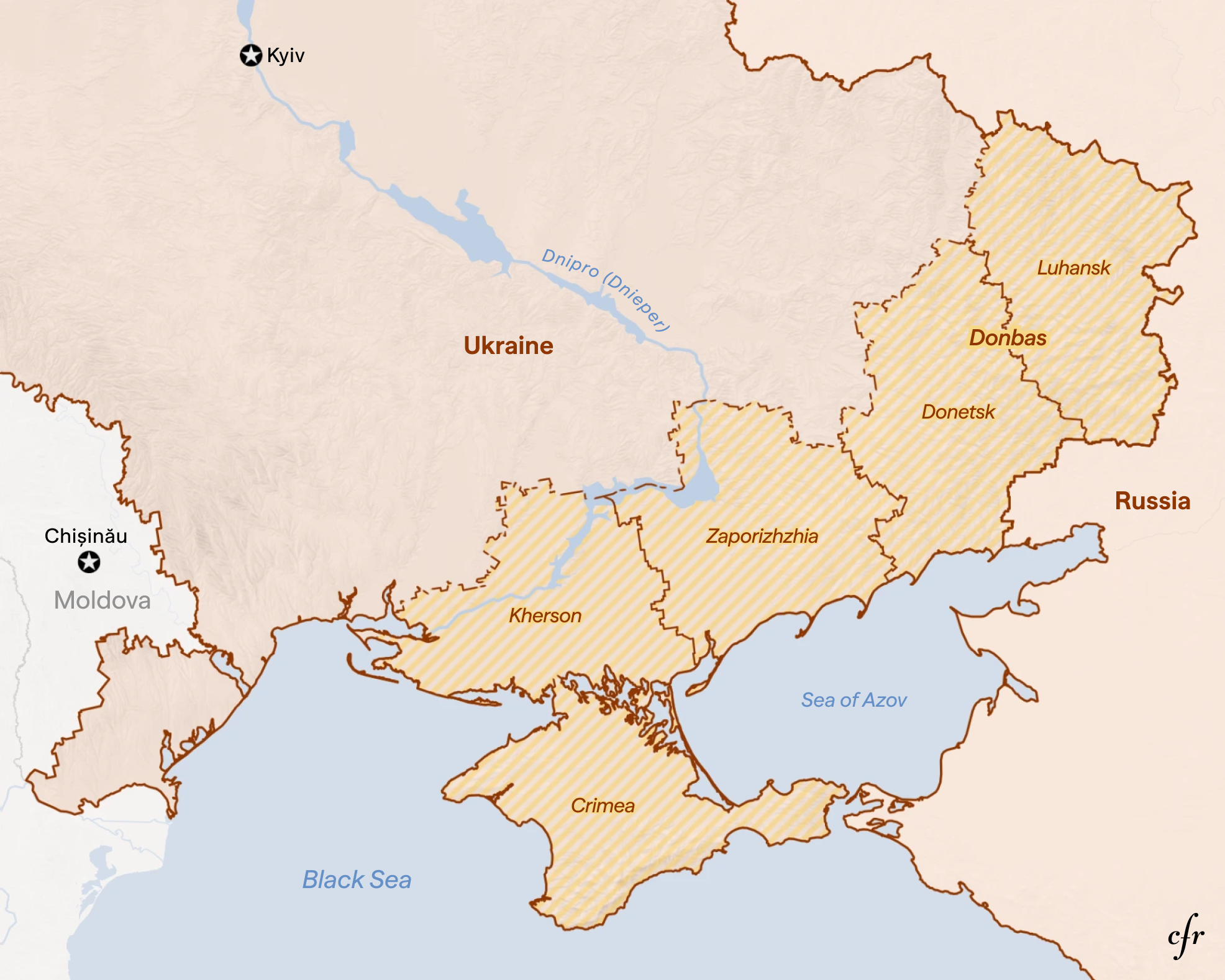
Nearly four years since Russia’s February 2022 full-scale invasion of Ukraine, Russia still occupies roughly 20 percent of the country after gaining over four thousand square kilometers of territory in 2024. Russia continues to bombard Ukrainian cities, while Ukraine maintains drone attacks on Russian oil infrastructure and military sites. Since January 2022, Ukraine has received about $175 billion in aid from the United States and $197 billion in aid from the European Union. Fighting and air strikes have inflicted over 53,000 civilian casualties, while 3.7 million people are internally displaced, and 6.9 million have fled Ukraine. 12.7 million people need humanitarian assistance.
The Trump administration recently revived its efforts to negotiate a settlement to end the war, setting out a twenty-point draft peace deal. Although Ukraine tentatively accepted the proposal after discussions in Geneva, many terms of the deal—including territorial concessions and security guarantees—remain unclear. Russia, meanwhile, has stated that it will not agree to an amended deal that departs from the “spirit and letter” of President Putin’s August summit with President Trump in Alaska.

Background
Armed conflict in eastern Ukraine erupted in early 2014 following Russia’s annexation of Crimea. The previous year, protests in Ukraine’s capital, Kyiv, against Ukrainian President Viktor Yanukovych’s rejection of a deal for greater economic integration with the European Union (EU) were met with a violent crackdown by state security forces. Subsequently, the protests escalated, and President Yanukovych fled the country in February 2014.
One month later, in March 2014, Russian special forces took control of the Ukrainian peninsula of Crimea. Russian President Vladimir Putin cited the need to protect the rights of Russian citizens and Russian speakers in Crimea and southeast Ukraine. Russia then formally annexed the peninsula after Crimeans voted to join the Russian Federation in a disputed local referendum. The crisis heightened ethnic divisions, and two months later, pro-Russian separatists in the eastern Ukrainian regions of Donetsk and Luhansk held independence referendums.
Armed conflict in the regions quickly broke out between Russian-backed forces and the Ukrainian military. Though Russia denied military involvement, both Ukraine and the North Atlantic Treaty Organization (NATO) reported Russian troops and military equipment near Donetsk and Russian cross-border shelling. The conflict transitioned to an active stalemate, with regular shelling and skirmishes occurring along the frontlines.
In October 2021, months of intelligence gathering of Russian troop movements, force build-up, and military contingency financing culminated in a White House briefing with U.S. intelligence, military, and diplomatic leaders on a near-certain mass-scale Russian invasion of Ukraine. Leading up to the invasion, the Joe Biden administration reduced information-sharing constraints and allowed for the broader dissemination of intelligence and findings, both with allies—including Ukraine—and publicly. Commercial satellite imagery, social media posts, and published intelligence from November and December 2021 showed armor, missiles, and other heavy weaponry moving toward Ukraine with no official explanation from the Kremlin. In mid-December 2021, Russia’s foreign ministry called on the United States and NATO to cease military activity in Eastern Europe and Central Asia, commit to no further NATO expansion toward Russia, and prevent Ukraine from joining NATO in the future. The United States and NATO rejected these demands and threatened to impose severe economic sanctions on Russia.
In early February 2022, satellite imagery showed the largest deployment of Russian troops to its border with Belarus since the end of the Cold War. Negotiations between the United States, Russia, and European powers failed to bring about a resolution. In late February 2022, the United States warned that Russia intended to invade Ukraine, citing Russia’s growing military presence at the Russia-Ukraine border. President Putin then ordered troops to Luhansk and Donetsk for a “peacekeeping” function. The United States responded by imposing sanctions on the regions and the Nord Stream 2 gas pipeline. Nevertheless, just before the invasion, U.S. and Ukrainian leaders remained at odds regarding the likelihood of an armed Russian threat, with Ukrainian officials playing down the possibility of an incursion and delaying the mobilization of their troops and reserve forces.
On February 24, 2022, during a last-ditch UN Security Council effort to dissuade Russia from invading Ukraine, Putin announced the beginning of a full-scale land, sea, and air invasion, targeting Ukrainian military assets and cities across the country. Putin claimed that the goals of the operation were to demilitarize and denazify Ukraine and end the alleged genocide of Russians in Ukrainian territory. U.S. President Joe Biden called the attack “unprovoked and unjustified” and issued severe sanctions against top Kremlin officials, including Putin and Russian Foreign Minister Sergey Lavrov; four of Russia’s largest banks; and the Russian oil and gas industry in coordination with European allies. On March 2, 141 of 193 UN member states voted to condemn Russia’s invasion in an emergency UN General Assembly session, demanding that Russia immediately withdraw from Ukraine.
As the initial Russian invasion slowed in March, long-range missile strikes caused significant damage to Ukrainian military assets, urban residential areas, and communication and transportation infrastructure. Hospitals and residential complexes also sustained shelling and bombing attacks. Later that month, Russia announced a “reduction in military activity” near Kyiv and Chernihiv, followed by a full withdrawal of all troops from Ukraine’s capital region by April 6. In Kyiv’s surrounding areas, civilians described apparent war crimes committed by Russian forces, including accounts of summary executions, torture, and rape.
On April 18, Russia launched a new major offensive in eastern Ukraine following its failed attempt to seize the capital. By May, Russian forces took control of Mariupol, a major and highly strategic southeastern port city. Indiscriminate and targeted attacks against civilians in the city amplified allegations against Russian forces for international humanitarian law violations. Since the summer of 2022, fighting has largely been confined to Ukraine’s east and south, with Russian cruise missiles, bombs, cluster munitions, and thermobaric weapons devastating port cities along the Black Sea and the Sea of Azov.
The Russian seizure of several Ukrainian ports and subsequent blockade of Ukrainian food exports compounded an already acute global food crisis. Before the conflict, Ukraine was the largest supplier of commodities to the World Food Program (WFP), which provides food assistance to vulnerable populations. In July 2022, Russia and Ukraine signed an agreement to free more than twenty million tons of grain from Russian-controlled Ukrainian ports. In October, Russia suspended the grain deal in response to an alleged Ukrainian attack on Russian naval forces. Turkey quickly negotiated Russia’s return to the deal, which was consistently extended until July 17, 2023, when Russia quit the deal. Ukraine later adopted safe shipping lanes along the coast of NATO members Romania and Bulgaria, which has facilitated higher rates of grain exports compared to 2023.
In mid-August 2022, the war’s frontline shifted south, sparking international fears of a nuclear disaster at the Zaporizhzhia nuclear plant along the Dnipro River. The largest nuclear plant in Europe, the Zaporizhzhia facility was seized by Russian forces in the earliest stages of the war. Fighting near the facility has raised concerns of critical damage to the plant: shelling of the plant’s switchyard has already led to nearby energy disruptions, such as a city-wide black-out in Enerhodar. Representatives of the International Atomic Energy Agency (IAEA) have visited Zaporizhzhia on multiple occasions to assess the threat of a nuclear accident. Attacks on the site and damage to its infrastructure continue: in February 2025, the IAEA warned that continued attacks on Ukraine’s power grids could increase the risk of nuclear disaster.
In September 2022, Ukrainian forces made strong advances in the northeast and mounted a revitalized southern counteroffensive. Ukraine retook significant territory in the Kharkiv region, surprising Russian forces and cutting off important supply lines at Lyman before stalling and settling into a new front line. In southern Ukraine, Ukrainian forces retook the city of Kherson and forced a Russian withdrawal from all territory west of the Dnipro River.
Russia then redeployed forces eastward to Donetsk, in addition to sending tens of thousands of reinforcements to the area in advance of a February 2023 offensive. Later that month, Putin moved to illegally annex four occupied territories: Luhansk, Donetsk, Kherson, and Zaporizhzhia. In his accompanying speech, Putin suggested the potential for nuclear escalation, referencing the United States’ use of nuclear weapons against Japan during World War II.
Following a winter stalemate, Putin announced plans in February to take all of Donbas by March 2023 in an offensive surge. However, the attack made little progress and devolved into a months-long siege of Bakhmut, a town of limited strategic—but substantial symbolic—value. By late May, Russia claimed control of the city, and Ukrainian attempts to recapture the area were unsuccessful. The United States estimates Russia suffered one hundred thousand casualties in Bakhmut.
On June 6, 2023, a breach in the Nova Kakhovka dam, sixty kilometers north of Kherson on the Dnipro River, caused severe flooding in southwest Ukraine, affecting over eighty thousand people who live in the riparian zone. Ukraine accused Russia of blowing up the dam to prevent a southeastern offensive. The Ukrainian dam operator said it was destroyed beyond repair. In June 2023, Ukraine launched a much-anticipated counteroffensive, attempting to break through Russian defenses eastward in Donetsk province and southward in Zaporizhzhia province, which forms the “land corridor” to Crimea. Ukrainian forces met stiff resistance and suffered heavy losses against hardened Russian defensive positions, air superiority, and minefields. Nonetheless, Ukraine made small gains on the ground and has stepped up attacks on bridges to Crimea, Russian ships, and buildings in Moscow.
Since February 24, 2022, the United States has committed over $118 billion in assistance to Ukraine, including roughly $65 billion in immediate military aid. In early 2023, the Biden administration approved the provision of increasingly advanced weaponry, such as the Patriot air defense system, crucial for defending against Russian airstrikes, and top-tier battle tanks. U.S. troop presence in Europe has also increased to more than one hundred thousand soldiers. Despite continued condemnation by key international actors, Russia continues to build valuable partnerships; North Korea and Iran share intelligence and military equipment, while others, namely India and China, have begun purchasing Russian oil and gas at discounted prices.
On June 23, Putin faced a major internal challenge when Yevgeniy Prigozhin, the former leader of the Wagner Group of mercenaries, accused the Russian Ministry of Defense (MoD) of shelling his forces and announced a “march of justice” to unseat the military leadership. The mutiny followed months of tensions with the MoD. Wagner forces quickly occupied Rostov-on-Don, seized Russia’s southern military headquarters, and subsequently advanced more than halfway to Moscow. Putin declared the march “treason” and offered amnesty for soldiers who stopped. On June 24, Belarussian President Alexander Lukashenko negotiated for Prigozhin and his Wagner soldiers to relocate to Belarus. Two months after the revolt, Prigozhin died in a private plane crash outside of Moscow. U.S. officials believe an explosion ordered by Putin likely brought it down.
In November 2023, Commander-in-Chief Valerii Zaluzhnyi said the war had reached a stalemate after Ukraine’s failed counteroffensive. Due to strategic tensions between the president and his top military official, Zelenskyy replaced Zaluzhnyi with seasoned General Oleksandr Syrsky on February 8, 2024. Soon after his appointment, Syrsky ordered the withdrawal of troops from Avdiivka, a strategically important town in Donetsk, where fighting was ongoing for four months. He argued the retreat was necessary to avoid being encircled. The decision, however, handed Russia its most significant battlefield victory since the capture of Bakhmut in May 2023.
Recent Developments
In early August 2024, Ukraine launched the Kursk Offensive, a surprise incursion into Russia’s Kursk Oblast. This marked the first cross-border offensive conducted primarily by Ukrainian military forces, aiming to divert Russian troops and resources from eastern Ukraine. Ukrainian forces captured 1,250 square kilometers of Russian territory; however, progress stalled as Russia deployed over 50,000 troops to counter the attack. Russia claims to have recaptured roughly half of the territory lost in Kursk. In January 2025, Ukraine followed up with a second incursion, though progress remains limited due to a swift Russian response. Over 10,000 North Korean troops joined Russian forces throughout both offensives, suffering high casualties and eventually being withdrawn in February 2025.
Ukraine remains intent on applying offensive pressure on Russia through continual attacks on Russian infrastructure. In May 2024, Russia reported that Ukrainian drones targeted civilians in the Belgorod Oblast, killing six. In November 2024, Ukraine launched its largest drone strike on Russian territory, attempting to target Moscow. A month later, Ukrainian drones penetrated deep into Russian territory, reaching Kazan. As part of persistent attacks on Russian critical infrastructure, Ukrainian drones continue to target oil refineries, depots, and gas processing plants.
Meanwhile, Russian forces relentlessly seek to weaken the Ukrainian frontline. In May 2024, Russia launched an offensive on the Kharkiv region, which, despite making territorial gains, ultimately stalled. However, Russia’s fall and winter campaigns pushed deeper into Ukraine’s east and southeast, particularly in Donetsk, seizing over 4,000 square kilometers of Ukrainian territory. Despite some doubts among international scholars and critics, Russia remains confident in its wartime economy.
Putin’s veiled threats throughout the war to use nuclear weapons continue to raise fears of escalation. In June 2023, Russia announced the move of tactical nuclear weapons into Belarus, with Belarus confirming receipt in December 2023. In June 2024, both parties conducted nuclear weapons exercises. In November 2024, Putin modified Russia’s nuclear doctrine, stating that Russia would treat a conventional attack by an ally of a nuclear state as grounds for Moscow to launch a nuclear strike.
Ukraine has received consistent aid from the United States, and NATO member states continue to support its war effort. However, following the election of U.S. President Trump, many believe the war may end this year. Trump vowed to end the war upon taking office and has sought to broker a peace deal between Russia and Ukraine. Zelenskyy has expressed concerns over exclusionary peace talks between the United States and Russia, fearing a disproportionate resolution and lack of security guarantees for Ukraine’s future. Additionally, Kyiv remains worried about freezes in military and humanitarian aid from the United States.
For CFR’s full coverage of Ukraine, please visit our Securing Ukraine’s Future Initiative.
New U.S. National Security Strategy Deprioritizes Europe
On Europe, the document calls for quickly ending hostilities in Ukraine, reestablishing “strategic stability” with Russia, and “ending the perception, and preventing the reality, of NATO as a perpetually expanding alliance;” it criticizes European officials for “unrealistic expectations” regarding the war in Ukraine, claiming that the “subversion of democratic processes” in Europe is blocking a broad public desire for peace (White House). The document is a shift from Trump’s first-term national security strategy in 2017, which pledged to work with Europe to “counter Russian subversion and aggression” (White House). Meanwhile, Turkey’s foreign minister condemned what he said were attacks on ships in Turkey’s exclusive economic zone in the Black Sea, saying they proved the Russia-Ukraine war is expanding; Ukraine has acknowledged attacking some Russia-linked oil ships in the Black Sea, where the cost of shipping insurance has risen (Hurriyet). Separately, Russian President Vladimir Putin insisted Moscow would capture Ukraine’s Donbas region through force if Ukraine does not pull its forces back, as the Kremlin rejects peace concessions (Reuters).
Ukraine’s Top Negotiator Meets With European Officials
NATO foreign ministers are discussing the war in Ukraine at a Brussels gathering that will be followed by a direct meeting with Ukrainian envoys (X). Multiple European officials today accused Russia of faking interest in peace, as Russian officials say President Putin has accepted some U.S. peace provisions and is prepared to keep negotiating (AP; Reuters). Meanwhile, Belgian Foreign Minister Maxime Prévot spoke out against an EU proposal to use Russia’s frozen assets in Europe to back a loan for Ukraine, saying it would introduce legal and financial risks; most of the frozen money is located in Belgium (AP). In response to Belgian concerns, EU leadership proposed two options for funding a large-scale loan to Ukraine: one would use as much as $245 billion in Belgian and other European-held frozen Russian assets to back the loan to Kyiv, while the other would use funds drawn directly from the EU budget (European Commission). The options are expected to be discussed further at a December 18-19 meeting (Reuters).
Peace Talks in Moscow
U.S. envoys Steve Witkoff and Jared Kushner spoke with Russian President Vladimir Putin for over four hours to discuss possible pathways to ending the war in Ukraine, amid disagreement over European and Ukrainian proposals (Reuters). Senior Putin aide Yuri Ushakov called the meeting “very useful” for staking out positions, though he noted Russia remained “critical and even negative” toward parts of the peace proposal (Kremlin). He added that the meeting was “the first time such a direct exchange of views has taken place” on U.S. President Donald Trump’s updated peace plan and added that “no compromise has been found yet” on certain disagreements, without specifying which ones (FT). Washington said it was still working to refine a framework acceptable to all sides, with Ukrainian President Volodymyr Zelenskyy saying the initial U.S. peace proposal “looks better” after revisions (NYT). NATO Secretary-General Mark Rutte said the U.S. push for peace was “important” but called for increased pressure on Russia if it does not succeed (NATO). To that end, the EU announced a deal today to permanently end the import of Russian liquefied natural gas by the end of 2026 and pipeline gas by the end of September 2027 (European Commission). Before the talks, Putin accused European governments of undermining U.S.-led ceasefire efforts by advancing demands he called incompatible with Russian interests, and warned that Moscow is prepared for war with the continent (Time). Putin also threatened to escalate attacks on Ukrainian ports and shipping in response to Kyiv’s drone attacks on Russian vessels in the Black Sea, following a strike earlier today (FT; AP).
European Leaders Rally to Support Ukraine
Kyiv’s European allies are holding a series of consultations this week on peace proposals and their ongoing support for Ukraine; European Union (EU) defense ministers are meeting in Brussels today as President Volodymyr Zelenskyy consults with French President Emmanuel Macron in Paris (Al Jazeera). EU foreign policy chief Kaja Kallas said ahead of the meeting that “it is clear Russia does not want peace, and therefore we need to make Ukraine as strong as possible” (X). Meanwhile, U.S. negotiators are due to fly to Moscow today after weekend talks with Ukraine (WSJ). On the battlefield, a Russian missile strike killed four and wounded more than forty individuals (Reuters). President Vladimir Putin also asserted that Russian forces had captured the Ukrainian cities of Pokrovsk and Vovchansk, a claim Ukrainian officials refuted as a negotiating tactic rather than a reflection of conditions on the ground (ABC).
Ukrainian Officials Meet With Trump Team in Florida
Ukraine’s National Security and Defense Council Secretary Rustem Umerov met with Rubio, U.S. envoy Steve Witkoff, and U.S. President Donald Trump’s son-in-law, Jared Kushner (Kyiv Independent). Umerov replaced former presidential chief of staff Andriy Yermak as Ukraine’s chief negotiator after Yermak’s resignation on Friday amid a corruption probe (AP). While officials offered few details about the talks, Rubio said that the United States wants to ensure Ukraine never faces another invasion and achieves economic prosperity (NBC). An unnamed senior U.S. official told the Wall Street Journal that the talks covered security guarantees, land swaps, and possible elections (WSJ). The flurry of shuttle diplomacy is part of a renewed effort to end the war, with Zelenskyy writing on social media that the coming days are “important” (X). While both Ukrainian and U.S. officials emphasized their commitment to Ukraine’s security, U.S. Secretary of State Marco Rubio added that “much work remains” and that Russia will “have to be part of the equation” (State). Ukraine continues its attacks on Russia’s oil infrastructure, and said over the weekend that it hit two tankers carrying Russian oil (CNN).
Deadly Russian Strikes in Kyiv
Russian missiles and drones killed at least three people, while Ukrainian operations disrupted a key Russian oil terminal near Novorossiysk; the attacks come alongside a push for peace talks, as Ukrainian officials traveled to the United States for renewed negotiations (AP).
Zelenskyy’s Chief of Staff Resigns as Corruption Probe Deepens
The resignation came amid an expanding investigation into alleged kickbacks tied to state contracts, marking the highest-level departure in Kyiv since Russia initiated its full-scale invasion; the shake-up threatens to complicate ongoing diplomacy as U.S. and European envoys seek progress toward a negotiated settlement with Moscow (NYT). Separately, two vessels tied to Russia’s sanctioned fleet were damaged by blasts off Turkey’s Black Sea coast, sparking fires and triggering emergency responses from Turkish authorities (Reuters). Ukraine later suggested it had struck the vessels with drones, prompting Turkish condemnation (AP).
Putin Suggests Openness to U.S. Peace Proposal
Russian President Vladimir Putin said the peace initiative could serve as a basis for negotiations but warned that fighting would continue unless Ukrainian forces pull back from contested territory; analysts suggested the U.S. proposal was heavily favorable towards Russia (AP). In Ukraine, Russian and Ukrainian troops continued to clash in Pokrovsk; Putin suggested Russia had surrounded the city, though Ukrainian military leaders pushed back on the claim (Reuters).
Moscow Rejects Peace Concessions
A senior Russian official said the Kremlin will not soften its core demands in negotiations to end the war in Ukraine as U.S. President Donald Trump’s envoy, Steve Witkoff, plans a visit to Moscow for further talks; the official’s statement follows the release of a recording suggesting Witkoff advised Russian officials on how to frame proposals to Washington, stirring backlash among U.S. lawmakers and European allies (NYT). Reuters reported that the initial U.S. peace framework incorporated material from a paper submitted by Moscow outlining its desired terms for ending the war; U.S. officials later revised the plan after European allies and Ukraine expressed concerns (Reuters).
U.S. Official Says Ukraine Agrees to Peace Deal
A U.S. official claimed only “minor details” remained outstanding, while Ukrainian President Volodymyr Zelenskyy said more work was needed; the White House announced that further talks were required among Russia, Ukraine, and the United States (CNN). Zelenskyy held bilateral calls with several European leaders ahead of a meeting with Ukraine’s European backers earlier in the day (European Commission). Russian overnight attacks on Kyiv killed at least seven people, while Ukrainian officials raised the death toll from an earlier strike in the city of Ternopil to thirty-four (AP; NPR). In Lithuania, Vilnius Airport resumed normal operations after two overnight shutdowns triggered by balloons that drifted into its airspace, as officials accuse Belarus of enabling the disruptive balloon launches (Reuters). Foreign incursions also occurred in Romania, where NATO aircraft intercepted a drone that traveled more than 100 kilometers inside Romanian territory, its farthest penetration to date (Guardian).
Reactions to New Trump Peace Framework
Ukrainian President Volodymyr Zelenskyy said today that this weekend’s talks with the United States in Geneva had enabled Ukraine “to keep extremely sensitive issues on the table” (President of Ukraine). Ukraine will continue consulting with European allies in the coming days, according to Zelenskyy’s chief of staff (WSJ). Finnish President Alexander Stubb wrote on social media that while steps were taken yesterday toward a just peace, there were still unresolved issues (X). A Kremlin spokesperson said that Moscow has not received an official update on the peace plan, which Rubio said would need to be approved by Trump and Zelenskyy before being presented back to Russia (NBC). Earlier, a Russian foreign policy official suggested that the European counterproposal to the U.S. plan was unacceptable to Moscow (Reuters).
U.S.-Ukraine Joint Statement Announces New Framework for Ending War
Ukraine and the United States said in a joint statement that their peace talks in Geneva had been “highly productive,” and affirmed that peace must ensure “Ukraine’s security, stability, and reconstruction” (White House). U.S. President Donald Trump has set a Thursday deadline for Ukraine to respond to the proposal (The Hill). The changes came after Kyiv pushed back on elements of a previous U.S. plan (AP). U.S. Secretary of State Marco Rubio said he was optimistic that an agreement could be reached “very soon,” though he acknowledged negotiations could stretch longer (State). Senior officials from several of Ukraine’s European allies attended part of the talks (FT). Widely reported details of the Trump administration’s draft peace plan said that it included major concessions by Kyiv, prompting European allies to create a detailed counterproposal; a version of Europe’s counterproposal published by Reuters included a higher cap on the size of Ukraine’s military and stronger language about funding for Ukraine’s reconstruction (Reuters).
Drone Sightings in the Netherlands
Officials suspended operations at Eindhoven Airport after multiple drones were detected nearby, prompting Dutch defense officials to implement security measures before traffic resumed later in the night; the incident is the latest in a series of unexplained drone incursions across Europe (Reuters).
U.S. and Ukrainian Officials Meet in Kyiv
A U.S. Army spokesperson said today’s talks aim “to discuss efforts to end the war” and follow a reported new U.S. peace proposal for Ukraine (BBC). Ukrainian President Volodymyr Zelenskyy said he was ready for “clear and honest work” with the United States regarding Trump’s plan to end the war (X). The White House press secretary said the proposal was prepared by Secretary of State Marco Rubio and U.S. special envoy Steve Witkoff (AP). Axios, which first reported the story, noted the plan was initially crafted with Russian, but not Ukrainian, input (Axios). Multiple news outlets have confirmed the existence of the U.S. plan, reportedly spurred by Washington’s twenty-point peace plan for Gaza (FT). The proposal calls for sweeping territorial and security concessions by Ukraine, while a separate U.S. document seen by the Wall Street Journal describes ten-year U.S. security guarantees to Ukraine that stop short of direct military assistance (WSJ). Washington warned it could scale back intelligence and weapons support unless Kyiv agrees to the outline of the peace plan, Reuters reported (Reuters). European Union foreign policy chief Kaja Kallas warned that any successful peace proposal would need “Ukrainians and Europeans on board” (X). Russia suggested it had not yet received the peace plan but that addressing the “root causes” of the conflict remains necessary (Axios; BBC). Separately, the Ukrainian military suggested it was successfully blocking Russian forces from pushing further in the city of Pokrovsk, as heavy weeks-long clashes continue (Facebook). In Zaporizhzhia, a Russian strike killed five and injured several others (Kyiv Post).
New Reported U.S. Peace Plan for Ukraine
The plan would force Ukraine to cede the entire eastern Donbas region, including territory it currently controls, recognize the Crimean peninsula and other occupied territories as Russian, reduce the size of its military, relinquish access to some long-range weapons, and prohibit foreign troops from Ukrainian-occupied territory after a ceasefire (NYT). Ukraine did not immediately comment on the details, but President Volodymyr Zelenskyy wrote on social media that Kyiv has supported “every strong and fair proposal aimed at ending this war” (X). Ukraine’s deputy foreign minister suggested that Moscow was pushing “a factory of unrealistic plans,” though he did not directly reference the U.S. proposal (X). The Kremlin declined to comment when asked about the reports (AFP). Despite the plan’s heavy demands on Ukraine, U.S. Secretary of State Marco Rubio wrote that “achieving a durable peace will require both sides to agree to difficult but necessary concessions” (X). Separately, Washington, London, and Canberra unveiled coordinated sanctions targeting Russia-based companies that enable ransomware and phishing operations, aiming to disrupt the infrastructure used by major cybercriminal groups (Reuters). The United States also approved the possible sale of the highly advanced Patriot missile defense system to Kyiv (Kyiv Post). Meanwhile, fighter jets were dispatched in Romania following a drone incursion into its borders, as Russian violations of NATO airspace continue (Newsweek). Lithuania, which instituted weeks-long border closures with Belarus over balloons that disrupted airport operations, said it will restore border crossings today, though it may close them again if necessary (AP).
Push to Accelerate Ukraine Diplomacy
Trump dispatched multiple senior army officials to Kyiv, the Wall Street Journal reported (WSJ). Meanwhile, Ukrainian President Volodymyr Zelenskyy said he will head to Turkey this week to meet President Recep Tayyip Erdoğan in hopes of advancing ceasefire discussions, though Russia said it will not attend, and U.S. participation remains uncertain (AP). Spain also pledged nearly $1 billion in military and energy aid to Ukraine (X). In Russia, the military intercepted four Ukrainian drones headed towards Moscow, forcing the city’s two largest airports to temporarily halt operations (Reuters). Finally, Russian envoy Kirill Dmitriev said he recently discussed another potential prisoner swap with U.S. officials, who confirmed their interest, though he stressed a deal is not currently close (Axios).
Ukraine’s Defense, Energy Deals
Ukraine plans to acquire as many as one hundred French fighter jets over the next decade, the presidents of both countries said today (Politico). Ukrainian President Volodymyr Zelenskyy said Kyiv was also looking to acquire French air-defense systems, radars, and air-to-air missiles and bombs (X). Meanwhile, Ukrainian officials said an overnight missile attack on the city of Balakliia killed three people and injured ten others, while additional strikes in the Kharkiv region led to power outages (Reuters). In Ukraine’s Odesa region, a Russian drone hit the Turkish-flagged MT Orinda while it was unloading liquefied petroleum gas, sparking fires and damaging nearby port infrastructure amid a broader wave of Russian overnight attacks across the Odesa region (AP).
Russia-Ukraine Prison Exchange Talks
Russian Drone Attack on Kyiv Kills Six
Two others were killed in attacks in the country’s south (Reuters). The offensive came during a turbulent political week for Ukraine; following an announcement of a probe into the state power company, Prime Minister Yulia Svyrydenko said the government would audit multiple state companies (X). Meanwhile, in Moscow, the Kremlin claimed it thwarted a Ukrainian attempt to assassinate a senior Russian official (Reuters). The Russian Defense Ministry also announced that North Korean soldiers fighting alongside Russian forces in the Kursk region are now heavily involved in clearing mines left after Ukraine’s months-long incursion (Anadolu Agency). In Poland, authorities announced they would reopen two border crossings with Belarus that have been closed since September due to Russian drone incursions; Lithuania, which has likewise shuttered its crossings, suggested it would not reopen them until at least the end of November (Euronews).
EU Funding for Ukraine
In Brussels, European finance ministers agreed that drawing on revenue from Russia’s frozen reserves is the most practical way to cover Ukraine’s financing needs through 2027, offering more than $160 billion without adding to member-state debt; Belgium urged stronger legal safeguards given the risk of Russian litigation over the assets (Reuters). Meanwhile, Moscow repeated its seeming openness to negotiations, claiming that Ukraine would have no choice but to return to talks as Russian military pressure intensifies (Anadolu Agency).
Ukrainian Minister Suspended
Ukraine suspended its justice minister as a probe into a corruption scheme tied to the country’s nuclear power company advances, Prime Minister Yulia Svyrydenko announced (AP). He was not immediately charged and agreed to the suspension (WaPo). Two Ukrainian anti-corruption agencies said they were probing a scheme linked to the same nuclear company that may have laundered up to $100 million (Bloomberg). Meanwhile, Ukrainian authorities began mass evacuations from frontline areas in Zaporizhzhia as heavy Russian attacks forced troops to retreat from at least six villages, with top general Oleksandr Syrskyi warning of a “significant deterioration” in Ukraine’s military position (Reuters). In Russia, a foreign ministry official suggested that Moscow is ready to restart talks with Ukraine in Istanbul, while British officials also attempt to initiate a back-channel dialogue (RFERL; FT). Finally, the Group of Seven (G7) foreign ministers jointly pledged to maintain economic pressure on Russia over its war in Ukraine following a meeting in Canada (State). In talks regarding a potential end to the war, Russia has made a demand that Ukraine cannot agree to, U.S. Secretary of State Marco Rubio told reporters (State).
EU Weighs Options To Finance Ukraine
European Union ministers will meet on Thursday to debate options for financing Ukraine over the next two years, with officials saying the most likely plan involves using frozen Russian assets rather than new borrowing, though Belgium has sought legal guarantees to shield securities depositor Euroclear from potential Russian lawsuits (Reuters). Kremlin spokesman Dmitry Peskov reiterated Russia’s desire for the war to end, but Ukrainian President Volodymyr Zelensky warned that Moscow continues provoking Europe to exploit fears of escalation across the continent (Newsweek).
Russian Strikes on Nuclear Powerplants
Russian drones and missiles hit substations supplying Ukraine’s Khmelnytskyi and Rivne nuclear power plants, killing seven people and knocking out power in several regions (Reuters).
EU General Calls for European Troop Presence in Post-War Settlement
European Union Military Committee Chair General Sean Clancy said the deployment of European troops should be part of Western security guarantees (Reuters). A U.S. official told Reuters that Washington also backs European efforts to repurpose more than $200 billion in frozen Russian assets to support Ukraine (Reuters). Meanwhile, heavy fighting continues in the Ukrainian city of Pokrovsk, as both sides push to increase their military leverage (AP).
Pokrovsk Battle Continues
Moscow said its troops seized dozens of buildings in Pokrovsk amid close-quarters fighting, aiming to cut off Ukrainian defenders as Russian forces advance toward nearby Myrnohrad; Kyiv acknowledges mounting pressure but continues to insist that its units remain engaged (Reuters). In Russia, Ukrainian forces hit an oil refinery in Volgograd for the second time in three months while also targeting other energy sites, as Kyiv continues to pressure Moscow by disrupting fuel supplies (Euronews). Separately, NATO officials told the Associated Press that the U.S.-made Merops platform is being positioned along the alliance’s eastern border to counter low-flying Russian drones, offering cheaper interceptions than fighter jets and improved detection where radar struggles, as the bloc accelerates defense efforts amid increased Russian drone incursions (AP).
Battle in Ukraine’s Pokrovsk
Russia and Ukraine both reported fierce fighting in the eastern Ukrainian logistics hub of Pokrovsk today; Russia has been trying to capture the city for over a year and claimed today that Ukrainian troops were “trapped” there, which Ukraine denied (NBC). Ukraine’s efforts to defend the city included a recent operation with U.S.-made Black Hawk helicopters (Business Insider). Separately, Russian President Vladimir Putin ordered preparations for a possible resumption of nuclear tests after Trump made a similar announcement last week (CNN). U.S. Energy Secretary Chris Wright has since clarified that Trump was talking about testing “non-critical explosions” (Fox News). Putin said Russia would only resume testing if the United States did so (CBS).
Heavy Fighting in Pokrovsk
Russian and Ukrainian forces clashed in Pokrovsk on Monday following a mass Russian troop mobilization; Ukraine denied a Russian claim of battlefield advancements and intensified operations in Dobropillia to distract Russian forces, while smaller-scale clashes occurred in Kupiansk (Reuters). Meanwhile, Ukrainian President Volodymyr Zelenskyy announced that Ukraine would establish defense production sites in Germany and Denmark to boost exports of low-demand weapons and thereby fund domestic production of urgent armaments (Kyiv Independent). Zelenskyy also announced that new U.S.-made Patriot air defense systems supplied via Germany are now active in Ukraine, as Russian missile and drone attacks killed civilians and damaged energy sites overnight; Kyiv continues to press Western partners for more air defenses (AP).
Russian Mobilization in Donetsk
Ukrainian President Volodymyr Zelenskyy said about 170,000 Russian soldiers are pressing to seize Pokrovsk, although he rejected Moscow’s claims of encirclement, even as Ukrainian forces struggle with manpower shortages; a Russian seizure of the city would be a significant victory (AP). Meanwhile, overnight drone attacks wounded civilians in Sumy, while the UN warned that expanding strikes on energy infrastructure could spark a severe winter crisis (Reuters; UN). In Poland, officials said that the military intercepted a Russian aircraft flying over the Baltic Sea, although it did not penetrate Polish airspace; the incident marks the third interception this week (Newsweek).
Russian Nuclear Weapons Test
Russian President Vladimir Putin said Moscow conducted a successful launch of a new Poseidon nuclear-powered undersea weapon, which analysts say is especially threatening to coastal regions; the weapons test comes amid heightened Russian nuclear signaling (Reuters). Meanwhile, in Belgium, officials launched an investigation after guards reported multiple drones flying over a military facility in Marche-en-Famenne, amid rising concern across Europe over recent Russian airspace incursions (Anadolu Agency).
Ukraine Reiterates Commitment to Truce
Ukrainian and European officials will meet this week to draft a ceasefire framework, as Ukrainian President Volodymyr Zelenskyy indicated that Kyiv is open to talks but would not withdraw from or cede more territory (Reuters). Zelenskyy also suggested that Ukrainian long-range attacks on Russian oil facilities have reduced Moscow’s refining capacity by one-fifth (AP).
Sanctions Bite Russian Oil Firm
Lukoil, Russia’s second-largest oil producer, said it will sell its international assets following new U.S. sanctions aimed at disrupting Russia’s war financing (Lukoil). The latest U.S. sanctions hit Russia’s two largest oil firms as well as their subsidiaries; Lukoil has businesses across Africa, Europe, and the Middle East (Bloomberg). Ukrainian President Volodymyr Zelenskyy told Axios that Ukraine and its allies would work on developing a ceasefire framework over the next ten days; he also suggested Ukraine was asking the United States for additional equipment “similar” to Tomahawk missiles (Axios). Meanwhile, Russia said it successfully tested its Burevestnik nuclear-powered cruise missile, which is capable of long-range flight and defense evasion, although many experts dismiss the weapon as politically symbolic and unsafe rather than militarily useful; U.S. President Donald Trump criticized the launch as “inappropriate” amid attempts to revive peace talks (NBC). In Lithuania, authorities shuttered Vilnius airport and land crossings with Belarus after unidentified objects entered its airspace for the fourth time in a single week (Reuters). Prime Minister Inga Ruginienė later announced a draft decision to close the land crossings indefinitely; Belarus criticized the plan as a “provocation” (AP).
Ukraine’s European Backers Meet in London
UK Prime Minister Keir Starmer was expected to discuss weapons support for Ukraine at today’s meeting as Ukrainian President Volodymyr Zelenskyy reiterated his requests for long-range missiles (Reuters; UKG). Meanwhile, Kirill Dmitriev, head of Russia’s sovereign wealth fund, landed in Washington to hold official meetings with Trump administration officials following the announcement of U.S. sanctions on major Russian oil firms (CNN).
Zelenskyy Continues Search for Long-Range Missiles
At a European Union (EU) summit in Brussels, Ukrainian President Volodymyr Zelenskyy appealed to European leaders to provide long-range missiles after failing to secure U.S. approval for Tomahawks, saying such arms could “change the course of the war;” he also pressed the bloc to finalize a plan to use frozen Russian assets for loans funding reconstruction and weapons purchases (DW). Ukraine also asked the Europeans to avoid applying restrictions on how it uses these funds (Reuters). European countries delayed a decision on a $163 billion loan guaranteed by frozen Russian assets; Belgium, where the assets are held, called for repayment guarantees and for broader participation in the loan (Bloomberg). The European Council said it was committed to addressing Ukraine’s “pressing financial needs for 2026-2027” and called for further consultations (EU). Separately, global oil prices rose 5 percent following the Trump administration’s new sanctions on Russian energy (Reuters). Indian refiners are planning to reduce Russian oil imports following the U.S. sanctions, unnamed industry sources told Reuters; the top Indian buyer of Russian crude said that “recalibration” of imports was underway (Reuters). Reuters also reported that four Chinese national oil companies would avoid immediately trading seaborne Russian oil due to sanctions concerns; the companies did not comment (Reuters). Russian President Vladimir Putin said the sanctions were “serious” and would have consequences, but vowed Russia would not be swayed by the pressure (WaPo). Reuters reported that Moscow sent an informal communique to Washington in which it repeated past demands for ending the war, including full control of the Donbas region and a ban on NATO troops there (Reuters). In Russia, President Vladimir Putin oversaw a nuclear forces readiness test as the Kremlin pushes for talks on renewing the New START treaty (CNN). In Lithuania, officials reported that Russian jets entered the country’s airspace from Kaliningrad, prompting NATO jets to respond; Vilnius condemned the incident as a “blatant breach of international law,” while Moscow denied any violation (Kyiv Independent).
U.S. Sanctions Russia’s Two Largest Oil Companies
The Trump administration this week sanctioned Russia’s two largest oil companies, Rosneft and Lukoil, as well as nearly three dozen of their subsidiaries (Treasury). Sanctioned firms Rosneft and Lukoil are major funders of Russia’s war effort and together account for about half of Russia’s daily oil exports (Guardian). Trump shared on social media a call for Russia to “immediately agree to [a] ceasefire” (Truth Social). These are the first significant new sanctions on Moscow during Trump’s second term (NYT). The European Union (EU) also announced new sanctions on Russia, while NATO Secretary General Mark Rutte met with Trump about a twelve-point peace plan for Ukraine (BBC).
Putin-Trump Summit Cancelled
The summit, scheduled to take place in Budapest, was called off after Moscow refused to accept an immediate ceasefire or halt its territorial demands; U.S. officials now say there are “no plans” for the leaders to meet (Reuters). The cancellation came after a preparatory meeting between Secretary of State Marco Rubio and Russian Foreign Minister Sergei Lavrov was likewise postponed (NBC). European diplomats urged Trump to maintain pressure for a ceasefire based on current front lines and warned that the talks had faltered due to Russian intransigence (BBC). Ukraine and European partners are also preparing a twelve-point peace plan that would see financial restrictions on Russia snap back if it attacked Ukraine again, Bloomberg reported (Bloomberg). On Thursday, European leaders will discuss the possibility of using frozen Russian assets to fund Ukraine’s war effort, with a follow-up meeting of the Coalition of the Willing, which consists of thirty-five countries backing Ukraine, to take place in London on Friday (AP).
Trump Pressured Zelenskyy to Concede Parts of Donetsk and Luhansk
Sources told Reuters that Trump made the demand during a White House meeting on Friday with Ukrainian President Volodymyr Zelenskyy (Reuters). Meanwhile, in Germany, Munich Airport briefly halted operations following multiple reports of drone activity, although authorities were unable to verify the claims (AP).
Trump Declines to Provide Tomahawk Missiles During White House Meeting
Trump declined to commit to providing Ukraine with Tomahawk missiles during a White House meeting on Friday with Ukrainian President Volodymyr Zelenskyy, Zelenskyy said (AP). He added that Trump’s support of freezing the conflict along its current front lines “is positive” for Ukraine and that Trump “does not want an escalation” until he meets with Russian officials (Politico). Zelenskyy’s White House visit comes as Washington has stepped up intelligence support for Ukraine after Putin rejected Trump’s call for direct talks with Zelenskyy (FT).
Trump and Putin Hold Phone Call
U.S. President Donald Trump said he will meet Russian President Vladimir Putin in Budapest to discuss ending the war in Ukraine; Secretary of State Marco Rubio will meet with Russian counterparts next week to prepare for the talks (CNBC). It would be their first in-person encounter since their August meeting in Alaska, which failed to yield a Putin-Zelenskyy meeting on ending the war (CFR). It would also be Putin’s first trip to a European capital in years; Hungary is currently withdrawing from the International Criminal Court, which has issued an arrest warrant for Putin (BBC; Euronews). Trump and Putin also spoke about potential U.S. transfers of cruise missiles for Ukraine during the call, which came at Putin’s request; Trump called that conversation “very productive” but did not provide further details (BBC). Meanwhile, Ukrainian officials announced that North Korean soldiers operating in Russia have been sending drones into Ukraine as part of reconnaissance missions (Reuters). Finally, the European Commission announced four major defense initiatives, including a continent-wide counter-drone network, to boost deterrence against such drone threats and secure its eastern flank (Reuters).
European Security Talks
The United States will impose “costs” on Russia if the war in Ukraine does not end soon, U.S. Defense Secretary Pete Hegseth said at a NATO meeting (WaPo). At the same meeting, NATO’s secretary-general said the alliance and the European Union are coordinating on a drone defense plan for European countries (NATO). Germany also announced a $2 billion aid package for Ukraine; it will include air defense systems, interceptors, and munitions as part of NATO’s program that purchases U.S. arms for Kyiv (AP).
Russian Drone Threat Accelerates
The UN said that Russian drones targeted a humanitarian convoy distributing aid in southern Ukraine (UN). Meanwhile, the European Commission announced it will expand the geographic scope of a proposed drone wall to include southern and western European states previously excluded, as the threat of Russian drones continues to stir fears across the continent (Reuters).
Zelenskyy to Visit Washington
Ukrainian President Volodymyr Zelenskyy will travel to Washington to discuss U.S. weapons deliveries, including Tomahawk missiles, and to meet U.S. President Donald Trump and members of Congress; the visit follows what Zelenskyy called a “productive” phone call with Trump, who warned Russia he may soon arm Kyiv with the missiles (AP).
U.S.-Ukraine Military Coordination
The United States might send Ukraine long-range Tomahawk missiles if Russia does not settle the war soon, Trump said (AP). A Kremlin spokesperson called the prospect of the provision one of “extreme concern” (Reuters). Separately, the Financial Times reported that the United States has stepped up intelligence support for Ukrainian long-range strikes on Russian energy facilities in recent months (FT).
Poland Reports Surge in Cyberattacks
Poland’s digital affairs minister said Russian military intelligence has tripled its cyber operations targeting Poland this year, reaching up to four thousand incidents per day and often coinciding with disinformation campaigns (Reuters). Meanwhile, Russian forces launched more than 450 drones and 30 missiles overnight, hitting several energy facilities in what officials dubbed one of the largest recent strikes on Ukrainian power infrastructure (AP).
Russia Steps Back From Plutonium Deal
Russia’s lower house voted to officially withdraw from an already-suspended deal with the United States on weapons-grade plutonium disposal; Russia’s deputy foreign minister said the deal could not be restored because “the strategic environment has changed” (Moscow Times). He also said the momentum toward a Ukraine peace deal generated at the August meeting with Trump in Alaska was “largely gone” (DW).
Putin Claims Russia Seized Thousands of Square Kilometers in Ukraine in 2025
President Vladimir Putin made the claim during an address to Russian military leaders, adding the territorial seizures cover 212 localities and have helped Russia “fully hold the strategic initiative” in the war, although Ukraine has reported counterattacks in Donetsk and Sumy despite continued Russian advances (France24).
Russia Says It Destroyed 251 Ukrainian Drones Overnight
Russian officials said the attack, which included 61 drones over the Black Sea and 40 in Crimea, was one of Kyiv’s largest to date (France 24). In Moscow, the Kremlin praised U.S. President Trump for calling Russia’s offer to pursue a one-year extension of the New START nuclear treaty “a good idea,” as it warned that letting the last U.S.-Russia arms pact expire could lead to increased nuclear instability (AP). Still, Russian President Vladimir Putin warned that sending Tomahawk missiles to Ukraine would undermine U.S. ties with Moscow and represent “a new stage of escalation,” even as he claimed the move wouldn’t alter the battlefield balance (Kyiv Post). Meanwhile, Norway’s Oslo Airport briefly paused some landings after a Norwegian Air pilot reported seeing three to five drones near the runway, continuing the spate of recent drone-related disruptions at major European airports (Reuters).
Ukraine Says China Aids Russian Operations
A Ukrainian intelligence official said that China is providing Russia with satellite intelligence to improve missile strikes inside Ukraine, citing the August attack on a U.S.-owned factory in Zakarpattia that injured fifteen; Ukrainian President Volodymyr Zelenskyy has previously accused China of providing Russia with weapons, gunpowder, and even manufacturing arms on its territory (Reuters). Meanwhile, Munich Airport reopened Saturday after two drone sightings forced its second shutdown in a single day, part of a broader pattern of drone-related disruptions at major European airports (PBS).
Russia Hits Ukraine’s Gas Network
The Russian barrage was the most significant attack yet against Ukraine’s energy sector, involving 381 drones and 35 missiles that targeted gas facilities in Kharkiv and Poltava, causing critical damage and injuries in what officials said was an effort to cripple the Ukrainian power grid before winter (AP). Meanwhile, U.S. officials suggested that plans to send long-range Tomahawk missiles to Ukraine face hurdles because of existing limits in U.S. stocks, rendering other long-range weapons or European alternatives more feasible (Reuters). In Western Europe, governments continue reporting malign Russian activity, with Denmark reporting that Russian warships have been provoking Danish forces in their strait and Belgium detecting drone incursions around a military base near its border with Germany (Anadolu Agency).
European Leaders Urge Tougher Stance on Russia
At a Copenhagen summit, leaders from Britain, France, Germany, and other states urged tougher action against Russia, including shooting down drones violating European airspace, seizing “shadow fleet” oil tankers funding Moscow’s war, and imposing stronger sanctions (AP). That same day, French authorities detained the captain of a ship they accused of being part of Russia’s “shadow fleet” to evade Western sanctions on Russian oil; French President Emmanuel Macron described the measure as a bid to increase pressure on Moscow (Reuters).
EU Considers Using Frozen Russian Assets to Back Ukraine Loan
At a European Political Community summit in Copenhagen, European Union leaders discussed a plan to fund long-term support for Kyiv by backing a roughly $165 billion “reparation loan” using hundreds of billions in frozen Russian assets; Commission President Ursula von der Leyen said Ukraine would repay only if Russia pays war reparations, while Moscow condemned the idea as “theft” (AP). Meanwhile, the Trump administration will begin giving Ukraine intelligence on Russia’s energy infrastructure in support of long-range strikes and is urging NATO allies to replicate the move; Washington is also weighing Kyiv’s request for Tomahawk missiles and continues pressing Europe and other buyers to halt Russian crude imports (Reuters).
Ukraine Drone Cooperation
Ukraine’s military is sending a mission to Denmark to share expertise on drone combat, Ukrainian President Volodymyr Zelenskyy announced (WaPo). Romania’s government also hopes to establish joint drone production with Ukraine (Reuters). The developments follow an agreement by European militaries last week to build a “drone wall” along their borders with Russia and Ukraine to better intercept airspace violations (AP).
Russia’s Exit From Anti-Torture Pact
President Vladimir Putin signed a law withdrawing Russia from the European Convention for the Prevention of Torture; the pact is part of the Council of Europe’s framework and allows international monitors to visit detention centers (CNA). Russia had remained a party to the convention until now, despite being expelled from the Council of Europe in 2022 following its invasion of Ukraine (AP).
Twelve-Hour Weekend Attack Kills At Least Four People in Kyiv
Ukrainian officials said the attacks wounded seventy others across the country (AP). Poland mobilized its air defenses as a precautionary measure during the attack (ABC). The aerial assault follows Russian Foreign Minister Sergey Lavrov’s comments at the UN Saturday that Russia is open to talks on “eliminating the root causes of the conflict,” a phrase that Moscow has often used to refer to its maximalist goals of demilitarizing Ukraine (UN; CFR). Meanwhile, U.S. Vice President JD Vance said that the United States is considering Ukraine’s request for long-range Tomahawk missiles to strike Russian forces; Kremlin spokesman Dmitry Peskov warned Moscow is “carefully analyzing” the potential deal and warned it could escalate the war (CBS).
Ukraine Plans U.S. Trip for Major Arms Deals
President Volodymyr Zelenskyy said Ukrainian officials will soon visit the United States to negotiate a $90 billion “Mega Deal” for American weapons and a separate “Drone Deal” for U.S. purchases of Ukrainian-made drones; the arms push comes as Kyiv expands drone strikes on Russian energy facilities and works to strengthen its air defenses (Reuters).
European Ministers Advance Plan for Border ‘Drone Wall’
Officials from ten eastern flank nations met virtually with NATO and Ukrainian officials to outline a one-year plan to develop advanced detection systems that would intercept drones along borders with Russia and Ukraine, amid rising airspace violations; EU leaders will discuss the project next week in Copenhagen and again in Brussels later in October (AP).
Merz’s Shift on Russian Assets
German Chancellor Friedrich Merz endorsed using frozen Russian financial assets to finance a continued weapons supply for Ukraine, reversing his previous position (CNN). He wrote in the Financial Times that doing so could give Kyiv “staying power” in repelling Russia’s invasion and suggested providing Ukraine with an interest-free loan of around $160 billion (FT). Copenhagen told NATO members that drones that shut airports and flew over military bases in western Denmark were linked to “state activity,” Latvian Foreign Minister Baiba Braze reported, while Danish Defense Minister Troels Lund Poulsen called the incursions “systematic hybrid attacks” and said Copenhagen may consider NATO Article 4 consultations (Reuters). Prime Minister Mette Frederiksen linked the activity to Russian drone operations in Europe, although the Kremlin rejected that claim as “unfounded” (BBC). To address these threats, NATO Secretary-General Mark Rutte supported US President Donald Trump’s suggestion to down Russian jets violating allied airspace, although only as a last resort (The Hill).
Trump Expresses Belief Ukraine Can Win Back Lost Territory
Previously, Trump had spoken of territory swaps as part of a deal to end the war (Reuters). As he met with Ukrainian President Volodymyr Zelenskyy, Trump also said NATO countries should shoot down Russian aircraft that enter their airspace (WaPo). NATO warned it would use “all necessary military and non-military tools” to defend its members after recent Russian airspace violations; Secretary-General Mark Rutte said suspect aircraft would be shot down depending on threat assessments, whereas Poland’s Prime Minister Donald Tusk vowed to strike any intruders “without discussion” (AP). The warnings came as Norway stated that Russia violated its airspace three times in 2025, while Estonia invoked Article 4 consultations following the recent intrusion of Russian jets (Al Jazeera). In parallel with these NATO efforts, Lithuania’s parliament approved emergency legislation allowing its armed forces to shoot down any unmanned drones violating its airspace; previously, the military could only do so if drones were armed or posed an imminent threat (Kyiv Post). Meanwhile, Poland announced it will reopen border crossings with Belarus following their closure due to Russian military exercises, although Russia and Ukraine exchanged missiles, drones, and bombs on Tuesday (Reuters; AP).
Russia Denies Estonian Airspace Incursion Claim
Kremlin spokesman Dmitry Peskov rejected Estonia’s allegation that three Russian MiG-31s violated its airspace Friday, accusing Tallinn of stoking tensions; Estonia says the jets entered for twelve minutes, prompting NATO consultations and a planned UN Security Council discussion (Reuters). Meanwhile, Polish Prime Minister Donald Tusk said Monday that Poland will immediately shoot down any foreign aircraft violating its territory, following repeated Russian drone and jet incursions into NATO airspace (Politico). Separately, Russia is prepared to extend its last remaining nuclear arms control treaty with the United States for one year, President Vladimir Putin said; the New START treaty, due to expire in February, limits both countries to 1,500 deployed nuclear warheads and 700 deployed missiles and bombers (WaPo). It also requires inspections for compliance, though Russia suspended these in 2023 (State).
German Jets Intercept Russian Plane Over Baltic
Two German Eurofighter jets scrambled to intercept a Russian Il-20M reconnaissance plane that switched off its transponders and ignored contact requests over the Baltic Sea; the incident followed Estonia’s accusation that three Russian MiG-31s violated its airspace on September 19 (Guardian).
Estonia Says Russian Jets Breached NATO Airspace
Estonia reported that three Russian MiG-31 fighter jets violated its airspace for twelve minutes, the fourth such incursion this year, prompting Tallinn to summon Moscow’s envoy and call for stronger Western pressure (Reuters). Meanwhile, Ukraine is asking Western allies to invest billions to boost its defense industry through joint ventures, licensing deals, and direct financing (AP).
Trump: U.S. Would Help Secure Peace After Russia’s War in Ukraine Is Settled
Trump and UK Prime Minister Keir Starmer discussed how to pressure Putin toward peace, with Trump calling for European countries to stop buying Russian oil as a prerequisite for new U.S. sanctions on Russia (Guardian).
European Plan for Russian Funds
Brussels is considering using frozen Russian funds to back some $200 billion in loans for Ukraine, unnamed sources told the Financial Times; one version of the plan would reportedly use Russian central bank assets to buy zero-interest EU bonds, which would then be transferred to Kyiv (FT).
Trump Administration Approves First Allied-Funded Arms Aid for Ukraine
Washington cleared up to $1 billion in U.S. weapons shipments under a new NATO-backed mechanism that uses allied funds to supply Kyiv with urgently needed systems such as air defenses (Reuters).
Belarus-Russia War Games
Delegations from Hungary, Turkey, and the United States were among the twenty-three countries that observed the drills; the multiday exercises are taking place in both Belarus and Russia (CNN). Belarus’ government invited the United States to observe the games as ties between the two countries improve (Al Jazeera).
Second NATO Nation Reports Russian Drone
Romania summoned Russia’s ambassador to protest a Russian drone entering its airspace; Moscow did not immediately comment on the incursion, which European Union foreign policy chief Kaja Kallas called a “reckless escalation” (Axios). It comes after NATO forces shot down Russian drones that violated Polish airspace last week (Guardian).
Trump Urges NATO Oil Ban and Tariffs on China to End Ukraine War
President Donald Trump called on all NATO members to stop buying Russian oil and impose tariffs of 50 to 100 percent on Chinese imports tied to Moscow’s energy sales, suggesting such measures would force Russia to end its war in Ukraine (AP).
UN Security Council Holding Emergency Meeting After Poland Downed Russian Drones
Poland is seeking reinforcements for its air defenses from NATO allies, who are debating their joint response to the incident; Polish Prime Minister Donald Tusk said that while the country did not appear on the brink of war, it was nevertheless at its closest to open conflict since World War II (FT). Poland, along with Lithuania and Ukraine, issued a joint statement condemning the drones as a “deliberate and coordinated attack” (Poland MoFA). NATO Supreme Allied Commander Europe Alexus Grynkewich said at a press conference that the alliance did not yet know whether the act was intentional; he recommended reserving “low confidence” in the number of drones that were reported (Guardian). Grynkewich called NATO allies’ response to the incident—which mobilized Polish, Dutch, Italian, and German forces—well executed, but said there were lessons to be learned; not all of the drones were shot down (Reuters).
Russian Drones in Poland
Poland triggered a mechanism for consultations with NATO allies after it said it shot down Russian drones in its airspace early this morning (EuroNews). Polish Prime Minister Donald Tusk called the drones an “unprecedented violation of airspace” and said that many came from Belarus; NATO chief Mark Rutte said the alliance was assessing the incident and denounced “Russia’s reckless behavior” (CNN). U.S. President Donald Trump held a call with Poland’s president and wrote on social media, “What’s with Russia violating Poland’s airspace with drones?” (CNN). Russia issued ambiguous statements: the Kremlin said it would not comment but the defense ministry said the drones had not planned to hit targets in Poland (Reuters; TASS).
Russian Strike Kills Twenty-Three Retirees
The retirees were collecting pension payments near the front line in eastern Ukraine when a Russian bomb struck, killing at least twenty-three and injuring eighteen; the head of Ukraine’s postal service believes Russia intentionally targeted the postal vehicle distributing pensions (NYT).
U.S. Demands European Countries Reduce Purchases of Russian Energy
U.S. Treasury Secretary Scott Bessent, U.S. Energy Secretary Christopher Wright, and Zelenskyy all called for European countries to purchase U.S. liquefied natural gas, gasoline, and other fossil fuel products instead (FT). The EU sourced 14 percent of its gas imports from Russia in 2024, according to an energy think tank (Ember). Responding to Trump's renewed threat of sanctions yesterday, a Kremlin spokesperson said that “no sanctions” will force Russia to change its position on the war (Reuters).
Russia Launches Its Largest Drone Attack of the War
Ukrainian President Volodymyr Zelenskyy called the attack “a deliberate crime and a prolongation of the war” (NYT). The attack included more than eight hundred drones and thirteen missiles, setting fire to a main government building in Kyiv (DW). The strikes killed at least four people across the country, according to Ukrainian officials (BBC). U.S. President Donald Trump said that he was ready to impose tougher sanctions on Russia for refusing to reach a peace deal (Guardian). U.S. Treasury Secretary Scott Bessent echoed Trump’s comments that Washington was ready to increase economic pressure on Moscow; Bessent said that European countries should increase their financial pressure, too (NBC). Certain European leaders are expected to visit Washington this week for talks, Trump said without specifying whom (BBC).