Confrontation Over Taiwan

Updated October 30, 2025
icon_expand
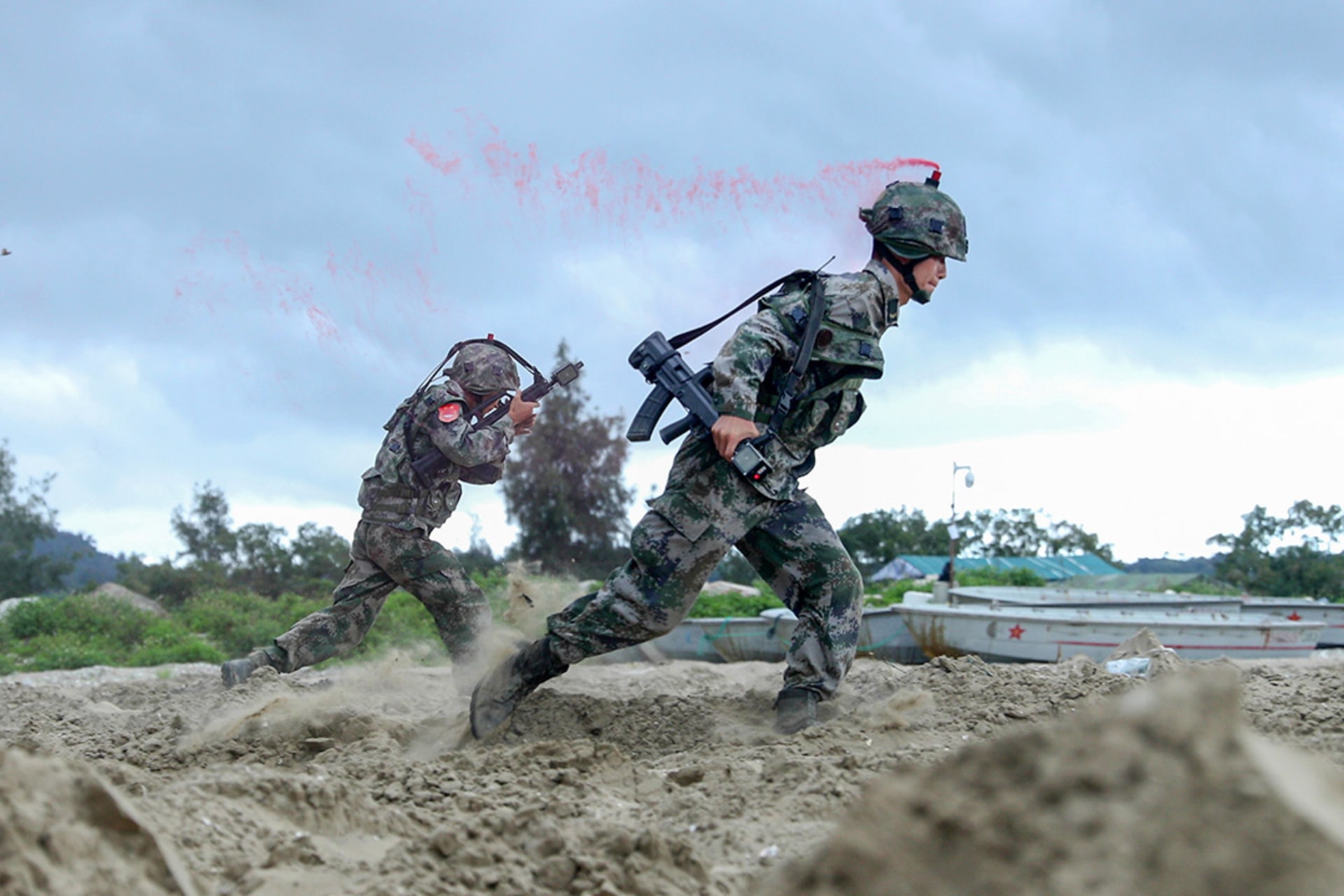
Two soldiers run through sand.
The PLA Navy and the PLA Army conduct a cross-day and all-factor live-fire red-blue confrontation drill in Zhangzhou City, Fujian Province, China, on August 24, 2022.
CFOTO/Future Publishing via Getty Images
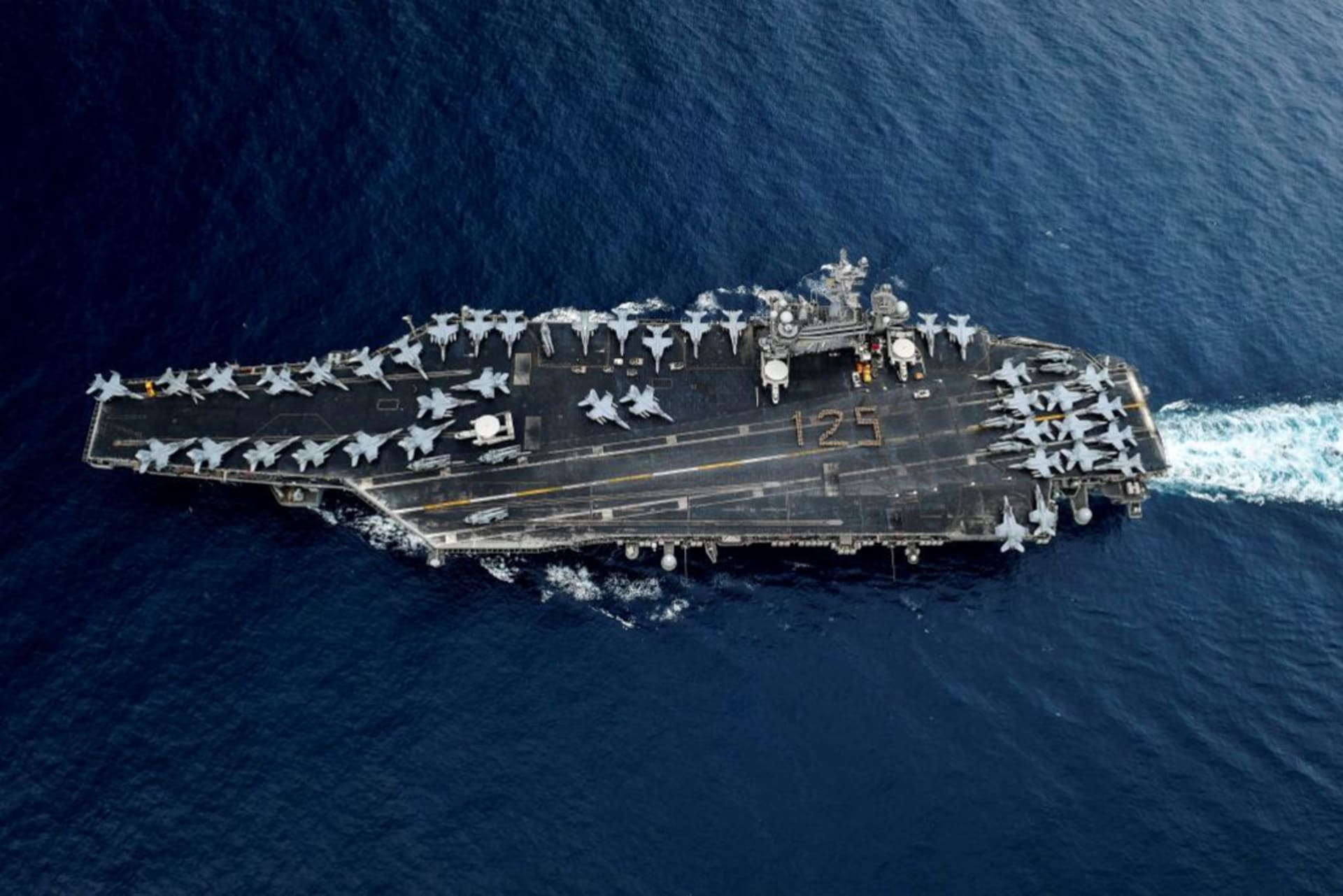
Large naval vessel moves through Taiwan Strait.
Legend-class U.S. Coast Guard National Security Cutter Munro transits the Taiwan Strait during a routine transit with Arleigh-burke class guided-missile destroyer USS Kidd on August 27, 2021
Kaylianna Genier/U.S. 7th Fleet Public Affairs
Tanks move on beach
The PLA Navy and the PLA Army conduct a cross-day and all-factor live-fire red-blue confrontation drill in Zhangzhou City, Fujian Province, China, on August 24, 2022.
CFOTO/Future Publishing via Getty Images
Amphibious vehicles land on beach.
Amphibious armoured vehicles under Chinese People's Liberation Army (PLA) Eastern Theatre Command take part in an assault wave formation training exercise in Zhangzhou, Fujian Province, China, on August 14, 2022.
CNS Photo via Reuters
Tank shoots missile in front of mountain.
The PLA Navy and the PLA Army conduct a cross-day and all-factor live-fire red-blue confrontation drill in Zhangzhou City, Fujian Province, China, on August 24, 2022.
CFOTO/Future Publishing via Getty Images

Background  

Taiwan’s disputed status is a direct result of the Chinese Civil War, in which the defeated Nationalist (Kuomintang) government fled the mainland and moved its government to the island in 1949. While the People’s Republic of China (PRC) has never exercised control over Taiwan, it claims that the island is an inalienable part of China that must be “reunified” with the mainland. In a 2022 white paper, the PRC said the resolution of the Taiwan question is “indispensable for the realization of China’s rejuvenation” and a “historic mission” of the Chinese Communist Party. The PRC has a stated preference for seeking reunification through peaceful means but reserves the right to use force to achieve its aims. 

Taiwan’s main political parties, the Democratic Progressive Party (DPP) and the Kuomintang (KMT), hold differing views regarding Taiwan’s relationship with mainland China. President Ma Ying-jeou of the KMT (2008–16) championed the “1992 Consensus,” in which both Taiwan and the PRC agreed that there is only one China—while differing on what “China” means. This (non-consensus) consensus allowed for cross-strait relations to expand and deepen, but led to criticism in Taiwan, as many Taiwanese feared that growing interdependence would limit Taiwan’s choices in the future. Taiwan’s previous president, Tsai Ing-wen of the DPP, declined to endorse the 1992 Consensus. As a result, the PRC cut off official communication in 2016 and has sought to punish Tsai through economic sanctions, diplomatic pressure, and heightened military activities.  

While the DPP is seen as the “pro-independence” party, President Tsai stated that there was no need for Taiwan to declare independence because it is already an independent country. In the wake of the PRC’s crackdown on democracy in Hong Kong, Taiwan’s electorate has grown more skeptical of closer ties with the mainland, leading the “pro-China” KMT to struggle at the ballot box. In addition, a 2022 poll from the National Chengchi University in Taipei suggests a growing sense of Taiwanese national identity among the population and an increase in support for Taiwan’s eventual independence. 

The ongoing dispute has led to heightened military confrontation in the Taiwan Strait, which geographically separates mainland China from the island of Taiwan. In the First Taiwan Strait Crisis of 1954–55, the PRC shelled the Kinmen and Matsu islands, situated close to the mainland, in an unsuccessful attempt to deter the United States from signing a mutual defense treaty with the Nationalist government. Following the First Taiwan Strait Crisis, Taipei and Beijing reached a tacit understanding of a “median line,” also called the center line, to guide rules of engagement and prevent miscalculation in the Taiwan Strait. The PRC repeated its artillery bombardment of Kinmen in 1958 during the Second Taiwan Strait Crisis. In response, the United States drew up plans for a nuclear strike on mainland China, demonstrating the Dwight Eisenhower administration’s Cold War commitment to Taiwan. The PRC fired live ammunition and missiles into Taiwan’s waters during the Third Taiwan Strait Crisis of 1995–96 to express disapproval of Taiwanese President Lee Teng-hui’s visit to the United States. 

In 1979, the United States abrogated the mutual defense treaty it had with Taiwan since 1954 and transferred its official diplomatic recognition from Taipei to Beijing. At that time, it acknowledged (but did not endorse) the PRC’s position that there is one China, and that Taiwan is a part of China. Rather, U.S. policy is to not take a position on Taiwan’s sovereignty and regard its ultimate status as undetermined. Also in 1979, President Jimmy Carter signed into law the Taiwan Relations Act (TRA), which commits the United States to “make available to Taiwan such defense articles and defense services in such quantity as may be necessary to enable Taiwan to maintain a sufficient self-defense capability.” The TRA also obligates the United States to maintain the capacity “to resist any resort to force or other forms of coercion that would jeopardize the security, or social or economic system, of the people of Taiwan.” The TRA, however, does not obligate the United States to come to Taiwan’s defense, and for decades U.S. presidents have refused to say whether they would intervene on Taiwan’s behalf—a policy known as strategic ambiguity.  

Concerns  

Tensions between China and the United States over Taiwan amount to a classic security dilemma: both are taking actions they view as defensive that the opposing side views as escalatory. A potential conflict between China and Taiwan has significant implications for U.S. security interests, as the United States would need to balance its desire to support Taiwan against the risks of a broader war with China. The United States has objected to China’s efforts to isolate Taiwan, which include blocking its participation in international organizations, interfering in its elections, pressuring Taiwanese firms to oppose independence, and sanctioning its industries.  

Military activities near Taiwan have grown significantly in recent years. China is developing the military capabilities of the People’s Liberation Army (PLA)—the U.S. Department of Defense’s 2021 Military Power Report highlighted China’s prioritization of “joint long-range precision strikes across domains, increasingly sophisticated space, counterspace, and cyber capabilities, and accelerating the large-scale expansion of its nuclear forces.” Moreover, China has integrated emerging technology into its military strategy through an approach known as “intelligentized” warfare. The Department of Defense’s aforementioned report notes China seeks to dominate technologies associated with the “Fourth Industrial Revolution,” such as artificial intelligence and quantum computing. The PRC increasingly sends aircraft into Taiwan’s Air Defense Identification Zone as a show of force, and in 2020, Taiwan reported a Chinese cyberattack on ten government agencies to steal information. As the military balance in the Taiwan Strait has deteriorated, competition between the United States and China has intensified, and the prospect of China using force against Taiwan has risen. In an attempt to ensure Taiwan has the ability to defend itself and in response to a growing military gap, the Donald Trump administration sold more than $18 billion in arms to Taiwan, and in 2020 the State Department eliminated long-standing restrictions on U.S. diplomatic engagement with Taiwanese officials. Moreover, officials now acknowledge that a small but expanding contingent of Marines has been secretly training Taiwan’s forces since at least 2021.

Taiwan is the leading global producer of advanced semiconductors. Taiwan Semiconductor Manufacturing Company produces 65 percent of the world’s semiconductors and 90 percent of the most advanced chips. If conflict between China and Taiwan were to break out, global supply chains would be severely disrupted to the detriment of U.S. interests. Speaking in 2022 alongside MI5 General Director Ken McCallum in London, FBI Director Christopher Wray warned that an invasion of Taiwan would “represent one of the most horrific business disruptions the world has ever seen,” as a potential sanctions regime against China would harm the global economy “at a much larger scale” than the current sanctions response to Russia’s invasion of Ukraine. Bloomberg reports that the U.S. National Security Council anticipates that a Chinese attack and the corresponding loss of the Taiwan Semiconductor Manufacturing Company would cause a $1 trillion disruption to the global economy. 

A potential conflict in the Taiwan Strait also has implications for the territorial dispute between China and Japan in the East China Sea. The PRC views the Senkaku/Diaoyu Islands as a part of “Taiwan province” and may seek to take the islands during a conflict. If the PLA Navy were to occupy Taiwan, the Council on Foreign Relations’ David Sacks argues that Japan would struggle to defend its westernmost islands, as well as the Senkaku/Diaoyu Islands, and even Okinawa. During its August 2022 military exercise aimed at Taiwan, China launched ballistic missiles over Taiwan that landed in Japan’s exclusive economic zone, in an attempt to warn Japan not to get involved during a Taiwan conflict. The late Japanese Prime Minister Abe Shinzo stated that Japan and the United States could not stand by if China invaded Taiwan. Current Japanese Prime Minister Kishida Fumio has pledged to double Japan’s defense spending in response to the tense security climate. Taiwan’s and Japan’s islands form a crucial link in the so-called first island chain; if China were to take these islands, it would constrain U.S. naval movements and its ability to contain China in potential future conflicts.

Recent Developments  

In response to China’s growing assertiveness toward Taiwan, the Joe Biden administration has maintained many aspects of the Trump administration’s approach. In a seeming departure from strategic ambiguity, President Biden remarked in May 2022 that the United States had a commitment to come to Taiwan’s defense, if necessary, and that his administration would uphold that commitment. While the White House denied any formal change in U.S. policy, the president’s remarks reflected a move toward “strategic clarity,” a policy of explicit commitment to defending Taiwan against the use of force by the PRC, rather than strategic ambiguity. President Biden has made at least three similar statements since 2021. Beijing, on the other hand, has accused Washington of breaching its sovereignty and abandoning its One China policy [PDF].  

In a further demonstration of support for Taiwan, U.S. Speaker of the House Nancy Pelosi (D-CA) visited Taipei in early August 2022 and met with President Tsai Ing-wen and democracy and human rights activists. Speaker Pelosi’s visit to Taiwan provoked severe condemnation from PRC officials. The PLA launched a four-day military drill and surrounded Taiwan, simulating a blockade. The live-fire exercises were more extensive than those performed during the Third Taiwan Strait Crisis. Chinese military aircraft crossed the median line over three hundred times during the demonstration and continue to cross it on a near-daily basis, effectively erasing the status quo. The PRC applied additional pressure through sanctions, halted exports, and, allegedly, cyberattacks.

After Pelosi’s visit, several other U.S. delegations visited Taiwan, and President Tsai met with Pelosi’s successor as U.S. Speaker of the House, Kevin McCarthy, on a stopover in the United States. Meanwhile, China has intensified threatening air maneuvers, flying more frequently and closer to Taiwan, and Chinese warships have increasingly joined in the movements.

U.S.-Taiwan Tech Talks
January 27, 2026

Senior U.S. and Taiwanese officials held talks on economic cooperation in Washington focusing on the tech sector; the meeting was the sixth edition of an annual U.S.-Taiwan dialogue launched in 2020 (State). Taiwan’s diplomatic office in the United States endorsed the so-called Pax Silica, a Trump administration effort to ensure joint access to chip and artificial intelligence materials (Focus Taiwan).

Chinese Military Purge
January 24, 2026

China’s top general was put under investigation for “serious violations of discipline and law,” its defense ministry said, in an apparent extension of a purge within the senior ranks of the military; only one of the six generals that President Xi Jinping appointed to the country’s top military commission in 2022 has so far avoided removal (NYT).

Journalist Detained in Taiwan
January 18, 2026

A journalist was detained on suspicion of bribing army officers to obtain military information allegedly passed to individuals in mainland China; his detention comes as Taiwan intensifies efforts to curb infiltration from Beijing (AP).

New Trade and Technology Agreement Between U.S. and Taiwan
January 15, 2026

A new bilateral trade agreement will see Taiwan invest $250 billion in U.S. chip and technology manufacturing, while the United States lowers its base tariff on Taiwanese goods from 20 to 15 percent; under the deal announced by the U.S. Commerce Department, Taiwan will also guarantee at least $250 billion in credit to Taiwanese businesses for their growth in the United States (Commerce). Much of today’s global chip wafer production is based in Taiwan, where some officials argue that its status as a global chipmaking hub serves as an incentive for partners to defend the island against China’s threats (CFR).

Taiwan’s Tech Exports
January 10, 2026

According to new data. Taiwan’s exports to the United States surpassed those to China last year for the first time in twenty-six years, driven by U.S. demand for high-tech products related to artificial intelligence systems (Nikkei).  Taiwan is currently negotiating to reduce a 20 percent U.S. tariff on its exports; semiconductors are already excluded from that levy (Reuters).

U.S. Arms Package for Taiwan
December 17, 2025

The Trump administration has notified Congress of its intent to sell Washington’s largest-ever arms package to Taiwan at an estimated value of $11.1 billion, Taiwan’s defense ministry said; the sale includes rocket systems and anti-tank missiles (Reuters). The Department of Defense said the sale helps Taiwan maintain a “credible defensive capability” (Defense Security Cooperation Agency).

Joint U.S.-Japanese Military Exercise
December 11, 2025

Two U.S. B-52 bombers flew with Japanese F-35 and F-15 fighters over the Sea of Japan in a display of combined readiness following recent Chinese and Russian bomber operations near Japan and South Korea (Reuters). When asked about tensions between the two countries, the White House press secretary said Trump believes the United States should maintain its positive relationships with both China and Japan (White House).

United States Backs Japan Over China Radar Incident
December 10, 2025

Washington publicly criticized China for directing targeting radars at Japanese military aircraft during recent drills near Okinawa, calling the move destabilizing and reaffirming its commitment to Japan’s security (Bloomberg). Japan’s defense minister also denied Chinese reports that Japanese forces turned their radar on Chinese aircraft during the incident (Reuters).

Joint Chinese-Russian Patrol Near Japanese Waters
December 9, 2025

Japan dispatched fighter aircraft after Russian Tu-95 bombers and Chinese H-6 bombers carried out a coordinated long-range patrol near its airspace; the operation, which Tokyo called a deliberate show of force amid its escalating tensions with Beijing, followed a similar Chinese-Russian exercise that penetrated South Korea’s air defense zone earlier this week (Reuters).

China Warns Washington Over New U.S. National Security Strategy
December 8, 2025

China condemned “external interference” after the U.S. strategy outlined plans to bolster regional military power to deter conflict with Beijing over Taiwan; Taiwan welcomed the strategy (Reuters).

NDAA Funds for Taiwan
December 7, 2025

The updated draft of the National Defense Authorization Act allocates up to $1 billion for Taiwan-related security cooperation, including expanded Coast Guard training and joint maritime planning (U.S. House of Representatives).

Chinese Warplanes Turn Radar at Japanese Aircraft
December 6, 2025

The incident occurred near the Okinawa islands, marking the most serious Sino-Japanese military confrontation in years and prompting condemnations from Tokyo; China claimed the move was a response to a Japanese disruption of carrier-based drills (Bloomberg). Chinese Foreign Minister Wang Yi later told his German counterpart that Tokyo was threatening Beijing through a “completely unacceptable” policy stance (Reuters).

Taiwan and Japan Warn of Expanding Chinese Activity
December 5, 2025

The warnings, which the president of Taiwan and the Japanese Defense Ministry separately issued, came after Reuters revealed documents showing that China has rapidly expanded its naval and coast guard vessel deployments across multiple East Asian waterways; the warnings suggested that the deployments heighten regional security risks (Reuters).

China’s Maritime Show of Force
December 4, 2025

More than ninety Chinese naval and coast guard vessels are currently positioned across East Asian waters, marking one of Beijing’s largest maritime deployments to date, per intelligence reports; the buildup comes amid tensions with Japan over Taiwan and follows Taiwan’s announcement of increased defense spending, though officials said the activity so far reflects large-scale seasonal exercises rather than imminent action (Reuters). Separately, while the Trump administration’s new national security strategy commits to keeping the Indo-Pacific free and open, it also calls on Pacific allies such as Japan and South Korea to play a larger role in making that happen; it notes that “deterring a conflict over Taiwan, ideally by preserving military overmatch, is a priority” and reiterates the current U.S. policy of rejecting “any unilateral change to the status quo in the Taiwan Strait” (White House).

New Law on Assuring Taiwan
December 3, 2025

Taiwan’s presidential office thanked the United States today for signing the Taiwan Assurance Implementation Act into law, saying it “supports closer Taiwan-U.S. relations;” the law requires the U.S. State Department to regularly review and update its guidance on official interactions with Taipei (Office of the President; White House). A Chinese foreign ministry spokesperson urged the United States to “stop all official interactions” with Taiwan (Reuters). Separately, a senior Taiwanese official said Chinese forces often practice attack scenarios against foreign naval vessels transiting the Taiwan Strait, as multiple Western navies continue freedom-of-navigation sailings, drawing condemnation from Beijing (Reuters).

China-Japan Sea Confrontation
December 2, 2025

Japan’s Coast Guard said it intercepted and expelled two Chinese Coast Guard ships near the disputed Senkaku Islands earlier today, which both Japan and China lay claim to; China gave a conflicting report, saying that it expelled a Japanese fishing vessel in the same region (Reuters).

Trump-Takaichi Call
November 27, 2025

U.S. President Donald Trump urged Japan’s prime minister to avoid further inflaming a dispute with Beijing over remarks linking Taiwan’s security to Japan’s defense posture; the intervention comes as Washington balances its alliance with Tokyo against efforts to preserve a trade détente with China (Reuters). Beijing today reiterated its warnings to Tokyo over potential Japanese intervention in a Taiwan conflict (Xinhua). In Taipei, Taiwanese President Lai Ching-te announced a proposal for massive multiyear increases in military spending, including major U.S. arms purchases and investments in domestic weapons production; the proposal drew sharp criticism from Beijing and mixed reactions at home, as it awaits legislative approval (WaPo). Separately, Reuters reported that New Zealand’s largest naval vessel transited the Taiwan Strait earlier this month, a move Wellington said was consistent with international maritime law; Chinese ships and aircraft monitored the voyage (Reuters).

China Repeats Warnings on Foreign Intervention in Taiwan
November 26, 2025

Beijing declared it would “crush” any outside involvement, reiterating its condemnation of Japanese plans to station missiles near the island (Reuters).

Japan’s Planned Missile Deployment Near Taiwan
November 24, 2025

The Japanese government is moving forward with a plan to station a new missile unit on Yonaguni Island, prompting Beijing to accuse Tokyo of heightening regional tensions; Japanese officials say the deployment is intended to protect national territory, while Taipei argues the additional defenses support stability in the Taiwan Strait (Reuters). Meanwhile, U.S. President Trump spoke separately with Chinese President Xi Jinping today; Chinese state media reported that on the call, Xi stressed a desire for “Taiwan’s return to China” and that Trump had conveyed his understanding of the importance of the Taiwan question (Xinhua). Summaries of the conversation from Trump and the White House press secretary did not mention Taiwan, with the latter saying most of the conversation focused on trade issues (Truth Social; Sky News). Japanese Prime Minister Takaichi Sanae—whom Trump called hours after speaking with Xi—said the two leaders discussed how to approach challenges facing the Indo-Pacific region (FT)

U.S.-China Maritime Security Talks
November 22, 2025

Military delegations from both countries met in Hawaii for several days of candid discussions on regional air and maritime risks as part of their revived Military Maritime Consultative Agreement dialogue; Beijing used the talks to object to U.S. naval transits in the Taiwan Strait and South China Sea (Reuters). Separately, Beijing submitted a letter to the UN warning it would invoke its right to self-defense if Japan intervened in a future Taiwan conflict, following comments by Prime Minister Sanae Takaichi about potential military action; Japan dismissed the accusations as unacceptable, as the diplomatic rift continues to worsen (Politico).

China Says Trade Ties With Japan Damaged
November 21, 2025

Beijing again pushed Japanese Prime Minister Sanae Takaichi to retract comments suggesting Tokyo could respond militarily to a Chinese attack on Taiwan, warning of unspecified countermeasures and suggesting that commercial ties have been “severely damaged,” though Japanese officials stood by existing policy and U.S. diplomats reiterated support for Tokyo (Reuters).

Chinese Pressure Over Planned Panamanian Trip to Taiwan
November 19, 2025

Panama’s foreign ministry accused China of improper interference after the Chinese Embassy urged ten legislators to cancel a planned visit to Taiwan, prompting rebukes from both Panamanian and U.S. officials (AP).

Senior Chinese and Japanese Diplomats Meet to Diffuse Tensions
November 18, 2025

The rise in tensions was sparked by Japanese Prime Minister Takaichi Sanae’s comment last month that a Chinese attack on Taiwan could trigger a Japanese military response (Reuters). Many Chinese travelers cancelled flights to Japan in recent days, while Japan warned its citizens in China to increase safety precautions (Guardian). Meanwhile, Washington authorized a $698 million purchase of NASAMS air-defense units, its second major arms package for Taipei in a week, bringing total sales to $1 billion (Al Jazeera).

Japan Seeks To Defuse China Tension
November 17, 2025

Japan dispatched a senior foreign ministry official to Beijing to reassure Chinese counterparts that its security posture has not shifted, following escalating bilateral clashes; despite the de-escalatory move, some regional analysts warned the dispute may linger for months (Reuters).

China-Japan Tensions Over Taiwan
November 16, 2025

In response to rising tensions with Japan, China deployed its coast guard to patrol islands both countries claim; Beijing also warned citizens against traveling to Japan and cautioned Chinese students in Japan about alleged safety risks (NYT). The countries have traded verbal warnings since Japanese Prime Minister Takaichi Sanae said a Chinese attack on Taiwan could trigger a Japanese military response (Reuters). Meanwhile, in Taiwan, authorities announced they would deliver nearly ten million updated emergency handbooks to households this week, detailing instructions for crises ranging from natural disasters to an invasion by hostile forces, amid intensified Chinese coercion towards the island (Reuters).

China-Japan Tensions
November 12, 2025

Chinese state media continued condemnations of Japanese Prime Minister Sanae Takaichi for suggesting Japan would consider responding militarily to a Chinese attack on Taiwan; the backlash followed a threatening statement from China’s consul general in Osaka, prompting Tokyo to lodge a formal protest and some Japanese lawmakers to urge his expulsion (Reuters). Meanwhile, Takaichi refused to confirm whether she would abide by Japan’s long-standing non-nuclear principles in a forthcoming national security strategy update, as she considers the possibility of allowing U.S. nuclear weapons to enter Japan; many ruling-party lawmakers are urging such deterrence measures amid China’s growing nuclear arsenal (Reuters).

China Commissions Third Aircraft Carrier
November 7, 2025

The Fujian, Beijing’s first domestically designed carrier equipped with electromagnetic catapults, marks a significant step in Chinese President Xi Jinping’s plan to build a “world-class” navy by mid-century; military analysts say the carrier enhances China’s ability to project power into the Pacific, though its conventional propulsion still limits range compared to U.S. nuclear-powered fleets (AP). Separately, in a conference address to members of the European Parliament, Taiwanese Vice President Bi-Khim Hsiao called on European lawmakers to deepen trade and security ties with Taiwan, warning that stability in the Taiwan Strait is vital to global security; she also urged the European Union to build technology supply chains with Taipei despite Beijing’s opposition (AP). Meanwhile, Japanese Prime Minister Takaichi Sanae said that an attack on Taiwan would be a “survival-threatening situation” that could trigger the use of Japanese force (WaPo). Her public comments broke with a general pattern of previous Japanese leaders discussing such contingencies for Taiwan in private (Nikkei). China’s consul general in Japan wrote and then deleted a social media post threatening to “cut off that dirty neck that has been lunged at us,” prompting outcry from Tokyo; China’s foreign ministry disavowed the consul general’s language but noted that it also took issue with Takaichi’s comments (Newsweek).

U.S. Officials Urge Equal Taiwanese Participation at Next Year’s APEC Summit
November 6, 2025

The State Department pushed this demand after Taipei accused Beijing of imposing new conditions on its participation in the event, which will be held in Shenzhen, as Chinese officials insisted Taiwan must follow the “One China” principle (Reuters). Meanwhile, in Taipei, Fiji’s UN ambassador met with Vice President Hsiao Bi-khim and Foreign Minister Lin Chia-lung, prompting Beijing to lodge a diplomatic protest against Fiji (Fiji Times). While Taiwan maintains de facto ties in the Pacific, the move is highly unusual given Fiji’s “One China” policy (Reuters).

Tsai Ing-wen to Visit Germany
November 5, 2025

Former Taiwan President Tsai Ing-wen will speak at a Berlin conference next week, as part of a broader effort to expand Taiwanese ties with Europe, even as the German Foreign Ministry suggested that the trip was not an official government visit from Taipei (Reuters).

China Reaffirms ‘Red Lines’ After Xi-Trump Meeting
November 4, 2025

China’s Ambassador to the United States Xie Feng demanded Washington steer clear of four policy areas, namely Taiwan, human rights, China’s domestic political system, and its development model, warning that crossing them could destabilize bilateral ties; Xie added that both sides must implement commitments made during last week’s Xi-Trump meeting in South Korea, which eased tariff tensions and paused new export controls (CNN). Meanwhile, Beijing refuted Taiwanese safety concerns about the location of next year’s Asia Pacific Economic Cooperation meeting in Shenzhen, insisting Taiwan can attend if it adheres to the “one China” framework (Reuters).