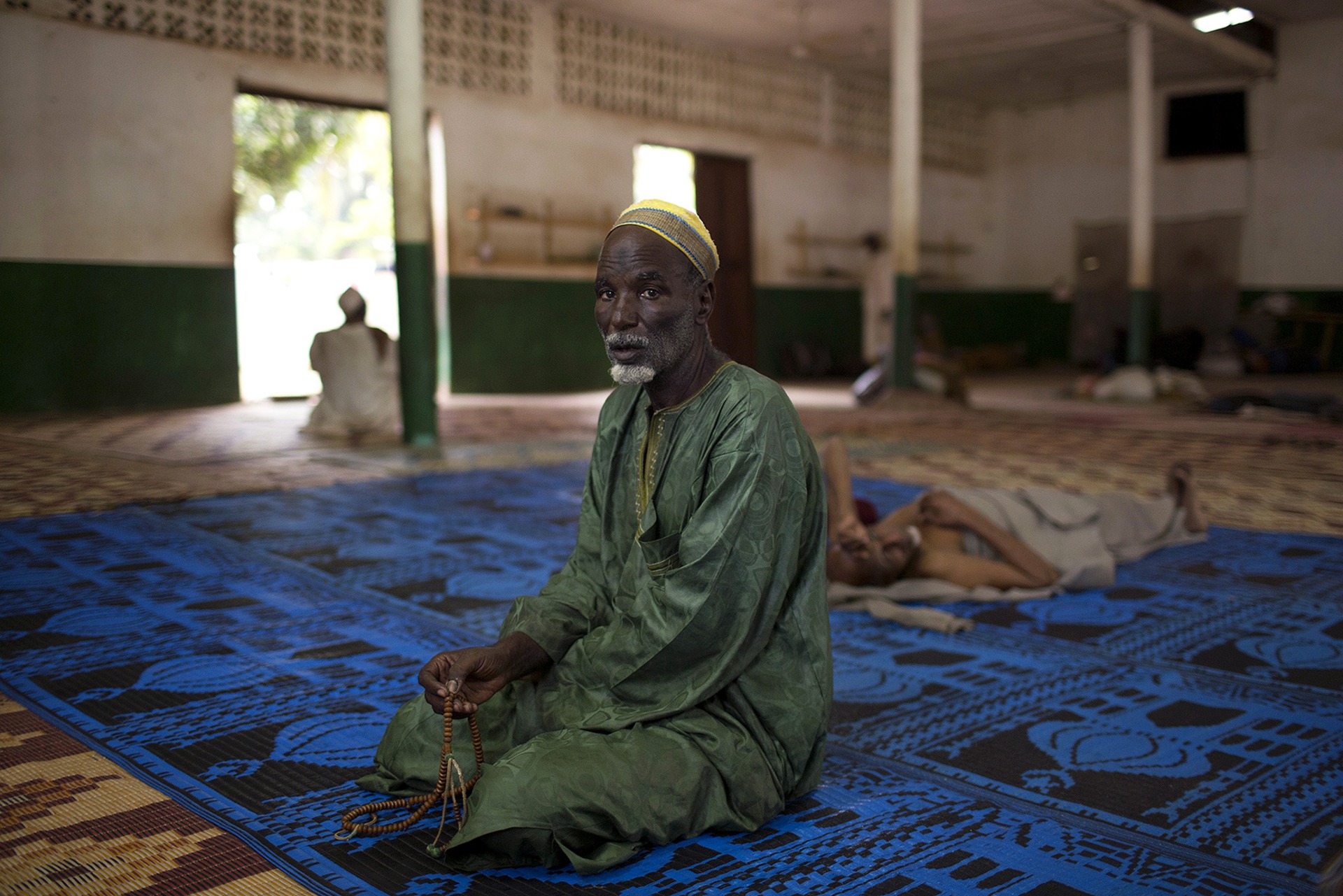
A man prays in a mosque near Kilometer 12 (PK12) where internally displaced Muslims are stranded due to ongoing sectarian violence in the capital of Bangui, Central African Republic on March 19, 2014.Siegfried Modola/Reuters
TYPE
Political Instability
IMPACT ON U.S.
Low
STATUS
Unchanging
Related
Central African Republic
Updated August 3, 2026
RelatedCentral African Republic
Updated August 3, 2026
Overview
Armed conflict between Muslim Séléka factions and Christian militias has destabilized the Central African Republic (CAR) since 2013, leaving much of the country outside government control. Russia’s Africa Corps has since propped up President Touadéra’s government in exchange for mineral concessions, deepening CAR’s dependence on Moscow as Western partners have distanced themselves. The UN peacekeeping mission has begun withdrawing from some bases, though armed groups still hold substantial territory.
A man prays in a mosque near Kilometer 12 (PK12) where internally displaced Muslims are stranded due to ongoing sectarian violence in the capital of Bangui, Central African Republic on March 19, 2014.Siegfried Modola/Reuters
In a briefing to the UN Security Council, UN Special Representative Valentine Rugwabiza cautioned against a premature withdrawal of the Central African Republic’s UN peacekeeping mission (MINUSCA), warning that violence was rising in the country’s east due to conflict in neighboring Sudan (UN News).
Wagner Group Heir Commands Russian Forces in CAR
The Wall Street Journal has reported that Pavel Prigozhin, the son of Yevgeny Prigozhin, inherited Wagner’s Africa operations after his father’s 2023 death; he commands roughly five hundred mercenaries from Bangui who guard President Faustin-Archange Touadéra and have been integrated into CAR’s police, army, and intelligence services (WSJ).
ICC Convicts Former Central African Republic Militia Leader
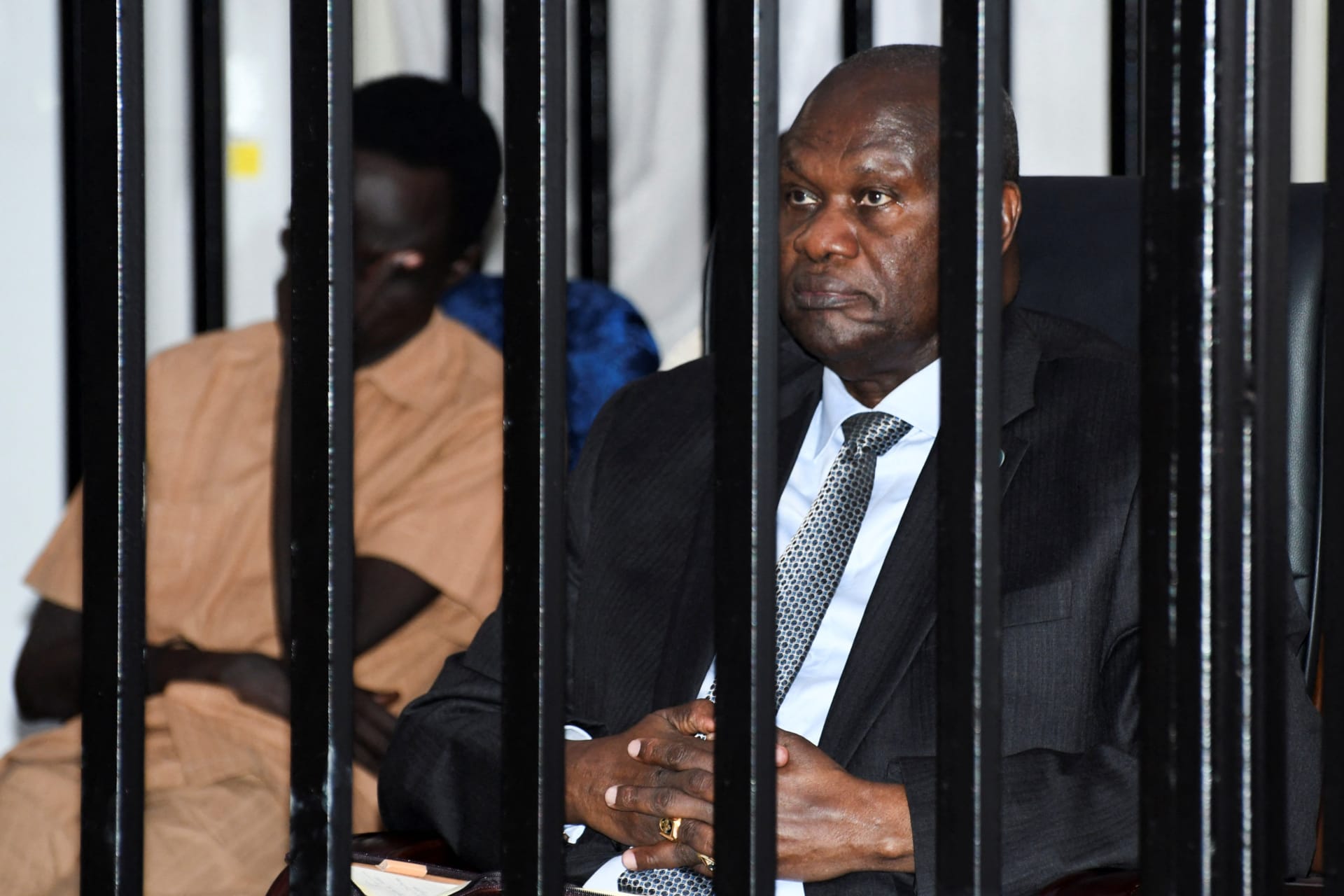
The International Criminal Court convicted Mahamat Said Abdel Kani of carrying out crimes against humanity, including torture, at a detention center during the armed conflict between Muslim Séléka factions and Christian militias (AP).
Gradual Recovery in Am-Dafok After Border Attack, MINUSCA Reports
The UN mission in CAR said more than five thousand displaced residents of Am-Dafok, on the Sudan border, have returned home after a June 30 attack by armed groups killed twenty-nine people and displaced more than seventeen thousand (UN Press).
Gunman Kills Soldier and Swiss National
Unidentified gunmen killed a Central African Armed Forces soldier and a Swiss national who had reportedly been conducting a gold prospecting mission around fifty kilometers north of Bangui, a region plagued by banditry and armed violence (RFI).
Background
Since the 2003 coup carried out by François Bozizé, much of CAR, especially the northern areas, has been controlled by rebels. In 2004, the government launched a war against the Union of Democratic Forces for Unity (UFDR). Despite efforts to achieve peace and disarmament, instability and attacks persisted. As the war came to a close, an insurgency led by the Seleka (or “alliance” in Sango) launched an offensive against the CAR government in December 2012. Seleka quickly took the north and center of the country before seizing the capital city of Bangui and staging a coup in March 2013. Michel Djotodia, the rebel leader, became president and attempted to dissolve the Seleka forces, but not all of the fighters complied.
In response to brutality by Seleka forces, “anti-balaka” (meaning “invincible” in Sango) coalitions of Christian fighters formed to carry out reprisal violence against Seleka fighters, adding an element of religious animosity to the violence. In September 2013, anti-balaka forces began committing widespread revenge attacks against mostly Muslim civilians, displacing tens of thousands of people to Seleka-controlled northern areas. Despite having officially disbanded, many ex-Seleka members launched counterattacks, plunging CAR into a chaotic state of violence and a humanitarian crisis. Since the outbreak of renewed conflict in 2013, thousands of people have been killed and the number of refugees has reached 750,000, the majority of whom have fled to neighboring Cameroon and the Democratic Republic of Congo, while an additional 500,000 have been internally displaced.
Despite optimism after the election of President Faustin Archange Touadera in the spring of 2016, the crisis only intensified. A de facto territorial partition led to a pause in Muslim-Christian fighting, but fighting between factions of the ex-Seleka grew. Though the government maintained control of Bangui, most armed groups boycotted President Touadera’s attempts to calm the region through disarmament, leaving the government powerless outside the capital. Lawlessness in the rest of the country allowed armed groups to thrive and fighting increased in the central, western, and eastern provinces. The conflict has also wreaked havoc on the economy, crippling the private sector and leaving nearly 75 percent of the country’s population in poverty.
In 2017, fighting intensified, forcing aid agencies to pull out and prompting MINUSCA, the UN peacekeeping mission, to boost its troop numbers. A peace agreement signed in June 2017 between the government and thirteen of the fourteen main armed factions had little effect, and ex-Seleka and anti-balaka militias, along with hundreds of other localized groups, operate openly and control much of CAR’s territory.
In July 2018, MINUSCA and government security forces launched an operation to disarm a militia group in Bangui’s PK5 neighborhood, a predominantly Muslim enclave in the majority-Christian city. After rumors spread that the peacekeepers intended to disarm all Muslims, leaving them vulnerable to attacks by armed Christian groups, heavy clashes broke out, and violence spread outside of PK5 as both ex-Seleka and anti-balaka militias carried out reprisal attacks. Ex-Seleka leaders then met in northern CAR and threatened to attack the capital, prompting MINUSCA to enhance security around the city. From 2018 to 2020, sporadic clashes occurred between the government and increasingly fragmented armed groups, and militants continued targeting civilians, particularly at places of worship. In February 2019, the government and fourteen armed groups signed a peace agreement, but most of its tenets have not been implemented. Reports by human rights groups and UN agencies suggest that violence committed by both ex-Seleka forces and anti-balaka groups amount to war crimes and crimes against humanity.
Due to the scale of the crisis, the UN Security Council established a peacekeeping force in April 2014 that incorporated African Union and French forces that had previously deployed to CAR. MINUSCA was established with a mandate to protect civilians and disarm militia groups, and it currently has more than eighteen thousand peacekeepers operating in CAR. In June 2024, the UN announced the deployment of additional MINUSCA troops to CAR’s war-torn southeast Haut Mbomou region to facilitate the delivery of humanitarian aid. MINUSCA faces significant challenges in fulfilling its mandate to protect civilians and dismantle armed groups, primarily due to a lack of infrastructure and reluctance to use military force. Numerous attacks have also been carried out against UN peacekeepers and humanitarian workers; 176 peacekeepers have been killed since the start of the mission.
Recent Developments
In late 2020, former President François Bozizé returned to the Central African Republic but was disqualified from running in the national election on account of his international arrest warrant. In opposition to the elections, six armed groups, including the ex-Seleka and anti-balaka, banded together to form the Patriots for Change (CPC), a united coalition to resist the government. Nonetheless, elections went forward as planned on December 27, and government and rebel groups clashed throughout the country. As a result, many polling places could not open, but Touadera claimed victory with 53 percent of the vote. However, the opposition contested the result, and the CPC attacked the capital on January 13, 2021.
Though the rebels advanced quickly toward Bangui, government forces managed to repel them with support from MINUSCA. Assistance from Rwandan soldiers and Wagner Group mercenaries then turned the tide decisively in the government’s favor. Taking a more aggressive approach than the UN forces, these fighters have helped the government retake much of the western part of the country. Since 2021, government-aligned forces have made slow progress, but rebels remain in control of many northern and eastern areas. The Wagner Group reportedly maintains around one thousand mercenaries in the country supporting government forces in exchange for access to gold and diamond mines, though its future is uncertain following the group’s failed mutiny in Russia. The UN says Wagner intimidates locals and has committed human rights violations.
In early 2023, CPC rebels launched a new wave of attacks with improved weaponry against the government, raising fears of a return to intense fighting. Meanwhile, some progress has been made in implementing the 2019 peace deal. In June 2023, the UN announced that two armed groups and three militant factions from a long-held rebel area disbanded. However, the challenges of disarmament and reintegration remain.
Furthermore, a July 2023 referendum denounced as a farce by the opposition removed presidential term limits, clearing the way for President Touadera, who has been in power since 2016, to run as many times as he wants. For the first time in thirty-five years, presidential elections are scheduled to be held in CAR in October 2024. Opposition figures and civil society groups have called for the postponement of elections due to the deteriorating security situation and over accusations that Touadera’s United Hearts Movement has rigged the election in its favor. MINUSCA has said its aim is to provide support with election preparations and will encourage the broad and safe participation of voters, particularly women.
CAR still faces a humanitarian crisis. In addition to the over one million displaced by violence, an estimated 5.6 percent of the population died in 2022, a rate twice as high as any other country. In June 2023, 3.4 million people needed assistance, worsened by flooding that affected more than 100,000 people. Over five thousand cases of gender-based violence were reported in the first quarter of 2023, and the UN has expelled some peacekeepers over allegations of sexual violence. The conflict in Sudan has caused an influx of over 31,000 refugees to CAR since April 2023, the majority of whom live in remote areas outside of the government’s control. Finally, the UN says aid workers have regularly faced violence, complicating efforts to provide services.
Key Actors
Government of the Central African Republic/President Faustin-Archange Touadéra
The ruling authority led by President Faustin-Archange Touadéra, who won a contested third term in the December 2025 elections after a 2023 constitutional referendum removed term limits, and who has consolidated power through close security partnerships with Russia and Rwanda while remaining deeply dependent on foreign forces to control territory outside of Bangui
Central African Armed Forces (FACA)
The national military with limited capacity to independently project force beyond the capital, operating in coordination with Africa Corps and Rwandan troops against rebel groups across the country
Coalition of Patriots for Change (CPC)
A rebel coalition formed in 2020 by six armed groups, including ex-Séléka and anti-balaka factions, under former President François Bozizé, that launched an assault on Bangui in January 2021 and continues to contest government control in northern and eastern areas of the country
Ex-Séléka Factions
A fragmented collection of predominantly Muslim armed groups descended from the Séléka coalition that seized Bangui in 2013, which continues to control territory in the north and east despite repeated peace agreements and partial disarmament efforts
Anti-Balaka Militias
Predominantly Christian self-defense militias formed in response to Séléka brutality in 2013, which have since evolved into largely predatory armed groups committing widespread atrocities against civilians
Wagner Group
A Russian private military company deployed in CAR from 2017 until its post-mutiny reorganization, playing a decisive role in repelling the 2021 rebel assault on Bangui and recapturing western territory in exchange for mineral concessions, while committing widespread human rights abuses against civilians
Russia/Africa Corps
The state-controlled successor to Wagner operating under direct Russian Ministry of Defense oversight, which assumed Wagner's security role in CAR and was formally consolidated following Touadéra's March 2026 visit to Putin, continuing to protect the government and conduct operations against rebel groups in exchange for mineral concessions
Rwanda
A significant bilateral security partner that has deployed approximately one thousand special forces to CAR since 2021, operating alongside FACA and Russia in exchange for agricultural land and mining rights
UN Multidimensional Integrated Stabilization Mission in the CAR (MINUSCA)
A UN peacekeeping mission with roughly fourteen thousand military personnel mandated to protect civilians and support disarmament, whose footprint is being gradually reduced amid budgetary constraints and the UN Security Council's direction to transfer security responsibilities back to Bangui
France
A historically dominant external actor whose influence has sharply declined as CAR has pivoted toward Russia