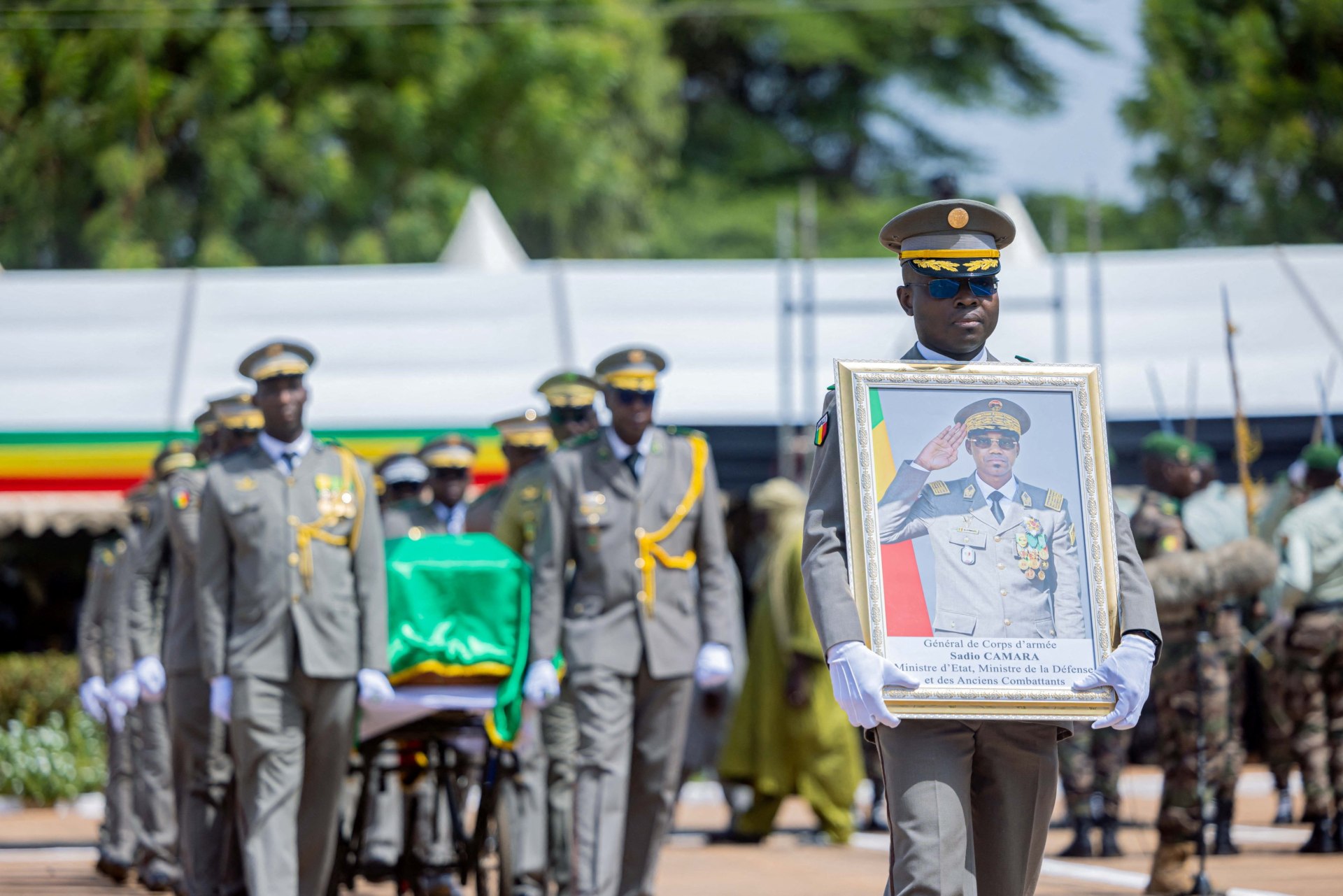
A framed portrait and the coffin of Malian Defence Minister Sadio Camara, who was killed in a militant attack, are displayed on the day of his state funeral, in Bamako, Mali, on April 30, 2026.Mali Presidency via Facebook /Handout via Reuters
TYPE
Political Instability
Terrorism
IMPACT ON U.S.
Low
STATUS
Worsening
Related
Burkina Faso
Chad
Mali
Niger
Nigeria
Updated October 14, 2026
RelatedBurkina Faso•Chad•Mali•Niger•Nigeria
Updated October 14, 2026
Overview
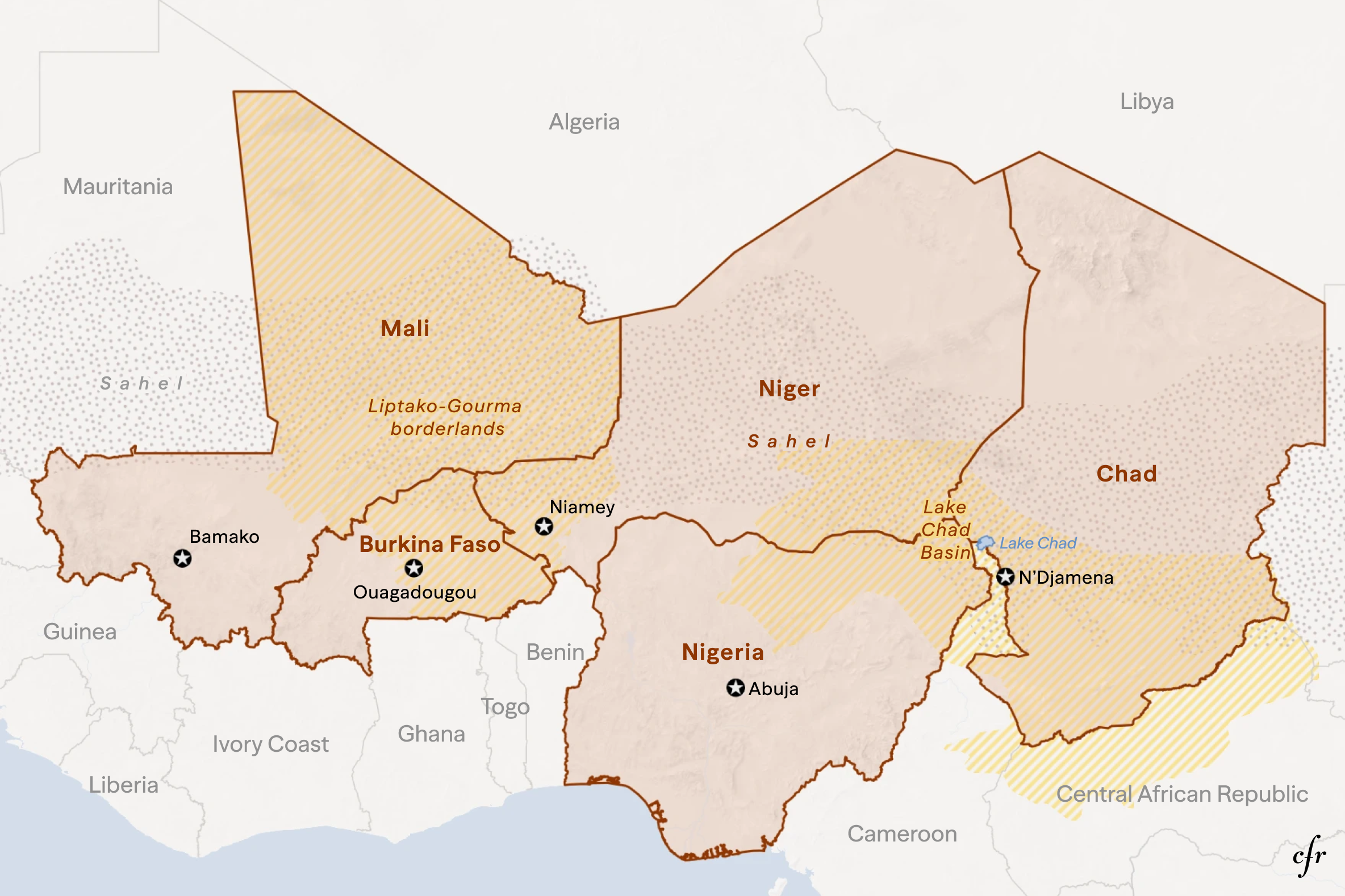
Weak governance, poverty, and climate stress have allowed jihadist groups to establish a foothold across the Sahel, with the Liptako-Gourma borderlands of Burkina Faso, Mali, and Niger now accounting for over half of global terrorism-related deaths. Military coups have severed Western security partnerships and invited Russian forces, whose retreat from northern Mali following jihadist and Tuareg attacks in 2026 has left governments exposed to an insurgency pushing southward into coastal West Africa.
A framed portrait and the coffin of Malian Defence Minister Sadio Camara, who was killed in a militant attack, are displayed on the day of his state funeral, in Bamako, Mali, on April 30, 2026.Mali Presidency via Facebook /Handout via Reuters
Malian Troops Reenter Kidal After Separatist Withdrawal
The Azawad Liberation Front (FLA) said it was carrying out a controlled pullout from the northern town of Kidal, citing airstrikes by Mali’s air force and its Russian allies, and Malian troops and Russian fighters moved back into the town after about six months of FLA control (Reuters).
Amnesty Accuses Malian Army and Russian Mercenaries of War Crimes
Amnesty International reported that Malian soldiers and Russia’s Wagner Group killed at least thirty-four civilians, most of them from Arab, Fulani, and Tuareg pastoralist communities, in seven incidents across the Mopti, Ségou, and Timbuktu regions between June 2023 and December 2025, and said the killings amounted to war crimes (Reuters).
JNIM Ambushes Government Troops, Africa Corps Soldiers in Central Mali
At least seven soldiers, including three or four Russians and some Malian troops, were killed when JNIM militants ambushed a convoy near Niono in Mali’s Ségou region, with reports differing slightly on the exact Russian death toll; a local official separately said four wounded Russian soldiers received first aid at a nearby health center before being airlifted out (Africa Insider).
JNIM Claims Strike on Air-Defense Systems, Russian Helicopters at Sévaré Airport
JNIM claimed to have struck air-defense systems and Russian helicopters at Sévaré airport on September 20, saying it killed thirty-three pro-government forces there and in nearby Konna, where Russia’s Africa Corps has been supporting Malian troops in combat (Reuters).
JNIM Attack on Dioura Killed More Than One Hundred Soldiers, AFP Reports
Agence France-Presse reported that JNIM’s September 10 attack on the Malian army camp at Dioura killed at least one hundred Malian soldiers and five Russian Africa Corps personnel, citing military, security, and local sources, with the garrison effectively ceasing to function as an organized fighting unit (African Security Analysis).
Background
Spanning the area from Senegal to Eritrea, situated between the Sahara to the north and the African tropics to the south, the Sahel region has long faced severe, complex security and humanitarian crises. Since gaining independence in the 1960s, many countries in the Sahel have experienced violent extremism due to the confluence of weak and illegitimate governance, economic decline, and the worsening effects of climate change. Violence, conflict, and crime have surged over the last decade, transcending national borders and posing significant challenges to countries both in and outside the region. The Sahel remains a principal transit point for migrants traveling from sub-Saharan Africa to northern coastal states and on to Europe. Further violence could exponentially increase the rate of displacement and migration from the region, compounding pressures on northern and coastal African states and Europe. The epicenters of violence and humanitarian disaster are in the Liptako-Gourma and Lake Chad Basin subregions.
Liptako-Gourma is in the central Sahel, in the borderlands of Burkina Faso, Mali, and Niger. Current instability is associated with the collapse of the Libyan state in 2011, which led to the proliferation of weapons and armed fighters in the region. The influx of extremists into northern Mali reignited the dormant Tuareg rebellion [PDF] in 2012, which had previously surfaced in 1963, 1990, and 2006. Representing only 10 percent of the Malian population, the Tuareg people, organized under the National Movement for the Liberation of Azawad (MNLA), sought an autonomous state and aligned themselves with multiple Islamist groups, including al-Qaeda in the Islamic Maghreb (AQIM), the Movement for Unity and Jihad in West Africa (MUJAO), and Ansar Dine to push government forces out of the north. Then-President Amadou Toumani Touré was deposed in a March 2012 coup by the army, which disapproved of the government’s failure to suppress the rebellion. The consequent collapse of state institutions in the north enabled the MNLA to capture the regional capitals of Gao, Kidal, and Timbuktu; the group had declared the independent state of Azawad [PDF] in northern Mali by April. The MNLA quickly split from al-Qaeda and other allied Islamist groups in June following their attempt to impose Islamic law and declare an Islamic caliphate over the northern territory.
After a period of relative calm, the crisis deteriorated in January 2013 as AQIM, MUJAO, and Ansar Dine pushed further south to capture Konna in central Mali. In August, Mali transitioned back to a civilian-led government under Ibrahim Boubacar Keïta, which later signed a peace agreement with a coalition of Tuareg independence groups including the MNLA in 2015. The coalition excluded Islamist organizations, which quickly took advantage of the agreement to expand their control, spreading further into central Mali and neighboring Burkina Faso and Niger. Liptako-Gourma has since become a hotbed for violent extremism in the Sahel.
Notable attacks targeting the Radisson Blu Hotel in Mali, the Splendid Hotel in Burkina Faso, and L’Etoule du Sud Hotel in Ivory Coast in 2015 and 2016 demonstrated the extent of the Islamist threat to the Sahel and West Africa. In September 2016, the Islamic State in the Greater Sahara (ISGS) surfaced in Burkina Faso, launching its first major attack on a border post near the Burkinabe city of Markoye. In 2017, several al-Qaeda affiliates merged to form Jama’at Nusrat al-Islam wal Muslimeen (JNIM). The emergence of ISGS and JNIM have intensified violence in the Sahel. Both JNIM and ISGS have pushed farther south in Liptako-Gourma, threatening the security of West Africa’s relatively stable coastal states. JNIM has more recently gained control over territory in northern and central Mali, while ISGS has been confined to northern Burkina Faso and western Niger due to clashes with JNIM that began in 2020.
Violent extremism in the Lake Chad Basin at the intersection of Cameroon, Chad, Niger, and Nigeria prevailed in the same period with the reemergence of Boko Haram in northern Nigeria. Founded by Muhammed Yusuf in northeastern Nigeria in 2002, Boko Haram was forced underground in 2009 after Nigerian police forces killed over seven hundred members, including Yusuf, during a raid that July. In June and August 2011, Boko Haram resurfaced, indicating its more expansive and aggressive strategy by launching suicide attacks [PDF] on police and the UN headquarters in Abuja, Nigeria. The group gained international notoriety following its abduction of 276 girls from the town of Chibok, Nigeria, giving rise to the global Bring Back Our Girls movement in April 2014.
In 2015, Boko Haram pledged allegiance to the self-proclaimed Islamic State and rebranded as the Islamic State in the West African Province (ISWAP). A splinter faction of the original Boko Haram was active until 2021, when ISWAP killed its leader, absorbed its territory, and relegated its members to remote islands in Lake Chad. ISWAP has since established control of northeastern Nigeria and parts of Niger.
Experts attribute the expansion of violent extremism in the Sahel to persistently weak governance, characterized by corruption, democratic backsliding, legitimacy deficits, and human rights violations. Many countries in the region share similar internal dynamics of inequality [PDF]—state power tends to be concentrated in southern, urban regions while rural, northern areas remain underdeveloped and ripe for exploitation by extremist groups. Thus, Sahel countries are consistently ranked high on the Fragile State Index, particularly Chad, Mali, and Nigeria. Frequent transfers of power are also a problem: Chad, Burkina Faso, Mali, Mauritania, and Niger experienced a combined twenty-five successful coups d’état between 1960 and 2022. Consecutive military coups in Mali in 2020 and 2021, resulting in Mali’s current interim government under a military junta, launched the region’s most recent so-called coup epidemic, which saw similar occurrences in Burkina Faso, Chad, and Niger.
The death of Chadian President Idriss Déby on April 20, 2021, created a leadership crisis in regional counterterrorism efforts. Under Déby, Chad and its military acted as a linchpin in regional security coalitions across both Liptako-Gourma and the Lake Chad Basin. The Multinational Joint Task Force (MNJTF)—comprised of Benin, Cameroon, Chad, Niger, and Nigeria—was activated in 2014 to respond to the threat of Boko Haram, organized crime, and banditry in the Lake Chad Basin. In February 2017, France and the Group of Five for the Sahel (G5) countries—Burkina Faso, Chad, Mali, Mauritania, and Niger—announced the creation of the G5 Sahel Force, a five-thousand-troop-strong counterterrorism force aimed at fighting militant groups with an expanded mandate to cross borders in the Sahel region. Increasing civilian casualties and severe human rights violations by security forces in Chad, Mali, and Nigeria have further undermined regional and national efforts.
In 2013, international involvement began in earnest when French forces entered Mali at the request of the Malian government. Operation Serval, later transformed into Operation Barkhane, became a three-thousand-strong force based in N’Djamena, Chad, focused on rooting out violent extremists in Burkina Faso, Mali, and Niger, in partnership with local governments and with the support of Chad and Mauritania. In 2015, Operation Barkhane’s mandate expanded to provide additional support to the MNJTF [PDF] in its fight against Boko Haram. Operation Barkhane was quickly succeeded by the establishment of the UN Multidimensional Integrated Stabilization Mission in Mali (MINSUMA) and, in 2020, support from the European Union–led Task Force Takuba. By 2020, France had deployed 5,100 troops supported by 15,000 UN peacekeepers from around the world.
The United States has also provided logistics and advisory support to both the MNJTF and G5 Sahel Force. In addition, the U.S. military has increased its presence in the Sahel, deploying approximately 1,500 troops to the region and building a drone base in Niger as a platform for strikes against groups across West and North Africa. On October 4, 2017, members of the U.S. Special Operations Task Force were ambushed by an Islamic State–affiliate group in Tongo Tongo, Niger, leading to the deaths of four servicemen. The United States also remains a top donor of humanitarian assistance; continues to provide military training, such as the Flintlock program; and has delivered millions of dollars of arms to the region.
Despite increased international involvement, the campaign against militants has instead caused the spread of militancy to countries across the Sahel. That failure, coupled with France’s growing unpopularity in its former colonies, led French President Emmanuel Macron to announce on July 13, 2021, that Operation Barkhane would end in the first quarter of 2022. In February 2022, France and its European allies comprising Task Force Takuba also announced their intent to withdraw all troops from Mali, ending their nearly decade-long intervention.
Violent extremists exploited the resulting security vacuum with heightened attacks across the Sahel. The first six months of 2022 saw a dramatic increase in attacks, particularly in the Liptako-Gourma area and spilling into coastal West Africa. More than two thousand civilians were killed during this period, an over 50 percent increase from 2021. Many attacks have specifically targeted MINUSMA, which has been dubbed the United Nations’ most dangerous peacekeeping mission. In lieu of French support, the Malian military junta sought security assistance from the Wagner Group, a Russian mercenary organization involved in other fragile contexts including the Central African Republic, Libya, Mozambique, Sudan, Syria, and Ukraine. Since its introduction in December 2021, the Wagner Group has deployed one thousand mercenaries to Mali housed at fifteen outposts, including former French bases. March 2022 was the deadliest month recorded by the Armed Conflict Location and Event Data Project since 1997—coinciding with renewed activism by ISGS along the Niger-Mali border and the Moura massacre in central Mali. On March 23, Malian soldiers accompanied by Russian mercenaries from the Wagner Group launched a five-day attack on the town to root out Islamist militants, killing more than three hundred civilians.
Prospects for regional and international counterterrorism efforts deteriorated further in May 2022 when the Malian government officially terminated its Defense Cooperation Treaty with France alongside the Status of Force Agreement formerly governing France and the European Union’s operations in the country. Mali’s military government also pulled out of the G5 Sahel—greatly diminishing the organization’s counterterrorism capacity. In June, JNIM killed 132 villagers in central Mali, the deadliest attack on civilians since the coup.
In June 2023, Mali’s government demanded the departure of MINUSMA, the UN peacekeeping force. The UN agreed to withdraw within six months, raising concerns of a power vacuum and setbacks for Mali’s transition to civilian rule, for which the junta claims a June 2023 referendum was a first step. MINUSMA has also played a key role in assuaging Tuareg separatists, who warn that the UN departure will deal a “fatal blow” to the peace agreement.
An acute humanitarian crisis is exacerbating violent extremism’s threat to regional stability. The last decade of conflict has displaced 2.6 million people in Liptako-Gourma and 2.8 million people in the Lake Chad Basin, with hundreds of thousands of refugees pouring into neighboring countries. Sahel countries consistently rank [PDF] among the world’s poorest with compounding issues [PDF] of poverty, food insecurity, high unemployment, and the world’s fastest-growing population. The Lake Chad Basin crisis has long been recognized as one of the worst humanitarian disasters in the world due to the severe harm of climate change and weak governance in rural areas. Temperatures in the Sahel are rising 1.5 times faster than the global average, directly damaging the livelihoods of millions dependent upon natural resources. Diminishing land and water resources have led to increasingly frequent clashes between herding, farming, and fishing communities. Violent extremist organizations have not only helped worsen humanitarian conditions, including by targeting humanitarian workers, but have also exploited [PDF] insecure conditions to recruit and control populations in the Sahel. In addition, the weakened economies and proliferating violent extremists have increased illicit activity and criminal organizations in the region, further contributing to instability.
Recent Developments
In January 2023, UN experts advocated for an independent investigation into potential war crimes and crimes against humanity committed by government forces and the Wagner Group in Mali. The experts claimed a “climate of terror and complete impunity” characterized the Wagner Group’s activities in the country, pointing to the Moura massacre in March 2022. Wagner’s future in West Africa is less certain after the group’s failed June 2023 rebellion in Russia, but Russian Foreign Minister Sergei Lavrov said Russia would allow its African operations to continue. In July 2023, the United States accused Wagner Group leader Yevgeny Prigozhin of orchestrating Mali’s decision to expel MINUSMA to advance Wagner’s interests. Neighboring Burkina Faso has denied contracting Wagner Group, but the interim president said Russia is a strategic ally.
In 2023, security forces in Mali and Burkina Faso faced allegations of civilian massacres. First, in April, survivors of a massacre in Burkina Faso blamed the military for the deaths of 136 civilians. Then, in May, the UN released a report accusing Malian soldiers and foreign fighters of executing more than five hundred civilians in a March 2022 operation. Meanwhile, armed groups have stepped up attacks on poorly trained civilian volunteer forces. The withdrawal of the UN from Mali raises the risk of violence against civilians, as extremist groups might attempt to seize urban centers as they have in Burkina Faso.
A July 26 coup d’etat in Niger, the ninth attempted overthrow of a West African government in the last three years, dealt a significant blow to counterterrorism and stabilization efforts in the Sahel. Niger’s government fended off a coup attempt in March 2021, two days before President-elect Mohamed Bazoum assumed office, but the most recent coup attempt succeeded in unseating him. Despite pressure from ECOWAS, including sanctions and the threat of military intervention, the coup leaders have refused to cede power and declared a new government. The military junta have since announced that they will prosecute Bazoum for treason; Bazoum is currently being held in an undisclosed location after a failed escape from his home in Niamey. In response, the African Union suspended Niger, which was the institution’s first public communication since it convened immediately following the coup. Nearby military regimes Guinea, Burkina Faso, and Mali have backed junta, with the latter two vowing to treat military intervention in Niger as a “declaration of war.” On September 16, the military leaders of Mali, Burkina Faso, and Niger signed a mutual defense pact, solidifying their alliance against external intervention.
Niger had become the West’s last major counterterrorism partner in the Sahel in recent years after a series of coups in neighboring countries, but the takeover threatens to upend its status as a bulwark against an expanding power vacuum. Shortly after seizing power, the coup leaders ceased military cooperation with France, which moved its troops to Niger in 2022 as its relations with Mali deteriorated. On October 22, France completed the withdrawal of its forces from Niger, repatriating troops and equipment via Chad and Cameroon.
In contrast, the United States signaled that it will pursue pragmatic relations with Niger’s military junta. This came shortly after the United States officially designated the military takeover a coup, requiring the United States to suspend over $500 million in economic and military aid. The United States still maintains around one thousand troops in the country, and recently resumed drone flights and manned counterterrorism operations from its bases in the country. However, there is increased fear that Russia’s Wagner Group is “taking advantage” of Niger’s instability to expand its regional influence, as U.S. Secretary of State Antony Blinken warned after the coup.
Meanwhile, extremist violence has surged across the Sahel. The first seven months of 2023 saw at least 7,800 civilian deaths, a significant increase from 2022, according to the Armed Conflict Location and Event Data Project (ACLED). This data contradicts claims by the military juntas in Mali, Burkina Faso, and Niger that they are effectively tackling insecurity.
Mali is on the brink of civil war as Islamist groups and Tuareg rebels consolidate power in northern Mali. The increase in violence coincides with the withdrawal of UN peacekeepers with attacks more than doubling since they completed the first phase in August. JNIM, in particular, has taken advantage of the withdrawal to launch a renewed offensive, blockading the northern city of Timbuktu and carrying out a series of attacks on military and civilian targets. In parallel, Mali has redeployed its forces to the northeast as clashes intensify with Tuareg rebels comprising the Coordination of Azawad Movements (CMA). The Wagner Group is said to be leading the Malian offensive to overtake the rebel stronghold in Kidal.
Recent violence in Mali has spilled over into neighboring Burkina Faso and Niger. On September 5, seventeen soldiers and thirty-six volunteer fighters were killed in clashes with Islamist militants in northern Burkina Faso. Less than a month later, twenty-nine soldiers were killed in an attack by ISGS in western Niger. Worsening instability has led to increasing democratic backsliding as the military governments in Mali, Burkina Faso, and Niger are struggling to regain control in the wake of dissolving international support.
Key Actors
Alliance of Sahel States (AES)
A confederation of three military junta-led states—Mali, Burkina Faso, and Niger—that formally withdrew from ECOWAS in January 2025, signed a mutual defense pact, and have pivoted sharply away from Western security partnerships toward Russia, while their forces have been accused of killing more civilians than the jihadist groups they claim to be fighting
Malian Military Junta/General Assimi Goïta
The ruling military government in Mali that seized power in coups in 2020 and 2021, expelled French forces and the UN peacekeeping mission MINUSMA, and has relied heavily on Russia's Africa Corps for security support, though a major April 2026 JNIM and Tuareg rebel offensive killed the defense minister and forced Russian forces to temporarily withdraw from northern positions
Burkinabé Military Junta/Capital Ibrahim Traoré
The ruling military government in Burkina Faso that came to power in a 2022 coup, has expelled French forces and Western partners, aligned with Russia, and presides over one of the world's most terror-affected countries, with its forces repeatedly accused of mass atrocities against civilians
Nigerien Military Junta/General Abdourahamane Tchiani
The ruling military junta that seized power in a July 2023 coup, expelled French forces, terminated U.S. basing rights, and has pivoted toward Russia while the country faces growing JNIM and ISSP activity
Nigeria
The region's largest military power and an anchor state for counterterrorism efforts in the Lake Chad Basin through the Multinational Joint Task Force, contending with persistent ISWAP and Boko Haram attacks while deepening security ties with the United States, France, and Turkey
Jama’at Nusrat al-Islam wal-Muslimin (JNIM)
An al-Qaeda affiliate and the dominant jihadist group in the central Sahel, operating primarily in Mali and Burkina Faso, that has expanded its territorial control following the withdrawal of French and UN forces, blockaded Bamako's fuel supply in early 2026, and launched coordinated nationwide attacks on Mali in April 2026 alongside Tuareg rebels
Islamic State Sahel Province (ISSP, formerly ISGS)
An ISIS affiliate operating primarily in northern Burkina Faso, western Niger, and the Mali-Niger border area that competes violently with JNIM for territory and influence, and recorded its first clashes in Niger in 2026
Islamic State West Africa Province (ISWAP)
An ISIS affiliate dominant in northeastern Nigeria and parts of Niger that absorbed Boko Haram's remnants in 2021 and continues to conduct large-scale attacks on military and civilian targets in the Lake Chad Basin
Boko Haram
The jihadist movement that originated in northeastern Nigeria in 2002 whose main faction was absorbed by ISWAP in 2021, though residual elements continue sporadic attacks in the Lake Chad Basin
Azawad Liberation Front (FLA)
A coalition of Tuareg and Arab separatist groups in northern Mali seeking independence for the Azawad region, which has allied with JNIM in coordinated attacks against the Malian junta and Russian forces, including the April 2026 nationwide offensive
Russia/Africa Corps
A key security partner of the AES juntas deployed primarily in Mali with a presence in Burkina Faso and Niger, providing military training, arms, and combat support in exchange for political influence and resource access
France
The former dominant security power in the Sahel whose Operation Barkhane and Task Force Takuba were expelled by the AES juntas between 2022 and 2023, and which has since refocused its counterterrorism partnerships on coastal West African states, particularly Nigeria
Economic Community of West African States (ECOWAS)
The West African regional body significantly weakened by the formal withdrawal of Burkina Faso, Mali, and Niger in January 2025, which continues efforts to re-engage the AES states through diplomatic outreach while struggling to maintain relevance as a security actor in the Sahel
United States
A counterterrorism partner that has lost basing rights in Niger but retains a military presence in the region, has deepened security cooperation with Nigeria including drone deployments, and has made tentative diplomatic outreach to AES junta governments under the Trump administration
Multinational Joint Task Force (MNJTF)
A five-nation force comprising Benin, Cameroon, Chad, Niger, and Nigeria established to coordinate counterterrorism operations against Boko Haram and ISWAP in the Lake Chad Basin
Chad
A regional security actor that hosts the MNJTF headquarters and has served as a key counterterrorism partner for Western forces, while absorbing massive refugee flows from Sudan and contending with spillover instability from neighboring AES states along its porous borders
UN Multidimensional Integrated Stabilization Mission in Mali (MINUSMA)
The UN peacekeeping mission that operated in Mali from 2013 until its expulsion by the Malian junta in 2023, whose withdrawal created a significant security vacuum that jihadist groups rapidly exploited to expand their territorial control across northern and central Mali