Trump’s Greenland Ambitions, With Heather Conley and Rebecca Pincus
This episode unpacks President Trump’s desire to acquire Greenland and its implications for the transatlantic relationship.
Published
Host
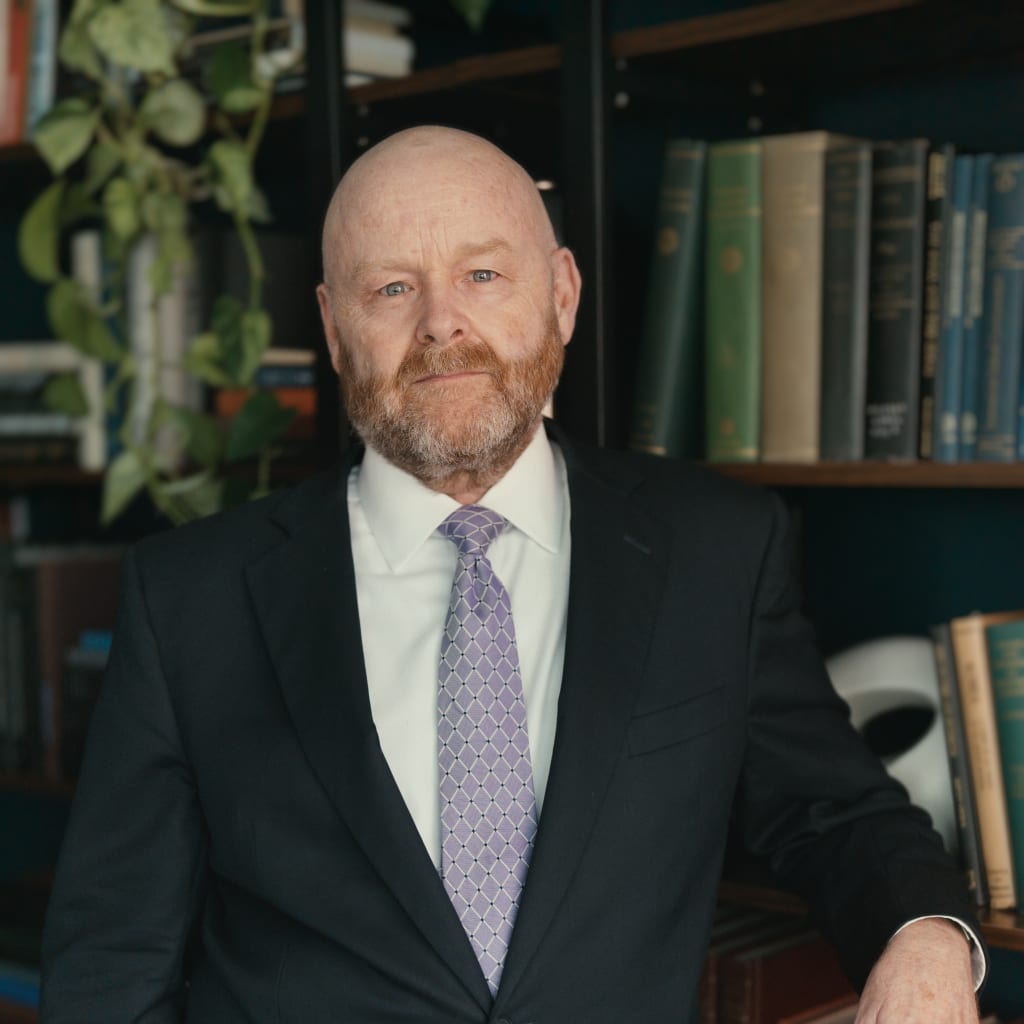 James M. LindsayCFR ExpertMary and David Boies Distinguished Senior Fellow in U.S. Foreign Policy
Guest
- Heather ConleyNonresident Senior Fellow, American Enterprise Institute
[Video: https://youtu.be/WNJNVdkkknk?si=O9QRdzZpQKSfuR3l]
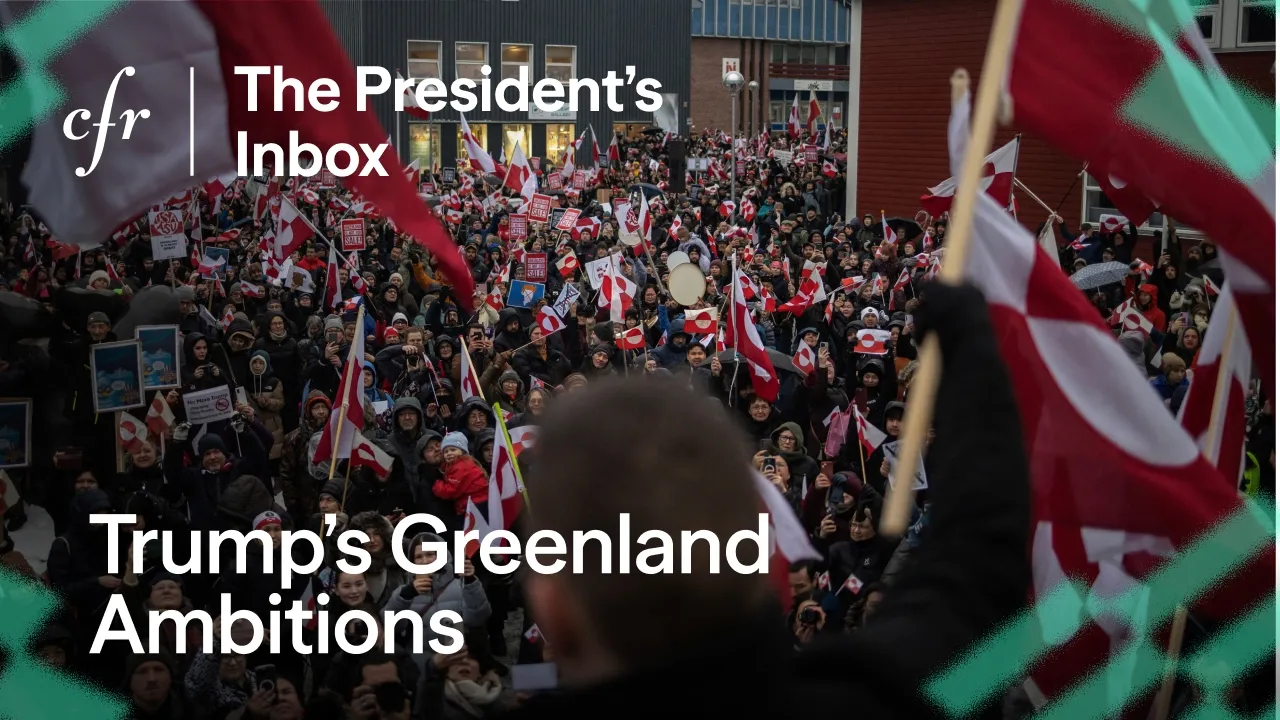
Heather Conley, nonresident senior fellow at the American Enterprise Institute, and Rebecca Pincus, senior fellow at the Foreign Policy Research Institute, sit down with James M. Lindsay to discuss how President Trump’s desire to acquire Greenland has thrown the transatlantic relationship into its latest crisis.
Transcript
LINDSAY:
A month after winning the 2024 election, President Donald Trump took the Truth Social to surface an idea he had floated during his first term in office.
ABC 7 CHICAGO: He wrote, “The United States of America feels that the ownership and control of Greenland is an absolute necessity.”
LINDSAY:
But as Trump’s second term began, he focused on other territorial ambitions.
PBS NEWSHOUR: [Donald Trump] My administration will be reclaiming the Panama Canal. The U.S. will take over the Gaza Strip and we will do a job with it too. We’ll own it. What I’d like to see Canada become our 51st state.
LINDSAY:
As 2025 ended, however, Trump turned again to Greenland.
BLOOMBERG TV: The White House says President Trump won’t rule out the use of military action to acquire Greenland.
BLOOMBERG TV: If the United States chooses to attack another NATO country militarily, then everything stops.
SKY NEWS: Given the fact that obviously it’s effectively Danish territory and in essence then kind of part of NATO. I mean, some suggesting that would then be the end of NATO. Then at last week’s world economic form in Davos, Switzerland, Trump trumped his threat to use force against Greenland.
ABC NEWS: The president sitting down with NATO Secretary General emerging with the framework of a deal. The president claiming the U.S. will take full control of Greenland, but not telling us how.
LINDSAY:
The crisis was diverted, at least for now. Uncertainty swirls around what was agreed to and about the future of the Trans-Atlantic Alliance. From the Council on Formulations, welcome to the President’s Inbox. I’m Jim Lindsay. Today I’m being joined by Heather Conley, non-resident senior fellow at the American Enterprise Institute and Rebecca Pincus, a senior fellow at the Foreign Policy Research Institute. Heather and Rebecca, thank you for joining me.
CONLEY:
Great to be here, Jim. Thanks.
PINCUS:
Thank you.
LINDSAY:
Heather, if I may, I’d like to begin with you and I’d like to just do some basics so we also have a common understanding of the issues at stake. Could you explain to us what exactly the relationship is between Denmark and Greenland? Since I hear the Danish government speak on this issue, I also hear the leadership in Greenland speak quite forcefully on the issue. So just sort of help us understand the relationship there.
CONLEY:
Absolutely. And just on a modern mention, I mean, there has been a slow evolution of Greenland achieving greater autonomy from the kingdom of Denmark. So really the hallmark was in 1979 when they went to a home rule type of situation where more autonomy was given. And then in 2009, they went to self-rule, meaning that the Greenland government has control over decisions related to the economy to some taxation issues, but foreign policy and national security policy still remains with the kingdom of Denmark. And this has been always a tense relationship, I would say, leading up to this crisis. It has been one of Greenland seeking more autonomy, even independence from Denmark, but not sure how to do that economically because the Kingdom of Denmark provides annually upwards of over $700 million of subsidies as well as law enforcement and other capabilities. And the Kingdom of Denmark was a little frustrated as well with this relationship.
However, the United States has managed to resolve all that over the last few decades and to unite the Greenland government and the Danish government in ways we haven’t seen in decades. So they’re united. But as I said, this has been a story of evolution of greater autonomy, and that’s what we’re continuing to see today.
LINDSAY:
Just a follow-up question there, Heather. It’s not the case that Greenland or Denmark has set a date for an independence referendum, even though there is discussion on the island about seeking independence.
CONLEY:
So in 2009, when that self-rule government was decided, I mean, there is a process should those steps be taken. But the challenge, and you’ll hear echoes of this, even with the previous Scottish referendums, until the Greenland government can make a decision of how to replace those very generous annual subsidies and support, the idea of independence, yes, but how do you make that economically work has always been the challenge. But as the Greenland of government and people have been so clear over the last few weeks and months, they wish to be Greenlanders. They wish to have independence eventually. That doesn’t mean they want to fall under the United States. They want their own path. And that is very, very… That self-determination is so very important to them and they will not let go of that.
LINDSAY:
Rebecca, I want to do a little bit of history first. We all know that in 2019, President Trump, during his first administration, expressed this idea for the United States to gain control of Greenland. I think for most people, it came out of left field because I don’t think most Americans spend much time thinking about territorial acquisition, but there’s actually a history there. Donald Trump isn’t the first president, first American leader to express interest in gaining control of Greenland. Maybe you can give us just a little bit of that history.
PINCUS:
Yeah, sure, absolutely. The U.S. has made some major territorial acquisitions in the past. We can think about the Louisiana purchase or the purchase of Alaska. And indeed, previous U.S. presidents have made offers on Greenland. During World War II, the U.S. took protection of Greenland because Denmark was occupied by the Nazis. And following the war, I think there was some interest, particularly given the importance of Greenland to the U.S. military and to the emerging Cold War. So there have certainly been some attempts to purchase in the past or to retain control after the war. But when the U.S. took the U.S. Virgin Islands from Denmark, we recognized their interest in Greenland. And there’s a piece of paper there, a treaty. So that has sort of settled the issue. And I think Heather is absolutely correct in really underlining that Greenland’s arc has been towards greater and greater autonomy and more independence from the Danish, from the Kingdom of Denmark.
And so it’s really hard to imagine a purchase when the Greenlanders are so explicit about what they want. And I think one thing that I wanted to kind of circle back on when it comes to their rights and the Self-Rule Act of 2009, a really important piece of Greenland’s autonomy is control over its natural resources. They won that right in 2009. So they make decisions around mineral leasing, for example, and that was a hard one right. And it’s incredibly important to Greenlanders. And they have set a pretty high bar when it comes to environmental standards, which is not surprising given that 90 percent of the Greenlandic economy is fisheries and that almost everyone in the country relies on locally sourced foods. So subsistence foods, fish, other sorts of wild foods from the Greenland environment. So protection of the environment is really important. It’s not surprising that they’ve set a high bar for mining and other extractive industries.
And I think that’s something that plugs back into the conversation around Greenland’s strategic minerals. Greenland has set high environmental standards. They have control over that body of law, and it’s very unlikely, I mean, it’s impossible for me to imagine that they would’ve cede control of their resources and of those environmental standards to anyone else. Heather, I mean, please let me know if you disagree, but to me, that’s just sort of a fundamental point.
CONLEY:
100 percent. And this is why, I mean, there’s a lot of confusion. Greenland is part of NATO as the kingdom of Denmark. It is not a member of the European Union, part of the EU because of fisheries. It wanted to maintain that control. So this absolutely to reinforce they want greater control and autonomy. They want greater economic opportunity, of course, and investment, but not loss of control.
LINDSAY:
Okay. Heather, help me understand what Donald Trump’s case is for the United States acquiring Greenland because I don’t think it’s purely a whim. There’s a strategic and economic calculation there. And again, if you look at the history of this, the United States has previous iterations sought to take control of Greenland for economic or security reasons. Even Rebecca mentioned Alaska, and I will note that Secretary of State William Seward, who’s responsible for the purchase of Alaska was then known as Steward’s fall that he had bought an icebox, actually also wanted to buy Greenland, but the fact he had just spent $7 million buying what to most Americans seemed to be a frozen wasteland, sort of ruled out getting Congress to give him money to buy Greenland. But there is a strategic calculus driving the president decision maker. So if you could lay that out for me.
CONLEY:
Yeah. I mean, I feel like this is a split screen conversation because I think divining what the president’s view on this, I mean, there’s a personal issue to this and then there’s the actual geostrategic issue at hand. So I mean, I think the president has been very transparent. He really views foreign and security policy through the lens of a real estate professional. He wants to build beautiful things and develop. He thinks he’s like a developer. He also sees his unique place in history to expand the United States at this historic juncture. America’s 250th anniversary, just that expansion is very much part of, I think, how he thinks about things, embracing President Polk, embracing, as you said, the history of previous presidents from Johnson to Truman that sought this expansion. I’m going to put that aside, although that gets really convoluted. And I don’t want to speak for Becca, but I think the frustration we’ve had with all of this has been there is a really important discussion that needs to be had about Arctic security, about preparing the United States for this new or opening this strategic northern front to protect North America.
LINDSAY:
Let’s talk about that.
CONLEY:
It doesn’t have any… Yeah, absolutely. So I’ll give you my, what I jokingly call sort of the quick Arctic 101. What makes the Arctic strategic? It shortens distances. It shortens distances for intercontinental ballistic missiles. It shortens distances for submarines. It shortens distances for maritime vessels for undersea cables. So think about that control over the top of the world and even their space connectivity is there. It is really, really important. That is why historically our missile defense line, the distant early warning line that the Eisenhower Administration was to create that protection, that early warning. So we could see those missiles coming over, which is why we have the America’s most northern early warning space space, PDUFIC, is in Northwest Greenland. It’s part of that arc. It’s very important. And as Russia modernizes its nuclear submarine fleet presents new exotic weapons, that’s really, really important, that missile defense architecture, but America doesn’t do it alone. It needs Greenland. It needs Canada. It needs our other countries to help present that. So that’s part of it. We’re also seeing-
LINDSAY:
Can I just stop you there a second, Heather. I just want to make clear the reason this is a concern now, much more so than a couple of decades ago is because climate change means that the polar ice cap is melting and we’re now headed toward a place in which the northern seas will be navigable all year round. And that sort of changes the calculation, correct?
CONLEY:
Absolutely. Environmentally, yes, we’re seeing more commercial, scientific and military activity. And we are seeing where Russia and China, we were a little slow to catch up to this, understand the Arctic as a strategic frontier. The power that does have control and is able to allude missile defense to be able to put vessels there, put more offensive capabilities, that will be a controlling factor. So it’s really both, Jim. And I think the environmental change, the transformative environmental change is accelerating all of this, but it’s also a military play. China wants to be a great polar power. They see the new strategic frontiers. Russia’s future military and economic survival depends on the Arctic. So the state’s stakes are enormously high for both the military as well as the economic development.
LINDSAY:
Rebecca, Heather’s just laid out the strategic argument for the United States to gain control of Greenland. Can you lay out the economic arguments? Because you’ve already alluded to this in your talk about the concerns that Greenlanders have about preserving their environment. But I do think given all the talk about critical minerals and how they are key to the future of the American economy, if you could just sort of help us understand what it is we think Greenland has.
PINCUS:
Yes, absolutely. So Greenland is expected to have a very rich endowment of a lot of different minerals and hydrocarbons. And I will say the Arctic in general is sort of a resource basket. The region is rich in minerals, it’s rich in hydrocarbons, it’s rich in fish. I should note as well, part of the reason that the Arctic broadly and Greenland specifically is sort of full of all these resources is that it’s so hard to access them. I mean, we have known about minerals and hydrocarbons in the Arctic region in Greenland for many decades, for a hundred years, but because of the added costs of getting to them because of the climate and the ice and the darkness and the cold, the economics have never really shaken out because you have to have… For mining in Greenland or the Arctic to make sense, and if you look at the specific, the few mines that are out there, whether it’s Red Dog or Merry River or anything, you have to have a deposit that is remarkable.
It has to be sort of a world-class deposit of whatever it is so that the profit margins are large enough to support the upfront and ongoing costs associated with extraction in an Arctic context. And so Greenland has not had much of any mining activity outside of World War II. I will say during World War II, there was a very important cryolite mine in Southern Greenland. Cryolite was used in aluminum production, so it was very important to fighter aircraft. And that was a really strategic mine, just like again, across Alaska, across Canada during World War II and the early days of the Cold War, there was a ton of mining because it was on national security grounds. Those weren’t necessarily driven by profit, it was sort of wartime decision basis. And so after the war, and as the United States and Canada and Europe sort of raised their environmental standards throughout the ‘60s and ’70s and ‘80s, almost all of those mines were shut down.
And these days, there’s very little mining happening in Greenland. There’s a very small gold mine opening up in Southern Greenland. They’ve been mining some rubies. There’s sort of a couple here and there, but most of the resources in Greenland are still in the ground. And it’s things like strategic minerals, probably uranium. Uranium and strategic minerals or rare earths often co-occur. So it makes the mining a little bit tricky. And I don’t want to get sort of too into the weeds here, but if you’re talking about uranium production, that touches on Danish authorities over national security and foreign policy. And so mining for uranium gets a little bit more complicated from a sort of political perspective with regards to Greenland and Denmark. We don’t sort of need to get into that. But I’ll note that there’ve been some uranium deposits found in Greenland often around those rare earths, probably hydrocarbons, probably oil and gas, gold, certainly some precious metals, rubies, as I mentioned before.
There’s just a lot of resources in Greenland given its geology. And again, it’s similar geology… It’s the North American shield, so it’s similar geology across Canada and Alaska. But again, the upfront costs, given that you’re talking about a greenfield production site without any infrastructure under incredibly harsh conditions, has really foreclosed minerals development. And I will say that in Greenland in particular, most of these deposits are expected. We have sort of probabilities given the underlying geology, but they have not been characterized. So the first step, just going out and taking field samples and figuring out what is actually there, how much of it, what quality, none of that work has been done for the most part across Greenland. So we’re really-
LINDSAY:
Understood. I mean, we’re looking at a situation in which there’s a belief that there’s a lot of riches lying under thousands of feet of ice sheet in Greenland, and it may not be exploitable at a positive return today, but it may decades from now. I want to come back to this broader issue though, the strategic necessity for Greenland, an issue of sovereignty. If I can turn to you, Heather, the United States has long been active in Greenland, as you noted. And after World War II, the United States signed an agreement with Greenland, the Netherlands 1951, pursuant to the NATO Treaty, the United States has had military bases throughout the Cold War in Greenland. At one point, I think at least seventeen, we’ve had military installations there. So it seems like the United States has great access to Greenland. Why is sovereignty over Greenland so important to Donald Trump? What is the difference there of having sovereignty?
CONLEY:
Well, I’m going to get back to that original, the real estate professional believes ownership is the only way you control the property.
LINDSAY:
The president has been explicit on that point.
CONLEY:
He’s been explicit. No, you have to understand, I think what shapes his worldview. And this is why this ownership, this acquisition, and this is what we’re all frustrated because we have everything we need. And as you mentioned, and again, the history is important here. So in 1946, the Truman Administration quietly approached the Kingdom of Denmark to talk about acquisition, and they were quietly told, “We’re not interested.” And then three years later, what we did was founding of NATO, that a multilateral security umbrella of which the Kingdom of Denmark and Greenland were the founding part of that, we built that basis. And then on top of that came the U.S. Bilateral Defense Agreement in 1951 that has been updated over time. So when this conversation began back in 2019, Copenhagen and Newt were like, “Okay, we have these instruments. What do you want?” And they heard silence because we weren’t suggesting we wanted to add more military installations or increase our economic opportunity.
It just became about acquisition and ownership. So this has been the frustration. And now twelve months later of this more intense cycle, now we have the worst of all worlds because we haven’t walked through that open door of welcoming more U.S. military posture, economic posture. Now we’ve built such great distrust because of our methods and our approach. Now, I think that door, it will be opened, but now it’s going to be viewed with suspicion because are we really talking about collaboration or is this just something we’re trying to do? And that is, again, this is the great tragedy of where we walked. We had everything we wanted and now we’ve really harmed the trust and the credibility. And I will say on top of all this, the cherry on top of this particular Sunday was the president’s comments about Danish and British forces fighting in Afghanistan.
This is just, it’s broken. And people need to understand there’s a cost to breaking and we’re going to see what that cost is as we start these negotiations.
LINDSAY:
Let me draw you out on that, Heather, because you spent a lot of time thinking about the transatlantic relationship and clearly President Trump approached this not simply as a real estate deal or as a traditional real estate deal because he not only sort of offered to buy it, but he also said, “If I can’t buy it, I’m going to take it.” What is your sense of how seriously the Europeans took that military threat? And again, against the backdrop, they knew that if the United States decided to take control of Greenland militarily, they could do it and do it very quickly.
CONLEY:
So I think they took this very seriously. And Jim, of course, this happened in the aftermath of the Maduro seizure operation, which was extraordinary. No, very, very seriously. In part, why they began to… Several NATO countries started to put forces, very, very small forces. They were basically preparatory for a military exercise that would been held. Honestly, they were doing it for the exercise, but it was a reassurance presence. I mean, and the Danes flowing Danish special forces, it was to just say, “We have to protect our sovereignty.” This is how serious it became. And of course, I think the president interpreted as serious, which is why he threatened the tariffs. This was very, very serious. And I never thought, Jim, in my professional experience, the hill that we were going to die on transatlantically would be Greenland. And that’s sort of what we started to do.
But I will say the Europeans held to the principles of territorial integrity and sovereignty, which is what we are supposed to be holding onto, our sovereignty, our territorial integrity, yet this purchase, this acquisition, erodes our own demand for sovereignty of our borders and protection of that. So it’s very, very harsh. I hope we get it back on track.
LINDSAY:
Why do you think the president backed down at the end because he threatened to use military force, or maybe say more correctly, refused to rule out using military force until he went to Davos, and then he said he wasn’t going to use military force. Was that out of just goodwill? Was someone persuaded him? Was he persuaded by the determination of the Europeans?
CONLEY:
This is a guess, speculation. And Becca, you have great thoughts on this as well. I think in part, it was consuming too much. It was consuming too much of headlines and obviously the president’s juggling an enormous portfolio of issues. And I think honestly, this is what Native Secretary General Mark Ruta gave him. He needed a way out of it. And I think it showed some limitations. Now, I don’t think anybody should be happy. I mean, I’m pleased with the climb down. I’m pleased that we can hopefully get this back into the track that it should have been in that Vice President Vance offered just the week before of a high level dialogue. Let’s get that back on track. But I think it was the president acknowledging that if he would continue on, he was going to lose. I hope that was the case, but it was a shame that we had to go out on that limb as far as we did.
LINDSAY:
Rebecca, let’s talk about the framework agreement because that was the surprise coming out of Davos. I mean, really, literally within twenty-four hours, we went from a fear of a military invasion to we have a framework agreement. Now, I’ve heard some people refer to the framework agreement as Heather did as a climb down. This was a way of letting Trump get out of the box canyon he wrote himself into. Whereas heard other people say, this is Donald Trump’s art of the deal in operation. President banged the table, got everybody upset, and then he got what he wanted. So before we assess that, maybe you could just tell me what’s in the framework agreement.
PINCUS:
I have yet to get any hard details. In fact, I think-
LINDSAY:
That seems to be true of a lot of framework agreements.
PINCUS:
Well, and I mean, I think framework agreement here is carrying a lot of water. The president sat down with Secretary General Ruta and they came to some kind of agreement, but the Danes and the Greenlanders were not part of that conversation. So I don’t think we have anything approaching a real framework agreement. I think because the Secretary General of NATO can only speak for NATO. I think it’s wonderful that he got to an agreement with the president and diffused the immediate crisis. And I think the market’s reaction to what was going on with tariffs was a big part of this. So I’m really glad that we-
LINDSAY:
I’ll say the bond market wasn’t particularly crazy about this.
PINCUS:
Exactly, exactly. And I think that sort of lit a fire under everybody. Let’s find an off-ramp. I’m glad we’ve gotten that. But as Heather has said, this is sort of the worst possible outcome. The United States has alienated allies and sort of brandished this big weapon around of, we might use military force, we’re going to impose these tariffs and then climbed back down from that. And we don’t appear to be getting anything that we didn’t already have.
LINDSAY:
Let me ask you about that, Rebecca, because one of the things I’ve heard being suggested is the way they’re going to square the circle here is that the United States will get military bases in Greenland. Again, long history of that. But in this case, we will sign some sort of agreement suggesting that the land in which the American bases sit are sovereign American territory. And there are analogies here to the arrangement Britain has, I believe at Diego, Garcia and elsewhere. So is there any there there? Is that something that would be acceptable to Denmark or to Greenland, or is that a red line for them as well?
PINCUS:
I have a hard time imagining Greenland ceding territory to the United States or Denmark. That’s what that would be. Something like a Guantanamo Bay ninety-nine-year lease, maybe. That seems more plausible, Heather. I’d be interested in your thoughts on that, but I think the idea that the U.S. is going to own territory in Greenland, that it’s going to be ceded. I find that hard to believe.
LINDSAY:
Let me ask you that. Why wouldn’t Greenland agree to that? What if it came with financial compensation? Why would Greenlanders not want to do a deal like that? What would the sticking point be?
PINCUS:
Well, I mean, I think it’s important to look at the history here. The United States has had military bases, had the first Tully base now Batufik in Northwest Greenland since the early days of… It’s been a U.S. base since the early days of the Cold War, and we’ve had relatively free latitude there, a pretty remarkable amount of control over that territory, and it’s pretty badly polluted. And there is other-
LINDSAY:
Well, in 1968, a B-52 crashed while carrying nuclear weapons there and there was contamination.
PINCUS:
Project Ice Worm, there’s a lot of toxic military waste in Greenland that is American. So I think we don’t have necessarily… A lot of people I think don’t fully appreciate the history here, but we are not coming in with clean hands and also the local population was forcibly relocated to build the Tully air base. So there’s all these Painful spots in the U.S. history in Greenland. And for example, in 2015, those sort of wounds were reopened just because of the base maintenance contract didn’t go to a Greenland company. And that was a big crisis. It’s amazing ten years ago, that was the big crisis in sort of U.S. Denmark Greenland. But I mean, there is this sore history and particularly the way the administration has come in with the language, as Heather talked about, it hasn’t been in a sort of partnership approach and there is this legacy of toxic military waste.
So I think there would be grave concerns about the U.S. taking control of parts of Greenland. And I guess if you put a gun to their heads, maybe, but I think it’s something that I have a really hard time imagining. And the fact that the conversation has not yet appeared to have included Danish and Greenlandic participants, I think it’s too early to say that this would be an outcome. Ruta can’t promise that.
LINDSAY:
Okay. Well, Heather, on that score, what Rebecca is suggesting is that this issue is not settled. It is going to continue. So how do you see all of this playing out on the transatlantic relationship? You and I are both of an age in which this was the foundational pillar of American foreign policy that pillar seems to be being questioned or at least tested.
CONLEY:
Yeah. I actually see this is where I think there’s going to be some positive things coming out. And so thank goodness we can sort of talk on a more positive note. I think what you’re going to see is NATO putting together a more significant Arctic posture. And so, I mean, we’re seeing in March, the exercise cold response, which will be a pretty significant… It happens every two years, Northern Norway, Northern Finland. I think you’ll see more, whether that’s Arctic endurance, but more exercising. And so I would suspect in the July NATO summit, you will see Native leaders approving whether it’s Arctic century or something. There’ll be some posture there. And that’s great because NATO has been really, really slow moving and thinking about a more forceful NATO posture. So I think that’s the benefit. The other benefit, and I hate to say this, the more the president talked about annexation and corporation ownership, we have the Kingdom of Denmark putting forward a pretty significant Arctic security package.
I’d like to see the United States put forward its own pretty significant Arctic security package for Alaska. We can talk about that at another time, but you’re going to see really much greater security posture, frigates, surveillance, sensors. This is great. Canada is doing the same thing. This is great. We need more security, but it’s unfortunate that it took saber-rattling from an American president to get everybody moving, but everybody’s moving in the right direction. And I think the way forward is much more of a NATO-ization of this because to Becca’s point, yes, we have the 1951 agreement. There was some suggestion. Again, there was just such chaos coming out of Davos. I was like, what in the world was the concept of the framework of the framework of the agreement? We don’t know. We was talking about reopening the 1951 agreement. I don’t think that’s possible right now.
There’s such distrust. We can work within the confines of the 1951 agreement right now, but until we rebuild trust and confidence, I think the Greenlanders and the Danes will give greater latitude for NATO-ization, the UK, other allies, until we start rebuilding our own trust with the Greenland government as well as the Danish government. So I think there’s some goodness coming out of this, but oh my gosh, the damage, the collateral damage done and how we approach this, we don’t yet know the costs of that.
LINDSAY:
So you seem to be suggesting, Heather, that when the president said we can do this the easy way or the hard way, he actually ended up unintentionally doing it the hard way. Is that what you’re telling me?
CONLEY:
Yeah, we had the easy way. We’ve always had the easy way, but we did take the hard way. And the stock market and the bond market and the Davos conversations clearly said that. Yeah.
LINDSAY:
Rebecca, I want to close with you, what is your sense of where we’re going to go with this issue? And also to the extent to which the United States, in terms of its own force posture, is able to provide security to Greenland. And we all know that Greenland may be inaptly described. There’s an awful lot of ice in Greenland. One thing I noticed that the United States is very short on icebreakers, which I assume would be critical in that part of the world. Last I heard we had three in theory. One apparently isn’t really seaworthy or could only take on small ice cubes, but just sort of close me up by giving me some sense of how well positioned the United States is to take advantage of or to provide security to Greenland.
PINCUS:
Yeah, sure. And I mean, it’s a big topic, but there’s sort of no immediate threat to Greenland, right? No one is about to seize it. And I think that’s something that gets talked about a lot. Greenland is important to the United States because of our base providing early warning and missile defense to North America, but there’s nobody out there who’s sort of poised to take Greenland. Obviously, Heather talked about Russia’s military capabilities and the broader Arctic and the importance of the GIUK gap and submarine warfare. And China is clearly interested in the Arctic and in Greenlandic resources, but in a sort of much more, I would say low level, like they’re not going to seize Greenland. That wouldn’t make sense for the Chinese government for a lot of different reasons. So in terms of the gaps around Greenland, what has been acknowledged and what NATO and what the United States, the Pentagon has said is we need better situational awareness.
It’s a huge AOR. There’s increasing maritime traffic. We need to know what’s going on and be prepared to respond. So the first part of that is sensors, satellites, drones in the air, in the water, and that’s stuff that’s all contained in the Danish military package announced last year. From United States perspective, we want to shift that burden to our allies. So when Denmark pledges four or $5 billion to Greenlandic security, that’s a win for us. That’s something we don’t have to do. The U.S. has a lot of demands on our military. And so for having Denmark take that over or having maybe like a NATO air policing mission or something, that would be a win for us because it would enable us to focus elsewhere. So the first part is sort of the situational awareness, the ISR capabilities. A lot of that can be unmanned capabilities that can-
LINDSAY:
When you say ISR, ISR stands for?
PINCUS:
Sorry, intelligence, surveillance, and reconnaissance. So sort of domain awareness, what’s going on? Who’s there? What are they doing? And then being able to respond is very important. Obviously the U.S. has ACE undersea capabilities. I don’t need to get into that, but we do lack icebreakers. And that’s something that the Trump administration has, and I will absolutely, full credit, has been really pushing the gas on. They have moved ahead with some pretty unconventional approaches to building icebreakers, which is something that the U.S. hasn’t done in a long time.
LINDSAY:
And I believe we’re getting help from our friends in Finland.
PINCUS:
Yes, exactly. Yeah, yeah. Finland and Canada through a trilateral-
LINDSAY:
Shout out to Helsinki.
PINCUS:
Yes, called the Ice Pact. And so we’re going to be getting a lot more icebreakers in coming years. And I would imagine the Coast Guard has been planning on stationing some of them on the East Coast. So I would imagine we’ll be seeing U.S. icebreakers pulling into Nuke and maybe other ports in Greenland in the next ten to twenty years.
LINDSAY:
Okay. On that note, I’ll close up the President’s Inbox for this week. My guests have been Heather Conley, non-resident senior fellow at the American Enterprise Institute, and Rebecca Pincus, who is a senior fellow at the Foreign Policy Institute. Heather, Rebecca, thank you very much for joining me.
PINCUS:
Thank you.
CONLEY:
Thanks, Jim.
LINDSAY:
Today’s episode was produced by Justin Schuster with Director of Video, Jeremy Sherlick, and Director of Podcasting Gabrielle Sierra. Production assistance was provided by Oscar Berry and Kaleah Haddock.
Opinions expressed on The President’s Inbox are solely those of the host or our guests, not of CFR, which takes no institutional positions on matters of policy.
Associate Producer
- Associate Producer, Video and Audio
Editorial Director and Producer
- Director, Podcasting
Director of Video
- Director of Video
More Episodes
 33:42Podcast
 36:05Podcast
 41:07Podcast
 39:26Podcast
 35:04Podcast
 31:46Podcast