Canada Hedges Against the United States, With Jonathan Berkshire Miller
This episode unpacks Canada’s efforts to diminish its vulnerability to U.S. economic threats.
Published
Host
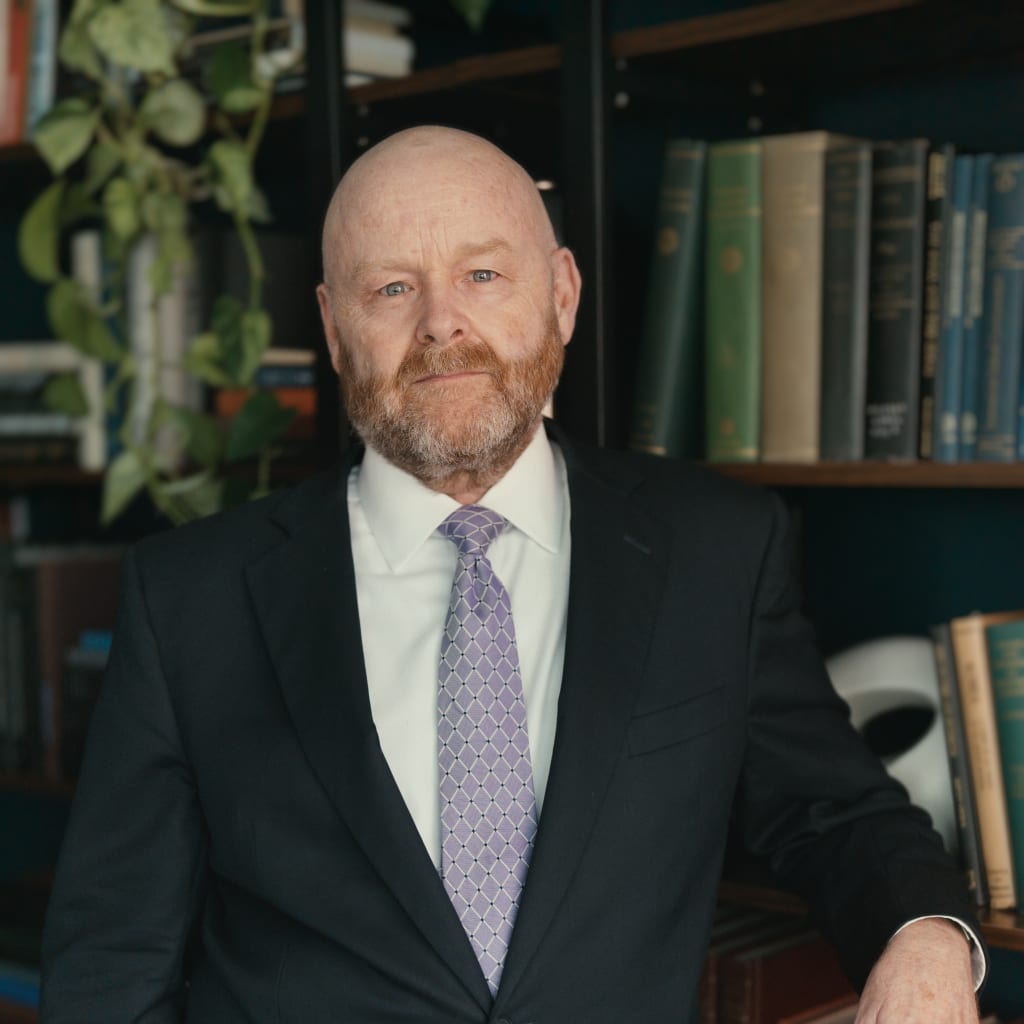 James M. LindsayCFR ExpertMary and David Boies Distinguished Senior Fellow in U.S. Foreign Policy
Guest
- Jonathan Berkshire MillerSenior Fellow and Director of Foreign Affairs, National Defense and National Security, Macdonald-Laurier Institute
[Video: https://youtu.be/3cxHfZEJGZQ?si=lbSdz7395nfQCzUn]
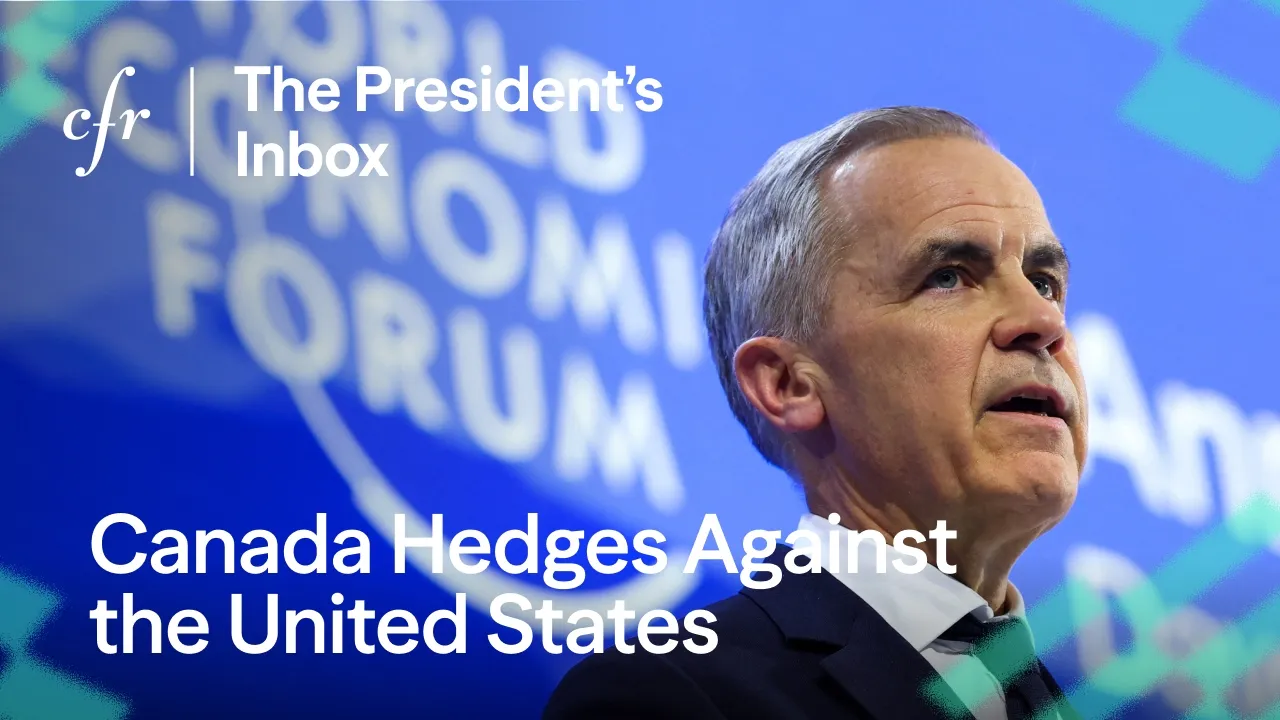
Jonathan Berkshire Miller, senior fellow at the Macdonald Laurier Institute, sits down with James M. Lindsay to discuss Canada’s effort to diminish its vulnerability to U.S. economic threats and just how much middle powers like Canada can successfully hedge in a world of great power competition.
TRANSCRIPT
Mark CARNEY:
Let me be direct, we are in the midst of a rupture, not a transition. Great powers have begun using economic integration as weapons, tariffs as leverage, financial infrastructure as coercion, supply chains as vulnerabilities to be exploited.
LINDSAY:
Over the past year, Donald Trump has pressured Canada in unprecedented ways. He has hiked tariffs on Canadian goods, threatened to impose more, and even questioned Canada sovereignty.
Mark CARNEY:
And as a result, many countries are drawing the same conclusions that they must develop greater strategic autonomy.
LINDSAY:
To lessen Canada’s dependence on the United States, Carney has sought to strike new trade and security deals with countries around the world, including China. But can Canada diminish its reliance on the U.S. economy? And what would a lasting estrangement between Ottawa and Washington mean for the security of both countries in an increasingly uncertain world?
Mark CARNEY:
We understand that this rupture calls for more than adaptation, it calls for honesty about the world as it is. We know the old order is not coming back, but we believe that from the fracture, we can build something bigger, better, stronger, more just. This is the task of the middle powers.
LINDSAY:
From the Council on Foreign Relations, welcome to The President’s Inbox. I’m Jim Lindsay. Joining me today is Jonathan Berkshire Miller, a senior fellow at the Macdonald-Laurier Institute in Ottawa, Canada. Jonathan, thank you for coming back on The President’s Inbox.
BERKSHIRE MILLER:
Thanks so much, Jim, for having me back on.
LINDSAY:
I want to begin big-picture, if we may, Jonathan, give me a sense of what the mood is in Canada these days in terms of U.S.-Canadian relations.
BERKSHIRE MILLER:
Well, thanks, Jim. And generally, Canadians, I guess, like a lot of electorates, don’t really focus on foreign policy too much, but I think it’s telling that in the last federal election, foreign policy, and in particular the relationship with the United States, was the defining factor in the result of the Prime Minister’s election.
So the new prime minister, Mark Carney, effectively was elected on the heels of a very antagonistic relationship now between the United States and Canada. Part of this, of course, started with Mark Carney’s predecessor, Prime Minister Justin Trudeau, who had an antagonistic relationship with President Trump and President Trump’s often what many framed as a joke, but the Canadian side did not take it as a joke as listing Canada as the potential fifty- first state. There’s also the renegotiation of the USMCA, which is the new NAFTA trade agreement between Canada, the United States, and Mexico, and increasingly other hostile issues over alliance burden sharing in other areas. So it’s become a very contentious relationship right now, and it’s one that is in the forefront now of Canadian politics.
LINDSAY:
Well, Jonathan, let me ask you about one thing you didn’t mention but that popped up last week, which was a news report that U.S. State Department officials met with a secession group in the province of Alberta. The state department said no promises were made. This was just part of ordinary meeting with civil society groups, but perhaps you could sort of give us some sense of how this has been read in Canada and a little bit about the nature of the tensions between Alberta and Ottawa.
BERKSHIRE MILLER:
It’s a really good point, Jim. So Canada has a couple of areas of sensitivity right now when it comes to potential secessionist movements. The longstanding, of course, issue has been in Quebec, which has had referendums before, and there’s a potential for another referendum coming in the next few years as well.
The second area, which you’ve mentioned is in the West Coast, Alberta, which houses most of our energy resources. And it’s still a fringe, a small movement, but it is growing for a potential referendum in Alberta to separate from Canada.
Of course, the reports that several of the proponents of this group have met with senior officials from the United States is abnormal, to say the least, and has drawn a rebuke from both sides of the political aisle. So of course, the ruling party, the Liberal Party led by Mark Carney, but also conservatives who are largely popular in that part of the world, in that part of Canada, but they have reacted to this news in a united fashion and see this as unhelpful.
LINDSAY:
And I should add that it wasn’t merely a news report. U.S. Secretary of the Treasury, Scott Bessent, was on TV being interviewed, and he seemingly encouraged the idea of Alberta’s independence. And there has been talk about Alberta organizing a referendum on independence for the fall. Any truth to that?
BERKSHIRE MILLER:
Yeah, it’s very possible. So I think the mandate has come out that it would be possible in the provincial legislation to have such a referendum. I think the chances and prospects of success are still … I don’t even want to say they’re slim, but right now, I think most of the polling shows that Alberta would not succeed. However, I think this sort of foreign pressure right now is the least that many Canadian politicians want right now.
LINDSAY:
Okay. So Prime Minister Carney went to Davos last month, last week, and gave a speech that was incredibly well received certainly by the people in the room in which he talked about the rupture in what we used to call the liberal rules-based order. Tell me a little bit about how the speech has been received in Canada. I know how it’s been received here in Washington. And I’m curious about how the reaction has been, not just in Ottawa, but maybe in Canada more broadly.
BERKSHIRE MILLER:
Well, I think generally the speech received a lot of attention, as you mentioned, abroad, but also here in Canada. I think it was generally received well. So there’s an emotional response, which I think what I call the mom and pop response, a lot of folks have been feeling the brunt of the pressure from the Trump administration, whether it’s through tariffs, whether it’s just turning on your television and trying to live through this day-by-day that I think there was an emotional response that was almost a little bit of satisfaction that someone, and especially our prime minister, finally stood up on the world stage and mentioned this. So I think from a first blush emotional perspective, I think many Canadians were happy and there probably was a tinge of pride after the remarks were made.
I do think though, politically, this was received different, of course, on both sides. So the conservative side, which is the opposition right now, didn’t criticize so much the comments that were critical of the United States, even if it didn’t necessarily … Mark Carney didn’t identify President Trump or identify the United States.
LINDSAY:
He never mentioned Trump’s name, never said the words the United States.
BERKSHIRE MILLER:
Yeah, he didn’t mention either in the speech. However, so the conservatives didn’t criticize that element, but I think they did criticize the fact that the rhetoric was great, but the reality of Canada actually moving to diversify itself from the United States, I think we’re not quite there yet. So I think that was sort of a bit of the reaction in Canada.
LINDSAY:
So Jonathan, tell me a little bit about how ordinary everyday Canadians are feeling, if they are, the results of President Trump’s economic pressure, his tariffs on Canada, is the impact of tariffs being felt yet? And if so, who’s feeling the brunt?
BERKSHIRE MILLER:
It is. I would say that it’s very sectoral-based. So first of all, I should say that while Canada’s in a difficult position, we still do have an effective trade arrangement. Actually, it’s Donald Trump’s trade deal, the USMCA, which he renegotiated the NAFTA agreement in his first term, and that agreement’s currently under review. But most of the goods that are covered under USMCA are still tariff-free. There are those that are outside of USMCA that are now under pressure. And some of those sectors include the steel and aluminum sector. Of course, we know the automotive sector now is one that is definitely under stress. So those areas and those jobs, and many of them in Ontario, are under particular stress.
Other areas I think are sort of waiting on to see what might happen with USMCA negotiations and some of the pressures there. But we’ve noticed, like a lot of U.S. allies, pressures on inflationary pressures and other things as a result of the global tariff conflict. So there’s those that are happening unique to Canada’s economy, and then there’s the overall effect that’s happening because of Trump’s tariff policy globally.
LINDSAY:
So Jonathan, Prime Minister Carney in his speech at Davos really talked about the issue of hedging and how Canada had to hedge given the uncertainty it faced with U.S. behavior. I want to get to what that means in practice in a moment, but before we do, I’d like you to help me understand why it is that Carney has opted for hedging, finding other partners to deal with. When I will note that the other party to the U.S.-Mexico-Canada trade agreement, Mexico has taken a very different approach. I think President Sheinbaum has tried to find every way she can to tamp down tensions with President Trump. Why is it, you think, that Carney has not played the same hand?
BERKSHIRE MILLER:
Well, I think part of the answer is domestic and part of it is a sort of international strategy piece. So let me just first mention a little bit of the domestic side. And I would say for any speech, there’s multiple audiences. And obviously for Davos, I think many people viewed this from an international perspective, and the international audience, be it in Davos, be it Washington, be it elsewhere. But Mark Carney, of course, is also speaking to an audience at home. And for context, he’s one seat shy of a majority. There’s hints that he might call a snap election very soon, maybe even this spring. As I mentioned earlier in our conversation, Mark Carney was elected primarily on the winds of being a prime minister that could challenge and stand up to President Trump.
LINDSAY:
Yes, going into the federal elections last April, the betting money was that conservatives are going to win and win big.
BERKSHIRE MILLER:
Absolutely. There was a 25 percent spread for a while, months before Donald Trump started talking about the fifty-first state. So Mark Carney … So there is a bit of a domestic angle of this pushing back against the United States.
The international angle though is that Canada has a lot of friends, whether it’s in Europe, whether it’s in Japan and South Korea. And I think naturally looking to diversify our economy, I see it less as sort of hedging completely off the United States, but hedging into like-minded democracies that might compliment eventually a United States trade relationship that maybe comes back, maybe it does not come back.
The sort of last and final element I’ll talk about, maybe this we can talk in a separate question, but is the role of China. So contextualizing the fact that this Davos trip was made right on the heels of a four-day trip to China, which was the first trip that a Canadian Prime Minister has made in several years because of tense relationships with China, I think it’s very interesting and something that maybe we need to dig into a little bit more.
LINDSAY:
I want to get to the China question in just a moment, and particularly why Carney’s trip was so significant indeed, in part because Ottawa had so closely aligned itself to U.S. policy to this point. But give me a sense of what it is that Prime Minister Carney is doing in terms of hedging. Again, he comes out of the financial world. He said explicitly in his speech at Davos that hedging is sort of standard operating procedure when you’re faced with uncertainty. He talked about inking, I think it was a dozen trade and security deals, not just with China, with other countries, but give me a sense of what it is he’s actually doing.
BERKSHIRE MILLER:
So I think there’s a couple different elements of this. First on the broader global trade side. So I’ll give you some quantitative context here. Canada’s a trading relationship with the United States is over 60 percent, sometimes between 60 to 65 percent. The next closest trading partner is China, which is about 8 percent. The European Union altogether is around between 7 and 8 percent. So while hedging and diversifying is important, the idea of any sort of quick answers on this are challenging, but I think that he does want to change those margins a lot. And he’s talked about in a defined period of time actually doubling the sort of rate of trade of non-U.S. partners. So I think there is a financial goal to up that trade diversification.
It’s also happening in a security field. So some of the areas that you might see as examples of this right now is the fighter jet procurement decision. So we have already procured a number of F-35s from the United States. There’s a looming decision. We had already committed actually to get a second tranche of F-35s, but there’s a looming decision where we might actually procure the Swedish Gripens instead. So that’s another example of where we might try to diversify ourselves a little bit in our defense supply chain.
And the final point I’ll mention is on submarines, which right now we have one operational submarine for three oceans, but we will be procuring twelve submarines. And those submarines will either come from South Korea in the Indo-Pacific or Germany-Norway in the transatlantic. So we are looking at ways from a defense industrial base side also to have a little bit of variance from our dependence on the United States.
LINDSAY:
I want to go back to the fighter issue because I think it raises some real dilemmas for the Carney government. My sense is that Donald Trump has been so elated to get NATO countries, of which Canada is one, to commit to spending more on defense because he expects those extra defense dollars to go to buy weapons and support material from the United States. But if Canada decides that it’s not going to buy F-35s, but it’s going to opt for a Swedish fighter, that seems to be a recipe for further tension in U.S.-Canadian relations, or am I missing something?
BERKSHIRE MILLER:
Yeah, absolutely. I think this is one of the conundrums that he faces, and to be honest, Canada will face as well, because not only is there a political consequence here, and I think if we decide not to procure F-35s, this will impact USMCA and other elements of the relationship, but also an operational one. We’ve had decades where we’ve worked in tandem with the United States, whether it’s through NORAD in the North or whether it’s through NATO, and operationally, the Canadian Armed Forces are well integrated with the United States. So I understand there’s a political question here, and it’s a challenging one for Prime Minister Carney, but operationally, there’s all sorts of considerations as well about which capability would be the best for Canada’s interests and Canada’s security. So I think this is a challenging one that we’re going through right now.
LINDSAY:
Yeah. And again, I don’t think this is a challenge or dilemma just for Ottawa. I think similar calculations are being made in places like Berlin about where to spend money given the desire to stand at our own two feet and not create additional vulnerabilities by relying or deepening reliance on the United States.
So let’s talk about Prime Minister Carney’s outreach, particularly the deal with China. I’ve seen sort of two critical reactions to it or two reactions that were critical. One reaction is that Carney is essentially talking out of both sides of his mouth. And his speech at Davos was about working with like-minded countries, importance of democracy and values, yet he’s going to deepen Canada’s economic ties with China, a country that is not upholding the values that Canadians hold dear. Second argument that I’ve heard from people as he sort of talk about it is that at the end of the day, he’s gotten very little from China or anyone else in these deals. How do you respond to those two criticisms?
BERKSHIRE MILLER:
Yeah, I think it’s a bit of a mix of the two. So I think there’s a deep irony in making this speech in Davos right after the four-day trip to China. I mean, and while you could say, “Well, if you look at the actual deals on paper, not much significant has been agreed to even a deal.”
LINDSAY:
Unless you are a farmer who grows canola oil.
BERKSHIRE MILLER:
Exactly, yeah. There were some wins for Canada on canola and other things, but even the deal, for example, on electric vehicles, which I think got a lot of attention and lowering the entry for a certain amount of Chinese EVs, I don’t think this is a significant long-term policy shift, but more of a one-time tactical deal in order to get some relief on one industry, which was canola in this standpoint.
But I do think that there is deep irony in making this type of speech after talking about “strategic partnership with China,” even reference to a new world order, which I think raised some eyebrows in Ottawa and probably also in Washington, D.C., is the realization that yes, you can have dialogue with China, but wishing away the problems of the past few years is also not going to be a reasonable area to focus on. And I think there’s-
LINDSAY:
Can you speak to those challenges, Jonathan? Because I don’t think most Americans are aware that Canadian-Chinese relations went into a deep freeze in good part because Canada supported Washington’s policy toward China.
BERKSHIRE MILLER:
Sure. I think the most visceral example of this was the detention of what we call them the two Michaels. So Michael Kovrig and Michael Spavor who were detained in 2018 and both spent about 1,000 days in detention, arbitrary detention in China. And this was the result of Canada falling through on its extradition commitments for a United States warrant for Meng Wanzhou, who is the chief financial officer of Huawei. So this saga played out and definitely took the Canada-China relationships to new depths. As a result of that, we had very little contact with the Chinese side.
Throw on top of that, the detention of the two Michaels, we went through the issue of Huawei and 5G and our 5G networks. We also took a policy that was very aligned with the United States and eventually banning Huawei and other Chinese carriers in our networks. So all of this to be said, the relationship is really at its nadir for the last few years. So to see this sort of rebound is quite stunning, I think, for many here in Ottawa.
LINDSAY:
So let’s talk about the future of the U.S.-Canadian economic relationship. You’ve already alluded to the fact that USMCA is up for its required review. I guess it formerly begins on July 1st, but it’s been underway. I think informally discussion has been going on for some time. And one possibility is that everyone says they’re happy and the agreement continues, I think, for another fifteen years, otherwise you go to annual reviews, which I think most producers, regardless of what country you are in, aren’t keen on because that means they won’t know what the rules of the game might be. But how do you see this flap over Carney’s speech folding into the broader negotiations on the USMCA?
BERKSHIRE MILLER:
Well, I think it’s going to create some challenges. So an example I’ll give you is even the sort of arrangement that was made on canola for EV. I think there was a quick reaction in Washington that this was an agreement, and I think there were some social media posts and interviews from some of Trump’s team and Trump himself actually that if there was any agreement, trade agreement with China, that this would essentially make USMCA irrelevant because there is a clause in the USMCA that no party can have a trade agreement with a non-market economy, China being a clear example of this.
What the Canadian side is trying to communicate to the Trump administration is deals like this or arrangements are just certain deals to get tariff relief and it’s not a free trade agreement. So I do think that you’re going to see a lot of headwinds in the next few months as we lead up to the USMCA. And I think the Canadian side is going to be … it’s going to be the prime political focus and take most of the oxygen from the Canadian side to focus on getting a deal because you said that we need that certainty with 65 percent of our trade going to the United States.
LINDSAY:
So what is it that Ottawa would want out of the review? Is it a case in which Ottawa simply wants to hold on and prevent anything bad from happening, or does Ottawa have a proactive agenda of things it hopes to accomplish?
BERKSHIRE MILLER:
I think a lot of it is holding on. I think expectations to get many additional wins are probably relatively muted. I think there’s certain sectors that we want to protect as much as we can. And I know the United States has those sectors as well. The dairy sector in particular is always a sensitive one in trade negotiations, and Canada has a raft of subsidies on dairy to protect our dairy sectors. I know those will be … that’s a bone of contention with the United States. As much as we can protect those, I’m sure we will try.
I’m sure we’ll also try to make some relief for our steel producers, our aluminum producers, softwood lumber. There’s a number of different sectors there, sensitive sectors that I think will come up there. So I think it’s more of a maintenance and protecting as much of the gates as we can and getting the best possible deal that I would say is acceptable in many ways rather than a likable deal.
LINDSAY:
Do you have a sense that Canada could live with an outcome in which we ended up with annual reviews of the USMCA, or is it that Ottawa really has to get sort of the review approved so we get … Let me correct myself, I think it goes for sixteen years if you can get an agreement on the review this time around.
BERKSHIRE MILLER:
I think there’s a couple of different ways to think about it. So the annual reviews, you’re right. I mean, this is difficult for industry and suppliers and knowing the uncertainty, but the benefit of annual deals, at least at this point, is that this administration will not last forever. And I think Canada’s not alone with the idea that somehow waiting out this administration, making tactical deals, protecting your short-term interests, and not hoping, but part of it is the policy is making those deals and then realizing that you may need to reconstruct new deals with a new administration.
I should preface that with, I don’t think deals will be easy with a new administration regardless of the politics in Washington, but I do feel like this is one of the considerations for the Canadian side.
LINDSAY:
But Jonathan, you mentioned that Prime Minister Carney has to worry not about what just happens in meeting rooms with other foreign leaders, but he has domestic politics of his own to deal with. What does he face on that front in terms of USMCA? Is it going to be the case that the conservatives push him really hard to keep the agreement as is, or are you going to expect him to demand more? How do you see that playing out?
BERKSHIRE MILLER:
Yeah, it’s a bit of a two-edged sword here because, as I mentioned, the Trump administration … the silver lining for Carney was this is what got him elected. The challenge though is this is what got him elected. So primarily the focus as USMCA negotiations go forward as this is the man to deliver you a deal to protect Canadian interests. And if it looks like he’s not able to, it presents a big opportunity for the opposition to then come in and say, “Look, this was the technocrat, former governor of the Bank of Canada, Bank of England. This was the guy who indicated that he could manage a trading relationship with the United States.” So I do think this is going to be the thing to watch as these negotiations go forward, and if certain sectors start seeing areas being carved out against their interests, I think you’re going to start seeing a lot more pressure from the opposition on that front.
LINDSAY:
Let’s talk about the security side of the U.S.-Canada relationship because we have deep security cooperation. You mentioned NORAD before. We can go on and list all the other ways in which the two countries’ security establishments are interconnected, but what is your sense right now as to whether this to-ing and fro-ing on the political front has infiltrated, infected, undermined what’s happening on the security side?
BERKSHIRE MILLER:
So I think there’s an operational side of that and a political side. And the operational side, I should say, has been weakened piece by piece because I think you’re losing a lot of pieces of the operational side from the professionals from the United States side.
So for example, within the Five Eyes intelligence sharing arrangement, NATO, of course, Canada being a founding member of NATO and NORAD, it’s just three examples of our security cooperation.
The short answer is that I think our professionals continue to work side by side closely with United States. We feel comfortable with that, we feel integrated with our U.S. colleagues on security issues, but we can’t dismiss the political side of this. And I think this has got us thinking about different options. Not to say that we’re going to leave any of these groups, but I think realize that we probably need to do more ourselves and rely on more of our information.
So one of the developments you might see, for example, in the coming months is the discussion of a much more independent Canadian intelligence apparatus. Currently, we don’t have something equivalent to the CIA, for example, with human source intelligence. We rely on most of our human source intelligence from the Five Eyes and from the United States. In this politicized world, we might actually start looking at developing our own capabilities in that sense. So you’re going to see a few areas that would, I think, give you a bit of a diversification and hedge, but I think still we’re very deeply committed to most of the U.S. security arrangements that are out there.
LINDSAY:
Jonathan, I’ll note that this is happening at time in which Canada’s own security environment is changing quite dramatically. As we have the melting of the polar ice cap, all of a sudden Canada’s north, which was always seen as being impenetrable because the conditions there were so difficult, now we’re looking at a polar ice cap that’s going to be open for, right now, part of the year and, pretty soon as trends go, for all of the year, creating some real issues for Canada in its far north. This is one of the things that Donald Trump has been beating the drum about, particularly with Greenland. How is Ottawa thinking about this, given that it would be a lot easier for Canada to defend its far north in cooperation with the United States as opposed to separate from the United States?
BERKSHIRE MILLER:
Yeah, absolutely. So I think, I mean, we’ve released an Arctic Foreign Policy. Much of this foreign policy, some analysts say that it is moot because now we have the developments from the United States. A lot of this was developed before Donald Trump’s messaging has changed with Canada.
But I would say that the longstanding shared interest in the Arctic continue. We do have NORAD. We have committed to modernize NORAD in tandem with the United States.
And one thing I would say too is that you ask a lot of Canadians who their neighbors are, and they say, “Well, we only have one neighbor. It’s the United States to the south and then, of course, to the west and Alaska.” But I always tell them to look up north, and you do have another neighbor, it’s Russia, and increasingly, it’s become more adversarial. So we do need to do more to secure the north.
I should also note, while Russia, of course, is an Arctic nation and an adversarial one, we do have China much more interested in the Arctic now as well. So it’s a good point about the Northwest passage, for example, being more transmissible. The Chinese now have shown a great interest in the Arctic. And the Russians, I think, in many ways are distrustful of the Chinese in the Arctic, but are finding ways to collaborate with them in a commercial sense and potentially even in a military sense as that partnership continues to sort of be more balanced in the favor of the Chinese side. So I think there are a lot of things for Canada to watch out for and more reasons for us to be cooperating more with the United States.
LINDSAY:
And I should note that when we talk about the Arctic, that it’s not just a security issue, there’s obviously potential commercial exploitation, access to oil and gas, minerals and the like that is going to factor in to the calculations as countries are laying claims to or re-upping claims they have made to the Arctic in the past. And I will note that the countries that border on the Arctic don’t always agree on where the lines should be for territorial claims. It’s a big and longstanding issue.
If I may, I’d like to sort of close on maybe a lighter note because today marks the opening of the Winter Olympics and the Canadian women’s hockey team has met the U.S. women’s hockey team in, I believe, every gold cup final with one exception since women began playing hockey in the games at Nagano back in 1998.
And on the men’s side, NHL players are back in the Olympics for the first time since 2014. So I guess Sidney Crosby and Connor McDavid and Nathan MacKinnon are going to get to play for the Canadians that are all incredibly good hockey players. I grew up in a part of the United States where hockey is a big deal. Are we going to have good games or are you afraid we’re going to have fist fights on the ice if the Canadians meet the Americans in either bracket?
BERKSHIRE MILLER:
Well, I think we might have both. I think that the one winner here is going to be the TV companies who are hosting the Olympics. I think the ratings are going to be through the roof. So it’s good news for hockey and for promoting hockey globally. If anyone watched the … They had something they called the Four Nations Face-Off last year.
LINDSAY:
That was splendid, that was splendid hockey.
BERKSHIRE MILLER:
That was great hockey.
LINDSAY:
I want to give candidates too, one in overtime. It was spectacular.
BERKSHIRE MILLER:
It was great. And I think the United States is probably … I mean, again, one of our greatest friends and we share so much, but when it comes to sports, one of our greatest rivals too, especially in hockey now. So it’s a lot of fun. And I know politics will be in the background, but I’m going to just enjoy this as a fan, and I think it should be great hockey.
LINDSAY:
Well, I do hope we get to see the Americans play the Canadians for a gold medal. It’ll be a lot of fun.
And on that note, I’m going to close up this episode of The President’s Inbox. My guest has been Jonathan Berkshire Miller, a senior fellow at the Macdonald-Laurier Institute in Ottawa, Canada. Jonathan, thank you very much for joining me.
BERKSHIRE MILLER:
Thanks so much, Jim, for having me back on.
LINDSAY:
Today’s episode was produced by Justin Schuster, with Director of Video, Jeremy Sherlick, and Director of Podcasting, Gabrielle Sierra. Our recording engineers were Antonio Antonelli and Bryan Mendives. Production assistance was provided by Oscar Berry and Kaleah Haddock.
Mentioned on the Episode:
“Live From Davos: Exclusive Interview With Secretary of the Treasury Scott Bessent,” Human Events Daily with Jack Posobiec
Mark Carney, “Principled and Pragmatic: Canada’s Path,” Office of the Prime Minister of Canada
“Canada’s Arctic Foreign Policy,” Government of Canada. Updated March 25, 2025
Opinions expressed on The President’s Inbox are solely those of the host or our guests, not of CFR, which takes no institutional positions on matters of policy.
Associate Producer
- Associate Producer, Video and Audio
Editorial Director and Producer
- Director, Podcasting
Director of Video
- Director of Video
More Episodes
 33:42Podcast
 36:05Podcast
 41:07Podcast
 39:26Podcast
 35:04Podcast
 31:46Podcast