China in the Indo-Pacific: October 2025
In October, China intensified coercive activities in the South China Sea while expanding military sales, diplomatic engagement, and economic initiatives across various states in South and Southeast Asia, underscoring its push for regional influence despite persistent geopolitical frictions.
By experts and staff
- Published
- Khaled Robert MaaloufIntern, Conflict Prevention, Fall 2025, Council on Foreign Relations
More Tensions in the South China Sea: On October 12, Chinese ships rammed and damaged an anchored Philippine government vessel off Philippine-controlled Thitu Island and used water cannons on two other vessels nearby. The Chinese coast guard accused the boats of illegally entering Chinese waters around a maritime area known as Sandy Cay, though international rulings have rejected China’s claims over that zone. The Philippines and the United States condemned the Chinese move, vowing Manila would continue exercising its maritime navigation rights. One week after the incident, Beijing pushed the Philippines to surrender its “unrealistic illusions” in the South China Sea, prompting more U.S. pushback.
Despite these tensions, Philippines Foreign Affairs Secretary Maria Theresa Lazaro stated on October 14 that Beijing and Manila were negotiating a memorandum of understanding to reduce confrontation in the South China Sea. The deal would not address the underlying sovereignty disputes at the heart of the clashes, however, prompting analysts to portray it as insufficient.
At the sidelines of the annual summit for the Association of Southeast Asian Nations (ASEAN), U.S. Secretary of Defense Pete Hegseth and his Philippines counterpart Gilberto Teodoro announced the formation of a joint military task force to increase operational coordination in the South China Sea and strengthen deterrence against Chinese activity. On November 2, the Philippines and Canada signed a similar deal, named the Status of Visiting Forces Agreement, to boost security cooperation and allow mutual troop participation in military drills.
In addition to Chinese transits in Philippine-claimed waters, three Chinese coastguard ships conducted a two-day patrol around multiple reefs controlled by Vietnam in the contested Spratly Islands, though Chinese officials did not specify the purpose of the patrol. China claims these reefs as sovereign territory, although it has generally avoided direct clashes with Vietnam. South China Sea analysts say this is because Beijing seeks to maintain stable relations with Hanoi while concentrating its pressure on the Philippines.
Recently, China and Vietnam pledged to “properly handle” maritime disputes. This month, separate reports from Reuters and the New York Times detailed increased Vietnamese affinity towards Beijing, as U.S. tariffs, aid slowdowns, and stalled arms deals empower pro-China factions in Hanoi. Coss-border infrastructure deals with Beijing, Chinese entry into Vietnam’s markets, and cultural rapport have likewise boosted China-Vietnam ties.
Chinese Aircraft Footprint Expands: On October 15, Indonesian Defense Minister Sjafrie Sjamsoeddin announced that his country would purchase forty-two Chinese Chengdu J-10C fighter jets for around $9 billion, though he later suggested the purchase decision was not finalized. If completed, the deal would mark Indonesia’s first acquisition of non-Western aircraft. The purchase is part of an effort by the administration of Indonesian President Prabowo Subianto to modernize the Indonesian armed forces, though some regional analysts suggested it could undercut Prabowo’s desire to frame Indonesia as a geopolitically neutral state.
On October 23, Brunei issued new regulations authorizing domestic civilian airlines to use aircraft from COMAC, a Chinese state-owned plane manufacturer, boosting Beijing’s broader efforts to compete with Western aviation companies.
China Backs Myanmar Junta: On October 29, China mediated a ceasefire deal in which the Ta’ang National Liberation Army (TNLA), a leading ethnic rebel militia, and the military junta promised to pause attacks against each other in Naypyidaw. The deal also requires TNLA forces to withdraw from several towns near the Chinese border, potentially bolstering the junta as it attempts to capture additional territory ahead of the contested December elections. Throughout this year, China has brokered multiple ceasefire agreements between regime forces and their opponents, often allowing the junta to gain additional territorial control. China’s special envoy to Southeast Asia, Deng Xijun, reiterated Beijing’s support for the upcoming elections in a speech in Naypyidaw, and Chinese diplomats privately pressured ASEAN states to do so as well, even as Western diplomats condemn the elections as a junta power grab.
China-Malaysia Military Cooperation: The Chinese and Malaysian militaries held a joint drill from October 15 to 23, involving more than 1,000 personnel and equipment ranging from vessels and helicopters to unmanned systems. The exercise is part of Beijing’s effort to strengthen defense cooperation with regional states.
Chinese involvement in Cambodia-Thailand Conflict: On October 10, two Chinese warships arrived in southern Cambodia. Fears mounted in Thailand that the visit demonstrated increased Chinese support for Cambodia in the Cambodia-Thailand conflict, but both Chinese and Cambodian officials downplayed the event, suggesting it merely represented their countries’ historically warm ties. To underscore the strength of China-Thailand ties, Chinese President Xi Jinping met with Thai Prime Minister Anutin Charnvirakul in South Korea on the sidelines of the Asia-Pacific Economic Cooperation, a regional economic forum established in 1989. The leaders discussed expanded ties in agriculture, green and digital economies, tourism, and trade.
China welcomed progress in Cambodia-Thailand peace efforts, amid a U.S.-mediated peace agreement signed during this month’s ASEAN summit, though U.S. officials suggested China played a minimal role in the deal’s breakthrough.
Bilateral Chinese Economic Initiatives in Southeast Asia: On October 2, Reuters reported that Malaysia’s sovereign wealth fund Khazanah is in talks with a Chinese state-owned rare earths enterprise to establish a joint refinery. Such a facility would make Malaysia one of the first countries to receive Chinese processing technology. The deal would also diversify supply away from Australia’s Lynas corporation, which is deployed in Malaysia’s Pahang state. Still, Malaysian officials have expressed doubt about the deal’s feasibility, citing regulatory hurdles, environmental risks, and the country’s ability to supply sufficient raw material.
Separately, Indonesia announced on October 8 that it has begun discussions with China to renegotiate debt surrounding the high-speed Whoosh railway, which was backed by Chinese loans but has struggled with high costs and procurement challenges. Despite these difficulties, Indonesia continues to pursue additional financial projects with China. Two weeks after the Indonesian announcement, Beijing suggested it is helping Indonesia boost the railway’s operations.
Meanwhile, a Chinese government report released this month suggested that China’s multi-billion-dollar railway connecting Kunming, China, to Vientiane, Laos, now serves as a crucial route for transporting potassium, a mineral essential for high-yield agriculture and food security. Because China has traditionally depended on potassium imports from Canada, tapping into these Laotian reserves potentially grants Beijing new leverage in trade negotiations with Western states.
Finally, Chinese Premier Li Qiang visited Singapore over the weekend of October 25 to celebrate thirty-five years of diplomatic ties, marking the first visit to the city-state by a senior Chinese leader since 2018. The countries pledged to bolster bilateral free trade and signed memorandums of understanding expanding cooperation in areas like green energy and digital connectivity. Recently, Chinese investment in Singapore has expanded, especially in the food and beverage industry, as firms flee China’s weak domestic economy.
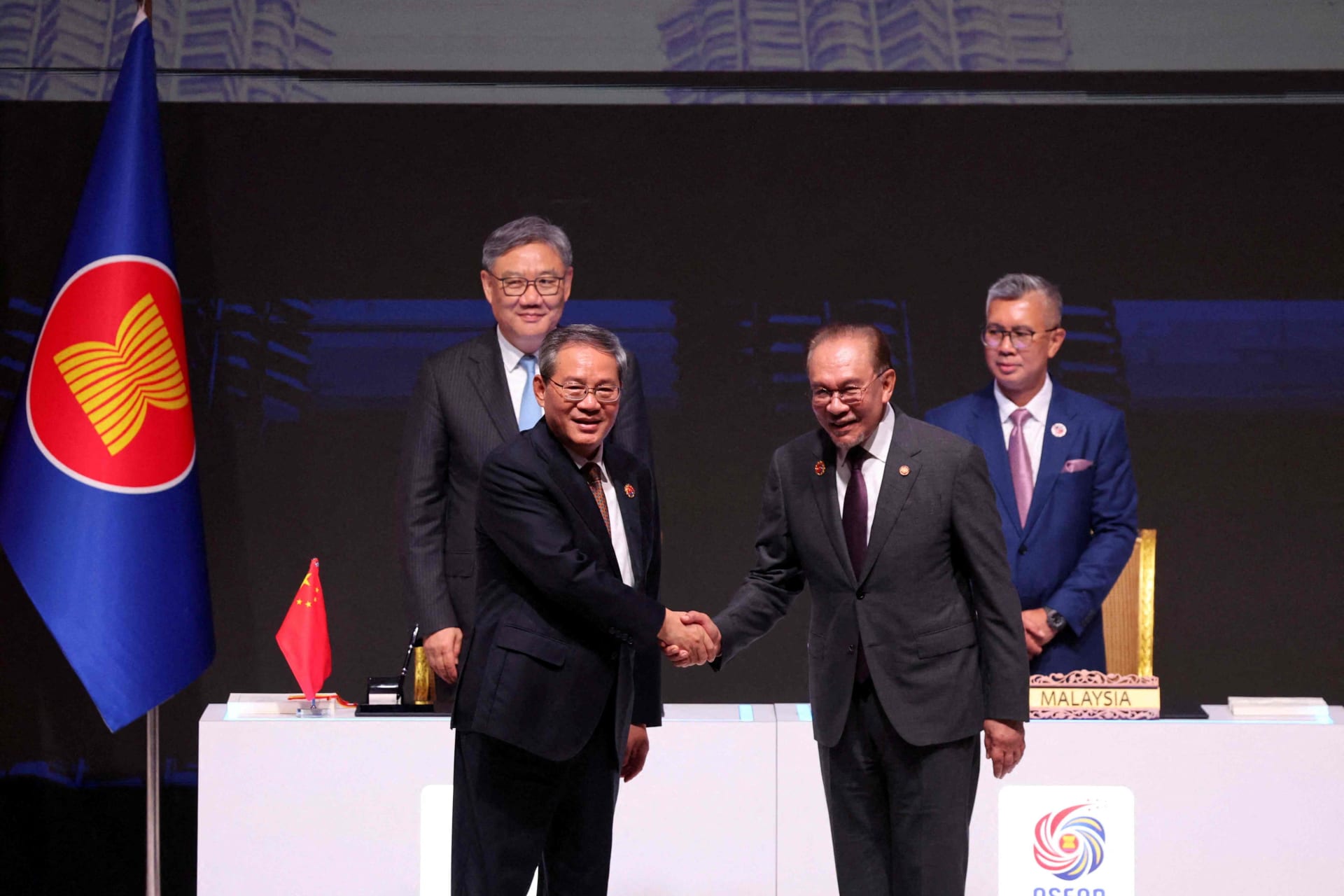
ASEAN Summit in Malaysia: China and ASEAN signed an upgraded “FTA 3.0” free-trade agreement at this month’s ASEAN annual summit in Malaysia. The deal potentially expands cooperation in digital and green industries, agriculture, and pharmaceuticals, while aiming to strengthen supply-chain integration and counter escalating U.S. tariffs on regional states. Still, China’s military conflicts with various ASEAN members will likely continue undercutting its efforts to lead regional trade.
At the summit, ASEAN leaders also announced that Timor-Leste would join the bloc, following years of effort by Dili to join. China’s increasing economic influence in East Timor, combined with declining U.S. engagement in the country, may render it the most powerful actor in the country.
Unsteady Rapprochement Between China and India: On October 2, China and India announced that they would restart direct flights, following a five-year suspension instituted during the COVID-19 pandemic and later maintained due to bilateral tensions over the contested Himalayan border. The Indian Embassy in Beijing framed the flight resumptions as being part of an effort to attain “gradual normalization of relations,” following Indian Prime Minister Naredra Modi’s visit to Beijing in late August, while regional analysts suggest the flights resumption will spur business, tourism, and education ties. The first direct flight occurred on October 27, when an IndiGo airline flight arrived in Guangzhou, China. Despite this warming of ties, recent talks have not addressed many underlying bilateral disagreements, including border demarcation and mutual concerns over domestic economic security, prompting analysts of the bilateral relationship to downplay the strategic implications of this rapprochement.
On October 29, the Chinese and Indian militaries announced they had held talks in which they agreed to maintain dialogue over managing their contested Himalayan border. Despite this seeming reduction in bilateral tensions regarding the land border, India deployed a warship to the South China Sea on October 2, docking in the Kemaman port in Malaysia and marking the ship’s third arrival to that country since 2016. Later, on October 13, the warship sailed to Busan, South Korea, conducting the first ever joint Indian-South Korean military exercise, despite China’s long-held aim to expand its footprint in the disputed Yellow Sea.
Despite stated Chinese support for India amid its tariff dispute with the United States, Beijing filed a complaint against New Delhi at the World Trade Organization on October 15, claiming that India’s subsidies to domestic electronic vehicles and batteries provide an unfair advantage over Chinese industry. Indian officials suggest that the subsidies aim to support their manufacturing sector rather than discriminate against particular foreign states.
Last, on October 30, India and China finalized an agreement allowing Indian companies to import rare earth magnets, even though Beijing has generally been tightening its rare earth export controls. During negotiations, reports suggested that China conditioned the deal on guarantees that India would not re-export these magnets to other countries, including the United States.
India Counters Potential Chinese Influence in Bhutan: In early October, reports suggested that India and Bhutan had agreed to establish two cross-border railways linking the countries. India will reportedly fund the initiative entirely. Regional analysts suggested that the move is part of a broader Indian effort to boost its ties with the small state and prevent potential thaws in the Bhutan-China relationship, which is hindered by border disputes.
Bangladesh Maintains Pivot to China: On October 9, a Bangladeshi official suggested that his government aims to acquire twenty J-10CE Chinese fighter jets for $2.2 billion as part of a military modernization effort, after the aircraft caught notice for its role in Pakistan’s defense against Indian forces during military clashes earlier this year. China is reportedly open to the Bangladeshi proposal. Later in the month, Pakistan reportedly offered Bangladesh the option to use the Karachi Port to facilitate Dhaka’s trade with China, as Chinese and Bangladeshi officials reaffirm their desire to expand bilateral trade and investment ties.
Along with other recent Bangladeshi actions, including interim leader Muhammad Yunus’s visit to China in March 2025 and expanded industrial cooperation, Bangladesh’s engagement with Beijing this month has prompted analysts to conclude that Dhaka is shifting away from an “India-first” foreign policy in favor of China. Decreasing U.S. engagement in the country, exemplified by a stalled defense cooperation agreement and other paused joint efforts, has further encouraged this shift.
Minimal Chinese Role in Afghanistan-Pakistan Confrontation: China expressed concern over ongoing Afghanistan-Pakistan clashes, which began over allegations that the Afghan Taliban is harboring rebel Pakistani militants, and offered to mediate talks between the two sides, though a Chinese mediation role has not materialized. China later supported a temporary ceasefire announced on October 15. Regional analysts suggest that Beijing remains wary of cross-border militant activity potentially spilling over into Chinese borders and threatening Chinese personnel operating economic projects in Pakistan.
Chinese Economic Ties Across South Asia: On October 14, Chinese President Xi Jinping met with Sri Lankan Prime Minister Harini Amarasuriya in Beijing during the Global Leaders’ Meeting on Women, an event hosted by China and involving UN Women. The two leaders vowed to comprehensively expand bilateral ties. During a forum in Colombo at the end of the month, Chinese Ambassador to Sri Lanka Qi Zhenhong likewise promised to “work in hand” with the country on trade and investment, digital cooperation, and rural development, while also proposing increased use of the Chinese yuan to settle in cross-border transactions and thereby diversify Sri Lanka’s foreign reserves.
Meanwhile, Pakistani officials promised China that their cooperation with the United States would not impede China-Pakistan ties, in reference to reports that Pakistan had been sharing Chinese rare earth technology with Washington. China rejected these allegations as “misinformation” and claimed that recent restrictions on rare earth exports were unrelated to these rumors. Later, on October 22, China and Pakistan signed a memorandum of understanding promoting closer ties in quantum engineering as part of the second phase of the China-Pakistan Economic Corridor, an initiative that aims to improve bilateral trade ties. Pakistan’s cooperation with China has pushed U.S.-based analysts to note that the recent strengthening of ties between Islamabad and Washington does not reflect a corresponding weakening of Pakistani ties with Beijing.
In the Maldives, Minister of Housing Abdullah Muththalib and Chinese Ambassador Kong Xianhua signed a $130 million road development deal for the Maldivian cities of Malé and Villimalé. Earlier in the month, Maldivian President Mohamed Muizzu vowed to continue boosting bilateral cooperation across various sectors.
Last, on October 27, Nepali authorities reported that bilateral trade with China through the newly opened Korala checkpoint in Upper Mustang had reached around $60 million, emerging as an alternative land corridor for imports such as electric vehicles, clothing, and fruit. Since the September resignation of pro-Beijing Prime Minister Khadga Prasad Sharma Oli amid massive protests, China has attempted to maintain its influence in Kathmandu by emphasizing the countries’ economic ties as well as Chinese aid and investment in Nepal.