China in the Middle East: March 2025
China deepened its Middle East ties in March with new air routes, fintech, and nuclear deals in the Gulf, joint naval drills with Iran and Russia, and energy investments across Saudi Arabia, Qatar, and Egypt. Beijing backed Arab plans for Gaza, condemned Israel’s war, and used BRICS and the UN to press its regional agenda.
UAE
New Air Routes: New air routes between China and the United Arab Emirates (UAE) opened in March. In the first few days of the month, the UAE announced a daily direct flight to Shenzhen, in southern China, starting in July 2025. The flight serves as the first from a Middle Eastern carrier to the Chinese technological hub and serves to create “new doors for business and economic exchange between this technological powerhouse and global markets,” according to the airline’s chief commercial officer. The freight division of the UAE-based airline, Emirates SkyCargo, will also transport ten tons of cargo per flight between Dubai and Shenzhen.
Then, toward the middle of the month, Shanghai-based China Eastern Airlines announced new, direct flights between Abu Dhabi and Shanghai starting in late April 2025. Abu Dhabi’s Eithad Airways will jointly operate the flights. According to the UAE’s state media, “the new route is expected to enhance trade, investment, and cultural exchanges between the UAE and China.” That development builds on February’s deep collaboration between Abu Dhabi’s investment authorities and the government of Shanghai.
Credit Card Deal: In early March, credit card and payment solution subsidiaries of the Central Bank of the UAE and state-owned China UnionPay announced a strategic agreement to launch UnionPay-Jaywan credit cards in the Gulf country’s market. With UnionPay operating in 180 countries, the new cards allow Emirati residents to use a single card for local and global payments, salary disbursements, and travel.
Crane Construction Begins: Chinese state-owned engineering company Shanghai Zhenhua Heavy Industries Co. Ltd. began construction on a floating crane for UAE state-owned Drydocks World. The crane—estimated to deliver in summer 2026 as the region’s largest—can lift 5,000 tons over 360 feet above water and will significantly increase the Emirati firm’s capacity to build offshore.
China-Investopia Deal: Investopia—not to be confused with Investopedia—is a UAE-based, state-owned, global networking hub that facilitates connections among investors. In mid-March, Investopia signed a memorandum of understanding (MOU) with the Sino-International Entrepreneurs Federation (SIEF), a Chinese organization that connects Beijing’s businesses with the world to facilitate investment opportunities and international business partnerships. The deal will boost collaboration between the UAE and China in entrepreneurship, small-and-medium-enterprises support, and investment promotion. SIEF will help promote Investopia in China and connect Emirati and Chinese investors, paving the way for strategic partnerships, investment, and greater economic cooperation between the two countries.
Nuclear Regulation Cooperation: In the latter half of March, Dong Baotong, China’s vice minister of the Ministry of Ecology and Environment and administrator of the National Nuclear Safety Administration, led a delegation to the headquarters of the UAE’s Federal Authority for Nuclear Regulation. The visit built on a three-year, cooperative framework signed by the two sides in November 2024 and a 2018 MOU. According to the Emirati readout, the two sides discussed “enhancing cooperation in knowledge exchange, research and development, capacity building in nuclear safety and security, nuclear non-proliferation, and regulatory frameworks for advanced nuclear technologies.”
Testing Chinese Autonomous Cars: Building on February talks between the UAE and Chinese technology company Baidu, the firm signed a strategic cooperation agreement with the Dubai government in late March to launch self-driving vehicles in the city. Baidu will begin with one hundred fully autonomous cars launched by December 2025 with the goal of one thousand by 2028. Dubai will serve as the first location outside of China for Baidu to test its product.
Saudi Arabia
ACWA Innovation Center Launches in China: Saudi Arabia’s state-owned electric power company is making progress on its December 2024 pledge to invest $50 billion in China by 2030. After striking two deals valued at $312 million in China in January, ACWA Power launched its first international innovation center in Shanghai in March to build its presence in China’s green-energy sector. According to Arab News, the company hopes the center will “foster a dynamic ecosystem, bringing together government entities, state-owned enterprises, and startups, as well as original equipment manufacturers, universities, research institutions, and certification authorities.”
New Gas-Fired Plants: In the first half of March, German firm Siemens Energy received a $1.6 billion contract to provide the technology behind Saudi Arabia’s gas-fired Rumah 2 and Nairyah 2 power plants. A subsidiary of Chinese state-owned Harbin Electric Corporation was given the engineering, procurement, and construction contract. The two plants will provide power to 1.5 million homes with 3.6 gigawatts.
China Agrees to Build More Saudi Energy Infrastructure: In late March, the state-owned China Offshore Oil Engineering Company signed an MOU with Saudi Arabia’s gas giant Aramco to boost local fabrication and engineering capacity in order to support the kingdom’s offshore energy projects and meet Aramco’s localization objectives. The fabrication yard will construct large, complex structures and components used in offshore oil and gas operations. The yard further integrates China in Saudi Arabia’s energy infrastructure.
Saudi Aramco President Meets Xi: As U.S. President Donald Trump levied tariffs in March, Chinese President Xi Jinping invited the world’s business leaders to Beijing to assure them of China’s economic health amid a budding trade war with the United States. The Chinese leader also positioned China has the unifier of those who want to protect global trade. Among the group was Amin Nasser, the president and CEO of Saudi Arabco. In his remarks to the group, Nasser praised “China’s pursuit of progress while ensuring stability” and shared his hopes for increased trade between China and Saudi Arabia. He added, “China is becoming an oasis of certainty in an increasingly unpredictable global environment.”
Amin Nasser was not the only Saudi CEO making headlines in China in March. Abdulrahman Al-Fageeh, CEO of chemical manufacturer Saudi Arabia Basic Industries Corporation (SABIC), had a written interview with Chinese state-media outlet Xinhua late in the month. He too praised China’s innovative capabilities and industrial policy and shared his plans for SABIC to further expand in the country.
Undercutting Local Business: Since its October 2024 launch, Keeta—the international program of China’s largest food delivery app, Meituan, has quickly become a major challenger to the locally developed HungerStation and Jahez. Becoming the third-largest food delivery platform in Saudi Arabia, Keeta has taken 10 percent of market share and is the top download among free applications in Saudi Arabis’s Apple App Store. The Chinese app has quickly surpassed many food courier services in the kingdom, offering various incentives (vouchers, free delivery, and discounted meals). Then, on the last day of March, the South China Morning Post reported that a Saudi tailor who crafted bishūt, or long cloaks, for royals had been undercut by cheap, imported Chinese-made robes and was finding it difficult to make a profit.
Year of Culture: In October 2024, the Saudi and Chinese ministers of culture signed the Saudi-China Cultural Year 2025 program. In March 2025, the program officially launched with the goal of creating “a series of events designed to enrich the cultural landscapes of both Saudi Arabia and China, and to deepen the historical ties between their peoples.” As part of the program, Ahmed Mater put on the first major solo exhibition in China from a Saudi artist; from March to July, Mater will showcase over one hundred pieces in Shanghai.
Qatar
New Oil Deal: A subsidiary of state-owned China National Offshore Oil Corporation, Chiwan Sembawang Engineering will construct an offshore drilling facility for Qatar’s Ruya project—an expansion of Doha’s al-Shaheen oil field. The contract was signed by Qingdao McDermott Wuchuan, a joint venture between the U.S.-based McDermott and China’s State Shipping Corporation.
Chinese Software Enters Qatar: Kingdee, a Chinese cloud software company, announced its entry into the Middle East as it established its regional headquarters in Qatar’s free zones. The move, backed by Qatar’s state investment vehicles and authorities, builds on the Gulf country’s $200 million investment in Kingdee in December 2023. The Chinese company hopes to use its new headquarters as a gateway to access other Middle East markets.
Enhancing Media Cooperation: In mid-March, the Qatari news outlet the Peninsula reported a meeting between Qatar New Agency and China Media Group—both state-run—to increase cooperation and media coordination. A few days later, the Peninsula reported that China’s Guangxi TV and Radio Channel had visited the outlet for the purposes of “fostering mutual understanding, sharing resources, and creating synergies that could enhance content delivery, increase audience engagement, and streamline operations for both organisations.”
Turkey
Chinese Ambassador Presents Credentials: In January, Beijing appointed a new ambassador to Ankara, Jiang Xuebin. In March, Jiang presented his credentials to Turkish President Recep Tayyip Erdoğan.
A Possible Chery Deal: In late March, Turkey announced that partners of Chinese automaker Chery Auto would invest $1 billion to establish a manufacturing facility in the northern city of Samsun, in order to produce two hundred thousand electric and hybrid vehicles annually. Despite Turkey’s public announcement involving Erdoğan and Chery representatives, the Chinese firm issued a statement denying direct plans for a factory and clarifying that the initiative would be carried out by its business partners, and emphasized its pursuit of ongoing partnerships rather than a direct investment.
New Steel Plant: Three Chinese companies—Yongjin Corporation, Lahne Holdings, and Hainan Fuxinhui Investment—established a joint venture in late March 2025 and announced a $257 million investment to build a stainless-steel plant in Turkey. Just south of Istanbul, in the Yalova Machinery Specialized Organized Industrial Zone, the plant will be ready to produce four hundred thousand tons of steel in two years.
China’s Vice Foreign Minister Visits Turkey: In mid-March, China’s Vice Foreign Minister Chen Xiaodong visited Turkey. In meetings with the country’s foreign minister and deputy foreign ministers, Chen described relations as developing steadily and that China stood ready to “to fully implement the important common understandings reached between the two heads of state, maintain high-level exchanges, consolidate political mutual trust, deepen practical cooperation, strengthen international coordination, and push bilateral relations to a new level,” according to the Chinese readout. Chen also met with Turkey’s outgoing ambassador to Beijing and praised his contributions to bilateral relations.
During his visit, Chen cochaired the second meeting of the Turkey-China Joint Security Cooperation Mechanism. The two sides discussed counterterrorism and “regional and international security issues.”
Israel
Chinese Cars Continue to Dominate: For the second month in a row, Chinese automobile manufacturers topped Israeli car sales. Chinese companies had 86.6 percent of Israel’s electric car market share in the first two months of 2025.
New Israeli Ambassador to China: In early March, Eli Belotserkovsky was appointed Israel’s new ambassador to China and Mongolia. A seasoned diplomat, Belotserkovsky previously served as ambassador to South Africa and Ukraine and as chargé d’affaires in Russia.
China Supports Arab Gaza Reconstruction Plan: In early March, Arab leaders gathered in Egypt for a Palestine Summit, which concluded by adopting Cairo’s plan for Gaza: a $53 billion reconstruction over five years where Israelis provide humanitarian aid, Egypt and Jordan train Palestinian security, and a Palestinian governing committee for Gaza is created without Hamas participation. The day after the summit, a Chinese foreign ministry spokesperson shared China’s support for the plan and repeated Beijing’s principle of “Palestinians governing Palestine.” Then, on March 7, Chinese Foreign Minister Wang Yi held a press conference where he called for a ceasefire and reiterated China’s support for the governance principle, the Egyptian reconstruction plan, and the two-state solution.
Fu Decries Israel’s War: In the latter half of March, China’s ambassador to the UN, Fu Cong, delivered two speeches condemning Israel’s devastating campaign in Gaza. In both remarks he urged Israel to abandon its “obsession with the use of force” and called for a permanent ceasefire in the strip.
More Media Feuds: Following a clash of op-eds in the Jerusalem Post between China and Taiwan’s representatives to Israel in January, the Israeli outlet served as the battleground of ideas once again in March. This time, the spokesperson of Beijing’s embassy, Zhang Guoping, authored “Lies About China Can in No Way Masquerade as Truth in Its Relations with Israel,” and defends China’s Israel policy. Two days later, Taiwan’s Ya-ping Lee, published, “Honoring the Enduring Friendship Between Taiwan and Israel,” where she appeals to shared values and in her concluding paragraph writes, “Taiwan remains a safe haven for Jews around the world and a reliable partner in these trying times.”
Iran
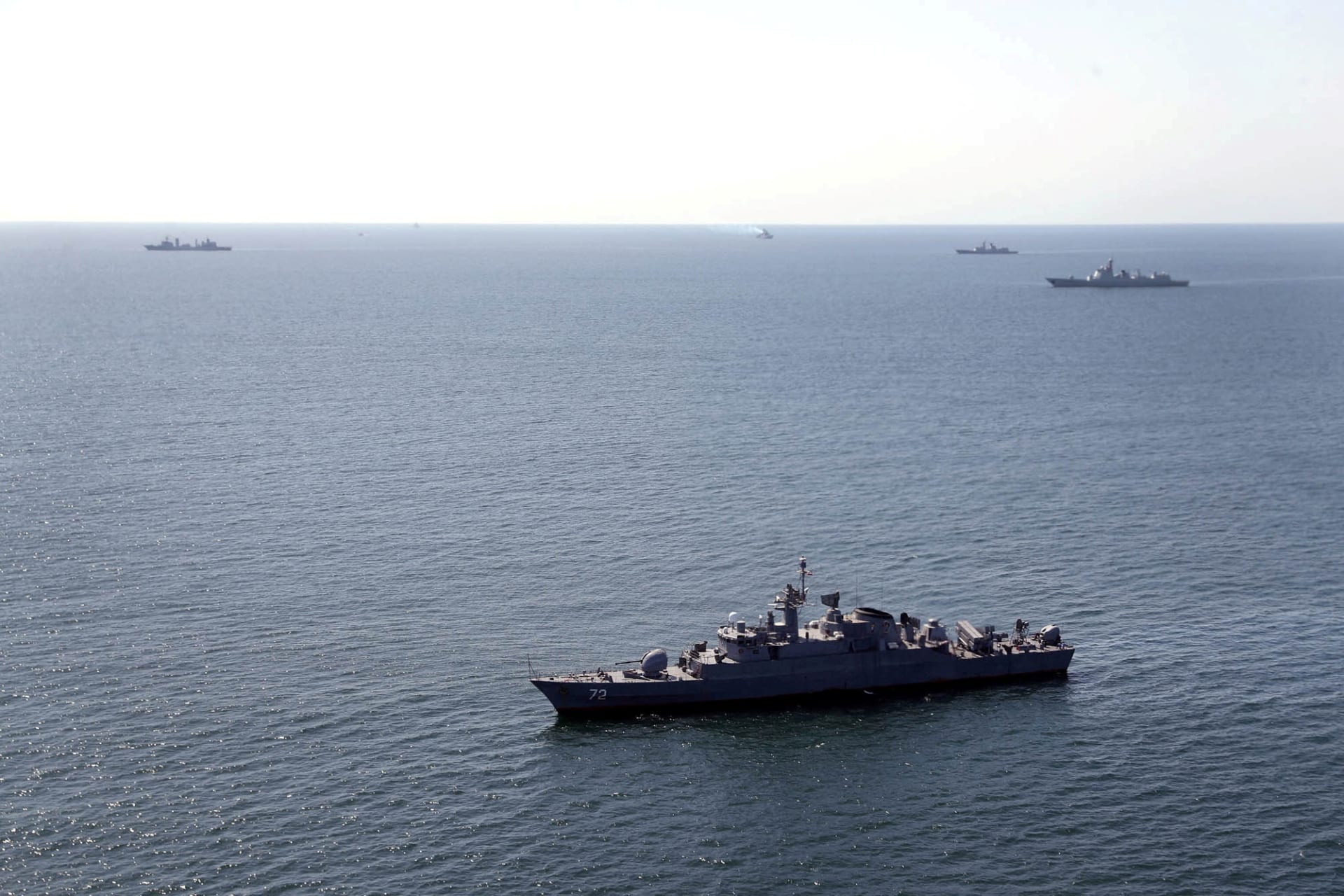
Joint Naval Exercise: In mid-March, China, Iran, and Russia held their annual joint naval exercise, dubbed Security Belt-2025, in the Gulf of Oman, marking the fifth consecutive year of trilateral military cooperation. The exercise involved around fifteen ships and support vessels from the three nations and focused on maritime security tasks, including anti-piracy, search-and-rescue, live-fire drills against simulated threats, and protection of critical shipping lanes such as the Strait of Hormuz. The drills aimed to send a signal of deepening military ties and a commitment to counter the U.S.-led world order.
Nuclear Talks: Shortly after the military drill, deputy foreign ministers from China, Iran, and Russia convened in Beijing for trilateral nuclear talks. The joint statement from the meeting stressed the primacy of diplomatic dialogue and mutual respect, rejected the legitimacy of coercive measures or military threats, and reaffirmed support for Iran’s declared peaceful nuclear objectives as well as continued cooperation with the International Atomic Energy Agency. After the session among the deputy foreign ministers, Wang met with the Iranian and Russian guests to propose a five-point framework that opposed “the use of force and illegal sanctions [imposed by the West on Iran]” and advocated resuming nuclear negotiations under the Joint Comprehensive Plan of Action framework. This coordination is one more instance of cooperation between the three revisionist powers.
U.S. Sanctions Chinese Entities for Iranian Oil: In the latter half of March, the U.S. State Department announced sanctions on Huaying Huizhou Daya Bay Petrochemical Terminal Storage, an oil storage terminal, “for buying and storing Iranian crude oil from a sanctioned vessel.” On the same day, the U.S. Treasury Department sanctioned “teapot” oil refinery Shandong Shouguang Luqing Petrochemical Co., Ltd., for “purchasing and refining hundreds of millions of dollars’ worth of Iranian crude oil.” The treasury’s action represents the first U.S. action against “teapot refineries,” small, independent refineries in China that have played a significant role in illicit oil trade as the main buyers of Iranian oil. In response, the Chinese foreign ministry said, “China is always opposed to the abuse of illegal unilateral sanctions and long-arm jurisdiction. The US should stop interfering in and undermining normal trade cooperation between China and Iran.”
The Jairan Docks: As reported in January, two Iranian-flagged ships with one thousand tons of a primary precursor for ballistic-missile fuel set sail from China to Iran. In late March, one of those ships, the Jairan, was spotted in the Bandar Abbas port. Though Bejing has denied knowledge of the shipments, the Financial Times confirmed the Islamic Revolutionary Guard Corps as the receiver of the shipment.
Bilateral Meetings: In the middle of March, China’s consul general in Bandar Abbas, Iran, met with the city’s vice chairman to discuss “closer cooperation at subnational levels,” according to the Chinese readout. Consul General Xu Wei relayed Beijing’s readiness to engage infrastructure developments. China’s special envoy for Afghan affairs visited Iran in addition to Pakistan and Qatar on a trip in mid-March. While in the Islamic Republic, Chinese Special Envoy Yue Xiaoyong met with Iran’s Deputy Foreign Minister for Political Affairs Majid Takht Ravanchi.
Morocco
Morocco Uses Chinese Weapons: As China expands its security presence in the Middle East, Morocco in March incorporated the Chinese TB-001 drone into the North African state’s arsenal. Capable of long-endurance surveillance and precision strikes, the TB-001 enhances Morocco’s ability to monitor vast territories and respond to regional threats.
Two Textile Factories: In mid-March, Chinese textile manufacturer Sunrise Group formalized a $230 million investment to build two new plants in Morocco. The facilities are estimated to create 7,000 direct jobs and over 1,500 indirect jobs. In addition to producing yarn, fabrics, and clothing products, Sunrise’s new plants will reduce logistics costs and lead times, making it easier to integrate Moroccan companies into global value chains.
Improving Air Connectivity: In the last days of March, Royal Air Maroc and China Southern Airlines, both state-owned companies, signed an MOU to bolster ties. The two firms seek to enhance air connectivity between Africa and China, paving the way for expanded direct flights, code-sharing, and integrated passenger and cargo services across their respective networks. Explicitly part of the Belt and Road Initiative, the agreement aims to expand bilateral tourism, commercial exchange, and logistics.
Across the Region
BRICS Meetings: From March 24 to 25, Brazil’s capital, Brasilia, hosted the tenth BRICS Policy Planning Dialogue. After the dialogue, Chinese Special Envoy for the Middle East Zhai Jun met with several foreign counterparts. First, he hosted a conversation with Iran’s Assistant Minister of Foreign Affairs Mahdi Shushtari. The two discussed bilateral relations and shared their respective sides’ willingness to increase coordination and cooperation through BRICS (the bloc of nations including Brazil, Russia, India, and China) and other platforms. On the same day, Zhai met with Brazil’s secretary for Africa and the Middle East at the Ministry of Foreign Affairs; the two sides discussed the bilateral relationship and their respective, complementary positions in the Middle East. The following day, Zhai met with Russia’s deputy foreign affairs minister to discuss Syria. He then participated in a consultation of foreign minister officials from BRICS countries working on the Middle East. In a joint statement released after the meeting, the officials expressed serious concern over conflicts and instability across the Middle East and called for diplomatic strategies and respect for international law.
New Egyptian Deals: In March 2025, Air Liquide Egypt and Chinese United Energy Group (UEG) signed an MOU to develop green ammonia projects in Egypt with green hydrogen. Under the partnership, Air Liquide will supply green nitrogen, a crucial component for ammonia production, while collaborating closely with UEG to ensure efficient and stable ammonia manufacturing. That development illustrates Egypt’s increasing momentum in green hydrogen projects and its growing role in the international renewable-energy landscape.
A few days later, Chinese firm Xinfeng Egypt announced a $1.65 billion investment to establish an industrial manufacturing complex in Egypt’s Suez Canal Economic Zone. The facility will support manufacturing across electronics, renewable energy, and automotive supply chains. A part of the Belt and Road Initiative, the deal leverages the economic zone’s logistics advantages from its proximity to the Suez Canal. Through it, Egypt hopes to attract further projects and solidify its position as a gateway for Chinese trade.
Fu’s Syria Remarks at UN: In late March, the UN Security Council hosted a briefing on Syria. During the session, Fu shared three points: first, Syria’s transition process should be inclusive; second, counterterrorism should be maintained and pursued; and third, efforts should be made to improve Syria’s living standard. China continues to pursue diplomatic engagement with Syria’s new interim authorities, but Beijing remains cautious as Fu signaled support for political transition while pressing for counterterrorism and territorial sovereignty issues.