Congress Declines to Demand a Say in the Iran War
Republican lawmakers in the House and Senate rallied around President Trump’s decision to attack Iran and passed on the opportunity to demand he make the case to Congress.
By experts and staff
- Published
Experts
![]() By James M. LindsayMary and David Boies Distinguished Senior Fellow in U.S. Foreign Policy
By James M. LindsayMary and David Boies Distinguished Senior Fellow in U.S. Foreign Policy

The Constitution vests the power of declaring war with Congress; therefore no offensive expedition of importance can be undertaken until after they have deliberated upon the subject, and authorized such a measure.
—George Washington, “Letter to William Moultrie,” August 28, 1793
The simple, the received and the fundamental doctrine of the constitution, that the power to declare war … is fully and exclusively vested in the legislature; that the executive has no right, in any case to decide the question, whether there is or is not cause for declaring war.
—James Madison, Helvidius Number 4, September 14, 1793
The Executive has no right to compromit the nation, in any question of war.
—James Monroe, Letter to James Madison, August 2, 1824
So much for original intent. Congress had the opportunity to this week to demand that President Donald Trump get its authorization for what he has called “major combat operations” against Iran. Rather than fulfilling the Framer’s vision that only Congress can authorize the initiation of the use of military force, both the House and Senate effectively gave the president a green light to proceed.
Congress Votes Not to Demand a Say
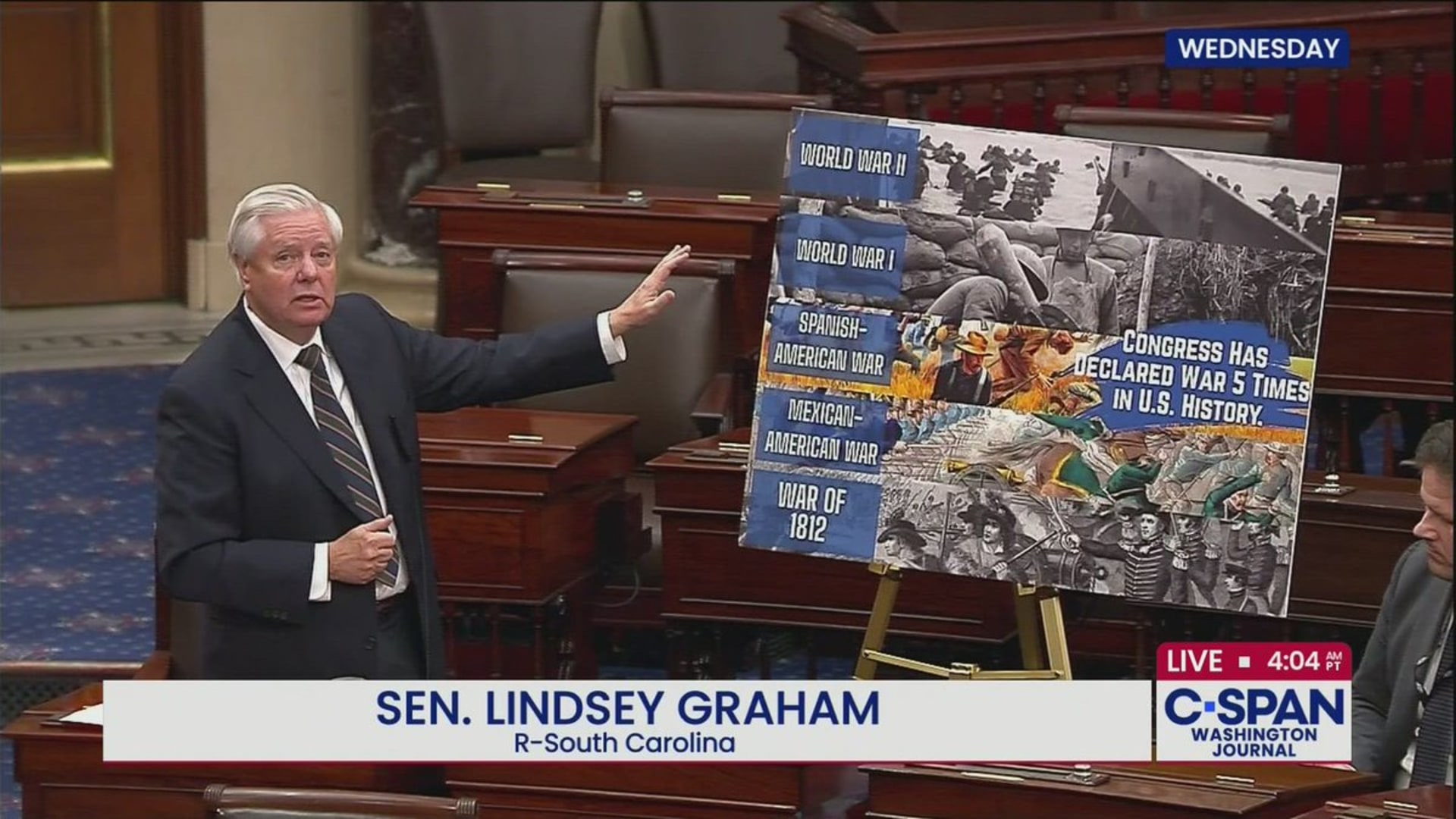
The Senate on Wednesday considered a measure introduced by Sen. Tim Kaine (D-VA) and co-sponsored by Sen. Rand Paul (R-KY) that called for removing “the United States Armed Forces from hostilities with or against Iran, unless explicitly authorized by a declaration of war or a specific authorization for the use of military force.” Only forty-seven senators voted in favor; fifty-three voted against. The vote was largely, but not entirely, on party lines. Paul voted for his bill, while Sen. John Fetterman (D-PA) voted against it.
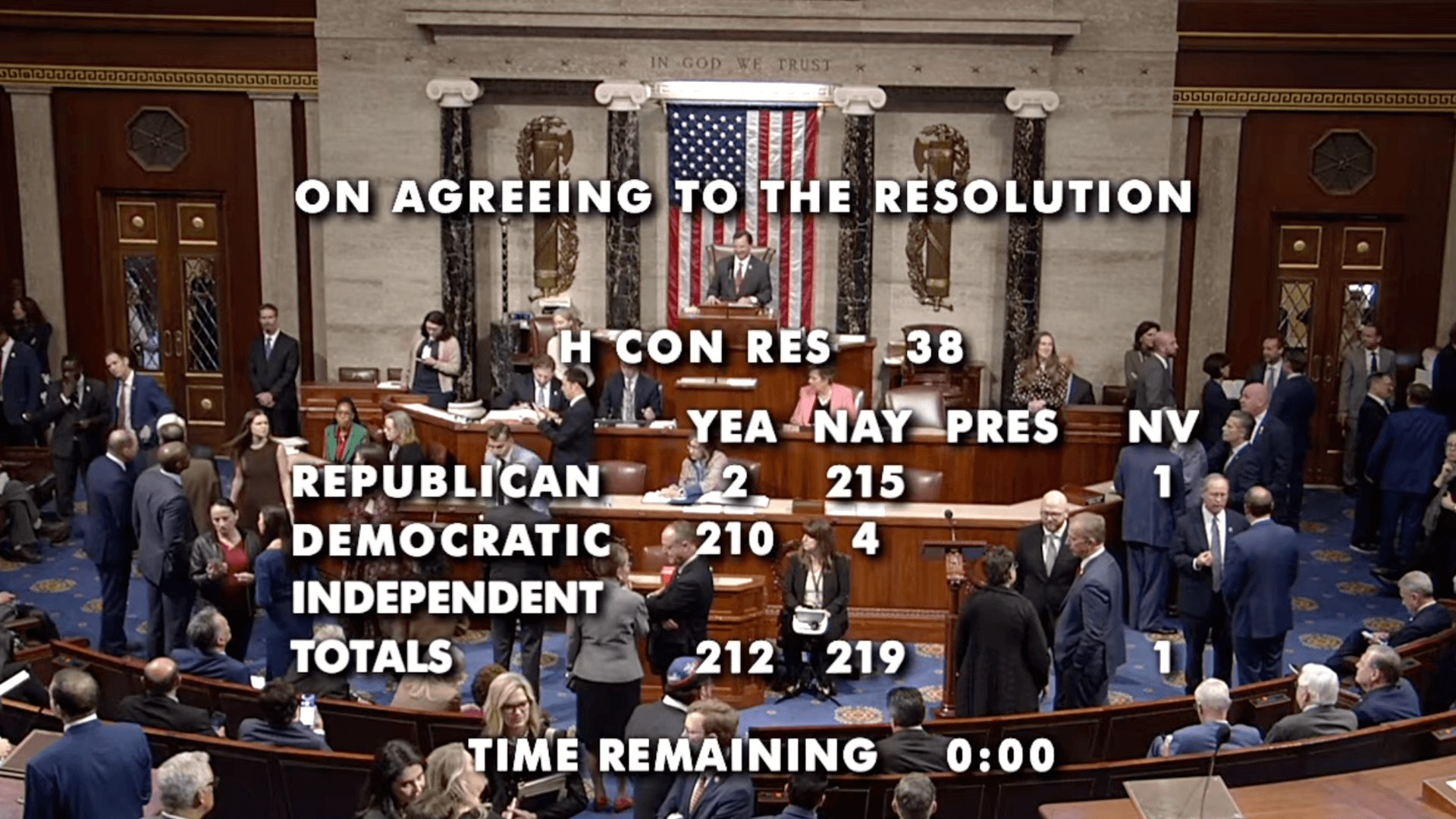
The House debate yesterday was on a similar resolution introduced by Rep. Ro Khanna (D-CA) and Rep. Thomas Massie (R-KY). Unlike the Senate resolution, the House resolution was non-binding and would not have been subject to a veto. The resolution merely would have stated Congress’s view that the president could not initiate major combat operations against Iran on his own authority. What the House voted on, however, was a motion to block consideration of the resolution. That motion prevailed by a vote of 219 to 212. As with the Senate, the vote broke largely on party lines. Two Republican representatives—Massie and Warren Davidson of Ohio—voted for the resolution, while four Democrats—Henry Cuellar of Texas, Jared Golden of Maine, Greg Landsman of Ohio, and Juan Vargas of California—voted against it.
The House also passed a separate nonbinding resolution stating that Iran is the most significant backer of state-sponsored terrorism. That motion, which the House Republican leadership introduced, passed by a lopsided margin of 372 to 53. All the no votes came from Democrats.
Why Did Congress Vote No?
Explanations for Congress’s reluctance to defend its constitutional war powers often cite lawmakers’ supposed desire to dodge responsibility for decisions to go to war. Whatever the merits of that argument generally, it hardly seems to apply to this week’s vote. After all, nearly half of all members of Congress voted to require Trump to seek congressional authorization. Moreover, initial polling shows that Americans are skeptical about the decision to wage war on Iran. One lesson of recent American military operations is that public support for them seldom grows with time.
The arguments opponents offered for not demanding a say in the decision to use force against Iran were varied. Senate Majority Leader John Thune (R-SD) likely spoke for many of his colleagues when he argued that Trump’s decision was “consistent with what previous administrations have done“ and that ”the president was perfectly within his rights to take the steps that he took.” Other lawmakers stressed that debating combat operations now would do more harm to the U.S. national interest than letting them proceed. Sen. Todd Young (R-IN), who voted in January in favor of a resolution to require congressional authorization for any military action in Venezuela beyond capturing Nicolás Maduro, warned: “The United States and our allies are now in conflict with a brutal, hostile, and dangerous regime. I believe that danger will only grow if we limit the President’s military options at this critical moment.”
Still other lawmakers dismissed the need for congressional authorization because the United States was striking Iran from the air and not on the ground. Sen. Josh Hawley (R-MO), who voted with Young in January on the Venezuela resolution, was explicit on this score: “My view has always been, ground troops will require congressional authorization.” And some lawmakers treated this week’s vote as equivalent to authorizing military operations. No one was more direct on this score than Senator Fetterman. He tweeted: “My vote is Operation Epic Fury.”
Whether these arguments are sincere or strategic, and they are likely a mix of both, the main takeaway of the week is that Trump succeeded in holding the majority Republican coalition together. In today’s deeply partisan times, it is tempting to think that Democrats and Republicans have always squared off on foreign policy in this fashion. Far from it, however. To offer just one example, in the late 1930s, Democrats held a supermajority of seats in Congress. Nonetheless, President Franklin Roosevelt failed repeatedly in his efforts to persuade lawmakers to give him discretion in applying the neutrality legislation they had passed in their effort to keep the United States from being drawn into war in Europe.
What Happens Next?
The U.S. courts are unlikely to insert themselves into the debate over whether Trump needs congressional authorization to continue combat operations against Iran. While it wasn’t always the case, for decades now the courts have generally sidestepped legal challenges to the president’s ability to initiate the use of force without congressional authority. As a result, the precise limits of presidential authority to initiate the use of force—and nearly all experts agree that he has some—is not a matter of settled law. There’s no reason to believe that the courts will suddenly reverse course and settle the constitutional question that has launched hundreds of law review articles. Indeed, the courts may even read Congress’s failure to assert its power as effectively authorizing military operations.
That puts the ball back in Congress’s court, if lawmakers are interested. They might get that chance if Trump requests a supplemental appropriations bill to fund the war. That seems likely, especially if the fighting lasts for weeks, as Trump has said. As James Madison wrote in Federalist 58: The “power over the purse may, in fact, be regarded as the most complete and effectual weapon with which any constitution can arm the immediate representatives of the people, for obtaining a redress of every grievance, and for carrying into effect every just and salutary measure.”
The problem, though, is that Congress has found it difficult in practice to wield Madison’s weapon. A case in point is the 2007 battle over President George W. Bush’s decision to surge U.S. troops into Iraq. He needed supplemental appropriations to sustain the operations. The Democratic-controlled Congress passed a supplemental appropriations bill that would have forced a U.S. drawdown. Bush vetoed the bill. Even though Bush’s stance was politically unpopular, Congress failed to override his veto. The surge went ahead as planned.
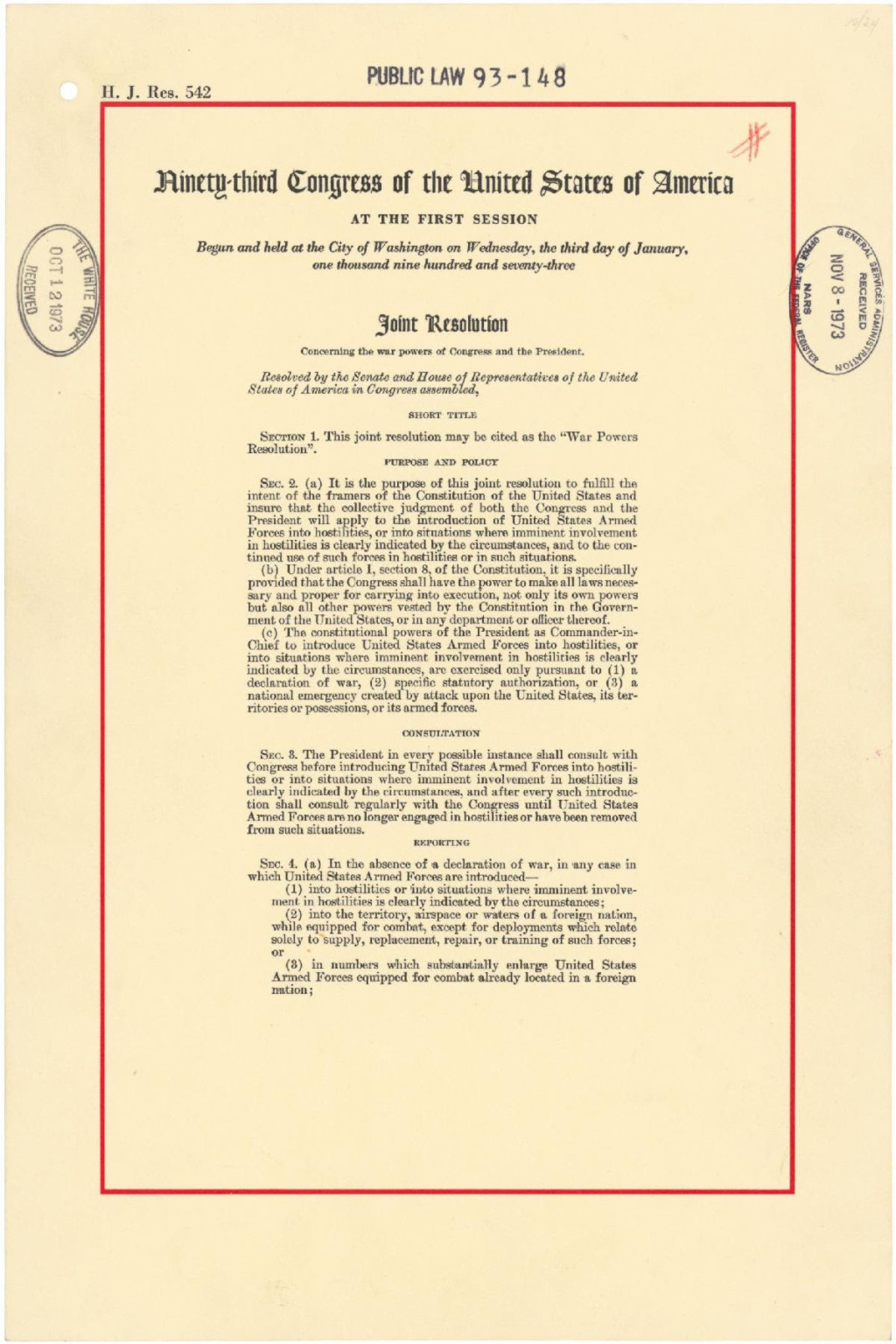
Another possible spur to congressional action would be if Trump sends U.S. combat troops to Iran, a step he has not ruled out. Lawmakers like Hawley who say that their red line is boots on the ground would presumably join the call for an authorization vote. Similarly, if hostilities last beyond the sixty- or ninety-day limits set in the 1973 Wars Powers Resolution, Congress might return to the question of continuing the war. (Trump could dodge the War Powers Resolution’s requirement that he terminate U.S. hostilities if Congress does not authorize them by those deadlines by arguing that the law is unconstitutional or that the U.S. operations against Iran do not rise to the level of war envisioned by the War Powers Resolution. His predecessors have taken both positions.) In either case, however, any congressional effort to assert its say would face a presidential veto. Barring a disastrous turn in the fighting, a veto override would remain unlikely.
Lessons and Consequences
The events since last Saturday have borne out an observation that the Harvard legal scholar Jack Goldsmith made six years ago in the wake of Trump’s decision to order the killing of Qassem Soleimani, the leader of Iran’s Quds force:
In short, our country has—through presidential aggrandizement accompanied by congressional authorization, delegation, and acquiescence—given one person, the president, a sprawling military and enormous discretion to use it in ways that can easily lead to a massive war. That is our system: One person decides.
The main question now is whether the current hostilities against Iran set a new high-water mark for presidential power or trigger a backlash that restricts it. The answer to that question will depend, as the remark attributed to former British Prime Minister Harold Macmillan would have it, on “events, dear boy, events.”
Oscar Berry assisted in the preparation of this article.