FDR’s “Stab-in-the-Back” Speech
Franklin Roosevelt’s June 1940 commencement address at the University of Virginia signaled that U.S. neutrality in World War II was ending.
By experts and staff
- Published
 James M. LindsayCFR ExpertMary and David Boies Distinguished Senior Fellow in U.S. Foreign Policy
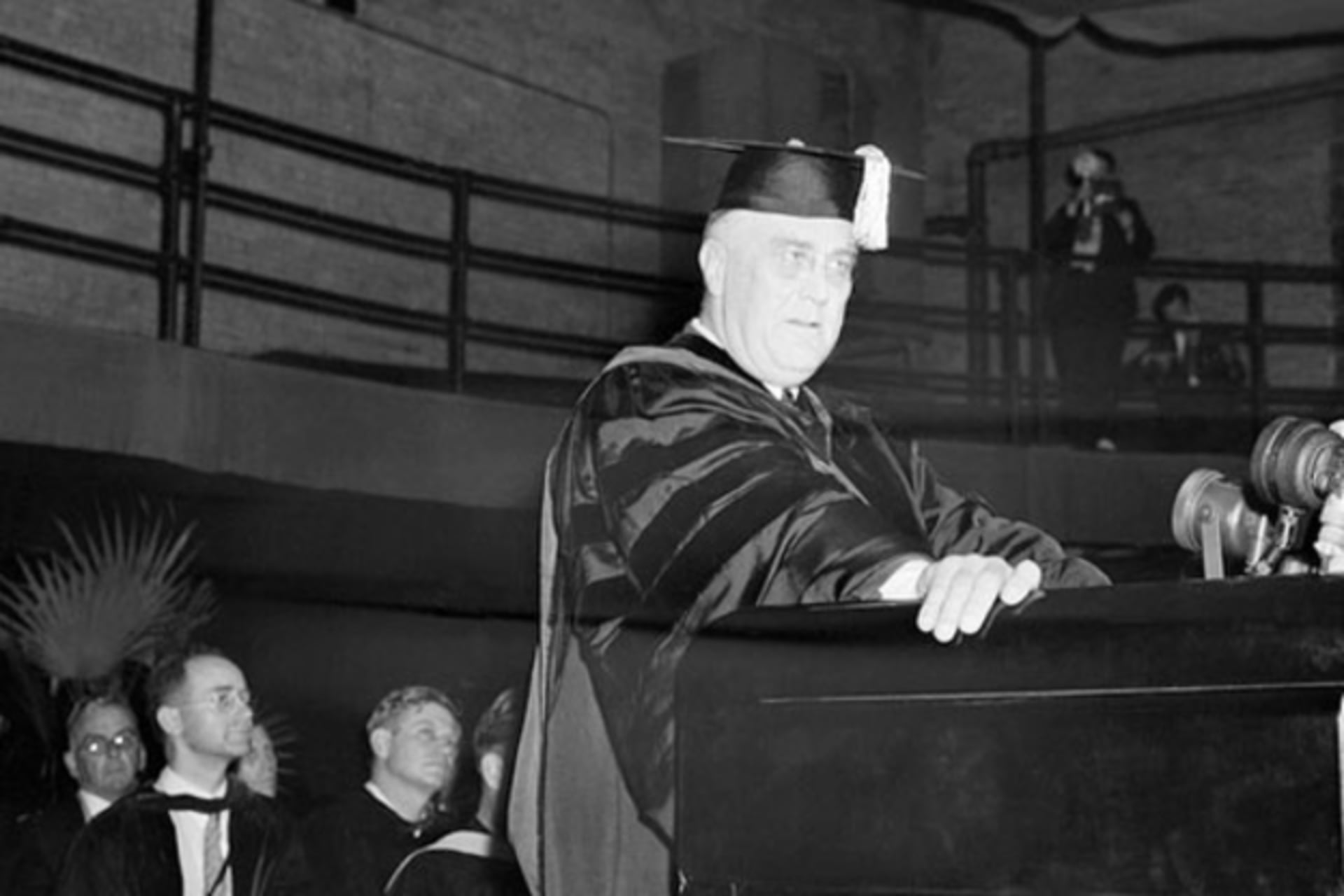
A president giving a commencement address is commonplace. A president giving a commencement address when his child is a member of the graduating class is rare. Rarer still is a president speaking at his child’s graduation and saying something memorable enough to make history. President Franklin Delano Roosevelt accomplished just that on the evening of June 10, 1940, in his “stab-in-the-back” speech at the University of Virginia.
Phony Wars and Real Ones
FDR had agreed to speak at UVA because his son, Franklin Jr., was graduating with a law degree. As he prepared to depart from Washington on the morning of June 10, FDR learned that Italy had declared war on France, thereby entering World War II on the side of Nazi Germany.
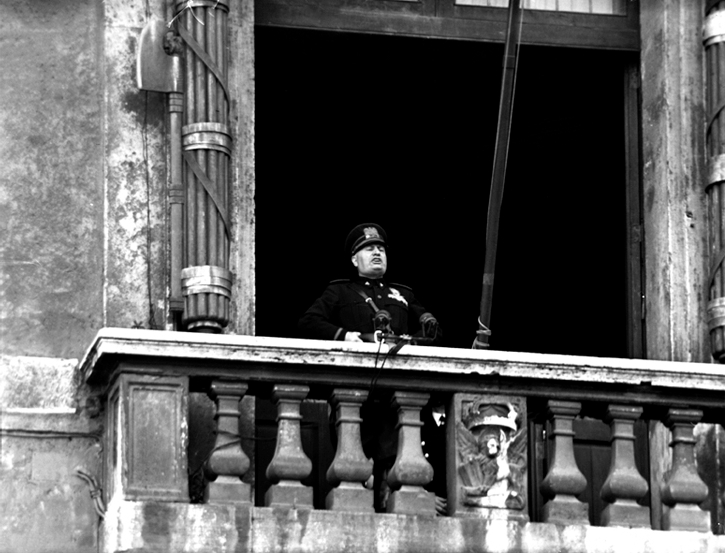
The war had begun the previous September when Germany invaded Poland. Western Europe saw little fighting during the winter of 1939-40, prompting talk of a “phony war.” That talk ceased in early April when Germany turned westward and launched its blitzkrieg. By the beginning of June, the Germans had overrun Belgium, Denmark, Luxembourg, Norway, and the Netherlands and was marching on Paris.
Less than a week before FDR traveled to Charlottesville, the British and French had completed their epic evacuation from Dunkirk. Now, with France on the verge of defeat, Italy had come off the sidelines to attack France from its southeast. Freed to focus on Britain, Germany looked poised to dominate the continent.
The Battle Over Neutrality
FDR had planned to use his commencement address to explain what the war in Europe meant for the United States. When the war began, he had declared U.S. neutrality. Unlike Woodrow Wilson a quarter century earlier, however, he had not asked his fellows Americans to be “impartial in thought as well as in action.” He instead said that “I cannot ask that every American remain neutral in thought... Even a neutral cannot be asked to close his mind or his conscience.”
While most Americans felt sympathy for the countries falling to German’s military might, FDR understood that they also feared being dragged unnecessarily into World War II as they had come to believe had happened with the U.S. entry into World War I. As the Great Depression deepened, a series of books, magazine articles, and congressional hearings had popularized the idea that weapons manufacturers and financial interests had maneuvered the United States into the Great War.
Although the evidence for this so-called Merchants-of-Death thesis was scarce, Congress in 1935 passed a law banning the sale of munitions to countries at war. Roosevelt initially supported law’s passage, but he soon came to regret it. At his request, Congress revised the Neutrality Act several times over the next four years. Each revision prompted pitched battles on Capitol Hill, and FDR got only a small part of what he wanted.
After Germany invaded Poland, Congress repealed the arms embargo but insisted that all belligerents pay cash for their purchases and ship their weapons in non-U.S.-flagged vessels. Even that change faced bitter opposition. Critics argued that the move favored Britain and France because of Britain’s naval superiority over Germany.
Rewriting on the Fly—and a Change of Mind
With the news that Italy had attacked France, FDR suddenly had more to say about the war and U.S. security. His aides reworked his remarks on the train ride down to Charlottesville, adding five pages of text detailing the duplicity of Italy’s leader, Benito Mussolini.
The five hundred graduates and their families who gathered in the University of Virginia’s Memorial Gymnasium to escape a rainy day heard a president on a mission. As the New York Times later described FDR’s delivery, “there could be no missing the depth of his feeling, since he put into the words all the emphasis at his command.”
FDR began his address by saying that the United States faced questions “not about the future of an individual or even of a generation, but about the future of the country, the future of the American people.” Without mentioning the war in Europe but confident that his audience understood the events he left implicit, Roosevelt argued that the United States could not retreat from the world:
Some indeed still hold to the now somewhat obvious delusion that we of the United States can safely permit the United States to become a lone island, a lone island in a world dominated by the philosophy of force.
Such an island may be the dream of those who still talk and vote as isolationists. Such an island represents to me and to the overwhelming majority of Americans today a helpless nightmare of a people without freedom—the nightmare of a people lodged in prison, handcuffed, hungry, and fed through the bars from day to day by the contemptuous, unpitying masters of other continents.
FDR then turned to Mussolini’s duplicity. Italy had entered the war that morning, with France tottering on the brink of collapse, in manifest “disregard for the rights and security of other nations, [and] disregard for the lives of the peoples of those nations which are directly threatened by this spread of the war.” FDR then uttered a line he had scrawled on his typewritten text:
On this tenth day of June, 1940, the hand that held the dagger has struck it into the back of its neighbor.
A variant of that line had been in an earlier version of the speech. FDR had taken it from a letter the French premier Paul Reynaud had sent that morning saying that “this very hour, another dictatorship has stabbed France in the back.’’ Undersecretary of State Sumner Welles argued, however, that the stab-in-the-back metaphor was inflammatory and should be dropped.
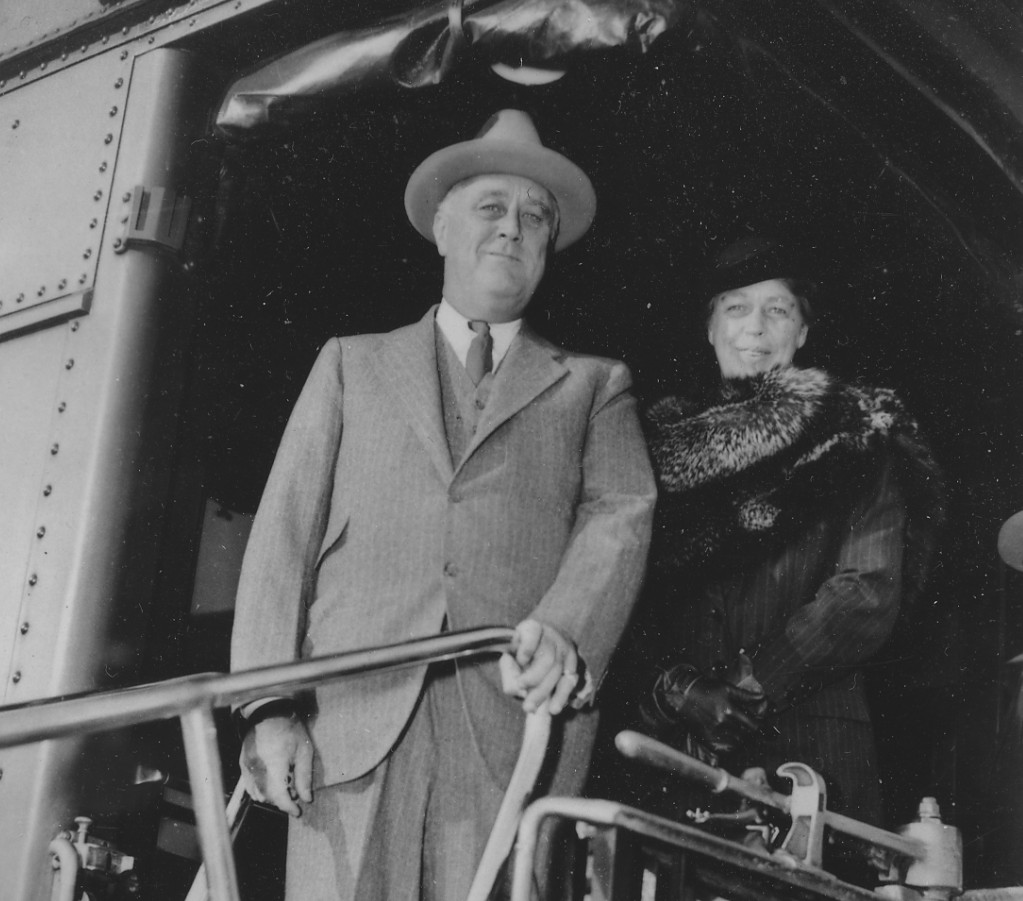
FDR agreed with Welles—a least for a time. On the train ride to Charlottesville, the president and First Lady Eleanor Roosevelt discussed the merits of observing diplomatic niceties versus speaking candidly. In the end, FDR opted for candor.
Even more significant than FDR’s willingness to ruffle diplomatic feathers was what came next. The president pledged to
pursue two obvious and simultaneous courses; we will extend to the opponents of force the material resources of this nation; and, at the same time, we will harness and speed up the use of those resources in order that we ourselves in the Americas may have equipment and training equal to the task of any emergency and every defense.
Roosevelt knew that even this pledge was pushing at the limits of what the American people, and Congress, were willing to tolerate.
Applause and Criticism
FDR’s denunciation of the champions of “the philosophy of force” (Hitler and his allies) and his pledge to aid their opponents (Great Britain) drew cheers from the audience. The New York Times wrote the next day:
When Mr. Roosevelt gave deliberate emphasis to this nation’s sympathies with those who were staking their lives in the fight for freedom overseas, they broke into the wildest applause, cheering, and rebel yells. As the President neared the end of his speech the cheering became general and members of the faculty stamped their feet and applauded. Whenever Mr. Roosevelt mentioned this nation’s determination to preserve free institutions and liberties and to perpetuate democracy within our borders, those on the platform and in the audience forgot academic decorum in spontaneous approbation.
Not all Americans reacted in that same way to FDR’s remarks. Some Democratic officials worried that the speech would alienate Italian-American voters and thereby hurt Roosevelt and the rest of the Democratic ticket with the presidential election just five months off. Isolationists saw the speech as more evidence that FDR was seeking to plunge the country into a war that it should not fight and would not win.
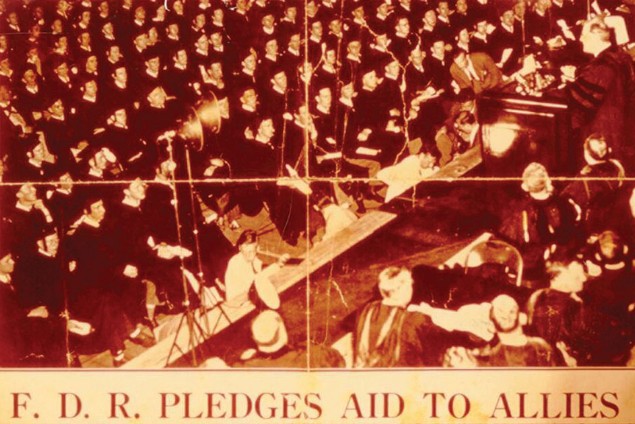
Yet as the graduates filed out of Memorial Gymnasium that rainy June evening to cheers of Wahoo Wah!, the die had been cast. As Time magazine put it, with the speech “the U.S. had taken sides. Ended was the myth of U.S. neutrality.”
Words and Deeds
Four days after the commencement address, Paris fell to the Germans. Six days after that, FDR nominated Henry Stimson to be secretary of war and Frank Knox to be secretary of the navy. Both men were Republicans. More significantly, both men staunchly favored aiding Britain.
Many epic political battles were yet to be fought. The country still had to face the questions of holding a peacetime draft, trading old destroyers for bases, and providing military aid to Britain. But as FDR returned to Washington on the night of June 10, 1940, having given what would be remembered as his “stab-in-the-back” speech, even though he never used those precise words, he had made clear that he would not let the United States become “a lone island in a world dominated by the philosophy of force.”
The United States celebrates its 250th anniversary in 2026. To mark that milestone, I am resurfacing essays I have written over the years about major events in U.S. foreign policy. A version of this essay was published on June 10, 2013.
Oscar Berry assisted in the preparation of this article.